Low MOQ Supplement Manufacturer for First Runs
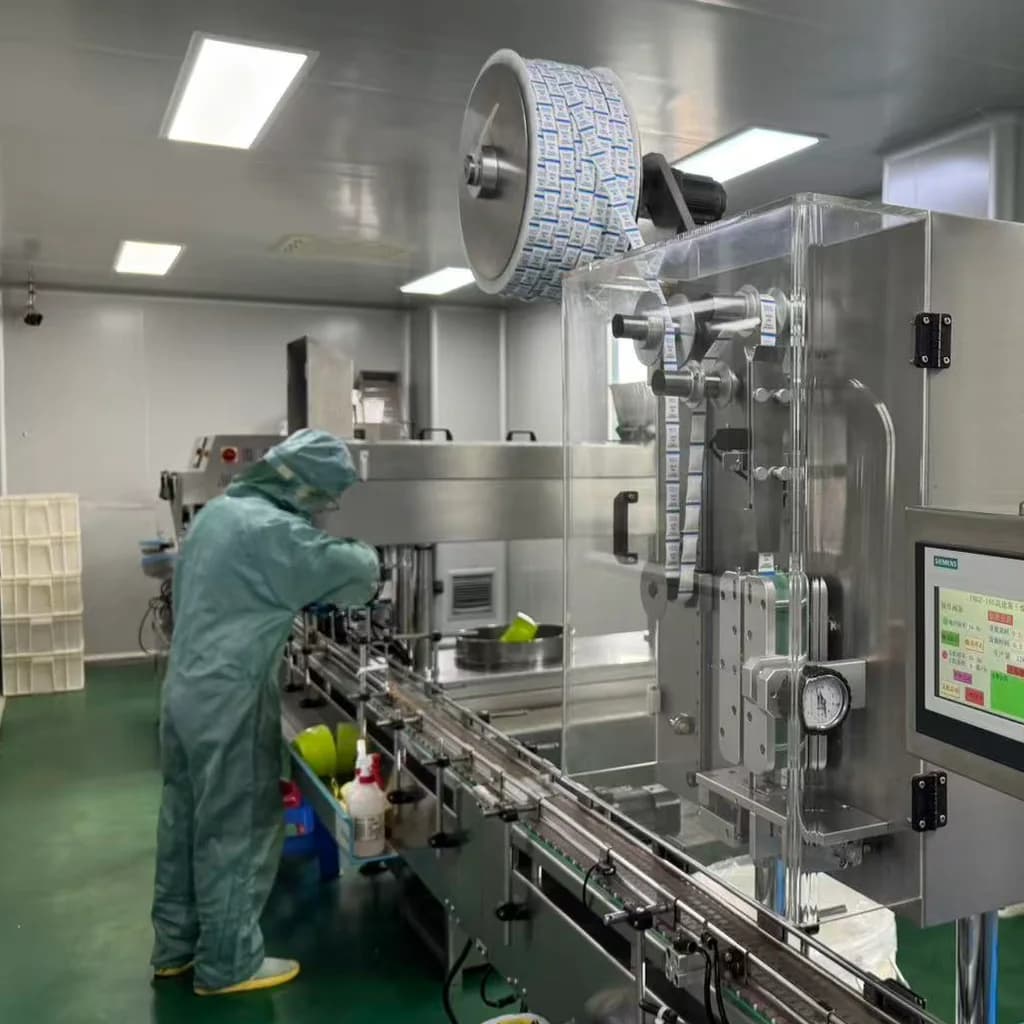
Start at 1,000 units per SKU for retail bottling, or 500 units for pilot runs. GMP-certified lines in Guangdong, 7–10 day samples, 20–35 day production.
Overview
Most contract manufacturers set minimum order quantities that only work once you already have volume. That leaves new brands and small-batch launches stuck. EUPHM runs retail bottling from 1,000 units per SKU, and pilot runs from 500 units, so you can test a formula, a flavour, or a market before committing to a full production batch. The plant holds GMP, ISO 22000, and HACCP certification.
| MOQ (retail bottling) | 1,000 units per SKU |
|---|---|
| MOQ (pilot run) | From 500 units |
| Sample lead time | 7–10 working days |
| Mass production lead time | 20–35 working days |
| Certifications | GMP, ISO 9001, ISO 22000, HACCP, NSF/ANSI 455-2, halal, FDA-registered |
| Additional certifications | Halal, organic, vegan (by formula) |
Low MOQ Without Compromising Line Speed
Low MOQ does not mean manual filling or hand-packed bottles. EUPHM runs the same automated capsule, tablet, and powder lines for pilot runs and full batches. A 500-unit pilot run uses the same equipment, same in-process checks, and same batch record as a 50,000-unit order. The difference is changeover time, not quality control.
For brands scaling up, the MOQ steps are predictable. Start at 500 units to validate a formula and packaging. Move to 1,000 units for retail bottling once the SKU sells. Above 5,000 units, pricing per unit drops as line utilisation improves. This gives founders a clear cost curve instead of a single large commitment.
Formulation and Ingredient Flexibility at Small Scale
Small batches still need full formulation support. EUPHM keeps a library of over 400 stock formulas across capsules, tablets, softgels, and powders. If you need a custom blend, the formulation team works from your target actives, fill weight, and dosage form. Typical fill weights range from 300 mg to 1,200 mg for capsules and 500 mg to 1,500 mg for tablets.
Ingredient sourcing is where low MOQ usually breaks down. Many suppliers will not ship small quantities of branded or specialty ingredients. EUPHM holds qualified supplier relationships for halal and vegan inputs, and can allocate partial lots to pilot runs. You get the same ingredient certificate of analysis as a full production order, with lot traceability from receipt to finished bottle.
Quality and Compliance for Small Orders
Every batch, regardless of size, goes through the same release testing. That includes identity testing of incoming raw materials, weight variation checks, and microbiological testing on finished product. The facility is GMP-certified, ISO 22000, and HACCP, and is FDA-registered for dietary supplements. Certificates of analysis are issued per batch.
For brands selling into the EU, UK, or Middle East, documentation matters as much as the product. EUPHM provides halal certificates where the formula allows, organic certification for USDA and EU organic claims, and vegan statements. Labels can be reviewed against your market's requirements before printing. This avoids the common problem of a small first run arriving with non-compliant artwork.
Quality Control and Batch Documentation
Every low MOQ supplement manufacturing batch at EUPHM is tested against a written specification before release. Incoming raw materials are sampled and checked for identity by FTIR or HPLC, and potency is verified against the certificate of analysis from the supplier. During production, in-process checks cover weight variation, hardness, and disintegration for tablets and capsules. Finished products are tested for microbial limits (total aerobic count, yeast and mould, E. coli, Salmonella), heavy metals (lead, cadmium, arsenic, mercury), and potency of active ingredients. Disintegration testing follows USP <701> or the relevant pharmacopoeial method for the dosage form.
Testing is carried out at three points: raw material receipt, bulk product before packaging, and finished packaged goods. For pilot runs from 500 units, the same testing panel applies as for a 1,000-unit retail batch, so small orders do not receive reduced verification. A certificate of analysis (COA) is issued per batch and includes the product name, batch number, manufacturing date, expiry date, tests performed, specifications, results, and the signature of the quality control manager. The COA is available in English and can be formatted to your brand's template if required.
Retention samples are kept for every batch for a minimum of two years after the expiry date. For stability, EUPHM runs accelerated studies at 40°C/75% RH for three months and real-time studies at 25°C/60% RH for up to 24 months, depending on the formula. Stability protocols can be customised for your target market, for example 30°C/65% RH for ASEAN countries. If you need a specific shelf life claim, the stability data package is provided with the batch documentation so your regulatory team can review it before the product goes to retail.
Batch documentation for a low MOQ order includes the executed batch record, raw material COAs, finished product COA, microbiological and heavy metal test reports, and a retention sample record. If your market requires it, EUPHM can also provide a free-sale certificate and a phytosanitary certificate for herbal ingredients. All documents are provided electronically within five working days of batch release, and hard copies can be couriered with the shipment on request.
Packaging, Labelling and Retail Readiness
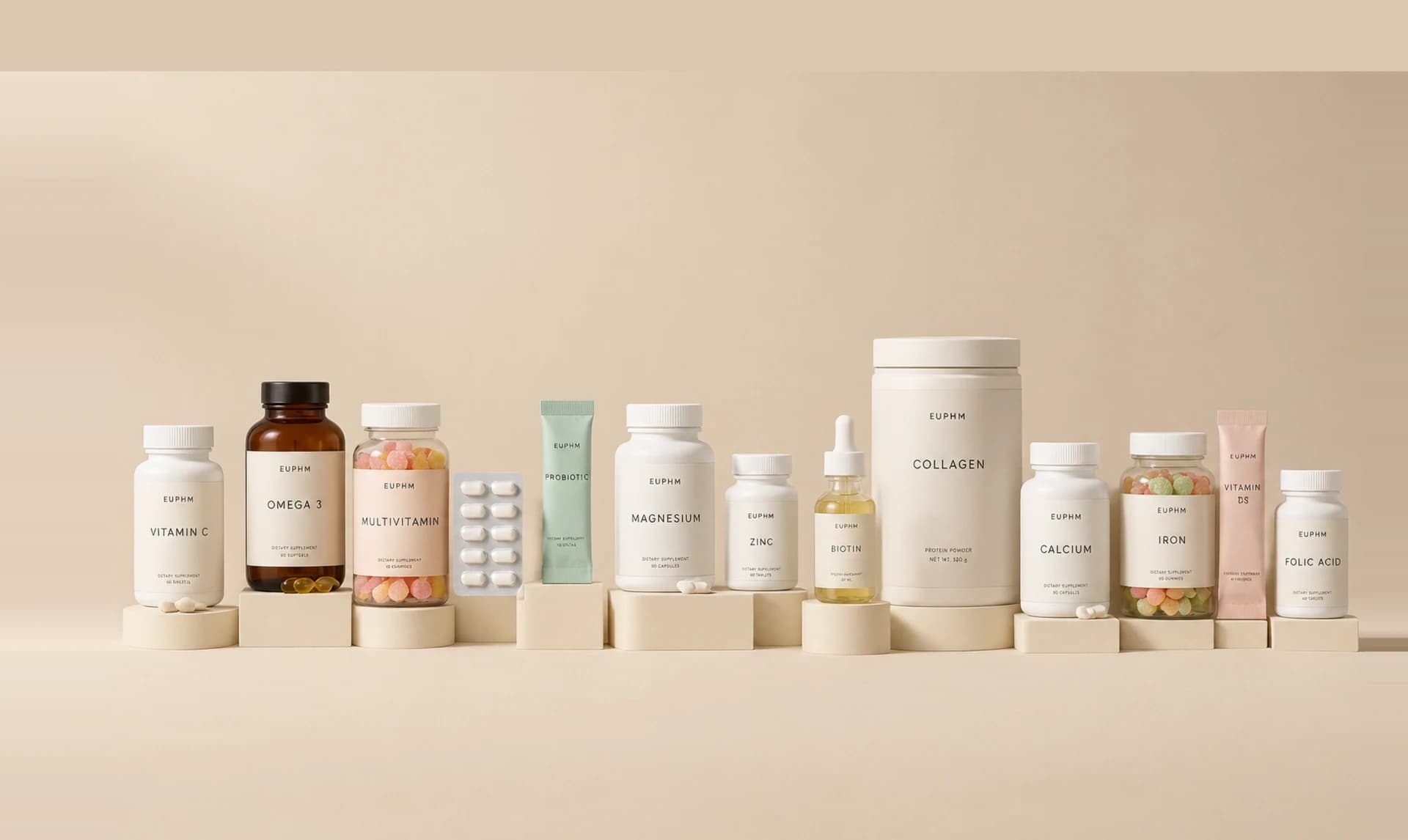
Low MOQ supplement manufacturing at EUPHM supports bottles (HDPE or PET, 60cc to 300cc), blisters (PVC/PVDC or alu-alu), stick packs, and sachets. Bottle filling runs from 500 units for pilot batches, with induction sealing and child-resistant closures available. Blister tooling is custom-made per project; the setup cost is quoted separately and the tool can be reused for future orders. Stick packs and sachets are filled on vertical form-fill-seal lines with fill weights from 2g to 30g. For small runs, stock bottle moulds are used to avoid tooling costs, and labels are printed digitally.
Labels for the US market must include the statement of identity, net quantity of contents, supplement facts panel, list of ingredients, allergen declaration, and the name and place of business of the manufacturer or distributor. EUPHM provides a label review service against FDA 21 CFR 101 requirements before printing. Lot and expiry coding is applied by inkjet or laser on the bottle, blister, or carton, with formats such as LOT 12345 and EXP 2026-08. For Amazon FNSKU labelling, EUPHM can apply the FNSKU barcode label over the retail barcode or print it directly on the carton, and can poly-bag units if required.
Cartons are specified to your retail or e-commerce requirements. Standard export cartons are 5-ply corrugated with a maximum weight of 15kg, and palletisation follows a 1200mm x 1000mm or 1200mm x 800mm footprint with a maximum height of 1.8m including the pallet. Shrink-wrapping and edge protectors are applied for sea freight. For retail-ready packaging, EUPHM can print shelf-ready trays and display cartons, but these require a minimum order of 1,000 units per SKU to justify the print setup.
Retail compliance support includes barcode verification (GS1), ingredient statement checks for the target market, and allergen cross-reference. EUPHM does not provide regulatory registration in the destination country, but the documentation package is structured so your importer or consultant can file without requesting additional batch records. For small orders, packaging materials are ordered in minimum quantities that may exceed your unit count; the surplus is either stored for your next run or invoiced at cost, and this is agreed before production starts.
MOQ, Lead Times and Delivery
The sample timeline starts with a formulation brief. If you use an existing formula from EUPHM's library, samples are dispatched in 7 to 10 working days. If a new formula requires development, the timeline extends to 15 to 20 working days for the first sample, with up to two rounds of revision included. Sample costs are quoted per project and are credited against the first production order if the order is placed within 90 days. Samples are sent by courier with a commercial invoice and a non-hazardous declaration.
Production lead time for a low MOQ order is 20 to 35 working days after receipt of the purchase order, deposit, and approved artwork. The lower end applies to stock formulas and stock packaging; the upper end applies to custom blister tooling or imported components. For pilot runs from 500 units, the production window is typically 15 to 25 working days. EUPHM provides a production schedule at order confirmation and updates it weekly. If a batch fails a specification, the batch is reworked or re-manufactured at no additional cost, and the lead time is extended by the rework period.
Delivery is quoted on EXW, FOB, or DDP terms. FOB applies from Shenzhen or Hong Kong ports; DDP is available for the US, EU, UK, and Australia, with duties and taxes included in the quoted rate. Air freight is used for pilot runs and urgent orders, with transit times of 5 to 10 days door-to-door. Sea freight is used for retail bottling orders above 1,000 units, with transit times of 25 to 40 days depending on the destination port. For DDP shipments, EUPHM arranges the import clearance through a nominated broker and provides the commercial invoice, packing list, and bill of lading.
The document package for a low MOQ shipment includes the commercial invoice, packing list, bill of lading or air waybill, certificate of analysis, material safety data sheet (MSDS) for the finished product, and a free-sale certificate where required by the destination country. For herbal ingredients, a phytosanitary certificate is provided if the importing country requests it. Certificates of origin can be issued for preferential tariff treatment under applicable trade agreements. All documents are checked against the shipping marks and carton count before the container is sealed.
What We Can Build
Capsule pilot runs
500 to 1,000 units. Hard capsules in sizes 0 to 2, fill weights 300–800 mg. Suitable for single-ingredient and simple blends.
Tablet pilot runs
500 to 1,000 units. Round or oblong tablets, 500–1,500 mg. Coating available for taste or moisture protection.
Powder pilot runs
500 to 1,000 units. Stick packs, jars, or pouches. Fill weights from 5 g to 500 g depending on format.
Retail bottling scale-up
1,000 units per SKU. Standard 60, 90, or 120 count bottles. Induction seal, label, and carton included.
From Spec to Shipment
- 01
Send your brief
Share target actives, dosage form, fill weight, and packaging. If you have a reference product, include it. Response within 1 working day.
- 02
Formulation review
The team checks feasibility, ingredient availability, and MOQ. You receive a draft formula and indicative pricing for pilot and retail volumes.
- 03
Sample production
Samples made in 7–10 working days. You receive physical samples with a specification sheet. Two revision rounds included.
- 04
Confirm and deposit
Approve the sample and specification. A 30–50% deposit starts the order. Balance due before shipment.
- 05
Production run
Mass production takes 20–35 working days. In-process checks at blending, filling, and packaging. Batch record kept for traceability.
- 06
Release and ship
Finished goods tested and released with a certificate of analysis. Shipping by air or sea, with documents for your market.
Why EUPHM
Test before scaling
Validate formula, packaging, and demand with 500 units. Avoid tying up capital in inventory that may need reformulation.
Same line, same quality
Pilot runs use the same GMP-certified equipment and batch records as full production. No downgrade in process control.
Clear cost curve
Per-unit cost falls as volume rises from 500 to 5,000 units. You can plan pricing and margins before committing to a large run.
Questions buyers ask.
What is the lowest MOQ for a supplement manufacturing run?+
Pilot runs start at 500 units for capsules, tablets, or powders. Retail bottling starts at 1,000 units per SKU. Below 500 units, hand-filling is possible but not cost-effective for most brands.
Can I get a sample before committing to 1,000 units?+
Yes. Samples are produced in 7–10 working days. You receive physical samples and a specification sheet. Two revision rounds are included before you approve the formula for production.
How long does a low MOQ production run take?+
Mass production takes 20–35 working days after sample approval and deposit. Pilot runs of 500–1,000 units can be faster, often 15–20 working days, depending on ingredient availability.
Do you provide halal, or organic certification for small orders?+
Yes, where the formula and ingredients qualify. Halal certificates are issued per batch. Organic certification is available for USDA and EU organic claims. Vegan statements are provided on request.
What documentation comes with a low MOQ order?+
Each batch ships with a certificate of analysis covering identity, potency, and microbiological results. You also receive a batch record, ingredient certificates, and label review support for your target market.
Can I use my own packaging components for a low MOQ order?+
Yes. EUPHM accepts customer-supplied bottles, closures, and cartons, provided they meet the line specifications and are delivered to the factory before the production date. You are responsible for the quality and regulatory compliance of your components. A pre-production sample run is recommended to check compatibility with the filling line. Freight and storage of your components are at your cost, and EUPHM will confirm the receiving schedule.
What happens if my low MOQ batch fails a quality test?+
If a batch fails a specification, EUPHM investigates the root cause and either reworks or re-manufactures the batch at no additional cost. You are notified within two working days of the failed result, and the corrective action is documented in a deviation report. The batch is not released for shipment until it passes retesting. If rework is not possible, a credit note or replacement batch is issued according to the terms of the supply agreement.
Do you offer kitting or assembly of multiple SKUs in one order?+
Yes. For low MOQ orders, EUPHM can assemble kits that combine two or more SKUs, such as a bottle and a sachet, into a single retail carton. Kitting is done manually or semi-automatically, with a minimum of 500 kits per configuration. Each kit is labelled with a unique lot number that links to the component batches. Kitting adds 3 to 5 working days to the production lead time, and the cost is quoted per kit.
Have a product in mind?
Send us the brief and we will come back with a formulation direction, indicative price and a realistic lead time — usually within one working day.