Supplement Packaging: Formats, Labelling and Retail Readiness
The packaging decisions that affect cost, shelf life and whether a retailer will accept the case.
Why packaging decides retail acceptance
Packaging is not a cosmetic afterthought. It determines whether a retailer accepts your case, how long the product survives transit and shelf life, and what the unit cost looks like at scale. For supplement brands, the packaging specification also carries regulatory weight: food-contact compliance, child-resistance where required, and labelling that satisfies the destination market. EUPHM manufactures in Guangdong, China, and ships from Shenzhen and Hong Kong ports. This page sets out the packaging formats we run, the labelling and compliance points that matter, and the carton and pallet specifications buyers ask for.
We hold GMP, ISO 9001, ISO 22000, HACCP, NSF/ANSI 455-2 and halal certification, and are FDA-registered for dietary supplements. Those certifications cover the manufacturing environment; packaging materials and their suppliers are qualified separately against food-contact requirements.
Primary packaging formats we run
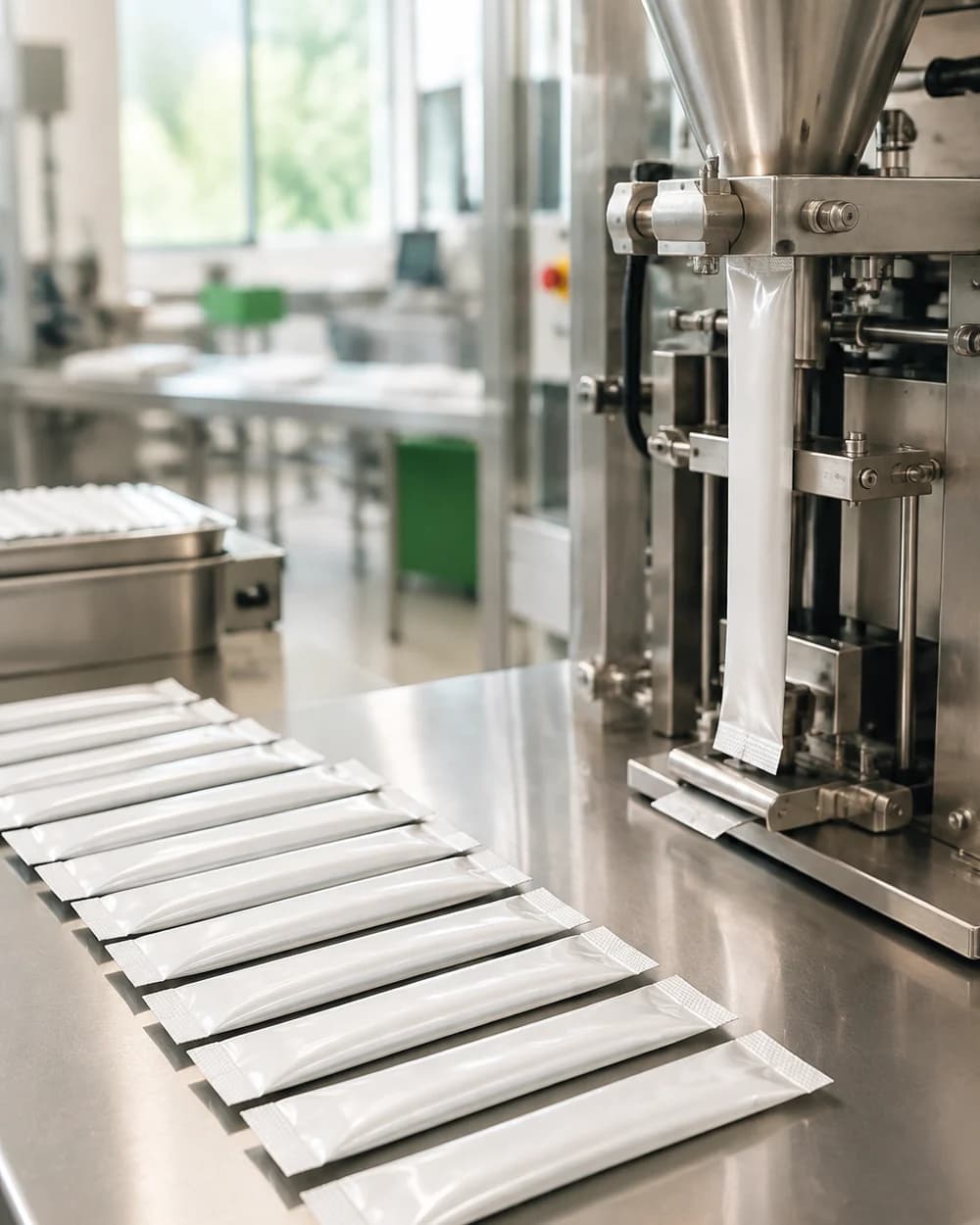
Primary packaging is what touches the product. The choice is driven by dosage form, moisture sensitivity, dose accuracy and the retail channel. HDPE bottles with induction seals and child-resistant or standard closures suit capsules, tablets and softgels at retail volumes. Blisters suit unit-dose tablets and capsules where dose tracking matters. Stick packs and three-side-seal sachets suit powders and granules in single-serve portions. Jars suit powders and gummies; pouches suit larger powder fills and refill formats.
Secondary packaging — labels, shrink sleeves, cartons — carries the brand and the mandatory information. Tertiary packaging — shipper cartons and pallets — is what the retailer or fulfilment centre actually receives. All three layers must be specified together; a bottle that passes lab testing can still fail at the retailer if the shipper carton is underspecified.
Format options at a glance
HDPE bottles and closures
High-density polyethylene bottles in common retail sizes, with induction seal liners, desiccant options, and standard or child-resistant closures. Suitable for capsules, tablets, softgels and some gummies. Label applied to bottle or shrink sleeve over cap for tamper evidence.
Blisters
PVC/PVdC or alu-alu blisters for unit-dose tablets and capsules. Alu-alu gives the strongest moisture and light barrier; PVC/PVdC is lower cost where barrier demand is moderate. Cartoned for retail.
Stick packs
Single-serve stick packs for powders and granules. Good dose control and low waste. Usually multi-packed into cartons or pouches for retail.
Three-side-seal sachets
Flat sachets for single-serve powders. Lower cost than stick packs at volume; barrier depends on laminate structure. Can be tear-notch and printed.
Jars
Wide-mouth jars for powders and gummies, with induction seal and scoop where needed. Common in sports nutrition and gummy retail.
Pouches
Stand-up or flat pouches with zipper or tear notch, for larger powder fills and refill formats. Barrier grade selected to product sensitivity.
Labels, shrink and tamper evidence
Labels carry the mandatory panel: product name, supplement facts or nutrition declaration per market, ingredient list, allergen statement where applicable, net quantity, batch and expiry, storage conditions, and manufacturer or importer details. For the US, the Supplement Facts panel format is prescribed; for the EU and UK, the nutrition declaration and permitted claims list apply; for Canada, the Natural Product Number and bilingual labelling apply. We do not draft regulatory label copy for your market — that is the brand's responsibility — but we apply approved artwork and check that the printed panel matches the approved file before mass production.
Tamper evidence is a retail requirement in most markets. Common approaches are a shrink sleeve over the closure, an induction seal under the cap, or a printed breakable band. Child-resistant closures are required where the product presents a hazard or where local rules mandate them; we can supply CR closures and can test to the applicable protocol on request. Send us the destination market and we will confirm the applicable test standard and closure requirements in writing before production.
Food-contact compliance and barrier performance
Every primary packaging material that touches the product must be food-contact compliant for the destination market. In the EU this means Regulation (EC) No 1935/2004 and the relevant material-specific measure; in the US, FDA food-contact substance requirements. We source packaging from suppliers who provide declarations of compliance, and we keep those declarations on file for the batch. Tell us the destination market and we will send the declaration format and the supplier list we would use for your order.
Moisture and light barrier determine shelf life. Hygroscopic powders and effervescents need high-barrier laminates or alu-alu blisters plus desiccant. Oils and softgels are more sensitive to oxygen and light; opaque or amber materials and nitrogen flushing where appropriate help. We select the barrier grade against your stability data and the shelf life you intend to claim, not against a default.
Format comparison
| Format | Best for | Barrier | Tamper evidence | Retail / FBA fit | Notes |
|---|---|---|---|---|---|
| HDPE bottle | Capsules, tablets, softgels | Moderate; add desiccant | Induction seal + shrink sleeve | Strong; standard retail and FBA | CR closure option |
| Blister (PVC/PVdC) | Unit-dose tablets, capsules | Moderate | Sealed cavity | Good; cartoned | Lower cost at moderate barrier |
| Blister (alu-alu) | Moisture-sensitive tablets | High | Sealed cavity | Good; cartoned | Highest barrier cost |
| Stick pack | Single-serve powders | Depends on laminate | Sealed ends | Good; multi-pack for retail | Good dose control |
| Three-side-seal sachet | Single-serve powders | Depends on laminate | Sealed edges | Good; cartoned | Lower cost at volume |
| Jar | Powders, gummies | Moderate; induction seal | Induction seal + shrink | Strong; sports and gummy retail | Scoop option |
| Pouch | Larger powder fills, refills | Depends on laminate | Zipper or tear notch | Good; FBA-friendly | Barrier grade selected to product |
Carton and pallet specifications
Shipper cartons are specified by unit count, carton dimensions, board grade and print. Retailers and fulfilment centres impose their own carton and pallet rules: maximum carton weight, pallet footprint and height, stacking strength, and labelling on the carton. Amazon FBA, for example, requires cartons that meet its weight and size limits and its own labelling and pallet requirements. We build to the specification you provide; where you do not have one, we propose a standard export carton and pallet configuration for your approval before production.
Pallet configuration affects freight cost and damage rates. Standard pallet footprints, maximum load height and stretch-wrap or corner-board protection are agreed per order. For LCL shipments from Shenzhen or Hong Kong, pallet height is often constrained by container loading; for FCL, the constraint is usually the retailer's receiving rule. Pallet and carton specifications are agreed per order and confirmed in writing on the packing list.
Retail shelf and e-commerce readiness
Retail shelf readiness means the pack stands, faces and scans correctly: barcode placement, shelf-ready packaging where the retailer requires it, and a label panel that meets the category's planogram rules. E-commerce readiness means the pack survives parcel handling without leaking or denting, and that the carton and label meet the marketplace's requirements. Amazon FBA has specific rules on unit packaging, suffocation warnings for poly bags, and carton labelling; other marketplaces differ. We can pack to the specification you supply.
Minimum order quantities are 1,000–2,000 units per SKU for retail bottling, with lower quantities for pilot runs. Samples take 7–10 working days; mass production takes 20–35 working days after deposit and artwork approval. Packaging lead time is included in that window only where the pack is a standard stock item; custom tooling or printed packaging adds time, which we confirm at quotation.
Frequently asked questions
Can you supply child-resistant closures, and do you test them?+
Yes, we can supply child-resistant closures and can test to the applicable protocol on request. The specific standard and any market-specific requirement should be confirmed before production; tell us the market and we will confirm the standard in writing.
Do you provide food-contact declarations for packaging materials?+
We source packaging from suppliers who provide declarations of compliance and keep those declarations on file for the batch. The declaration format and supplier list should be confirmed against your market's requirements; we will send the exact declaration we hold for your review.
Can you pack to Amazon FBA requirements?+
Yes, we can pack to the specification you supply, including FBA carton labelling and unit packaging rules. FBA requirements change, so the current specification should be provided at order, and we pack to the version you send.
What is the minimum order quantity for retail bottling?+
1,000–2,000 units per SKU for retail bottling, with lower quantities for pilot runs. Samples take 7–10 working days; mass production takes 20–35 working days after deposit and artwork approval.
Who is responsible for label compliance in my market?+
The brand is responsible for regulatory label copy and claims in its market. We apply approved artwork and check that the printed panel matches the approved file before mass production. We do not draft market-specific regulatory copy.
Have a product in mind?
Send us the brief and we will come back with a formulation direction, indicative price and a realistic lead time — usually within one working day.