Glucosamine and Joint Health: A Sourcing Guide for Brands
Glucosamine remains a top-selling joint health ingredient. This guide covers formats, dosages, and manufacturing parameters for brands sourcing a contract partner in China.

Practical guides for sourcing supplement manufacturing: MOQs from 1,000 units, sample lead times of 7-10 working days, and mass production runs of 20-35 working days from a GMP-certified plant in Guangdong.
This hub collects the numbers buyers ask for most. It covers retail bottling MOQs, pilot run thresholds, capsule and tablet fill weights, line capacity, and the documentation pack that accompanies each shipment. Use it to benchmark quotes, plan launch dates, and compare contract manufacturers on the same terms. Each section links back to the parent resources library for deeper dossiers on formulation, compliance and freight.

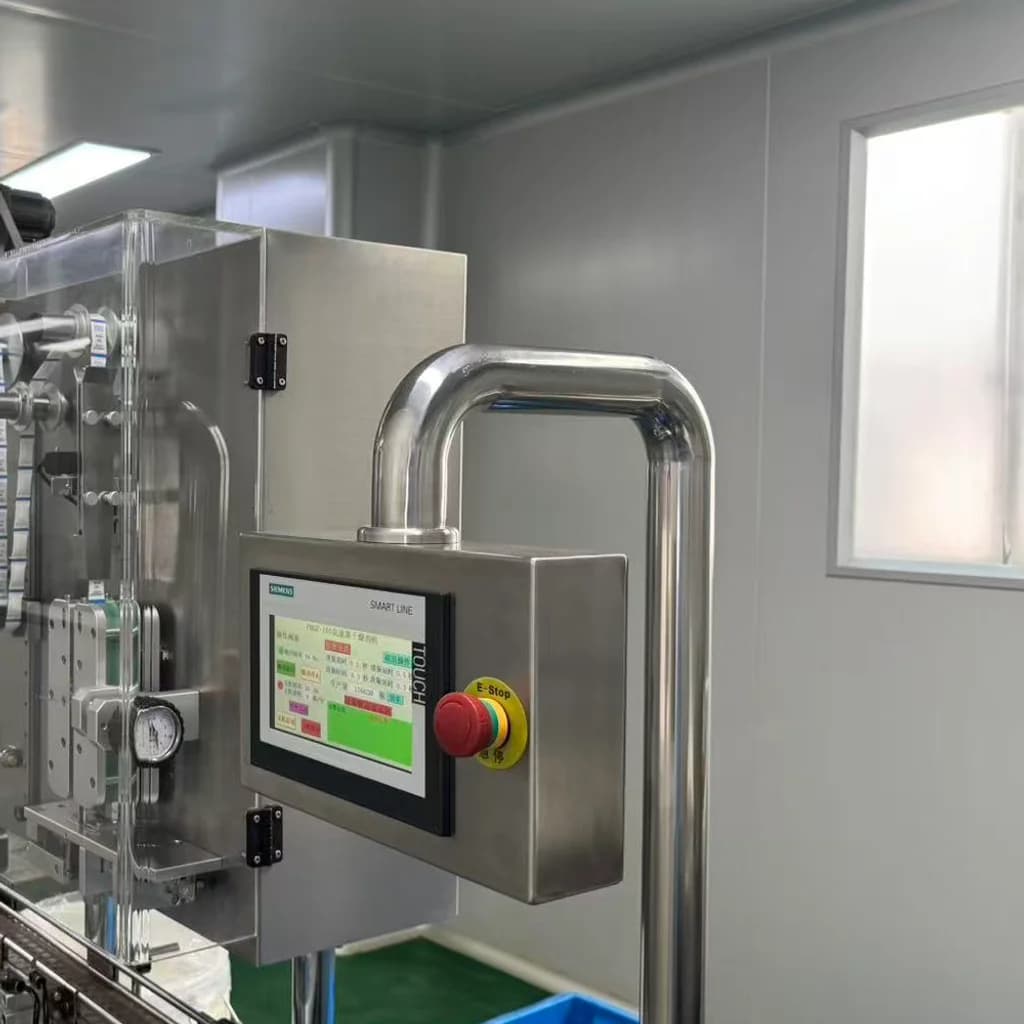
Bottling lines run at 60-120 bottles per minute depending on fill weight and cap type. A standard retail order of 5,000 units per SKU occupies a single shift block, which keeps changeover costs low. Pilot runs below 1,000 units are quoted case by case and often share a line with a compatible product to absorb setup time. Blister and sachet formats carry separate MOQs, typically 10,000 units, because tooling and foil runs cost more to start.
Scheduling works backward from your launch date. After formula approval, raw materials are booked and a production slot is reserved. Mass production takes 20-35 working days, then 3-5 days for QC release and packing. Sea freight to the US East Coast adds 25-35 days; to Rotterdam, 28-38 days. Air freight is 5-8 days. Build 6-8 weeks of buffer into first orders so label revisions or artwork changes do not push the run.
Capsule fill weights sit between 300 mg and 800 mg for a size 0 or 00 shell. Tablets range from 500 mg to 1,200 mg; above 1,000 mg, a caplet or two-piece format is usually more stable. Powders run 5-30 g per serving in stick packs or jars. Actives are dosed to the label claim with an overage where degradation is expected, and each batch is assayed before release. Common actives include vitamin D3, magnesium glycinate, ashwagandha KSM-66, creatine monohydrate and omega-3 concentrates.
Ingredient sourcing depends on the claim and the market. and EU organic inputs must come from certified supply chains with transaction certificates. Halal status depends on the excipient list, capsule shell and any processing aid. Vegan capsules use HPMC rather than gelatin. Where a branded ingredient is specified, we confirm the licence and royalty terms before quoting. For proprietary blends, we ask for the full quantitative formula so the assay method can be validated.
The plant operates under GMP, ISO 22000 and HACCP. That means incoming raw material testing, in-process checks and finished product release testing on every batch. An FDA-registered facility status applies for US-bound exports. Each shipment includes a certificate of analysis, a certificate of origin, a GMP certificate and a halal certificate where relevant. Stability data is available for 24 months under accelerated and real-time conditions. Heavy metals, microbiology and pesticide panels are run per SKU.
Logistics are quoted door-to-door or FOB. We handle carton labelling, pallet configuration and export documentation. For the Middle East, halal certificates are issued per production run, not per year, so the certificate number matches the batch. For the EU, we provide the importer with the technical dossier and, where required, the novel food status note. Retail-ready packaging, including shrink sleeves and tamper seals, is applied on site to reduce handling steps.
Every production batch is tested at three stages: incoming raw materials, in-process blends, and finished goods. Identity testing uses HPLC or FTIR against a reference standard. Potency assays quantify active markers, typically with a tolerance of ±5% of label claim. Microbial testing covers total aerobic count, yeast and mould, E. coli, Salmonella and Staphylococcus aureus. Heavy metals are screened by ICP-MS for lead, arsenic, cadmium and mercury against USP <232> limits. Disintegration testing follows USP <701> for tablets and capsules, with results recorded per batch.
A Certificate of Analysis (COA) accompanies each batch and lists the tests performed, specification limits, results, test methods and the analyst's signature. The COA also states the batch number, manufacturing date, expiry date and storage conditions. Retention samples of each batch are kept for 12 months beyond the expiry date, stored under labelled conditions. Stability protocols follow ICH Q1A(R2) guidelines: accelerated testing at 40°C/75% RH for six months and long-term testing at 25°C/60% RH for up to 36 months, with intervals at 0, 3, 6, 9, 12, 18, 24 and 36 months.
Documentation is compiled into a batch record that includes the master formula, raw material COAs, in-process checks, finished product COA, packaging records and deviation reports. This pack is available for review during audits and is sent with each shipment. For brands requiring third-party verification, samples can be couriered to an accredited external laboratory at the buyer's cost, with results typically returned within 10 working days.
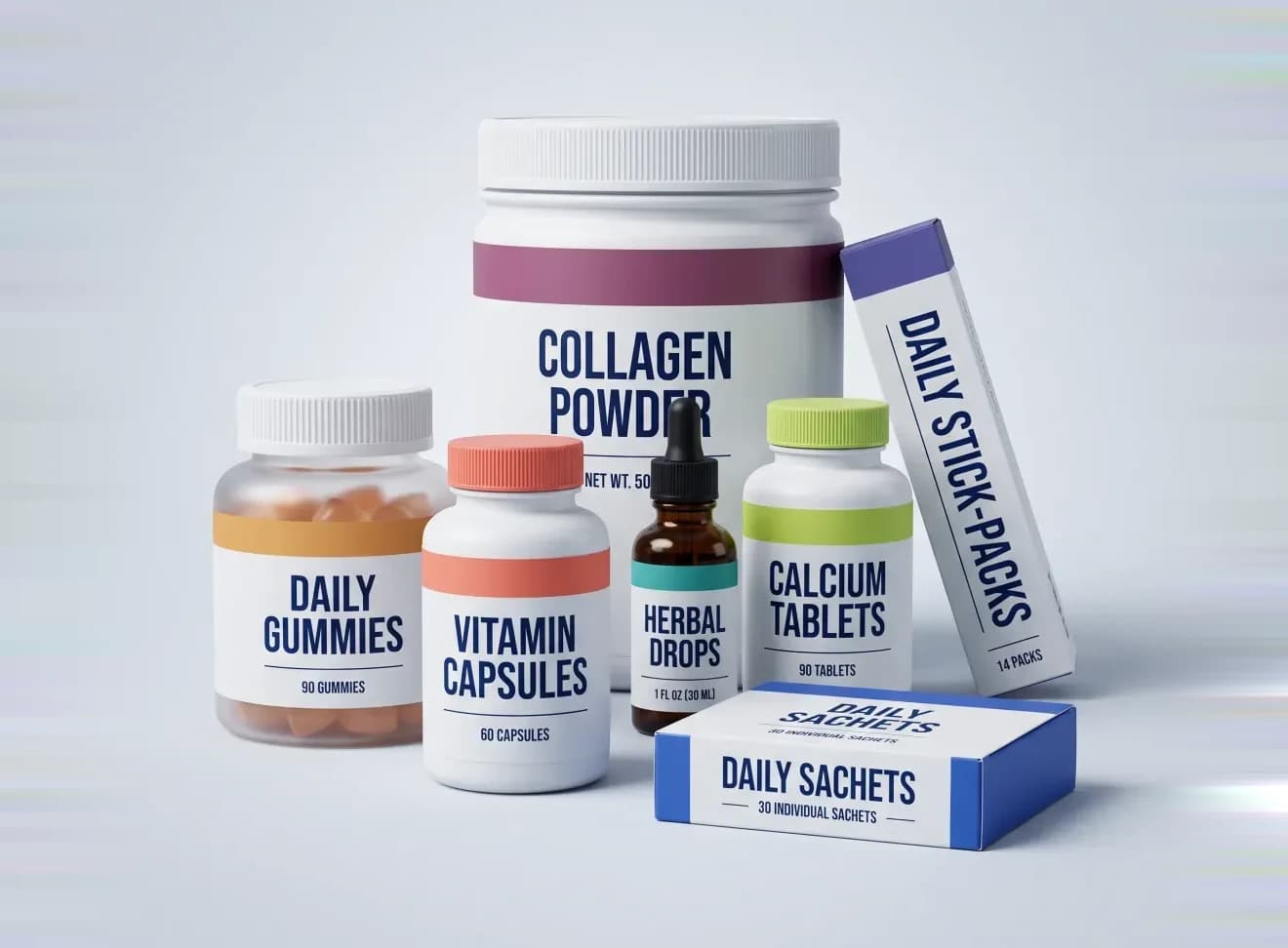
Primary packaging options include HDPE bottles (30, 60, 90, 120, 180 and 240 cc), glass bottles, blister packs (PVC/PVDC or alu-alu), stick packs (2-10 g), sachets (5-30 g) and single-serve pouches. Bottles can be supplied with induction seals, desiccant canisters or silica gel sachets. Blister cards are printed with lot and expiry coding. Stick and sachet formats are filled on vertical form-fill-seal lines with fill weight accuracy of ±2%. Cartons are specified with board grade, print process (offset or digital) and any required barcodes.
For the US market, labels must include the statement of identity, net quantity of contents, supplement facts panel, ingredient list, allergen declaration, and the manufacturer or distributor name and address. Lot codes and expiry dates are inkjet-printed or laser-etched on the bottle, carton and shipper. For Amazon FNSKU compliance, each unit requires a removable FNSKU label applied over the barcode, and cartons must meet Amazon's weight and dimension limits (typically under 23 kg and 63.5 cm on the longest side). Retail compliance for the EU requires the address of a responsible person within the EU and allergen labelling under Regulation (EU) No 1169/2011.
Pallet specifications are agreed per order: standard EUR pallets (1200 x 800 mm) or US GMA pallets (1219 x 1016 mm), with maximum load height of 1.8 m and stretch-wrapping. Carton drop testing and compression testing can be arranged on request. All packaging components are checked against the approved artwork and a signed proof before mass production.
The sampling timeline starts with a brief and formula review, typically 2-3 working days. Prototype samples are produced within 7-10 working days and couriered for approval. Once the sample is signed off and the purchase order is confirmed, mass production takes 20-35 working days, depending on format and packaging complexity. Pilot runs from 500 units can be scheduled within 15 working days, subject to ingredient availability.
Shipping options include air freight (5-10 days door-to-door) and sea freight (25-40 days port-to-port). Incoterms offered are EXW, FOB and DDP. For DDP shipments, the factory handles export clearance, freight, import clearance and duties, with delivery to the buyer's nominated address. Air shipments are typically used for pilot runs and urgent replenishments, while sea freight suits full-container orders above 500 kg.
Documents provided with each shipment include the commercial invoice, packing list, bill of lading or air waybill, Certificate of Analysis, Material Safety Data Sheet (MSDS) where applicable, and a free-sale certificate. For plant-based ingredients, a phytosanitary certificate can be arranged if required by the destination country. Certificates of origin are available on request. All documents are issued in English and can be legalised or apostilled for an additional fee.
Two-piece HPMC or gelatin capsules, 300-800 mg; compressed tablets and caplets, 500-1,200 mg. Coating, enteric and sustained-release options available.
5-30 g servings in jars, pouches or stick packs. Flavouring, sweetening and agglomeration handled in-house. Suitable for sports and meal-replacement lines.
Oil-based softgels and tinctures. Fill volumes from 0.5 ml to 30 ml. Nitrogen flushing for oxidation-sensitive oils such as omega-3 and vitamin D.
Pectin and gelatin gummies at 2-5 g per piece. Lower MOQs for pilot launches. Vegan pectin bases available with halal certification.
Send the formula, target market and pack format. A costed quote with MOQ, fill weight and lead time is returned within 3 working days.
Samples are made in 7-10 working days. You receive physical samples, a draft label and a preliminary specification sheet for review.
Actives, excipients and claims are finalised. Artwork is checked against the label claim and the destination market's rules before release.
Certified ingredients are ordered and quarantined. Incoming testing confirms identity, potency and absence of contaminants before release to production.
The run takes 20-35 working days. In-process checks cover weight, hardness, disintegration and fill volume at defined intervals.
Finished goods are assayed and released. Certificates and export documents are issued, then goods ship by sea or air as agreed.
Every guide states MOQ, fill weight, lead time and line speed. You can drop the figures into a comparison sheet against other suppliers.
halal and vegan documents are explained per market, including when certificates are issued per batch rather than per year.
Production and freight timelines are laid out end to end, so you can set a retail date and work backward without guesswork.
For retail bottling, MOQ is 1,000 units per SKU. Pilot runs can start lower, from 500 units, and are quoted case by case because setup time is shared across a compatible product. Blister and sachet formats typically start at 10,000 units due to tooling costs.
Samples are produced in 7-10 working days after formula and packaging details are confirmed. You receive physical samples and a draft specification. Mass production then takes 20-35 working days after sample approval, plus 3-5 days for QC release and packing.
This plant holds GMP, ISO 22000 and HACCP. halal and vegan certifications are available depending on the formula and capsule shell. For US-bound goods, the facility is FDA-registered. Certificates are issued per batch where the destination market requires it.
Yes, if you provide the full quantitative formula, the current label and the target market. We check the actives, excipients and capsule shell against local rules, then quote. Where a branded ingredient is used, we confirm licence terms before sampling. Reverse-engineering from a finished product alone is not offered.
Each batch ships with a certificate of analysis, certificate of origin, GMP certificate and, where relevant, halal certificates. Stability data covering 24 months is available on request. Heavy metals, microbiology and pesticide panels are run per SKU. Export documents for the EU and Middle East are prepared with the order.
Shelf life is established through stability testing under ICH Q1A(R2) conditions. Accelerated testing at 40°C/75% RH for six months supports an initial shelf life of 24 months for most capsule and tablet formats. Long-term testing at 25°C/60% RH continues for up to 36 months. The final expiry date is set based on real-time data and is stated on the COA and label.
Yes. We work with your approved artwork and can advise on FDA dietary-supplement label elements, EU allergen declarations and Amazon FNSKU placement. Lot and expiry coding are applied to primary packaging, cartons and shippers. Carton and pallet specifications are agreed per order, including board grade, barcode placement and maximum load height. A signed proof is required before mass production.
Standard terms are 50% deposit with the purchase order and 50% balance before shipment. For repeat orders, we can discuss 30% deposit and 70% against a copy of the bill of lading. Credit terms are considered case by case after three completed orders. All payments are in USD or EUR by bank transfer. Letters of credit are accepted for orders above USD 50,000.

Glucosamine remains a top-selling joint health ingredient. This guide covers formats, dosages, and manufacturing parameters for brands sourcing a contract partner in China.

Demand is shifting toward functional formats, traceable ingredients and labels that clear multiple markets. This guide covers the trends that affect your MOQ, fill weight and lead…

CFU counts drive cost, label claims and shelf life. This guide covers strain selection, overage, moisture control and realistic MOQ for retail bottling, so you can brief a contract…

A supplement label is a legal document, not marketing copy. Learn to read serving size, %NRV, ingredient forms, and certifications before you source or buy any product.
Send us the brief and we will come back with a formulation direction, indicative price and a realistic lead time — usually within one working day.