Supplement Manufacturer for Startups: From Pilot Run to Retail
Launching a supplement brand? EUPHM runs pilot batches from 1,000 units, delivers samples in 7–10 working days, and scales to full retail production in 20–35 working days. GMP, ISO 22000 and HACCP certified.
Overview
Most contract manufacturers set minimum order quantities at 10,000 units or more, which puts a first production run out of reach for new brands. This page compares the practical options for startups sourcing a supplement manufacturer: pilot-scale runs, stock formulations versus custom development, capsule and powder formats, and the certifications buyers in the US, EU, UK and Middle East ask for. Use it to shortlist a partner before you commit to tooling, packaging or a full container.
- Minimum order quantity
- 1,000 units per SKU for retail bottling; lower for pilot runs
- Sample lead time
- 7–10 working days
- Mass production lead time
- 20–35 working days after sample approval
- Certifications
- GMP, ISO 9001, ISO 22000, HACCP, NSF/ANSI 455-2, halal, FDA-registered
- Fill weights
- Capsules 300–1,200 mg; powders 100 g–2 kg; softgels 500–1,500 mg
- Formats
- Capsules, tablets, softgels, powders, gummies, stick packs, liquids
Capability: Pilot Runs That Scale
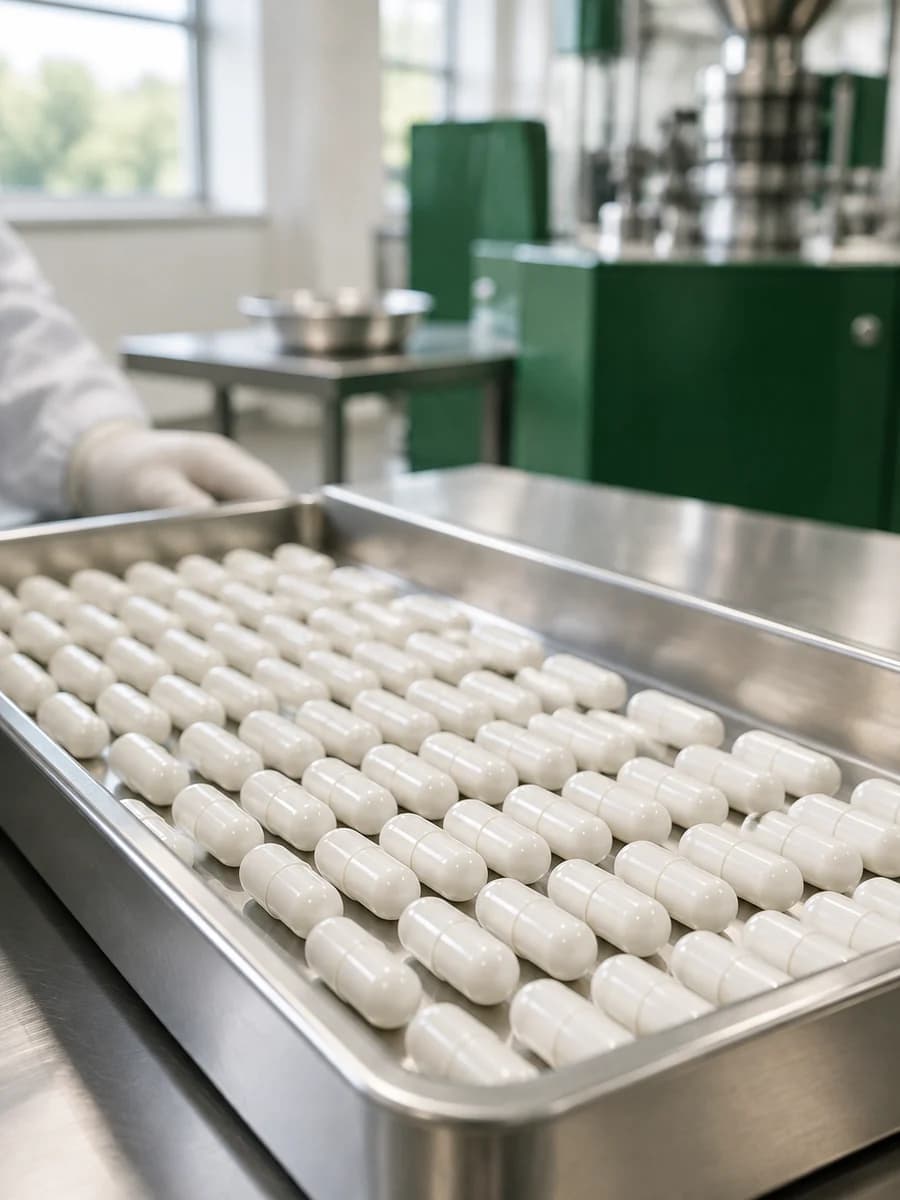
A startup does not need a full container of 30,000 bottles to test a market. EUPHM runs pilot batches from 1,000 units per SKU, which is enough for a soft launch on Amazon, Shopify or a regional retailer. The same lines, blenders and encapsulation equipment handle the scale-up to 50,000 units or more without reformulation or a new tooling cycle. That continuity matters: your second run matches your first.
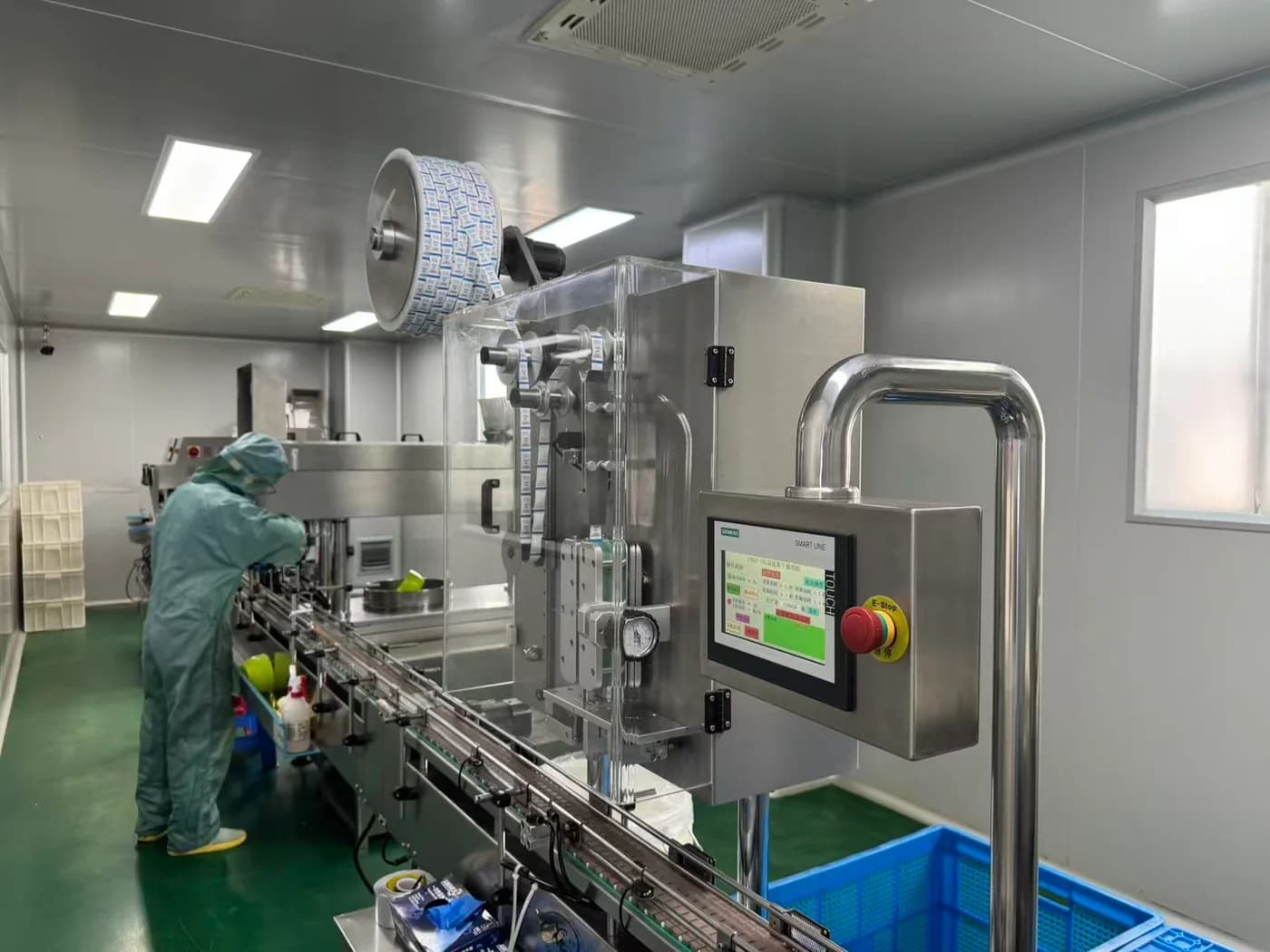
Line capacity at the Guangdong plant covers capsule filling, tablet compression, powder blending and stick-pack filling. Typical output is 200,000 capsules per shift, so a 5,000-unit pilot run does not sit behind large orders in the queue. If your first order is 1,000 units and your reorder is 30,000, the unit economics improve at the same supplier rather than forcing a move to a second manufacturer.
Formulation: Stock or Custom, Your Choice
Startups usually face a choice between a stock formula and a custom blend. Stock formulas for categories such as multivitamins, collagen, magnesium glycinate, ashwagandha and pre-workout are ready to sample in 7–10 working days and carry no development fee. Custom formulations take longer because they involve ingredient sourcing, stability checks and a flavour or capsule-shell trial, but they give you a product no competitor can copy.
Ingredient sourcing is where startup budgets often break. EUPHM quotes per ingredient with country of origin, certificate of analysis and allergen status, so you can see the cost of a branded extract versus a generic one before you commit. Dosages are set to label claims that hold up in the US, EU and UK, and excipient choices (magnesium stearate, silicon dioxide, rice hull) are listed for clean-label positioning.
Quality and Compliance: What Buyers Ask For
Retail buyers and marketplace compliance teams ask for the same documents: GMP certificate, ISO 22000, HACCP plan, and a certificate of analysis per batch. EUPHM holds GMP, ISO 22000 and HACCP, and can supply halal and vegan documentation where the formula and ingredient supply chain support the claim. The facility is FDA-registered, which is a registration, not an approval.
For the EU and UK, labelling must show allergens, net quantity and a nutrition declaration; for the Middle East, halal certification is often a listing requirement. Batch records, retention samples and stability data are kept so a retailer or importer can audit the file. If your buyer requests a third-party lab test, that can be arranged before shipment rather than after the container leaves the port.
Quality Control for Supplement Manufacturing Startups: Tests, Timing and COAs
Every batch produced for a startup supplement manufacturer run is tested against a written specification before release. Identity is confirmed by FTIR or HPLC against a reference standard. Potency is assayed for each active ingredient, typically by HPLC, with results expressed as a percentage of label claim. Microbial testing covers total aerobic count, yeast and mould, E. coli, Salmonella and Staphylococcus aureus. Heavy metals are screened for lead, arsenic, cadmium and mercury against USP <232> or EU limits. Disintegration testing follows USP <701> for capsules and tablets, with a 30-minute limit for most immediate-release formats.
Testing happens at three points. Raw materials are quarantined and sampled on receipt, with a certificate of analysis requested from each supplier. In-process checks cover weight variation, hardness for tablets and fill weight for capsules. Finished-product testing is carried out on the bulk or filled units before packing. For a 1,000-unit startup run, expect 5 to 10 working days for third-party laboratory turnaround, which is built into the 20 to 35 working day production window rather than added on top.
The certificate of analysis issued with each batch lists the product name, batch number, manufacture and expiry dates, specification limits, test methods and measured results, plus a release signature. It should match the specification you approved at sample stage. Retention samples are held for the shelf life plus one year, typically at 20 to 25 degrees Celsius and 60 percent relative humidity. If you need accelerated stability data for a 24-month claim, plan 3 months at 40 degrees Celsius and 75 percent relative humidity before your first retail shipment.
Packaging and Label Compliance for Startup Supplement Brands
Packaging options for a startup supplement manufacturer run include HDPE bottles from 30 to 500 ml, glass bottles for liquids and softgels, blister packs, stick packs and single-serve sachets. Bottle closures can be induction-sealed and fitted with child-resistant caps where the market requires it. Desiccant canisters or silica gel sachets are added for hygroscopic powders. For Amazon sellers, the unit must carry the FNSKU label rather than the manufacturer barcode, and the carton must meet the marketplace's shipping requirements for poly bags and overboxing.
For the US market, the FDA dietary supplement label needs a statement of identity, net quantity of contents, a Supplement Facts panel with serving size and percent daily value, an ingredient list in descending order of weight, and the name and place of business of the manufacturer or distributor. Allergen declarations follow FALCPA. Lot code and best-by date must be printed or laser-coded on the bottle and the carton. The EU and UK require a food supplement label with the permitted nutrition declaration, the recommended daily portion and a warning not to exceed it.
Carton specifications are agreed before printing. A typical setup is a 5-ply corrugated shipper holding 12 to 24 bottles, with a gross weight under 15 kg for manual handling. Pallets are usually 1,200 by 1,000 mm or 1,200 by 800 mm, stretch-wrapped and corner-boarded, with 20 to 24 cartons per layer depending on bottle size. Export cartons carry the lot number, quantity, gross and net weight, and country of origin. Artwork proofs should be signed off at least 10 working days before the planned packing date.
MOQ, Lead Times and Delivery
The startup supplement manufacturer timeline starts with the sample. After formulation and packaging are agreed, a sample is produced in 7 to 10 working days. Sample approval triggers purchase order and deposit, then mass production runs 20 to 35 working days depending on format: capsules and tablets are usually at the shorter end, gummies and liquids at the longer end because of setting and filling times. Chinese New Year and the September to November peak add 2 to 3 weeks, so plan launches around those windows.
Shipping from Guangdong depends on volume and urgency. Air freight takes 5 to 8 days door to door and suits pilot runs of 50 to 200 kg; sea freight takes 25 to 35 days to the US west coast or 30 to 40 days to Northern Europe and is cost-effective above roughly 500 kg. Incoterms are usually EXW, FOB Shenzhen or Hong Kong, or DDP for startups without a freight forwarder. DDP includes duties and customs clearance but limits your control over the routing, so confirm the landed cost in writing.
Documents issued with each shipment include the commercial invoice, packing list, certificate of analysis for each batch, safety data sheet where applicable, and a free-sale certificate for markets that request one. For plant-based ingredients, a phytosanitary certificate or certificate of origin may be needed. Certificates for halal or organic status are provided only where the specific product and line hold that certification, so confirm this at quotation stage rather than assuming it applies to every SKU.
Packaging and Format Choices
Pilot run
1,000 units per SKU. Ideal for market testing, trade shows and early e-commerce listings before a full retail commitment.
Stock formula
Pre-developed blends for common categories. No development fee, samples in 7–10 working days, fastest route to a first sale.
Custom formulation
Your own ingredient list and dosages. Includes sourcing, stability review and a capsule or flavour trial before production.
Private label
Existing formula with your brand, label and packaging. Lower cost per unit and shorter lead time than custom development.
How a Project Runs
- 01
Brief and quote
Send your formula, format, fill weight and target quantity. A costed quote follows, usually within 2–3 working days.
- 02
Sample approval
Samples ship in 7–10 working days. You check taste, capsule appearance, fill weight and label fit before paying for tooling.
- 03
Documentation check
Certificates, allergen statements and label artwork are reviewed against your destination market before production starts.
- 04
Production
Mass production runs in 20–35 working days after sample sign-off and deposit. Batch records are kept for audit.
- 05
QC and release
Each batch is tested for weight, disintegration and microbial limits. A certificate of analysis is issued before packing.
- 06
Shipping
Bottles are packed to your carton spec and shipped by air or sea. Export documents are prepared for your customs broker.
Why EUPHM
Low entry MOQ
Start at 1,000 units per SKU instead of 10,000 or more. Keeps your first inventory spend and storage footprint manageable.
Fast sampling
7–10 working days for samples means you can test a formula, adjust it and still hit a launch window in the same quarter.
Scale without switching
The same plant handles 1,000 and 50,000 units. Your second and third runs stay with one supplier and one set of documents.
Questions buyers ask.
What is the minimum order quantity for a startup supplement run?+
For retail bottling, 1,000 units per SKU. Pilot runs can be lower depending on the formula and packaging. If you are testing several SKUs, each one carries its own MOQ, so a three-SKU launch is planned as three separate minimums.
How long does it take to get a sample?+
Stock formulas ship in 7–10 working days. Custom formulations take longer because of ingredient sourcing and stability checks, typically 15–20 working days. Sample cost is usually credited against the first production order.
Can you help with label compliance for the US, EU and UK?+
Yes. The team reviews your label against destination-market rules: allergen declarations, net quantity, nutrition format and claim wording. This is a document review, not legal advice, and final responsibility sits with your brand. Many startups use it to catch issues before artwork goes to print.
Do you offer halal certification?+
halal and vegan documentation can be supplied where the formula and ingredient supply chain support the claim. Certification is ingredient- and process-specific, so confirm it at the quote stage rather than assuming it applies to every SKU.
What does a first order cost?+
Cost depends on formula, fill weight, packaging and quantity. A 1,000-unit capsule run with a stock formula and standard bottle is the lowest entry point. Custom blends, gummies and stick packs cost more per unit. Request a quote with your target quantity for a firm figure.
Can I use my own formula and still meet a 1,000-unit minimum?+
Yes, provided the formula uses commercially available ingredients and does not require custom synthesis. A custom formula typically needs a development fee and a 5 to 10 working day sample lead time. The 1,000-unit minimum applies per SKU for retail bottling; pilot runs below that are possible but carry a higher unit cost because setup and testing are spread over fewer units.
What payment terms do you offer for a first order?+
First orders are usually 30 percent deposit on purchase order and 70 percent before shipment, with payment by bank transfer. Letters of credit are accepted for orders above USD 30,000. For repeat orders, terms can be reviewed after three completed shipments. All amounts are quoted in USD unless otherwise agreed, and bank charges are shared according to the agreed Incoterm.
How do you handle a batch that fails specification?+
If a batch fails any release test, it is placed on hold and not packed or shipped. The laboratory report is shared with you, and the cause is investigated, whether raw material, process or method. Options are rework where technically valid, re-testing a second sample, or rejection and remanufacture. You are not invoiced for a rejected batch, and the replacement is scheduled into the next available production slot.
Have a product in mind?
Send us the brief and we will come back with a formulation direction, indicative price and a realistic lead time — usually within one working day.