How to Compare the Best Supplement Manufacturers
Sourcing a supplement manufacturing partner means comparing hard numbers: MOQ, lead times, certifications, fill weights and line capacity. This page sets out the benchmarks that separate capable contract manufacturers from the rest.
Overview
The best supplement manufacturers are not defined by marketing claims. They are defined by verifiable capability: GMP certification, ISO 22000 and HACCP food safety systems, documented batch records, and realistic lead times. For brand owners in the US, EU, UK and Middle East, the comparison usually comes down to four variables: minimum order quantity, sample turnaround, mass production window and regulatory documentation. This guide covers each, with reference parameters from a working GMP-certified facility in Guangdong, China.
| MOQ (retail bottling) | 1,000 units per SKU |
|---|---|
| MOQ (pilot runs) | Lower volumes available on request |
| Sample lead time | 7-10 working days |
| Mass production | 20-35 working days |
| Certifications | GMP, ISO 9001, ISO 22000, HACCP, NSF/ANSI 455-2, halal, FDA-registered |
| Fill weights | Capsules 300-1,000 mg; tablets 500-1,500 mg; powders 100-5,000 mg per serving |
Manufacturing capability and line capacity
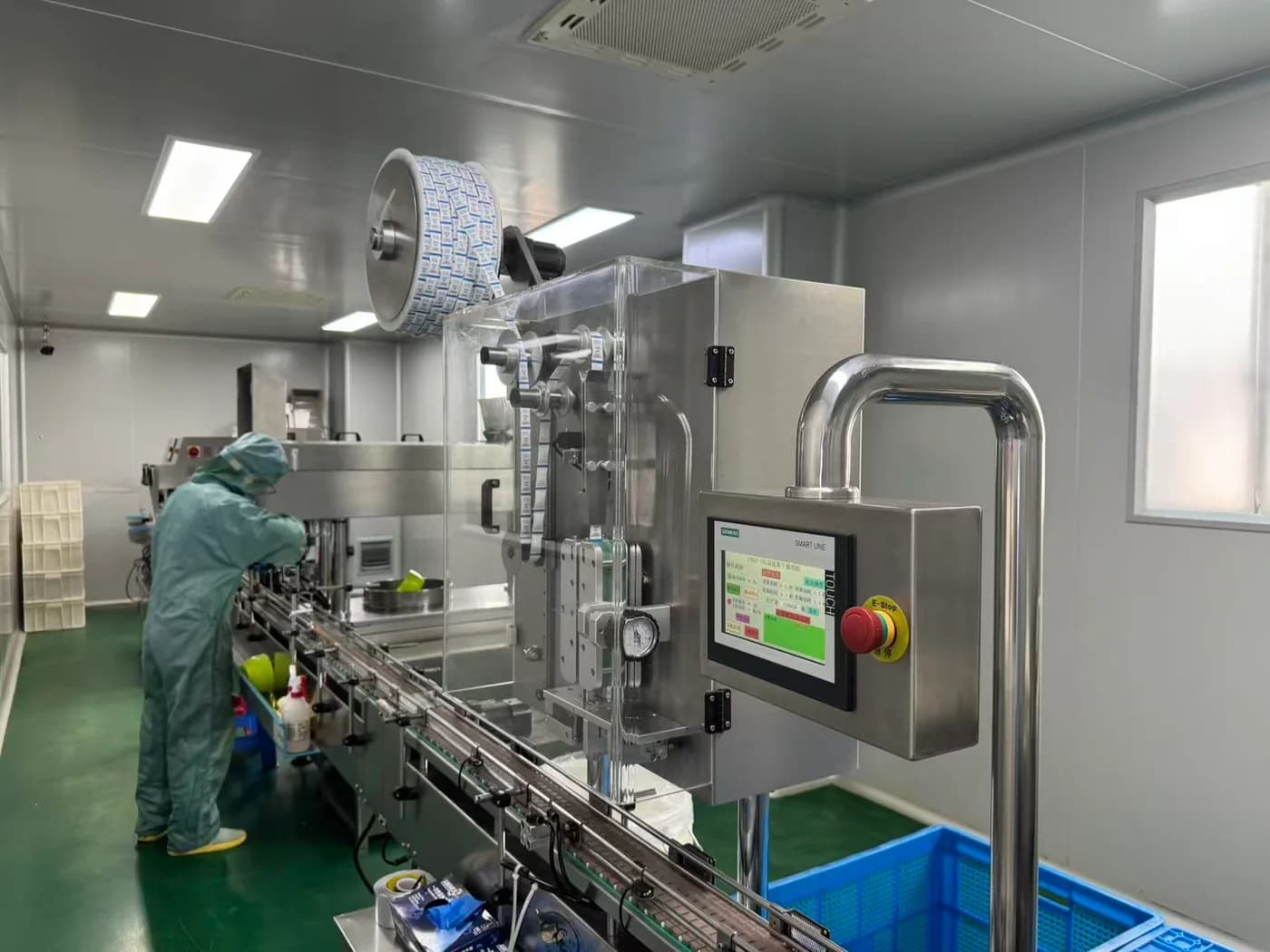
A contract manufacturer's equipment list tells you what it can actually produce. Look for encapsulation lines, tablet presses, powder blending and filling systems, and packaging lines for bottles, blisters and sachets. Capacity matters: a plant running 50 million capsules per month can absorb a 5,000-unit pilot without disrupting existing orders. A smaller operation may struggle. Ask for the number of encapsulation machines, their output per hour, and the maximum batch size per SKU.
Also confirm whether production is in-house or subcontracted. Some suppliers broker your order to a third party, which adds lead time and reduces traceability. A GMP-certified facility should be able to show you its own batch records, equipment logs and cleaning validation. If a supplier cannot provide these on request, treat that as a red flag. For pilot runs, ask whether the same line used for mass production is used for samples. Consistency between sample and bulk is a common failure point.
Formulation, ingredients and fill weights
Ingredient sourcing is where quality differences show up first. Ask for country of origin for each active ingredient, certificate of analysis (CoA) per lot, and allergen statements. For botanical extracts, confirm standardisation markers such as 10:1 or 4:1 ratios, or specific percentages of active compounds. Fill weights vary by dosage form: capsules typically hold 300-1,000 mg, tablets 500-1,500 mg, and powder sachets 100-5,000 mg per serving. These ranges affect both cost and label claims.
Formulation support separates a manufacturer from a filler. Can they adjust excipients for vegan or allergen-free requirements? Do they offer taste-masking for chewables or effervescents? For sports nutrition, can they handle 20-30 g protein per serving in a single scoop? Ask about stability testing: 24-month shelf life claims require accelerated and real-time data. If a supplier cannot provide stability protocols, your product may fail in market. Request a sample batch with the exact fill weight and dosage form you intend to sell.
Quality systems, compliance and logistics
Certifications are the baseline, not the differentiator. GMP, ISO 22000 and HACCP are expected. For Middle East markets, halal certification is often mandatory. For EU and UK, organic claims require organic certification and a clear audit trail. For US retail, a FDA-registered facility is relevant, but that is not the same as FDA approval. Ask for the certificate numbers and expiry dates, and verify them with the issuing body. A manufacturer that hesitates to share these is not worth shortlisting.
Logistics affect total landed cost. Confirm Incoterms: FOB, CIF or DDP. Ask for typical production windows: 20-35 working days for mass production is realistic for a GMP facility. Add shipping time: 25-35 days by sea to US East Coast, 30-40 days to EU, 15-25 days to Middle East. Air freight cuts transit to 5-10 days at higher cost. Request a packaging specification: bottle size, cap type, induction seal, label placement and carton dimensions. These details determine whether your product arrives shelf-ready.
Quality control and batch documentation at supplement manufacturers
Testing at a GMP-certified facility runs in three stages. Incoming raw materials are sampled and screened for identity by FTIR or HPLC against a reference standard before release to production. In-process checks cover weight variation, hardness for tablets and seal integrity for bottles. Finished batches are then tested for potency (assay of the active marker compound), microbial limits (total plate count, yeast and mould, E. coli, Salmonella, Staphylococcus aureus), heavy metals (lead, arsenic, cadmium, mercury by ICP-MS) and disintegration time, typically under 30 minutes for immediate-release capsules and tablets.
A certificate of analysis accompanies every batch and states the product name, lot number, manufacture and expiry dates, the test parameters, specification limits, measured results and the analytical method used. It is signed by the QC manager and references the batch record. Buyers should confirm whether the COA reflects third-party laboratory testing or in-house testing, and request the laboratory name. Retention samples of each lot are held for the full shelf life plus 12 months, which allows re-testing if a market complaint or regulatory query arises after delivery.
Stability follows a defined protocol rather than a single end-point test. Accelerated conditions at 40 degrees Celsius and 75 percent relative humidity over three and six months support the initial expiry claim, with real-time data at 25 degrees Celsius and 60 percent relative humidity running in parallel. Where a buyer needs a 24-month shelf life, the accelerated data plus ongoing real-time points are reviewed before the label claim is fixed. Any formulation change, including a new excipient or capsule shell, triggers a fresh stability study.
Batch records are the audit trail behind all of this. A complete record links the raw material lot numbers, the dispensing weights, the machine and line used, the operators, the in-process results and the final QC release signature. When comparing supplement manufacturers, ask to see a redacted batch record and a sample COA before placing a purchase order. A factory that cannot produce both on request is a risk to your brand regardless of the price quoted.
Packaging, Labelling and Retail Readiness
Primary packaging options cover high-density polyethylene bottles from 60 ml to 500 ml with induction seals and child-resistant or standard caps, blister packs on PVC or alu-alu for moisture-sensitive tablets, and single-serve stick packs or sachets from 2 g to 30 g for powders. Bottle labelling runs on automatic lines with orientation control, so front and back panels align consistently across a run. Buyers should confirm the bottle wall thickness and the desiccant or cotton configuration, since these affect stability in transit and on shelf.
For the US market, the dietary supplement label must carry a Supplement Facts panel with serving size, amounts per serving and percent daily value where established, plus the ingredient list in descending order of weight. Allergen declaration, the net quantity of contents, the manufacturer or distributor address and a lot code and expiry date are mandatory. Structure-function claims must carry the standard disclaimer. EU and UK labels instead require nutrition declaration per 100 g and per serving, and the food supplement symbol where applicable.
Lot and expiry coding is applied by inkjet or laser on the bottle, the carton and, where required, the shipper. The format is agreed in writing before production so it matches your own traceability system. Cartons are specified by dimensions, board grade and print, and pallets are built to a stated pattern, typically 1,200 by 1,000 mm or 1,200 by 800 mm, with a defined carton count per layer and per pallet. Shrink wrap and corner boards protect the load for sea freight.
Retail and marketplace compliance is a separate workstream. For Amazon, each unit needs an FNSKU label applied over the barcode, and the carton needs the correct box labelling and a packing list that matches the shipment. Some retailers require a GS1-registered barcode rather than an in-house code. Confirm early whether the manufacturer can apply FNSKU labels in-house, who supplies the artwork files, and how many proof rounds are included before plates or digital print are committed.
MOQ, lead times and delivery when comparing supplement manufacturers
The sample stage typically takes 7 to 10 working days from receipt of a signed specification and confirmed formula. That covers sourcing any non-stock ingredient, a small pilot batch, filling into your chosen pack and courier dispatch. Buyers should expect to pay for samples and freight, and to allow one or two revision rounds if flavour, colour or fill weight needs adjustment. Approving the sample in writing, with the exact fill weight and capsule or tablet dimensions recorded, prevents disputes once mass production starts.
Mass production runs 20 to 35 working days after sample approval and receipt of packaging materials. The lower end applies to stock formulas in standard bottles, the upper end to new formulations, custom-printed cartons or blister formats. Add time for artwork approval and, where relevant, for label printing by a third party. A production schedule with a confirmed ship date should be issued before the deposit is paid, and any slip beyond the agreed window should be notified in writing with a revised date.
Shipping is by air or sea. Air freight from Guangdong to the US or EU usually takes 5 to 10 days door to door and suits pilot orders or replenishment; sea freight takes roughly 25 to 40 days port to port depending on destination and routing. Incoterms should be stated explicitly: EXW leaves everything to the buyer, FOB places the goods on board at the named Chinese port, and DDP means the manufacturer or its forwarder handles freight, duty and final delivery. Each shifts cost and risk, so match the term to your experience.
The document pack that ships with the order includes the commercial invoice, packing list, bill of lading or airway bill, a COA per lot, and a material safety data sheet where the product requires one. A free-sale certificate or certificate of origin is available on request, and phytosanitary certificates apply only to certain botanical ingredients. Confirm the full document list in the purchase order, since missing paperwork at the destination port can delay clearance and add storage costs that are rarely recoverable.
Manufacturing Options to Compare
Turnkey private label
Choose from existing formulations, apply your branding. Lowest MOQ, fastest to market. Suitable for brands testing a category before investing in custom R&D.
Custom formulation
Develop a unique blend with your chosen actives and dosages. Higher MOQ, longer lead time, but creates differentiation and IP you control.
Pilot run programme
Small-batch production below standard MOQ for market testing, stability checks or trade show samples. Typically 500-2,000 units per SKU.
Full-service sourcing
Manufacturer handles ingredient procurement, blending, encapsulation, bottling, labelling and export documentation. Simplifies supply chain for first-time importers.
How a Project Runs
- 01
Define your specification
Write a clear brief: dosage form, fill weight, actives, servings per container, packaging type and target markets. This becomes your request for quotation.
- 02
Request samples and CoA
Ask for 7-10 working day sample turnaround. Review the certificate of analysis for each active. Check fill weight accuracy against your specification.
- 03
Audit certifications
GMP, ISO 9001, ISO 22000, HACCP, NSF/ANSI 455-2 and halal certification; FDA facility registration for US-bound shipments.
- 04
Confirm MOQ and pricing
Compare MOQ per SKU, unit cost at 1,000, 5,000 and 10,000 units, and setup fees. Ask whether pilot run volumes are available and at what premium.
- 05
Review lead times
Get written confirmation of sample lead time, mass production window (20-35 working days) and shipping transit. Add buffer for regulatory review and customs.
- 06
Place a pilot order
Before committing to full production, run a 500-2,000 unit pilot. Test packaging, label compliance and stability. Use the results to finalise your mass production order.
Why EUPHM
Transparent MOQ and lead times
1,000 units per SKU for retail bottling. Lower volumes for pilot runs. Sample turnaround 7-10 working days. Mass production 20-35 working days.
Certified quality systems
GMP, ISO 9001, ISO 22000, HACCP, NSF/ANSI 455-2 and halal certification; FDA facility registration for US-bound shipments.
Full dosage form range
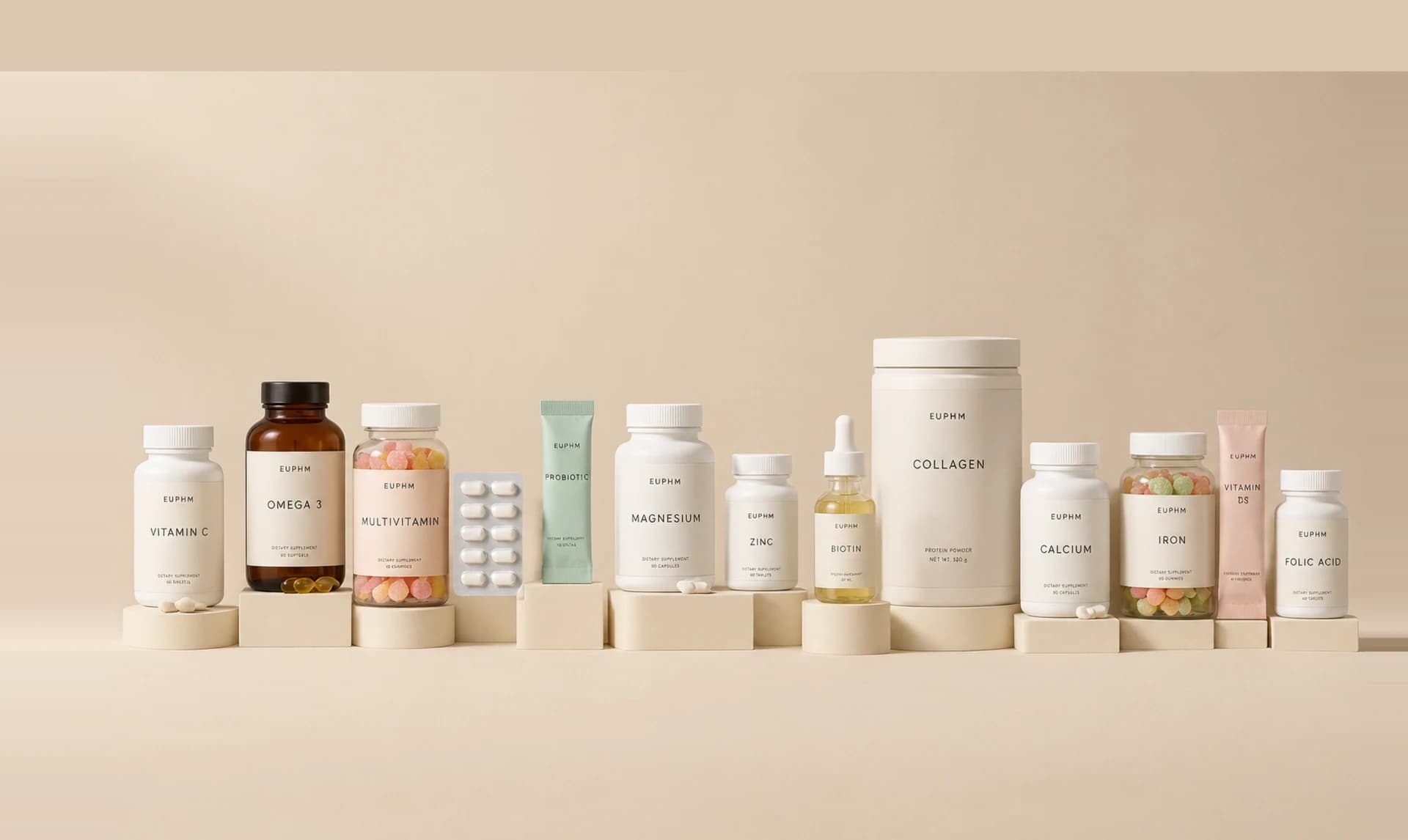
Capsules, tablets, powders, gummies and sachets. Fill weights from 300 mg to 5,000 mg per serving. Packaging in bottles, blisters and stick packs.
Questions buyers ask.
What is the minimum order quantity for supplement manufacturing?+
For retail bottling, expect 1,000 units per SKU. Pilot runs can be lower, often 500-2,000 units, at a higher per-unit cost. MOQ depends on dosage form and packaging. Capsules in stock bottles typically have lower MOQ than custom tablet shapes or sachets.
How long does sample and mass production take?+
Sample lead time is 7-10 working days from approved formulation and packaging. Mass production runs 20-35 working days after sample approval and deposit. Add shipping: 25-35 days by sea to the US, 30-40 days to the EU, 15-25 days to the Middle East.
Which certifications should a supplement manufacturer hold?+
At minimum: GMP, ISO 22000 and HACCP. For specific markets, halal for Middle East for Israel and some US buyers, organic for EU and claims, and vegan certification for plant-based products. Always verify certificate numbers and expiry dates with the issuing body.
Can I get a custom formulation with my own ingredients?+
Yes. Custom formulation is standard for brands seeking differentiation. Provide your target actives, dosages and fill weight. The manufacturer will confirm compatibility, excipients and stability. Expect a higher MOQ than private label, typically 5,000 units or more, and additional development time.
What fill weights are possible for capsules and tablets?+
Capsules typically hold 300-1,000 mg. Tablets range from 500-1,500 mg. Powders and sachets can go up to 5,000 mg per serving. Fill weight affects capsule size, tablet dimensions, packaging and cost. Request a sample at your target fill weight before committing to mass production.
How do I verify a supplement manufacturer's GMP certificate is genuine?+
Ask for the certificate number, the issuing body and the scope of certification, then check the issuer's public register directly. Confirm that the scope covers the dosage forms you are buying, such as capsules, tablets or powders, and that the certificate is current. A redacted batch record and a recent COA from the same facility give further evidence that the certified system is actually operating.
What should a supplement COA include for my market?+
A usable COA states the product and lot number, manufacture and expiry dates, each test parameter with its specification limit and measured result, and the analytical method used. It should be signed by the QC manager. For EU and US buyers, confirm whether testing was in-house or by an accredited third-party laboratory, and keep the laboratory name on file for retailer or importer audits.
Can you apply my own artwork and Amazon FNSKU labels?+
Yes, provided print-ready artwork is supplied to the agreed dieline and barcode standard. FNSKU labels can be applied over the retail barcode on each unit, and cartons can be labelled to the shipment specification. Artwork proofing is included before production, but allow extra working days for label printing and a final proof approval, since changes after plates are made add cost and delay.
Have a product in mind?
Send us the brief and we will come back with a formulation direction, indicative price and a realistic lead time — usually within one working day.