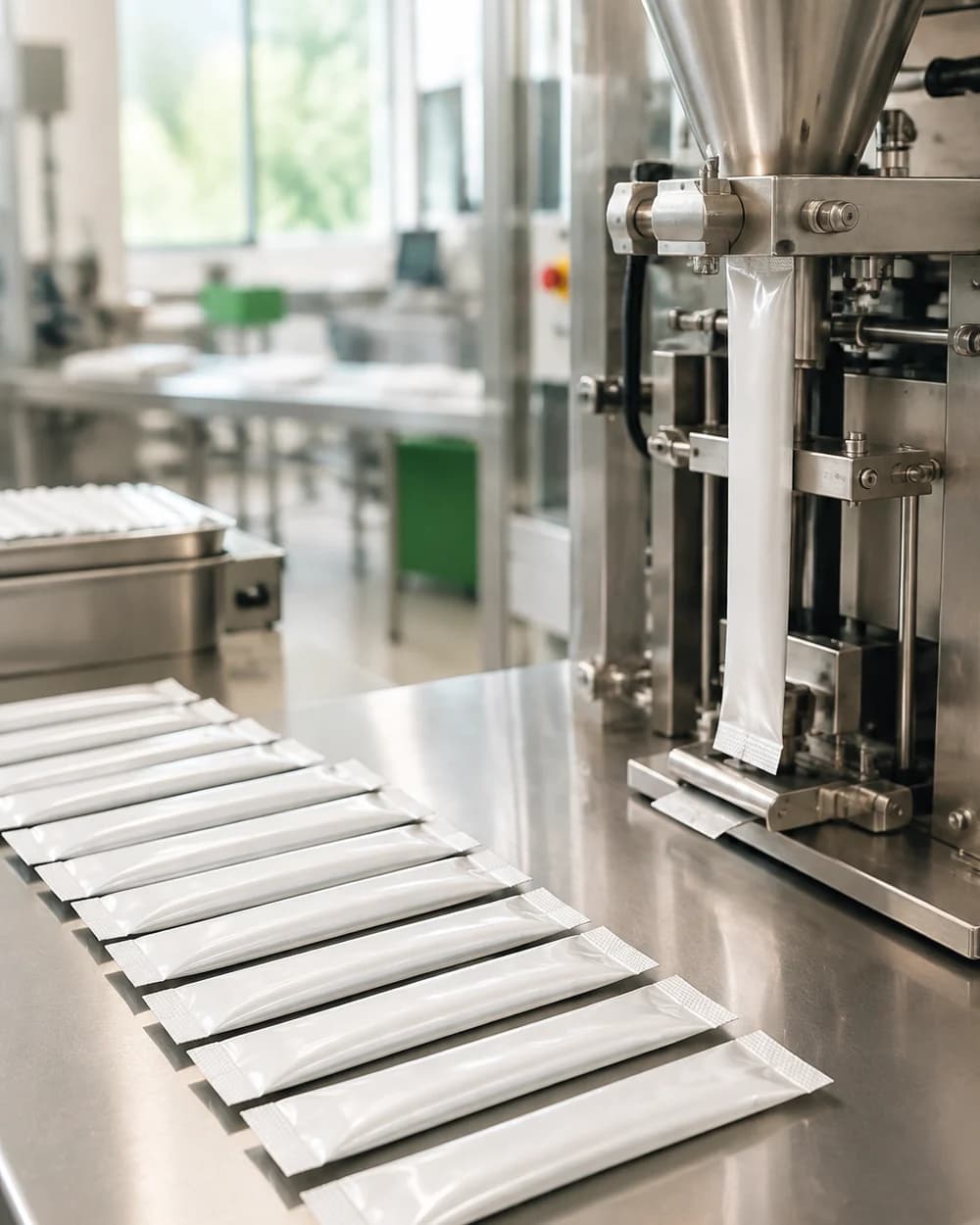
Sachet Manufacturer for Dietary Supplements and Powders
EUPHM fills stick packs and sachets from 2 g to 30 g on automated lines in Guangdong. MOQ starts at 1,000 units per SKU for retail cartons, with lower thresholds for pilot runs.
Overview
Sachets suit single-serve powders, electrolytes, collagen, probiotics and instant blends. The format protects hygroscopic ingredients, cuts freight weight versus glass, and gives brand owners a low-cost entry into retail. EUPHM runs vertical form-fill-seal lines with nitrogen flushing, four-side seal and stick pack configurations. This page covers fill weights, film structures, tooling, lead times and the certifications buyers ask for during supplier audits.
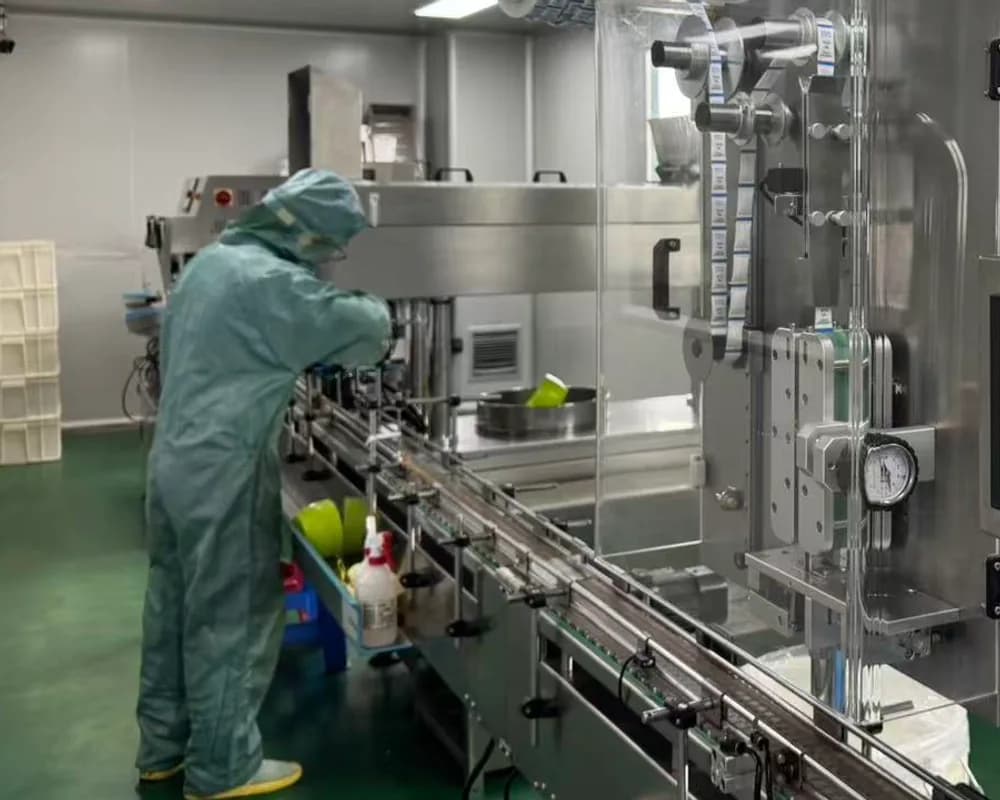
Sachet Filling Capability and Line Capacity
EUPHM operates vertical form-fill-seal sachet lines with a combined output of roughly 180,000 to 240,000 units per shift, depending on fill weight and film. Stick pack widths run from 20 mm to 60 mm; sachet sizes range from 60 mm x 80 mm up to 120 mm x 170 mm. We fill free-flowing powders, fine milled blends, granulates and micro-encapsulated actives. Accuracy is held at plus or minus 2 percent on most powder fills, which matters when a 3 g dose carries a 500 mg active.
Tooling is the main variable in lead time. If your sachet dimensions match an existing forming collar, we can schedule production within the standard 20-35 working day window. Custom stick pack widths add 5-8 working days for tooling. Nitrogen flushing is available for oxidation-sensitive ingredients such as omega-3 powders, vitamin C and certain probiotics. We run low-humidity filling rooms at 35-45 percent relative humidity for hygroscopic blends.
Formulation, Film and Ingredient Considerations
Sachet film is not a commodity. Standard structures are PET/PE, PET/AL/PE and PET/ALU/PE, with metallised and high-barrier clear options. The choice depends on moisture sensitivity, light sensitivity and shelf-life target. For a 24-month shelf life on a hygroscopic powder, we typically recommend a metallised or aluminium layer with a water vapour transmission rate below 0.5 g per square metre per day. Clean-label brands often choose clear high-barrier film to show the powder, at a higher cost per unit.
Formulation work happens before filling. We can blend actives with carriers, flow agents such as silicon dioxide at 0.5-1.5 percent, and sweeteners or flavour systems. Common bases include maltodextrin, inulin, erythritol and monk fruit. For probiotic sachets, we check water activity and use desiccant or oxygen absorbers where needed. Flavour and colour matching to a reference sample usually takes one to two rounds. We can also fill your supplied bulk powder under a toll arrangement.
Quality, Compliance and Export Logistics
The plant is GMP-certified and holds ISO 22000 and HACCP. We are FDA-registered for export to the United States. halal and vegan certification can be arranged for specific SKUs, with lead time of 2-4 weeks for documentation. Every batch carries a certificate of analysis covering identity, assay, microbial limits, heavy metals and moisture. Retention samples are held for 24 months. We do not claim FDA approval; registration is a facility listing, not a product approval.
Finished sachets are packed into retail cartons, display boxes or bulk bags. Carton artwork must be approved before mass production starts. We ship FOB Shenzhen or Yantian, with air freight from Hong Kong Baiyun for pilot runs. Typical carton counts are 30-60 sachets per retail box, 12-24 boxes per shipper. Documentation includes commercial invoice, packing list, certificate of origin, COA and, where required, health certificates for the destination market.
Sachet Quality Control and Batch Documentation
Every sachet batch is sampled at three points: incoming raw material, in-process powder blend, and finished sealed sachet. Identity testing uses FTIR or HPLC against a reference standard. Potency assays confirm active marker compounds within 95-105% of label claim for vitamins and 90-110% for herbal extracts. Microbial testing covers total aerobic count, yeast and mould, E. coli, Salmonella and Staphylococcus aureus. Heavy metals (lead, arsenic, cadmium, mercury) are screened by ICP-MS. Results are recorded against the batch number before release.
A Certificate of Analysis (COA) is issued per batch and includes: product name, batch number, manufacture date, expiry date, fill weight verification (average and range across 10 sachets), identity and potency results, microbial counts, heavy metals, moisture content, and seal integrity test results. Seal strength is checked by burst test at 0.6 bar for 30 seconds on a 2% sample. COAs are available in English, with additional languages on request. Retention samples of every batch are kept for 24 months at 25°C/60% RH.
Stability protocols follow ICH Q1A(R2) accelerated conditions (40°C/75% RH for 6 months) and long-term conditions (25°C/60% RH for 24 months). For probiotics, we additionally test viable count at 0, 3, 6, 12 and 24 months. Water activity is measured on hygroscopic powders before filling; target is below 0.3 Aw to prevent caking. Disintegration testing is not applicable to powders, but for sachets containing granulated or tablet-like cores we follow USP <701> where relevant.
Batch records include line clearance logs, metal detection checks (ferrous 1.5 mm, non-ferrous 2.0 mm, stainless steel 2.5 mm), fill weight control charts, and packaging reconciliation. Deviations are documented and investigated under CAPA. Buyers auditing the sachet line can review redacted batch records during a supplier visit. We do not release product without a signed QA release sheet.
Sachet Packaging, Labelling and Retail Readiness
Sachets are packed into cartons or pouches depending on retail channel. Standard carton configurations: 30 sachets per box (60 x 60 x 120 mm), 60 sachets per box, or 500 sachets per bulk polybag for repacking. Stick packs are typically 2 g to 6 g fill; four-side seal sachets run 5 g to 30 g. Film structures include PET/AL/PE for moisture barrier (WVTR <0.1 g/m²/day), PET/PE for cost-sensitive powders, and kraft/AL/PE for premium positioning. We can print up to 8 colours rotogravure or digital for short runs.
For US-bound dietary supplements, labels must include: statement of identity, net quantity, supplement facts panel with % Daily Value, other ingredients list, directions for use, and the manufacturer/distributor name and address. We do not write label copy but will check that mandatory FDA elements are present before printing. Lot number and expiry date are inkjet-coded on the sachet tail and on the carton. Expiry is set at 24 months from manufacture for most dry powders, 18 months for probiotics.
Cartons are specified to ISTA 1A or 3A depending on destination. Standard export carton: double-wall BC flute, 5-ply, with a 150 lb test strength. Pallet configuration is 1,200 x 1,000 mm or 1,200 x 800 mm, stretch-wrapped and corner-boarded. We provide carton dimensions, gross weight, and pallet count per container: typically 20-24 pallets per 40HQ. Amazon FNSKU labels can be applied at carton level or unit level; polybagging and suffocation warning labels are available.
Retail compliance support includes GS1 barcode verification (we can print EAN-13 or UPC-A on cartons), and we can supply dielines for custom display boxes. We do not provide Amazon Seller Central account management, but we format carton labels to your FNSKU specification. For EU retail, we can add the EC representative address and allergen declarations if provided. All printed artwork is proofed and signed off before mass production.
Sachet MOQ, Lead Times and Delivery Terms
Sample production takes 7-10 working days after receipt of formula and film artwork. Samples are supplied free for standard film structures; custom-printed film samples incur a plate fee (typically USD 300-600) and take 12-15 working days. Sample quantities are up to 100 sachets. We courier samples by DHL or FedEx at buyer's account. For probiotic or hygroscopic formulas, we recommend a 4-week accelerated stability check before committing to mass production.
Mass production lead time is 20-35 working days after artwork approval, PO, and deposit. This includes film printing (10-15 days), powder blending and filling (5-10 days), and QC release (3-5 days). Peak season (August to November) may add 5-7 days. We provide a production schedule with weekly updates. MOQ is 1,000 units per SKU are possible with a surcharge.
Incoterms offered: EXW (Guangdong factory), FOB Shenzhen or Hong Kong, and DDP for US and EU addresses. Sea freight to US West Coast takes 18-25 days port-to-port; air freight 5-8 days door-to-door. For DDP, we handle customs clearance and duties; buyer provides importer of record details. We do not act as importer of record. Shipping documents provided: commercial invoice, packing list, bill of lading or air waybill, COA, MSDS (for powder), free-sale certificate (on request), and phytosanitary certificate for herbal ingredients where required by destination.
Payment terms are 30% deposit with PO, 70% before shipment. For repeat orders over USD 20,000, we can discuss 30/70 against copy of documents. We accept T/T and can work with letters of credit at buyer's cost. All prices are quoted per sachet or per carton, excluding freight unless DDP is specified.
Why stick packs beat bottles for small doses
A stick pack is a single-serve, 1–10 g dose in a foil laminate: no scoop, no bottle, no opening a jar with wet hands. For collagen, creatine, electrolytes, greens and probiotics it is now the default retail format, and it lets you sell a 30-day supply in a box the size of a phone. Tooling is also far cheaper than a bottle line, which matters at 1,000-unit volumes.
The trade-offs are per-unit packaging cost, which is higher than a jar at the same gram weight, and barrier quality. Hygroscopic or oxidation-prone actives need an aluminium layer and often a desiccant; a cheap clear film will fail in a humid market. Stick packs also cannot carry a scoop-based multi-serve claim, and the fill weight tolerance is tighter than most people expect.
Sachet line control: fill weight, seals and oxygen
Vertical form-fill-seal runs at 40–60 packs per minute with fill weight controlled to ±2%, which for a 5 g pack is a 0.1 g window — checkweighers run 100% inline because a 5% overfill across a million packs is a real cost. Seal integrity is tested by dye penetration and burst test at the start of every shift, and jaw temperature is logged rather than set and forgotten.
For oxygen-sensitive actives we pull residual oxygen down and specify the laminate structure at formula stage, because you cannot fix barrier performance at the packing machine. Each batch is metal-detected, cartoned with a lot code, and retained for stability at 25 °C/60% RH and 40 °C/75% RH. If your market requires a nutrition panel per sachet, the fill weight tolerance is what makes the declared values defensible.
Formats and Packaging Options
Stick pack
Narrow single-serve tube, 20-60 mm wide, 2-10 g fill. Popular for collagen, electrolytes and pre-workout. Lower film cost per unit at volume.
3-side seal sachet
Flat rectangular pack, 60-120 mm wide, 5-30 g fill. Good for powders, greens blends and instant drinks. Wide print area for branding.
4-side seal sachet
Fin-sealed on all four edges, 60-120 mm wide, 5-30 g fill. Stronger seal integrity for fine powders and higher barrier needs.
Centre seal sachet
Back-sealed pillow style, 50-100 mm wide, 10-30 g fill. Cost-effective for larger single-serve doses and sample packs.
From Spec to Shipment
- 01
Brief and quote
Send target fill weight, sachet dimensions, film preference, order quantity and destination market. We return a quote with unit cost and lead time in 2-3 working days.
- 02
Formulation and sample
We confirm the powder blend, flow properties and film structure. Samples are produced in 7-10 working days. You approve flavour, texture and seal quality.
- 03
Artwork and tooling
Print-ready artwork is checked against sachet dimensions and seal areas. Custom forming collars are machined if needed, adding 5-8 working days.
- 04
Pilot run
A short run of 500–1,000 units validates fill accuracy, seal strength and packaging line performance before full commitment.
- 05
Mass production
Full batch runs on schedule. In-process checks every 30 minutes cover fill weight, seal integrity and print registration.
- 06
QC and dispatch
Batch COA, retention samples and export documents are prepared. Goods are palletised and shipped FOB Shenzhen or by air.
Why EUPHM
Low MOQ, real pilot runs
Start at 1,000 units per SKU for retail cartons. Pilot runs below that are possible to test the format before scaling.
Multi-certification plant
GMP, ISO 9001, ISO 22000, HACCP, NSF/ANSI 455-2 and halal certification; FDA facility registration for US-bound shipments.
Export-ready logistics
FOB Shenzhen and Yantian, air freight from Hong Kong. Full export documentation including COA, origin and health certificates.
Questions buyers ask.
What is the minimum order quantity for sachets?+
MOQ is 1,000 units per SKU for retail bottling or cartoning. Pilot runs below that are possible for format testing, typically 500–1,000 units. Custom film printing and tooling may carry a separate one-time cost at pilot volumes.
How long does sample production take?+
Sample lead time is 7-10 working days after we receive your brief and any reference samples. This covers blending, filling and seal checks. If a custom forming collar is required, add 5-8 working days for tooling before the sample run.
Can you fill probiotic and hygroscopic powders?+
Yes. We run low-humidity filling rooms at 35-45 percent relative humidity and can add desiccant or oxygen absorbers. For probiotics, we check water activity and recommend high-barrier film with a WVTR below 0.5 g per square metre per day.
What certifications do you hold?+
The facility is GMP-certified and holds ISO 22000 and HACCP. We are FDA-registered for US export. halal and vegan certification can be arranged per SKU, with 2-4 weeks for documentation. We do not claim FDA approval of products.
What is the mass production lead time?+
Mass production runs 20-35 working days after artwork and PO approval. This includes blending, filling, QC and packing. Delays usually come from artwork revisions or certificate-of-analysis turnaround on incoming raw materials.
Can you provide a free-sale certificate and MSDS for my sachet product?+
Yes. We issue a free-sale certificate on request, typically within 3 working days, confirming the product is manufactured in a GMP-certified facility and is freely sold in China. An MSDS (Safety Data Sheet) in English is provided for all powder blends, covering composition, handling, and transport classification. For herbal ingredients, we can also arrange a phytosanitary certificate if your destination country requires it. These documents are included at no extra cost for mass production orders.
What film structures do you recommend for hygroscopic powders like electrolytes?+
For hygroscopic powders, we recommend a three-layer laminate: PET/AL/PE (polyester/aluminium/polyethylene) with a water vapour transmission rate below 0.1 g/m²/day. Aluminium foil provides the moisture barrier. For cost-sensitive projects, PET/PE (WVTR around 1.5 g/m²/day) may suit less sensitive formulas. We can also add a desiccant sachet inside the carton, not inside the stick pack. Film choice affects shelf life, so we test water activity and moisture pickup during the sample stage.
Can you handle Amazon FNSKU labelling and polybagging for sachets?+
Yes. We apply FNSKU labels at unit or carton level according to your specification. Sachets can be polybagged with a suffocation warning label if required by Amazon. We do not manage your Seller Central account, but we format labels to your provided FNSKU and can print and apply them during packing. Carton dimensions and weights are provided for Amazon's shipping plan. Please supply the FNSKU file and any polybag labelling requirements before production.
Other versions built in this dosage form.
- Stick Pack Sachet Manufacturer
- Gel Sachet Manufacturer
- Powder Sachet Manufacturer
- Single-Dose Sachet Manufacturer
- Granule Sachet Manufacturer
- Effervescent Sachet Manufacturer
- Vitamin C Sachet Manufacturer
- Omega-3 Sachet Manufacturer
- Probiotics Sachet Manufacturer
- Prebiotics Sachet Manufacturer
- Elderberry Sachet Manufacturer
- Electrolytes Sachet Manufacturer
- Glutathione Sachet Manufacturer
- Immune Support Sachet Manufacturer
Have a product in mind?
Send us the brief and we will come back with a formulation direction, indicative price and a realistic lead time — usually within one working day.