Prebiotics Sachet Manufacturer for Custom Stick Pack Formulas
EUPHM produces prebiotic stick packs in 2g to 10g fill weights. MOQ 1,000 units per SKU. Samples in 7-10 working days. GMP, ISO 22000 and HACCP certified. halal and vegan options available.
Overview
Sourcing a prebiotics sachet manufacturer means matching powder flow, hygroscopicity and flavour to a stick pack line that holds fill weight within tight limits. EUPHM runs vertical form-fill-seal lines for prebiotic fibres such as inulin, FOS, GOS, resistant dextrin and PHGG. We work from 1,000 units and retail bottling from 1,000 units per SKU. Mass production takes 20-35 working days after sample approval.
| MOQ | 1,000 units per SKU for retail; 1,000 units for pilot runs |
|---|---|
| Fill weight | 2g to 10g per sachet, ±3% tolerance |
| Sample lead time | 7-10 working days |
| Mass production | 20-35 working days after sample sign-off |
| Certifications | GMP, ISO 9001, ISO 22000, HACCP, NSF/ANSI 455-2, halal, FDA-registered |
| Line capacity | Up to 180,000 sachets per day across four stick pack lines |
Stick Pack Lines Built for Prebiotic Powders
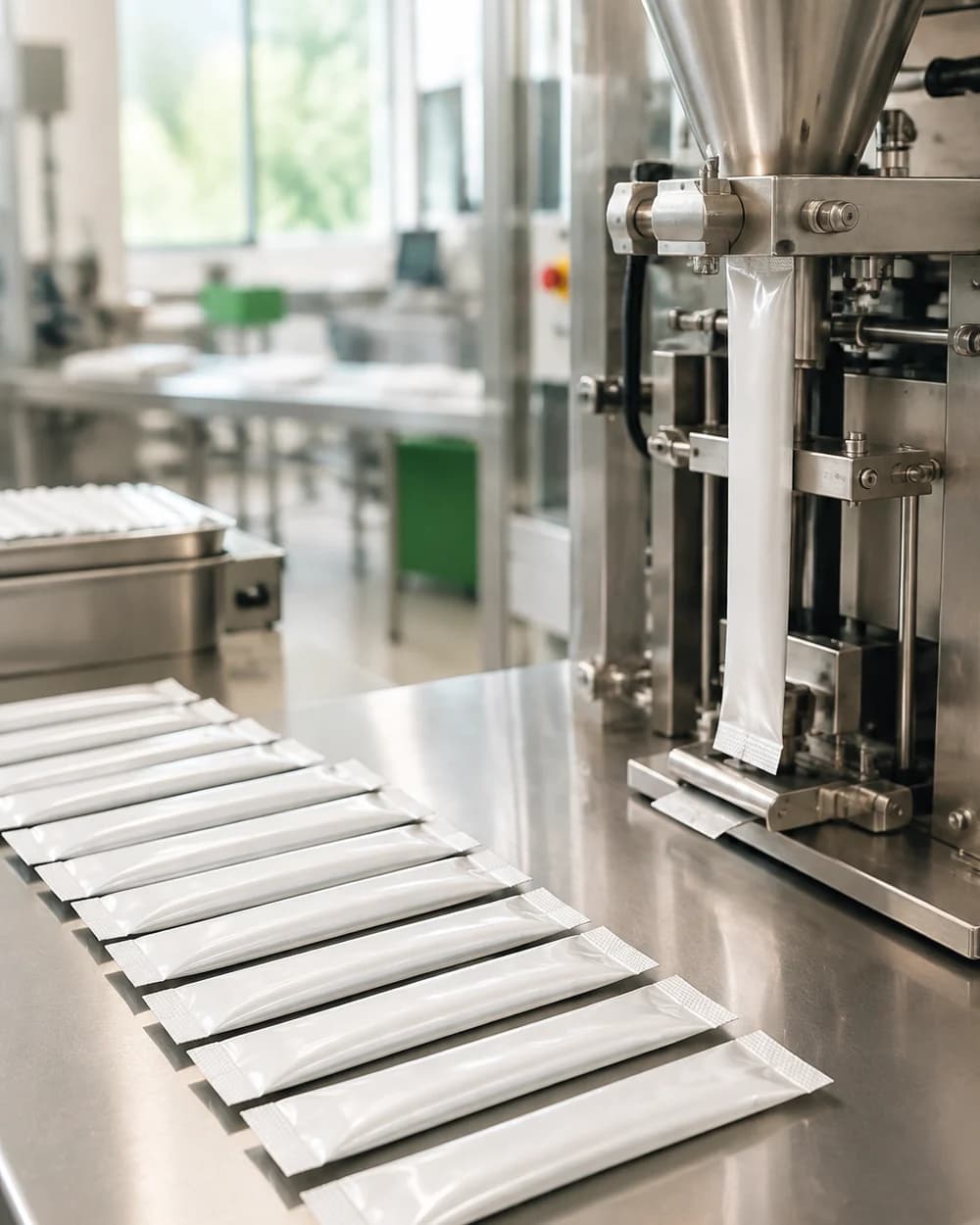
Prebiotic fibres are not all the same on a sachet line. Inulin and FOS are fine, static-prone and hygroscopic. GOS syrups need a carrier. Resistant dextrin flows well but can bridge in the hopper. Our four vertical form-fill-seal lines run auger and volumetric fillers with dehumidified dosing zones. We hold fill weight to ±3% at 2g to 10g, which keeps label claims accurate and reduces giveaway.
Each line runs at 40-60 cycles per minute. That gives a practical output of 180,000 sachets per day across four lines, or roughly 3.6 million per month on a single shift. We run 24-hour operations when a launch window is tight. Film is supplied as 3-ply or 4-ply laminate with a tear notch and a 5mm seal. Stick packs can be printed up to 8 colours, or left plain for a label-applied finish.
Formulation Support for Fibre Blends
Prebiotic sachets often combine two or more fibres with a flavour system and a sweetener. We work with inulin (chicory root), FOS, GOS, resistant dextrin, partially hydrolysed guar gum (PHGG), acacia fibre and beta-glucan. Typical inclusion rates are 3g to 5g of fibre per sachet. If the dose is higher, we adjust the carrier or split the serving across two sachets.
Flavour and mouthfeel matter more than buyers expect. Inulin has a mild sweetness and a slight body. GOS is less sweet. Resistant dextrin is close to neutral. We can add natural flavours, citric acid, monk fruit, stevia or sucralose, and a small amount of silicon dioxide or tricalcium phosphate to stop caking. For organic-certified projects, every input must be on the approved list before we start sampling.
Quality Checks and Export Documentation
Every batch of prebiotic sachets is tested for fill weight, seal strength, moisture content and microbiological limits. We hold raw material COAs, in-process records and finished product COAs for three years. The facility is GMP, ISO 22000 and HACCP certified. If you need halal or vegan certification, we arrange it through the relevant body and keep the certificate on file for your market.
For export, we prepare commercial invoice, packing list, certificate of origin, health certificate, and halal certificates where applicable. Sachets are packed into cartons or display boxes. We ship FOB Shenzhen or Yantian, or arrange air freight for pilot runs. Lead time for documents is 3-5 working days after production. We do not claim FDA approval; the facility is FDA-registered where that registration is relevant to your import file.
Quality Control and Batch Documentation
Every prebiotic sachet batch is tested against a written specification before release. Incoming raw materials are checked for identity by FTIR against a reference spectrum, and fibre assay is run to confirm the declared purity of inulin, FOS, GOS, resistant dextrin or PHGG. Microbial testing covers total aerobic count, yeast and mould, E. coli, Salmonella and Staphylococcus aureus. Heavy metals are screened by ICP-MS for lead, arsenic, cadmium and mercury against the limits set by the destination market. Where a blend includes a probiotic or enzyme component, potency is assayed at release and again at shelf-life end.
In-process checks run on each stick pack line at start-up, every 30 minutes and at line stop. Operators verify fill weight on a calibrated balance, seal integrity by dye penetration and visual seal inspection, and lot code legibility. A Certificate of Analysis is issued with each batch and lists the product name, batch number, manufacturing date, expiry date, tests performed, specification limits, results and the releasing QA signature. Retention samples of the finished sachet, the bulk powder and each raw material lot are held for the full shelf life plus 12 months.
Stability follows a defined protocol. Accelerated testing at 40 degrees Celsius and 75 percent relative humidity runs for six months with pulls at zero, one, three and six months. Real-time testing at 25 degrees Celsius and 60 percent relative humidity runs for the declared shelf life with pulls every three months. Tests cover appearance, moisture content, fibre assay, microbial count and seal strength. If you need a specific shelf-life claim for a retail listing, we can run a dedicated stability study before commercial production and share the raw data with your QA team.
Packaging, Labelling and Retail Readiness
The primary format is a three-side-seal or four-side-seal stick pack in laminated film, typically PET, aluminium and polyethylene at 90 to 120 microns, with a tear notch and optional laser scoring. Films can be supplied with a registered matte or gloss finish and up to eight colours. Secondary packaging options include a folding carton holding 10, 20 or 30 sachets, a stand-up pouch with a resealable zipper, or a rigid bottle for powder formats. We can also run blister packs where a tablet or capsule line is the chosen delivery form.
For the US market, we set up the label to the FDA dietary supplement requirements: statement of identity, net quantity, supplement facts panel with serving size and percent daily value, ingredient list in descending order of weight, and the required allergen and advisory statements. Lot number and best-before date are inkjet coded on the sachet, the carton and the shipping case, with the same code across all three levels so a recall can be traced from any point. We do not print health claims without your written substantiation and sign-off.
Cartons are specified to your retail channel. A standard export carton holds 60 to 120 sachets depending on stick size, with dimensions and gross weight confirmed at artwork approval. Pallet configuration uses a 1200 by 1000 millimetre pallet, shrink-wrapped and corner-boarded, with a maximum stacked height of 1.8 metres for sea freight. For Amazon sellers, we apply the FNSKU barcode to each unit and the box, print the FBA box label, and follow the poly-bag and suffocation-warning rules where loose sachets are packed. Retail compliance checks for barcode scannability and carton drop testing are done on the first production run.
MOQ, Lead Times and Delivery
The sample process starts with a formulation brief and a signed specification. We issue a quotation within two working days, then produce a pilot sample in 7 to 10 working days for standard fibre blends, or up to 15 working days where a new film print or a custom flavour system is involved. Samples are sent by courier with a draft COA. Once you approve the sample and the artwork, we lock the batch record and schedule production. Mass production runs 20 to 35 working days depending on fill weight, film lead time and whether the raw material is in stock.
Minimum order quantity is 1,000 units per SKU for retail-ready sachets and 1,000 units for pilot runs. Pilot runs use the same lines as mass production, so the fill weight and seal quality you approve are the ones you receive at scale. We hold safety stock of common prebiotic fibres so that repeat orders can start production within five working days of a purchase order, subject to film availability.
Shipping is arranged on EXW, FOB Shenzhen or Hong Kong, or DDP to your warehouse. Air freight takes 5 to 10 days door to door and suits pilot runs and urgent retail launches; sea freight takes 25 to 40 days port to port and is the default for full container loads. Documents issued with each shipment include the commercial invoice, packing list, Certificate of Analysis, material safety data sheet, free-sale certificate and, where the destination requires it, a phytosanitary certificate and certificate of origin. We can also provide a halal certificate on request where the ingredient and line status allow.
Packaging and Format Choices
Standard stick pack
2g to 6g fill, 3-ply laminate, tear notch. Suited to single-serve prebiotic fibre for daily gut support. Up to 8 colour print. MOQ 1,000 units.
Large stick pack
7g to 10g fill for higher fibre doses or multi-ingredient blends. Same film structure with a wider seal. Often used for prebiotic plus probiotic or prebiotic plus vitamin C.
Stick pack in carton
10, 20 or 30 sachets per carton. Cartons printed to your artwork. Retail-ready for pharmacy, grocery and online subscription channels. MOQ 1,000 cartons.
Pilot run pack
1,000 to 2,500 units for market testing, trade shows or influencer seeding. Same formulation and film as mass production. Sample lead time 7-10 working days.
From Enquiry to Delivery
- 01
Send your brief
Share target fill weight, fibre type, flavour direction, sweetener preference and certification needs. We confirm feasibility and MOQ within 1-2 working days.
- 02
Receive samples
We produce 2-3 sample variants in 7-10 working days. You get sachets, a spec sheet and a quote. Shipping by courier takes 3-5 days.
- 03
Approve formula
You sign off on the sample, fill weight, film and artwork. We lock the bill of materials and issue a proforma invoice. Deposit starts production.
- 04
Production run
Mass production takes 20-35 working days after sample approval. We send in-process photos at 50% completion and a finished goods report before packing.
- 05
Quality release
Finished product COA, fill weight records and microbiological results are issued. Certificates for halal or organic are attached where applicable.
- 06
Ship and document
We pack into cartons or display boxes and ship FOB Shenzhen or Yantian. Export documents follow within 3-5 working days. Air freight available for pilot runs.
Why EUPHM
Low MOQ 1,000
Retail bottling starts at 1,000 units per SKU. Pilot runs start at 1,000 units. This lets you test a prebiotic sachet line without committing to a full container.
Fibre-specific formulation
We work with inulin, FOS, GOS, resistant dextrin, PHGG and acacia fibre. We adjust carriers, flavours and anti-caking agents to match your dose and taste target.
Certified and documented
GMP, ISO 9001, ISO 22000, HACCP, NSF/ANSI 455-2 and halal certification; FDA facility registration for US-bound shipments.
Questions buyers ask.
What is the MOQ for prebiotic sachets?+
MOQ is 1,000 units per SKU for retail-ready sachets. Pilot runs start at 1,000 units. If your formula uses a certified organic fibre, the minimum may be higher because of raw material order quantities. We confirm MOQ in writing after reviewing your brief.
How long do samples take?+
Sample lead time is 7-10 working days after we receive your brief and confirm the formula. Courier delivery to the US, EU, UK or Middle East takes 3-5 working days. You receive 2-3 variants, a spec sheet and a price quote.
Can you produce organic prebiotic sachets?+
Yes. We produce and EU organic sachets when all inputs are certified. This includes the fibre, flavour, sweetener and any carrier. We arrange organic certification through an approved body and keep the certificate on file for your import documents. Lead time may extend by 5-7 working days.
What fill weights can you run?+
We run 2g to 10g per sachet. Most prebiotic products sit at 3g to 6g. Fill weight is held to ±3%. If your dose needs more than 10g, we can split the serving across two sachets or move to a larger stick pack format.
Do you offer halal certification?+
Yes. We arrange halal certification for prebiotic sachets when the formula and line are eligible. Certificates are issued per production batch and included in the export document pack. Lead time for certification is typically 5-10 working days after production.
How do you prevent cross-contamination between prebiotic sachet batches?+
Each stick pack line is cleaned and verified between products. We use a documented changeover procedure with dry cleaning, vacuum extraction and a line clearance check signed by the supervisor. Where a batch contains a declared allergen or a different fibre source, we run a rinse batch and test the first sachets for residue before release. Segregated storage and colour-coded scoops reduce the risk at the weighing stage.
Can you match a competitor's prebiotic sachet formulation?+
We can reverse-engineer the functional profile from the ingredient list and your target claims, but we do not copy a proprietary formula exactly. We start from the declared ingredients, assay the fibre content and rebuild a blend that meets your specification. You receive a formulation sheet with percentages and a sample for sensory and flow testing. Where a patented ingredient is involved, you must confirm you have the right to use it.
What happens if a batch fails a quality test?+
A failed result triggers an immediate hold on the batch and a deviation report. We investigate the root cause, which may be a raw material lot, a seal parameter or a moisture issue, and either rework the batch within specification or reject it. You are notified in writing within 48 hours. Rejected material is not shipped, and the replacement run is scheduled at our cost where the fault is ours.
Have a product in mind?
Send us the brief and we will come back with a formulation direction, indicative price and a realistic lead time — usually within one working day.