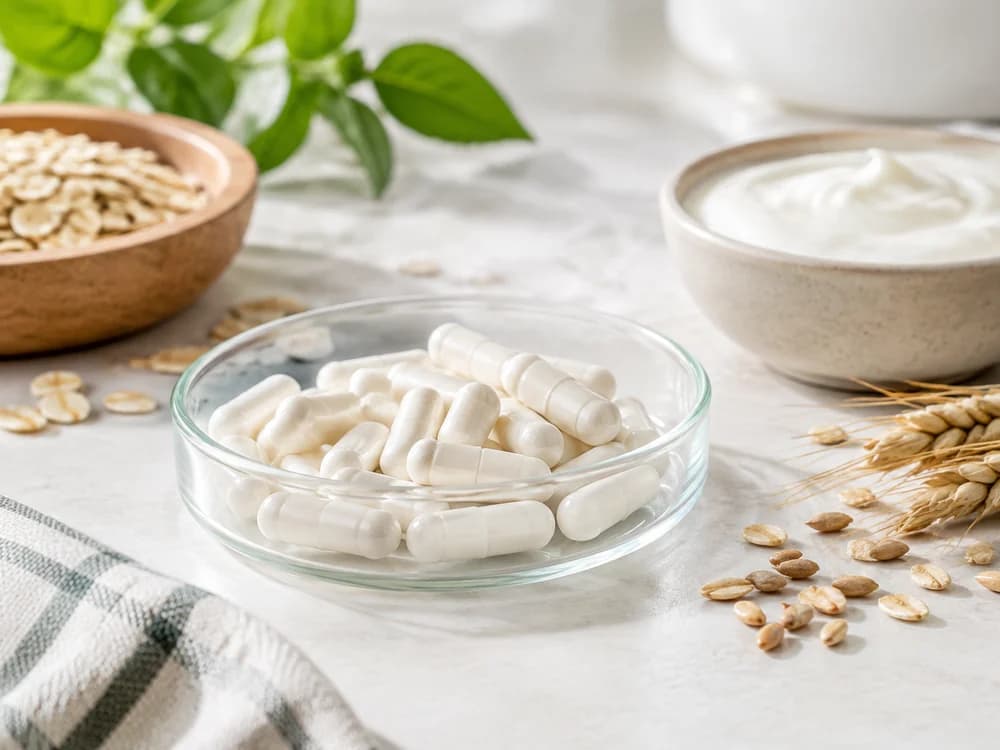
Probiotics Sachet Manufacturer for Stable CFU Counts
EUPHM fills probiotic powders into stick packs and sachets at 1,000 unit MOQ. We control moisture, oxygen and temperature across blending and filling to protect CFU counts from bulk powder to sealed sachet.
Overview
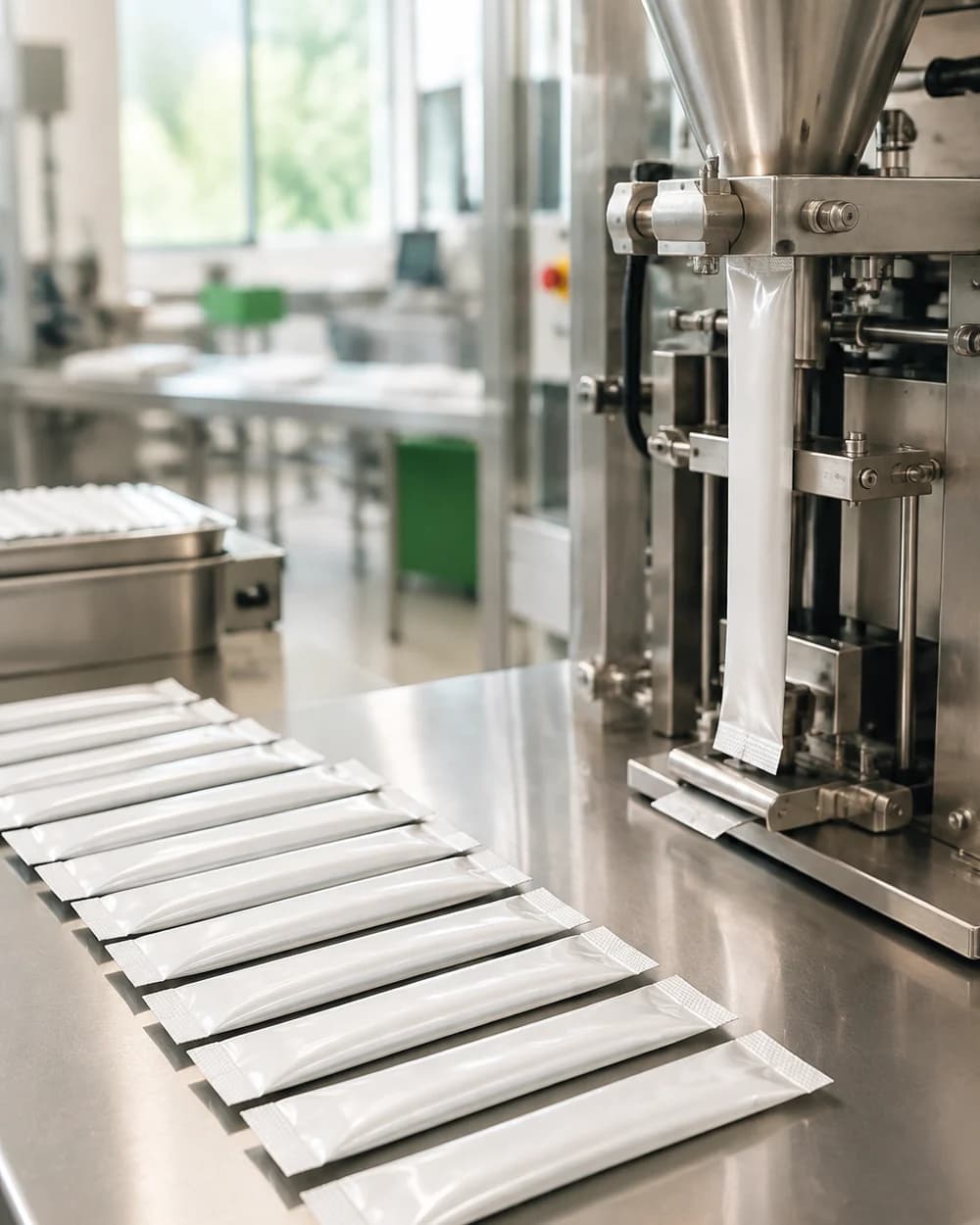
Probiotics are sensitive to heat, moisture and oxygen. A sachet line must move fast and stay dry. Our Guangdong facility runs dedicated low-humidity rooms for blending and filling, with inline checkweighing and metal detection. We handle lactobacillus, bifidobacterium, spore-forming strains and blends with prebiotics. Fill weights range from 1 g to 10 g per sachet, with overage calculated to meet your label claim at end of shelf life.
- MOQ
- 1,000 units per SKU
- Fill weight
- 1 g to 10 g per sachet, ±2% accuracy
- Sample lead time
- 7-10 working days
- Mass production
- 20-35 working days after sample approval
- Certifications
- GMP, ISO 9001, ISO 22000, HACCP, NSF/ANSI 455-2, halal, FDA-registered
- Line capacity
- Up to 120,000 sachets per day across two filling lines
Low-Moisture Filling for Live Cultures
Probiotic powders lose viability when relative humidity climbs above 30%. Our sachet room holds RH below 25% and temperature at 18-22°C. Blending and filling happen in the same controlled zone, so powder is never exposed to ambient air between steps. We use nitrogen flushing on the filling head to displace oxygen inside each sachet before sealing. This matters for anaerobic strains such as bifidobacterium, which die off quickly in the presence of oxygen.
The line runs at 40-60 sachets per minute per head, with inline checkweighing rejecting any unit outside ±2% of target fill weight. Metal detection sits after sealing. For heat-sensitive strains, we use a cold-seal sachet film that avoids thermal stress on the powder during closure. Every batch is sampled at start, middle and end of run for CFU count, moisture content and seal integrity.
Strain Selection and Overages
Label claims are not the same as fill claims. If your label says 10 billion CFU at end of shelf life, we calculate the overage needed at fill date. For a 24-month shelf life at 25°C, that often means filling at 15-20 billion CFU to allow for natural die-off. We work with your strain supplier or source from approved vendors with documented stability data. Common strains include L. acidophilus, L. rhamnosus, B. lactis, B. longum and Bacillus coagulans.
Sachet format suits probiotics because it limits headspace and protects against moisture ingress better than a jar. We can blend in prebiotics such as inulin, FOS or GOS, and add flavours or sweeteners. For paediatric or travel formats, we fill 1 g to 3 g stick packs. For adult daily sachets, 3 g to 6 g is typical. We do not blend probiotics with ingredients that raise water activity above 0.3.
Quality Checks and Shipping
Every probiotic batch is tested for total viable count, specified strain identity, moisture, water activity, and absence of pathogens including Salmonella and E. coli. We retain samples for the full shelf life. Documentation includes certificate of analysis, MSDS, and stability protocol. Our facility is GMP-certified, ISO 22000 and HACCP compliant, with halal and scopes available on request. We are an FDA-registered facility for export to the US.
Sachets are packed into cartons with desiccant where needed, then into export pallets. We ship FOB Shenzhen or Yantian, with air freight for urgent pilot runs. Lead time for mass production is 20-35 working days after sample approval. For repeat orders with fixed formulation, we can hold raw materials to shorten turnaround to 15-20 working days. Cold-chain is not required for most shelf-stable probiotic sachets.
Quality Control and Batch Documentation
Every probiotic sachet batch is tested at three stages: incoming raw materials, in-process blend, and finished sachets. Identity testing by PCR or biochemical methods confirms each strain before blending. Potency is measured by plate count at release and again at end of shelf life. Microbial safety covers total aerobic count, yeast and mould, E. coli, Salmonella and Staphylococcus aureus. Heavy metals (lead, arsenic, cadmium, mercury) are tested per batch or per raw material lot. Disintegration testing applies only to tablet or capsule formats, not sachets, so for powder fills we verify uniformity of content and fill weight instead.
A certificate of analysis (COA) is issued for each batch and includes: product name and code, lot number, manufacturing date, expiry date, fill weight results, potency at release (CFU per sachet), microbial results, heavy metal results, and a statement of conformity to the agreed specification. Where a strain has a documented shelf-life curve, the COA reports the overage used to meet the label claim at expiry. Retention samples of every batch are kept for at least two years under labelled storage conditions.
Stability protocol follows a standard real-time study at 25°C/60% RH and 30°C/65% RH, with optional accelerated conditions at 40°C/75% RH for 3 months. Time points are 0, 1, 3, 6, 12, 18 and 24 months. Potency, moisture content and microbial safety are monitored at each point. Water activity of the powder is kept below 0.2 to protect live cultures. If your market requires a specific shelf life claim, we can run a tailored study before mass production.
Batch documentation is compiled into a batch record that includes blending weights, machine parameters, environmental monitoring data (temperature and relative humidity in the low-humidity room), inline checkweighing results, metal detection records and packaging line clearance. This record is available for review during a customer audit. We do not issue certificates we do not hold; certification scope is confirmed in writing before order.
Packaging, Labelling and Retail Readiness
Probiotic sachets can be packed as single-dose stick packs, three-side seal sachets or centre-seal sachets, in widths from 25 mm to 90 mm. Secondary packaging options include cartons of 10, 20 or 30 sachets, and shelf-ready trays. For markets requiring child-resistant or high-barrier packaging, we use metallised film or aluminium laminate with a moisture vapour transmission rate below 0.1 g/m²/day. Sachet fill weights from 1 g to 10 g are available, with tear-notch and laser scoring options for easy opening.
Labels for the US market must include the FDA dietary supplement label elements: statement of identity, net quantity of contents, supplement facts panel with serving size and CFU amount, other ingredients list, and the name and place of business of the manufacturer, packer or distributor. For probiotic products, the CFU count must be declared at the end of shelf life unless otherwise stated. Allergen declarations follow the Food Allergen Labelling and Consumer Protection Act (FALCPA) for the US and EU Regulation 1169/2011 for Europe.
Lot and expiry coding is applied by inkjet or thermal transfer on the sachet and the carton. Codes are human-readable and can include a QR code or DataMatrix for traceability. Cartons are specified with dimensions, board grade and print colours; we can print to your artwork or provide plain white cartons for local labelling. Pallet specifications are built to your retailer's requirements: standard pallet 1200 x 1000 mm or 1200 x 800 mm, with a maximum height of 1.8 m including pallet, stretch-wrapped and corner-protected.
For Amazon FNSKU and retail compliance, we can apply FNSKU labels, poly-bag the cartons with a suffocation warning, and print the expiration date in the format required by the marketplace. We do not manage Amazon seller accounts, but we prepare shipments to your nominated warehouse or 3PL. Retailer-specific requirements such as Walmart's case pack labels or Costco's pallet configuration are confirmed before production.
MOQ, Lead Times and Delivery
The minimum order quantity for probiotic sachets is 1,000 units per SKU, depending on fill weight and film structure. Pilot runs from 1,000 units are available for market testing. Sample lead time is 7 to 10 working days after receipt of your strain blend and artwork. Samples are produced on the same low-humidity line as mass production, so fill weight and potency data are representative. Sample costs are credited against the first mass-production order.
Mass production runs 20 to 35 working days after sample approval, depending on raw material lead time and packaging complexity. This window includes blending, filling, labelling, coding and quality release. If your strain blend requires a specific overage calculation or a stability study before release, add 10 to 15 working days. We confirm the production schedule in writing and provide weekly progress updates once the batch is in filling.
Shipping is by air or sea. Air freight from Guangdong to the US or EU takes 5 to 8 days door to door; sea freight takes 25 to 35 days port to port. We quote EXW, FOB Shenzhen or Hong Kong, and DDP for most destinations. DDP includes customs clearance and delivery to your address, with duties and taxes billed separately or included as agreed. For DDP shipments, we require your importer of record details and a valid business address.
Documents provided with each shipment include: commercial invoice, packing list, bill of lading or air waybill, certificate of analysis for each batch, material safety data sheet (MSDS) for the finished product, and a free-sale certificate where required by your market. For plant-based or organic claims, we provide the relevant supplier certificates. Phytosanitary certificates apply only to raw agricultural materials, not to finished probiotic sachets, and are issued on request where a destination country requires them.
What We Can Build
Stick pack 1-3 g
Narrow stick for paediatric, travel or sample use. Suitable for 1-3 billion CFU per unit. Child-resistant options available.
Standard sachet 3-6 g
Most common adult daily format. Fits 5-20 billion CFU plus prebiotic. Tear notch and easy-open top.
Large sachet 6-10 g
For multi-strain blends or higher CFU counts. Often used for therapeutic or clinical nutrition positioning.
Nitrogen-flushed seal
Recommended for anaerobic strains. Reduces oxygen headspace to below 2%. Extends viability at ambient storage.
How a Project Runs
- 01
Send your brief
Share target CFU, strain list, fill weight, sachet size, shelf life and market. We confirm feasibility within 2 working days.
- 02
Formulation review
We check water activity, compatibility and overage. If needed, we propose prebiotic or carrier adjustments.
- 03
Sample production
We produce 7-10 working day samples with your chosen film and fill weight. You receive 20-50 units for testing.
- 04
Stability and approval
You test samples. We can run accelerated stability at 40°C/75% RH for 3 months to support your shelf-life claim.
- 05
Mass production
After approval, we schedule 20-35 working days of production. Inline checks run throughout the batch.
- 06
QC and dispatch
Final testing, certificate of analysis, packing and shipping. We handle export documents and palletisation.
Why EUPHM
CFU protection
Low-humidity room, nitrogen flush and cold-seal film keep viable counts within specification from fill to end of shelf life.
Flexible MOQ
Start at 1,000 units for pilot runs, then scale to 1,000 units for retail. No need to commit to full container loads.
Documentation ready
COA, MSDS, stability data, halal and organic certificates. We support retailer and distributor audits.
Questions buyers ask.
What is the minimum order for probiotic sachets?+
MOQ is 1,000 units per SKU for retail bottling. For pilot runs or market testing, we can go as low as 1,000 units. Sample lead time is 7-10 working days.
How do you protect CFU counts during filling?+
We blend and fill in a room below 25% relative humidity at 18-22°C. Nitrogen flushing reduces oxygen inside the sachet. Cold-seal film avoids heat stress. Each batch is tested for viable count at start, middle and end of run.
Can you match my existing probiotic strain blend?+
Yes. Send your strain list and target CFU per sachet. We source from approved vendors with documented stability data, or work with your supplied strains. We calculate overage based on your shelf life and storage conditions.
What certifications does the facility hold?+
GMP, ISO 22000, HACCP. Halal and scopes are available. We are an FDA-registered facility for US export. Certificates are provided with each order.
What is the production lead time after sample approval?+
Mass production takes 20-35 working days. For repeat orders with fixed formulation and raw materials in stock, we can shorten to 15-20 working days. Shipping is FOB Shenzhen or Yantian.
What is the water activity of your probiotic sachets and how do you control it?+
We target a water activity below 0.2 in the finished powder. Blending and filling take place in low-humidity rooms held at 20-25°C and below 30% relative humidity. Film structures with high moisture barrier are used, and each batch is tested for moisture content at release. This helps maintain CFU counts through shelf life, especially for lactobacillus and bifidobacterium strains.
Can you provide a free-sale certificate for my market?+
Yes, we can provide a free-sale certificate for most destination markets, issued by the relevant authority in China. The certificate confirms that the product is manufactured in a facility that holds GMP and ISO 22000 certification and is freely sold in the domestic market. Processing time is typically 10 to 15 working days, so please request it at the time of order confirmation.
Do you offer stability testing for custom probiotic blends?+
Yes. For custom blends, we run a real-time stability study at 25°C/60% RH and 30°C/65% RH with time points at 0, 1, 3, 6, 12, 18 and 24 months. Accelerated testing at 40°C/75% RH for 3 months is available as an optional screen. The study establishes the overage needed to meet your label claim at end of shelf life and is quoted separately from production.
Have a product in mind?
Send us the brief and we will come back with a formulation direction, indicative price and a realistic lead time — usually within one working day.