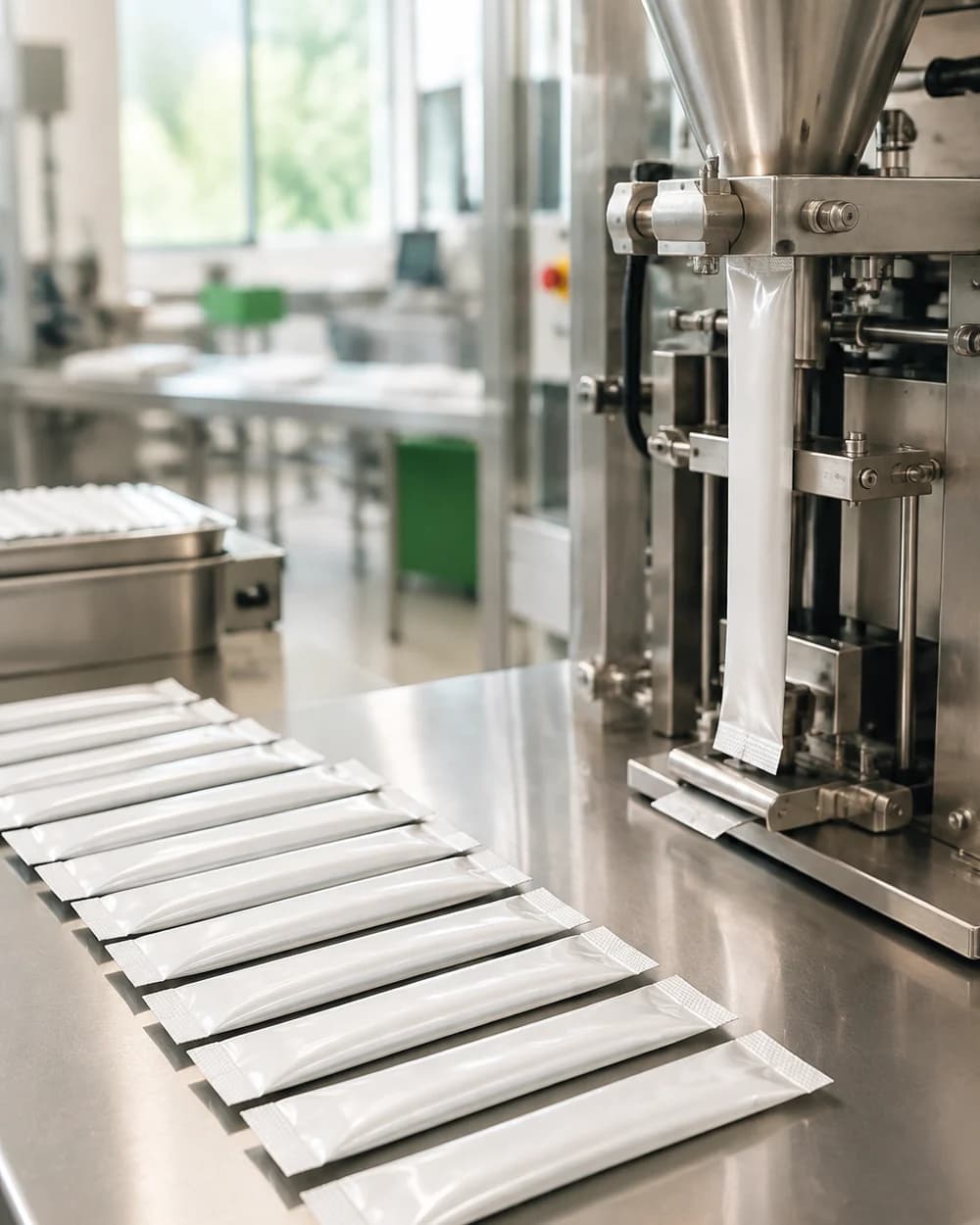
Granule Sachet Manufacturer for Custom Supplement Stick Packs
EUPHM produces granule sachets from 2 g to 30 g fill weights on high-speed vertical form-fill-seal lines. MOQ starts at 1,000 units per SKU. Certifications include GMP, ISO 22000, HACCP, plus halal and vegan options. Samples ship in 7–10 working days.
Overview
Granule sachets suit prebiotics, electrolyte blends, collagen peptides, fibre and instant drink mixes. As a contract manufacturer in Guangdong, China, EUPHM handles granule blending, sachet forming, filling, sealing and secondary cartoning under one roof. Lines run at 40–60 sachets per minute, with fill weight accuracy of ±2%. Stick packs use 4-layer foil laminate for moisture and oxygen barrier, giving 18–24 months shelf life. Retail bottling and bulk drum options are available from the same plant. The parent page for all pouch and sachet formats is /sachet-manufacturer.

Granule Sachet Production Capability
EUPHM runs four vertical form-fill-seal lines dedicated to granules and powders. Each line fills 40–60 sachets per minute, with a fill weight range of 2 g to 30 g. Servo auger dosing holds accuracy to ±2%, which matters for active ingredients dosed below 500 mg per sachet. Changeover between stick packs and 3-side seal sachets takes under 90 minutes. Nitrogen flushing is available for oxidation-sensitive blends.
Secondary packaging includes 10, 14, 20 or 30 sachets per carton, with optional child-resistant closures or single-serve tear notches. We also run bulk sachet filling into 500 g or 1 kg pouches for sampling or professional channels. Retail bottling remains available on separate lines if your brand sells both formats. MOQ for retail cartons is 1,000 units per SKU; pilot runs start at 1,000 units.
Formulation and Ingredient Handling for Granules
Granule blends are sensitive to particle size, flowability and hygroscopicity. EUPHM accepts actives including prebiotic fibres (inulin, FOS, GOS), electrolyte salts, collagen peptides, vitamin C, zinc, magnesium citrate, herbal extracts and probiotic blends at 1–10 billion CFU per sachet. We screen and mill raw materials to 40–80 mesh before blending, then use fluid-bed granulation or dry granulation depending on heat and moisture sensitivity.
Flavours and sweeteners are matched to your target profile: stevia, monk fruit, sucralose, erythritol or sucrose. Typical granule sachet formulations contain 70–90% carrier (maltodextrin, isomalt, or rice flour), 5–20% active blend, and 1–5% flavour and flow agent. We provide a formulation review within 5 working days of receiving your target dosage. Stability testing at 40°C/75% RH for 3 months is available before scale-up.
Quality, Compliance and Export Logistics
The plant holds GMP, ISO 22000 and HACCP certifications. Halal and vegan certifications are available per SKU. EUPHM operates as an FDA-registered facility for US-bound shipments. Every batch is tested for micro counts, heavy metals, fill weight and seal integrity. Certificates of analysis are issued per lot. Retain samples are kept for 24 months.
Export documents include commercial invoice, packing list, certificate of origin, health certificate and halal certificates where applicable. We ship FOB Shenzhen or Hong Kong, with air freight for samples and sea freight for full orders. Typical sea transit to US West Coast is 18–24 days; to Rotterdam 28–32 days; to Jebel Ali 16–20 days. DDP terms are available for repeat buyers.
Quality Control and Batch Documentation
Every granule sachet batch is tested against a written specification before release. Incoming raw materials are sampled at 100% of containers for identity by FTIR or HPLC, and composite samples are tested for potency, microbials (total plate count, yeast and mould, E. coli, Salmonella), heavy metals (lead, cadmium, arsenic, mercury) and, where applicable, disintegration. In-process checks run every 30 minutes on fill weight, seal integrity and sachet appearance. Finished sachets are tested for potency, microbials and moisture, with results recorded on the batch record.
A certificate of analysis (COA) accompanies each batch and states the product name, lot number, manufacture and expiry dates, tests performed, specifications, results and pass/fail status. It is signed by the QC manager and references the analytical methods used. Retention samples of every batch are kept for 24 months at controlled room temperature, and additional samples are stored under accelerated conditions (40°C/75% RH for 3 months) and intermediate conditions (30°C/65% RH for 6 months) to support the 18–24 month shelf life claim.
Stability protocols follow ICH Q1A(R2) principles adapted for dietary supplements. Real-time studies run for the declared shelf life, with testing at 0, 3, 6, 12, 18 and 24 months. Accelerated studies screen for formulation weaknesses before a batch is committed. If a batch fails any specification, it is quarantined, an investigation is opened and a deviation report is issued. Release only occurs after QC manager sign-off and, for export orders, a pre-shipment review of the batch record and COA.
Packaging, Labelling and Retail Readiness
Granule sachets can be packed in retail cartons, stick packs, 3-side seal sachets, bottles or bulk drums. Stick packs are typically 20–30 mm wide with a tear notch and are packed 10, 20 or 30 per carton. Bottles are available in 60, 120 or 180 cc HDPE with induction seals, and blisters are available for unit-dose formats. Cartons are printed with a full FDA dietary-supplement label, including supplement facts, ingredient list, allergen statement, net quantity, lot code and expiry date. Lot and expiry coding is applied by inkjet or laser at the filling line.
For Amazon FNSKU and retail compliance, we apply FNSKU labels, poly-bag the cartons where required, and print carton dimensions and weight on the master case. Master cartons are 5-ply corrugated, with a maximum weight of 15 kg, and are palletised at 1,200 × 1,000 mm or 1,200 × 800 mm. Each pallet is stretch-wrapped and labelled with the pallet ID, batch number and quantity. We can also provide a packaging specification sheet with dimensions, material composition and recycling codes for retailer onboarding.
Label artwork is checked against the approved formula and the destination market’s labelling rules before printing. For the US market, we verify that the supplement facts panel, serving size and % daily value are consistent with the formula. For the EU, we check allergen declarations and nutrition claims. We do not print claims that are not supported by the product specification. Artwork proofs are signed off by the customer, and a retained copy is kept with the batch record.
MOQ, Lead Times and Delivery
Sampling starts with a 7–10 working day turnaround after formula and packaging approval. The sample includes the granule blend in the proposed sachet, a draft COA and a packaging mock-up. Once the sample is approved in writing, mass production runs 20–35 working days, depending on raw material lead times and line scheduling. MOQ is 1,000 units per SKU for retail cartons and 1,000 units for pilot runs. For orders above 50,000 units, we can schedule dedicated line time and reduce the production window to 18–25 working days.
Shipping is by air or sea. Air freight is typically 5–8 days door-to-door for 100–500 kg orders, while sea freight is 25–35 days port-to-port for full containers. We quote EXW, FOB Shenzhen or Hong Kong, and DDP for selected destinations. DDP includes customs clearance and delivery to the customer’s warehouse, with duties and taxes billed at cost. For sea shipments, we provide a packing list, commercial invoice, bill of lading and, where required, a certificate of origin.
Export documents include the COA, material safety data sheet (MSDS) where applicable, free-sale certificate, and phytosanitary certificate for plant-derived ingredients. We also provide a halal certificate if the product is produced under a certified programme. Documents are issued within 3 working days of shipment. For repeat orders, we keep the approved artwork, formula and batch records on file so that reorders can be processed without re-sampling.
What We Can Build
Stick pack 20–30 mm
Narrow single-serve format for 2–6 g doses. Common for electrolytes, prebiotics and instant coffee blends. Tear notch on one end, 4-layer foil laminate.
3-side seal 40–60 mm
Wider sachet for 8–30 g fills. Suitable for fibre, collagen and meal-replacement granules. Flat or gusseted bottom for shelf standing.
Nitrogen-flushed sachets
Oxygen-sensitive actives such as probiotics and vitamin C. Residual oxygen below 2%. Adds one production step and 2–3 days lead time.
Child-resistant or tear-notch
CR closures for high-potency or CBD-adjacent granules. Tear notch for standard retail. Both fit existing form-fill-seal tooling.
How We Work
- 01
Send brief and target dose
Share active ingredients, fill weight, sachet format, MOQ and destination market. We reply within 1 working day with feasibility and indicative pricing.
- 02
Formulation review
Our team checks granule flow, hygroscopicity and compatibility. You receive a proposed formula, excipient list and overage recommendations within 5 working days.
- 03
Sample production
We produce 50–100 sachets for your approval. Sample lead time is 7–10 working days. You test flavour, mouthfeel, dissolution and packaging.
- 04
Quotation and PO
After sample approval, we issue a fixed quotation valid for 30 days. MOQ is 1,000 units per SKU. Deposit is 30–50% depending on order value.
- 05
Mass production
Production runs 20–35 working days after deposit and artwork approval. You receive weekly progress updates and batch records before shipment.
- 06
QC, documents and shipping
Final QC covers fill weight, seal strength, micro and heavy metals. We release COA, health certificate and export documents, then ship FOB or DDP.
Why EUPHM
Low MOQ 1,000
Test retail listings without committing to 10,000+ units. Pilot runs start at 1,000 units per SKU, with the same line and QC as full production.
Granule-specific expertise
We handle hygroscopic, static and low-dose actives daily. In-house granulation and milling reduce reliance on third-party pre-blends and cut lead time.
Certifications for global retail
GMP, ISO 9001, ISO 22000, HACCP, NSF/ANSI 455-2 and halal certification; FDA facility registration for US-bound shipments.
Questions buyers ask.
What is the minimum order quantity for granule sachets?+
MOQ is 1,000 units per SKU for retail cartons. Pilot runs start at 1,000 units with the same formulation and line setup. For orders above 50,000 units, unit pricing drops by 12–18% depending on fill weight and laminate.
Can you produce sachets with probiotics or live cultures?+
Yes. We blend probiotic powders at 1–10 billion CFU per sachet and use nitrogen flushing to keep residual oxygen below 2%. Stability testing at 25°C/60% RH and 40°C/75% RH is available. Note that probiotic granules require refrigerated shipping for some strains.
What fill weights can you run on granule sachets?+
Our lines fill from 2 g to 30 g per sachet. Stick packs typically run 2–6 g; 3-side seal sachets run 8–30 g. Fill accuracy is ±2% for most granule blends. We can run a trial of 100 sachets to confirm dosing before mass production.
How long does sampling and production take?+
Sample lead time is 7–10 working days after formulation approval. Mass production takes 20–35 working days after sample sign-off and deposit. Sea freight to US West Coast adds 18–24 days; to Rotterdam 28–32 days; to Jebel Ali 16–20 days.
Do you provide halal certification for sachets?+
Yes. Halal certificates are available per SKU. and EU organic certification require certified raw materials and a separate production run. Vegan certification is available for plant-based granule blends. Certificates are issued with the batch documents.
What is the shelf life of granule sachets and how is it validated?+
Shelf life is 18–24 months when stored below 25°C and 60% RH. It is validated by real-time stability studies at 0, 3, 6, 12, 18 and 24 months, supported by accelerated testing at 40°C/75% RH for 3 months. Moisture, potency and microbial counts are monitored. The sachet uses 4-layer foil laminate to maintain the barrier. We provide the stability summary with the COA on request.
Can you fill granule sachets with a combination of ingredients, such as prebiotics and electrolytes?+
Yes. We blend up to 8 active ingredients in a single granule sachet, provided the combined dose fits the 2–30 g fill range and the ingredients are compatible in granule form. We run a blend uniformity test on three samples per batch, with a relative standard deviation of 5% or less. If an ingredient is heat- or moisture-sensitive, we adjust the granulation method and packaging barrier accordingly.
What are the payment terms and currency for granule sachet orders?+
Payment terms are 50% deposit with the purchase order and 50% before shipment, or a letter of credit at sight for orders above USD 30,000. We invoice in USD or EUR. For repeat customers with a history of on-time payment, we can offer 30-day net terms after three completed orders. All bank charges outside China are borne by the buyer unless agreed otherwise in the contract.
Other versions built in this dosage form.
- Sachet Manufacturer
- Stick Pack Sachet Manufacturer
- Gel Sachet Manufacturer
- Powder Sachet Manufacturer
- Single-Dose Sachet Manufacturer
- Effervescent Sachet Manufacturer
- Vitamin C Sachet Manufacturer
- Omega-3 Sachet Manufacturer
- Probiotics Sachet Manufacturer
- Prebiotics Sachet Manufacturer
- Elderberry Sachet Manufacturer
- Electrolytes Sachet Manufacturer
- Glutathione Sachet Manufacturer
- Immune Support Sachet Manufacturer
Have a product in mind?
Send us the brief and we will come back with a formulation direction, indicative price and a realistic lead time — usually within one working day.