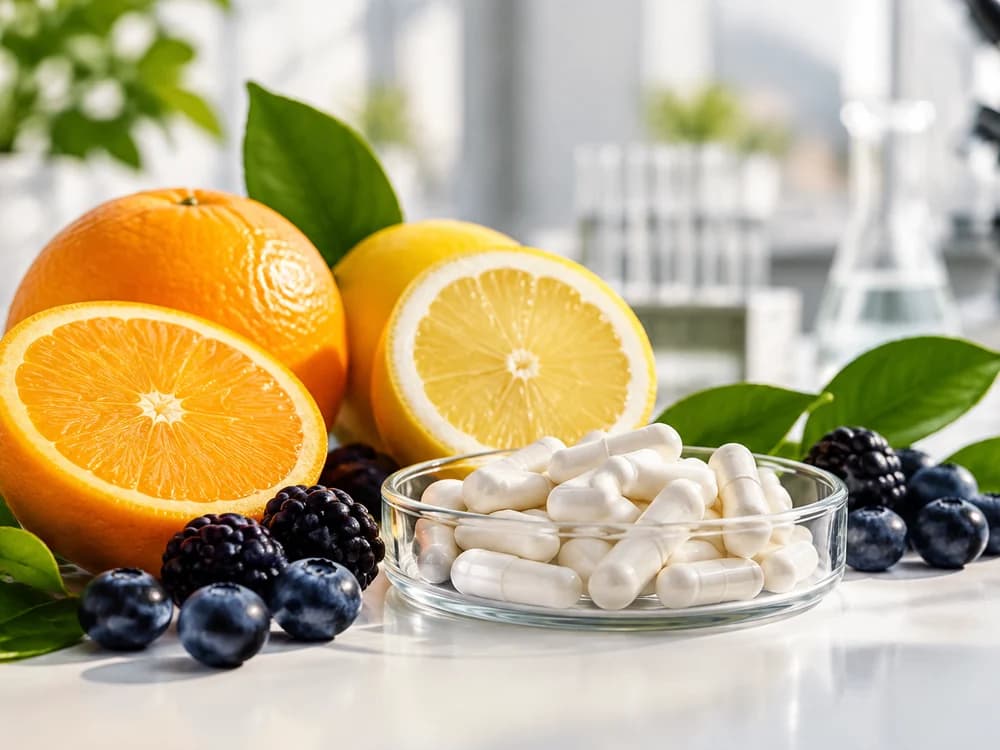
Elderberry Sachet Manufacturer for Custom Stick Pack Formulas
Elderberry sachets are a fast-growing format for immunity and wellness brands. As a GMP-certified contract manufacturer in Guangdong, EUPHM produces custom elderberry stick packs from 3 g to 10 g, with MOQs from 1,000 units per SKU.
Overview
Elderberry sachets suit brands that want a portable, single-serve dose without the cost of glass or rigid packaging. This page covers what a sachet manufacturer actually controls: fill weight, powder flow, seal integrity, ingredient sourcing, and certification. It is written for founders, brand owners and procurement managers comparing suppliers in the US, EU, UK and Middle East. If you are new to the format, start with our overview of sachet manufacturing.
- MOQ
- 1,000 units per SKU for retail bottling; lower for pilot runs
- Fill weight range
- 3 g to 10 g per sachet, ±0.2 g typical
- Sample lead time
- 7–10 working days
- Mass production
- 20–35 working days after sample approval
- Certifications
- GMP, ISO 9001, ISO 22000, HACCP, NSF/ANSI 455-2, halal, FDA-registered
- Line capacity
- Up to 120,000 sachets per day across two stick-pack lines
Sachet Filling and Sealing Capability
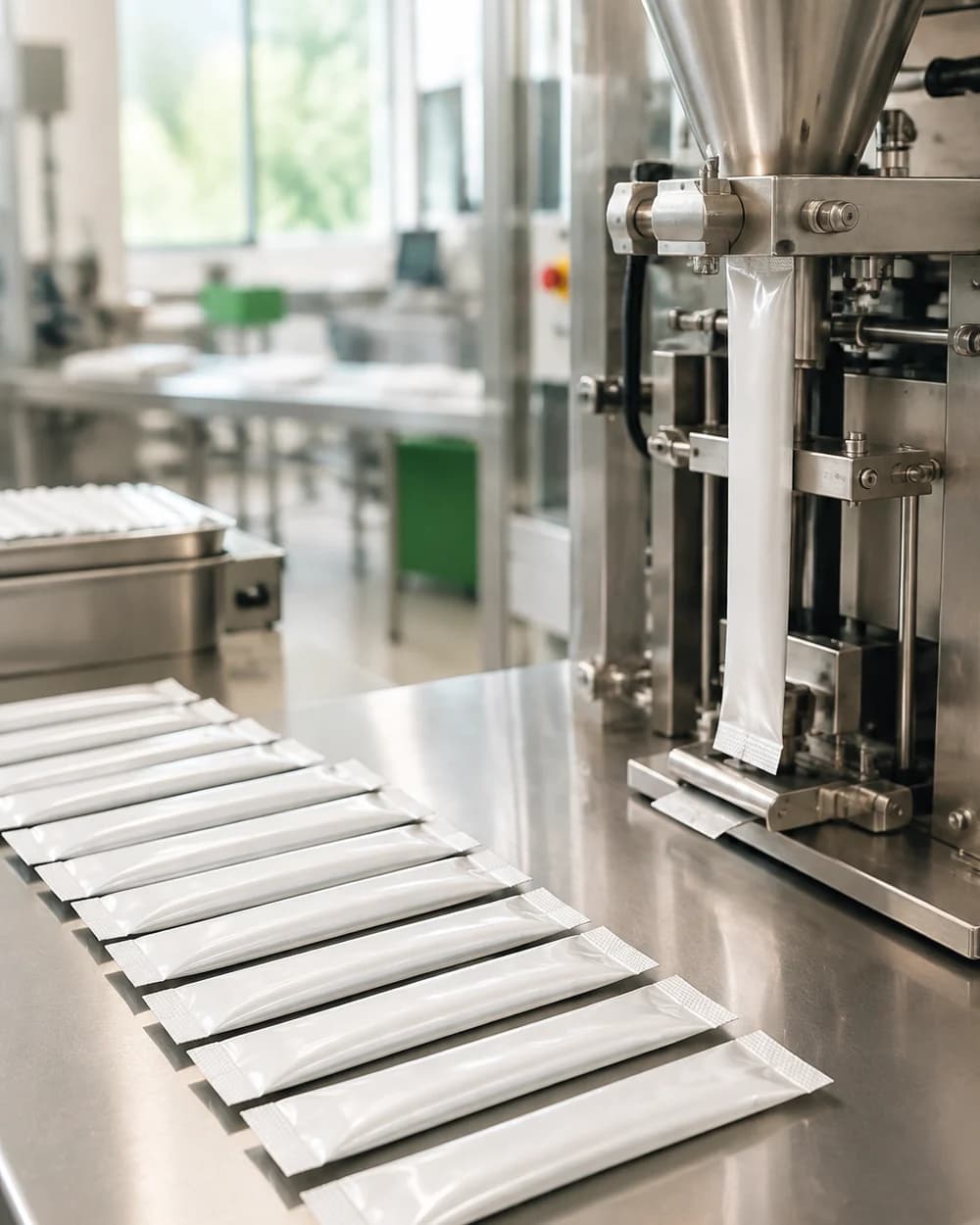
Elderberry powder is hygroscopic and tends to clump, so the filling stage matters more than the marketing suggests. Our vertical form-fill-seal lines run at 40–60 sachets per minute per lane, with fill accuracy of ±0.2 g on a 5 g dose. We run nitrogen flushing where the formula contains oxidation-sensitive actives, and we check seal strength on every 30-minute interval.
Stick packs are available in 3 g, 5 g, 7 g and 10 g formats, with standard dimensions of 20 mm × 90 mm to 30 mm × 120 mm. Film options include PET/AL/PE for full barrier, PET/PE for standard shelf life, and compostable laminates for EU-facing brands. We can print registration marks for your artwork and add a tear notch or a perforated twin-stick format.
Elderberry Formulation and Ingredient Options
Elderberry is rarely sold alone. Common formats combine 500–1,500 mg of elderberry extract (standardised to 5–10% anthocyanins) with vitamin C, zinc, echinacea, or manuka honey powder. We can source European black elderberry (Sambucus nigra) or American elderberry, and we hold documentation for country of origin on every lot.
Taste is the main reason elderberry sachets fail at retail. The fruit is tart and slightly astringent, so most brands use a sweetener system. We work with cane sugar, stevia (Reb A or Reb M), monk fruit, erythritol and allulose. Typical dosage is one sachet in 100–150 ml of water. We can also produce a direct-stick powder that dissolves on the tongue without water.
Quality, Compliance and Export Logistics
Our facility is GMP-certified, ISO 22000 and HACCP-compliant. We hold halal certificates for relevant lines, and we can produce and EU organic sachets under separate batch records. We are an FDA-registered facility for US-bound shipments, but we do not claim FDA approval for any product.
For export, we prepare documentation for the US, EU, UK and GCC. Typical lead time for mass production is 20–35 working days after sample sign-off, plus 7–10 days for third-party testing if required. We ship FOB Shenzhen or Yantian, and we can arrange air freight for pilot batches. Stability testing follows ICH accelerated conditions at 40°C/75% RH for 6 months.
Quality Control and Batch Documentation
Every elderberry sachet batch is tested against a written specification before release. Incoming elderberry raw material is sampled for identity by HPLC fingerprint and checked for potency as total anthocyanins, typically 5 to 12 percent depending on the extract grade. Microbial testing covers total plate count, yeast and mould, E. coli and Salmonella. Heavy metals are screened for lead, arsenic, cadmium and mercury against EU and US limits. Each finished sachet lot is also checked for fill weight, seal strength and disintegration time in water at 37 degrees Celsius.
Testing happens at three points: raw material receipt, in-process powder blend, and finished sachet. In-process checks run every 30 minutes during filling and include weight variation within plus or minus 0.2 grams and seal integrity by dye penetration. Finished goods are held in quarantine until the certificate of analysis is signed off by the quality manager. A typical COA lists batch number, production date, expiry date, appearance, fill weight, moisture content, microbial results, heavy metals and the identity test result. Retained samples of each batch are kept for 24 months at ambient conditions.
Stability follows an accelerated protocol at 40 degrees Celsius and 75 percent relative humidity for six months, with real-time data at 25 degrees Celsius and 60 percent relative humidity for 12 to 24 months. Parameters tracked include anthocyanin loss, moisture pick-up, colour change and seal integrity. For markets requiring a shelf life claim, we recommend a minimum of 18 months based on real-time data before a product launches. Customers receive the stability summary with the first commercial batch, not just the initial sample.
Elderberry Sachet Packaging, Labelling and Retail Readiness
Elderberry sachets are typically filled into three-side-seal stick packs or four-side-seal flat sachets, with foil or metallised film laminates that provide a moisture barrier. Standard film structures include PET/AL/PE and PET/PE, with child-resistant or tear-notch options. Sachets can be packed into cartons of 10, 20 or 30 units, or into retail boxes with a display-ready design. For Amazon and retail, we can apply FNSKU labels, poly-bag the cartons and print lot and expiry codes in the format the customer specifies, including Julian date or best-before date.
For the US market, the label must include the statement of identity, net quantity, supplement facts panel, ingredient list, allergen declaration if applicable, and the manufacturer or distributor address. We provide artwork templates and review labels for the mandatory elements before printing. Lot and expiry coding is applied by inkjet or thermal transfer on the sachet itself and on the carton. Carton dimensions and pallet patterns are confirmed at the sample stage so that the customer can calculate container loading. A standard 40-foot container holds approximately 1,200 to 1,500 cartons of 30 sachets, depending on carton size.
Retail readiness also covers barcode verification. We print EAN-13 or UPC-A barcodes and verify them with a scanner before dispatch. For EU markets, the label must show the food business operator address, net quantity, storage conditions and, where relevant, the nutrition declaration. We do not write claims; the brand owner is responsible for substantiating any health claim. Packaging materials are food-grade and meet EU 10/2011 and US FDA 21 CFR 177 requirements. If the customer supplies packaging, we can run it on our lines after a trial.
MOQ, Lead Times and Delivery
The MOQ for elderberry sachets is 1,000 units per SKU for retail-ready cartons, with lower quantities for pilot runs of 1,000 to 2,000 units. Samples are produced in 7 to 10 working days after artwork and formulation approval. Mass production takes 20 to 35 working days after sample sign-off, depending on film availability and whether the elderberry extract is a stock grade or a custom blend. We confirm the production window in writing before the purchase order is placed.
Shipping is arranged by air or sea. Air freight to the US or EU takes 5 to 10 days door to door for urgent launches, while sea freight takes 25 to 40 days depending on the port. We quote EXW, FOB Shenzhen or Hong Kong, and DDP for customers who want a landed cost. DDP is available for the US, UK, EU and selected Middle East markets. For sea shipments, we provide a packing list, commercial invoice, bill of lading and certificate of origin. A free-sale certificate is issued on request for markets that require it.
Documents provided with each shipment include the certificate of analysis, material safety data sheet where applicable, and a certificate of origin. Phytosanitary certificates are not normally required for processed elderberry extract, but we can arrange one if the destination country asks for it. We also provide a halal certificate if the product is produced under that certification. The customer is responsible for import clearance and any destination testing. We recommend booking sea freight at least six weeks before the required delivery date to allow for port congestion.
Packaging and Format Choices
Standard stick pack
Single-serve 3–10 g sachet, 20–30 mm wide. Suits retail cartons of 10, 14, 20 or 30 units. Standard barrier film for 12–18 month shelf life.
Twin-stick perforated
Two connected 3–5 g sachets, tear-apart. Common for travel and sample packs. Reduces per-unit film cost by 8–12% versus two separate sachets.
Direct-stick powder
Fine-milled powder that dissolves without water. Requires tighter particle size distribution (D90 under 300 µm) and a flow agent such as silicon dioxide.
Compostable film
Plant-based laminate for EU and UK brands with sustainability targets. Shelf life is shorter at 9–12 months. MOQ 10,000 units per SKU.
From Spec to Shipment
- 01
Brief and quote
Share your formula, fill weight, target MOQ and destination market. We return a quote and a feasibility note within 2 working days, including any ingredient sourcing flags.
- 02
Sample development
We produce lab-scale samples of your elderberry blend, typically 3–5 formulations if taste is a concern. Sample lead time is 7–10 working days including courier.
- 03
Sample approval
You review taste, mouthfeel, dissolution and packaging. We adjust the sweetener system or fill weight if needed. One revision round is included at no extra cost.
- 04
Order confirmation
You confirm the final specification and pay the deposit. We lock in raw material lots and schedule the production slot, usually within 5 working days.
- 05
Mass production
Production runs 20–35 working days. We send in-process photos and a fill-weight report. Third-party testing can run in parallel if you supply a lab preference.
- 06
QC and shipping
Final QC covers seal integrity, fill weight, moisture content and micro. We release the batch and ship FOB Shenzhen or Yantian, with all export documents.
Why EUPHM
Low MOQ for pilot runs
Start at 1,000 units per SKU for retail bottling, or lower for pilot runs. This lets you test elderberry sachets in one or two markets before committing to a full container.
Certification coverage
GMP, ISO 9001, ISO 22000, HACCP, NSF/ANSI 455-2 and halal certification; FDA facility registration for US-bound shipments.
Formulation support
We have produced elderberry sachets with vitamin C, zinc, echinacea, manuka and propolis. Our team can suggest sweetener systems and flow agents based on your target taste profile.
Questions buyers ask.
What is the MOQ for elderberry sachets?+
The standard MOQ is 1,000 units per SKU for retail bottling. For pilot runs, we can go lower depending on film and ingredient availability. If you need 1,000 units for a market test, ask — we quote those case by case.
Can you produce organic elderberry sachets?+
Yes. We hold organic certification for relevant lines and can produce and EU organic sachets under separate batch records. You will need to supply your own organic certificate for the finished product, or we can ship under our certificate if your brand qualifies.
How long does production take?+
Samples take 7–10 working days. Mass production runs 20–35 working days after sample approval, depending on film availability and order size. Add 7–10 days if you require third-party testing before shipment.
What fill weights can you run?+
We run 3 g to 10 g per sachet on standard stick-pack lines, with ±0.2 g accuracy on a 5 g fill. For direct-stick powders, we recommend 3–5 g. Larger fills above 10 g usually need a different format such as a pouch.
Do you ship to the US, EU and Middle East?+
Yes. We ship FOB Shenzhen or Yantian and prepare export documentation for the US, EU, UK and GCC. For US-bound orders, we are an FDA-registered facility. We do not claim FDA approval for any product. Air freight is available for pilot batches.
What is the shelf life of your elderberry sachets?+
Shelf life is typically 18 to 24 months from the date of production when stored below 25 degrees Celsius in the original sealed sachet. We support this with accelerated stability data at 40 degrees Celsius and 75 percent relative humidity for six months, plus real-time data. The expiry date is printed on each sachet and carton. If you need a longer shelf life, we can discuss a higher-barrier film or a different elderberry extract grade.
Can you match a competitor's elderberry sachet formula?+
We do not copy a competitor's exact formula, but we can match key parameters such as total anthocyanins, fill weight, sweetness and flowability. Send us the target specification or a sample, and our formulation team will propose a blend using food-grade elderberry extract, carriers and excipients. You will receive a sample for sensory and analytical comparison before production. Matching a proprietary blend exactly is not possible without the original formula, but functional equivalence is achievable.
Do you provide labels and artwork design?+
We provide dieline templates and a label checklist covering mandatory elements for the US, EU and UK. We do not design artwork or write claims, but we review your print-ready files for barcode placement, lot code area and legibility before printing. If you need design support, we can recommend third-party agencies. Final label compliance remains the brand owner's responsibility, and we recommend a regulatory review before the first print run.
Have a product in mind?
Send us the brief and we will come back with a formulation direction, indicative price and a realistic lead time — usually within one working day.