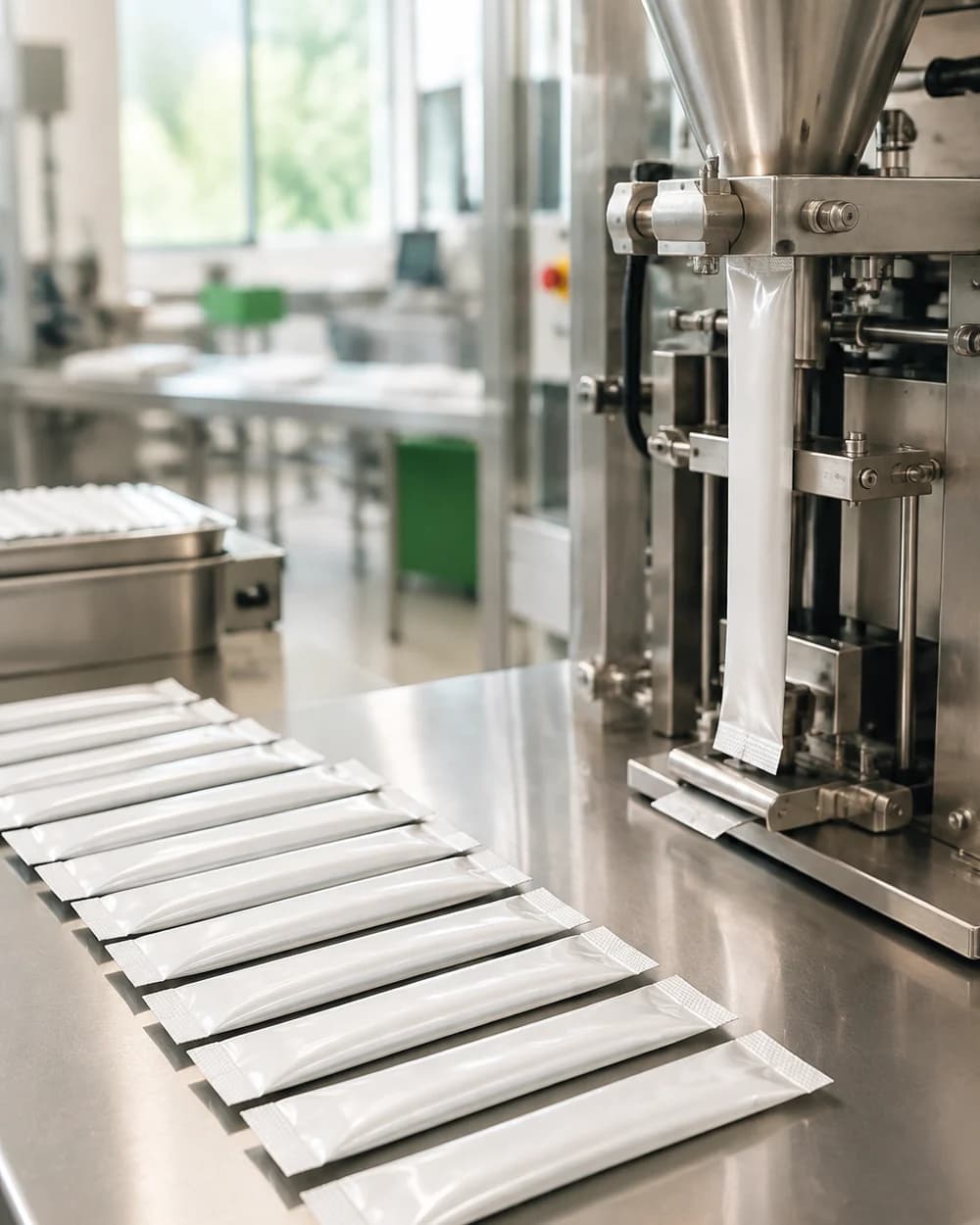
Gel Sachet Manufacturer for Liquid Supplement Brands
EUPHM fills low-viscosity gels and liquids into single-serve sachets at our Guangdong plant. MOQ starts at 1,000 units per SKU, samples ship in 7-10 working days, and mass production runs 20-35 working days.

Overview
Gel sachets suit actives that degrade in dry powder or need a measured liquid dose. Our lines handle fills from 10 ml to 30 ml, seal at 180-200°C, and run at 60-90 sachets per minute per lane. We fill water-based gels, oil suspensions, and emulsion systems. Every batch is tested for fill weight, seal integrity, and microbial limits before release. Certifications cover GMP, ISO 22000 and HACCP, with halal and vegan options where the formula allows.
| MOQ | 1,000 units per SKU for retail cartons; 1,000 units for pilot runs |
|---|---|
| Fill volume | 10 ml to 30 ml per sachet |
| Sample lead time | 7-10 working days |
| Mass production | 20-35 working days after sample approval |
| Line capacity | 60-90 sachets per minute per lane |
| Certifications | GMP, ISO 9001, ISO 22000, HACCP, NSF/ANSI 455-2, halal, FDA-registered |
Filling, Sealing and Format Capability
Our sachet lines are built for low-viscosity liquids and gels up to 3,000 cP. Each lane fills 60-90 sachets per minute, with fill weights from 10 g to 30 g. We run four-side-seal and three-side-seal formats. Film structures include PET/AL/PE for barrier protection and PET/PE for clear or translucent presentations. Seal temperature is held at 180-200°C and checked every 30 minutes. We test seal strength on a peel tester and run dye penetration checks on a sample per shift.
Changeover between SKUs takes 45-90 minutes, including film roll swap, fill line flush, and first-article checks. That makes 1,000-unit runs practical without excessive downtime. We can add a tear notch, a spout fitment, or a stick-pack profile. For brands moving from bottle to sachet, we run a side-by-side fill weight comparison so you can match your existing dose. The parent sachet manufacturer page covers powder and granule formats if your project sits outside liquids.
Formulation Support for Gel and Liquid Fills
Gel sachets need a viscosity window that flows through the nozzle but stays put in the pouch. We work with 500-3,000 cP at 25°C. Typical systems are xanthan gum, gellan gum, or modified starch at 0.2-0.8% w/w. For oil-based actives, we use medium-chain triglyceride suspensions or nanoemulsions. Water activity is kept below 0.85 where possible to limit microbial risk. If your formula includes vitamin C, probiotics, or omega-3, we run an accelerated stability check at 40°C and 75% RH for 4 weeks before scale-up.
Flavour and sweetener selection matters more in a 15 ml sachet than in a 500 ml bottle. We test 2-3 flavour systems at bench scale, then run a 500-unit pilot to confirm taste and mouthfeel. Common actives we fill include collagen peptides, iron bisglycinate, vitamin D3, coenzyme Q10, and melatonin. We do not fill carbonated liquids or high-ethanol tinctures. For halal projects, we verify all excipients and processing aids against the relevant certifying body before we quote.
Quality Checks and Export Logistics
Every batch is sampled at start, middle, and end of the run. We test fill weight on 20 sachets per lane, seal integrity on 10 sachets, and microbial limits on 5 sachets. Heavy metals and pesticide residue testing is available on request. Retain samples are held for 24 months. Batch records, certificates of analysis, and deviation reports are issued within 5 working days of release. Our facility is GMP-certified and holds ISO 22000 and HACCP. We are FDA-registered for export to the US market.
We ship from Shenzhen and Hong Kong ports. Standard export cartons hold 30-60 sachets, depending on size. We can print lot codes, expiry dates, and barcodes in-line. For US and EU buyers, we provide documentation for customs: commercial invoice, packing list, certificate of origin, and health certificate where required. Air freight samples take 3-5 working days to the US or EU. Sea freight for mass production runs 18-28 days to Los Angeles or Rotterdam, plus customs clearance. Full container loads ship on pallets or floor-loaded.
Quality Control and Batch Documentation
Every gel sachet batch is tested against a written specification before release. Incoming raw materials are checked for identity by FTIR or HPLC and for potency where applicable. During production, fill weight is verified every 30 minutes across each lane, with a tolerance of ±2% for 10–30 ml fills. Seal strength is tested by burst and peel methods at the start, middle and end of each run. Microbiological testing covers total aerobic count, yeast and mould, E. coli and Salmonella, with results compared to the limits agreed in the product specification.
Heavy metals testing for lead, cadmium, arsenic and mercury is carried out on each finished batch or on a risk-based schedule agreed with the client. For gel sachets, disintegration is not typically applicable, but viscosity and pH are checked to confirm the gel matrix meets the approved standard. Stability protocols follow ICH climatic zone II conditions at 25°C/60% RH and zone IVb at 30°C/75% RH, with testing at 0, 3, 6, 12 and 24 months. Accelerated conditions at 40°C/75% RH are used for 6 months to support shelf-life claims.
The certificate of analysis (COA) issued with each batch lists the product name, batch number, manufacturing date, expiry date, tests performed, specification limits, results and the pass/fail status. It is signed by the quality control manager and references the analytical methods used. Retention samples of each batch are kept for the full shelf life plus 12 months, stored under the same conditions as the commercial stock. This allows re-testing if a customer query or regulatory request arises after shipment.
Batch documentation is compiled into a batch record that includes raw material certificates, in-process checks, fill weight records, seal integrity results, microbiological and chemical test reports, and the final COA. These records are retained for at least five years and are available for client audit. For gel sachet manufacturing, the batch record also captures the gel preparation log, including mixing times, temperatures and homogenisation parameters, so that any deviation can be traced to a specific step in the process.
Packaging, Labelling and Retail Readiness
Gel sachets can be packed into retail cartons, display boxes, stick packs or larger pouches, depending on the brand format. Standard sachet material is a PET/Alu/PE laminate with a tear notch and a 3 mm seal margin. Cartons are printed with a 4-colour process and can include a lot code and expiry date applied by inkjet or laser. For Amazon and retail compliance, we apply FNSKU labels on request and can shrink-wrap or poly-bag cartons to meet marketplace requirements. Carton dimensions and pallet configurations are agreed at the artwork stage.
For the US market, the label must include the statement of identity, net quantity of contents, nutrition or supplement facts panel, ingredient list, allergen declaration where applicable, and the name and place of business of the manufacturer, packer or distributor. The FDA does not pre-approve labels, so the brand owner is responsible for compliance. We provide a label review against the agreed formula and can supply the supplement facts values based on the formula and overage. Lot and expiry coding follows the client's format, typically Julian date or YYMMDD, printed on the sachet and the carton.
Pallet specifications are built around the carton size and the destination market. Standard pallets are 1200 x 1000 mm or 1200 x 800 mm, with a maximum height of 1.8 m including the pallet. Shrink wrap and edge boards are used for sea freight. For air freight, cartons are packed into a master carton to reduce volume. We can provide a packaging specification sheet that lists carton dimensions, gross and net weight, sachets per carton, cartons per pallet and pallet weight, so the brand owner can calculate freight and storage costs before production.
Retail-ready packaging also includes the correct barcode format. We can print EAN-13 or UPC-A barcodes on the carton and apply FNSKU labels for Amazon. For EU markets, the label must include the food business operator address, a lot mark, a best-before date and a nutrition declaration where required. We check that the artwork includes the mandatory elements before printing. Cartons are packed into a master carton with a maximum of 24 retail cartons per master, and each master is labelled with the product name, lot number, quantity and destination.
MOQ, Lead Times and Delivery
The MOQ for gel sachets is 1,000 units per SKU for retail cartons and 1,000 units for pilot runs. Sample production takes 7–10 working days after artwork and formula approval, including raw material sourcing and a small pilot batch. Mass production runs 20–35 working days after sample approval, depending on the fill volume, packaging complexity and whether the sachets are packed into retail cartons or supplied as bulk. For repeat orders, the lead time is typically 20–25 working days.
Shipping is arranged by air or sea. Air freight is suitable for pilot runs and urgent orders, with transit times of 3–7 days to the US and EU. Sea freight takes 25–35 days to the US West Coast and 30–40 days to EU ports. We quote EXW, FOB Shenzhen or Hong Kong, and DDP where the destination allows. DDP includes customs clearance and delivery to the consignee's door, but the buyer remains responsible for product compliance in the destination market.
Documents provided with each shipment include the commercial invoice, packing list, bill of lading or air waybill, certificate of analysis, material safety data sheet (MSDS) where applicable, and a free-sale certificate if required by the destination country. For products containing botanical ingredients, a phytosanitary certificate can be arranged if the importing country requires it. Certificates of origin can be issued for preferential tariff treatment where applicable. All documents are checked against the shipment details before release.
For gel sachet manufacturing, the production window includes gel preparation, filling, sealing, cartoning and quality control testing. If the formula requires a stability study before release, the lead time may extend by 4–6 weeks for accelerated testing. We recommend booking production capacity at least 6–8 weeks before the required delivery date, especially for new SKUs that need artwork approval and sample testing. A production schedule is shared after the deposit is received, with weekly updates on progress.
Formats and Packaging Options
Four-side-seal sachet
Standard format for 10-30 ml fills. Strong seal on all four edges. Good for retail cartons and multipacks. Available in matte or gloss finish.
Stick pack
Narrow profile for 10-15 ml doses. Fits into slim cartons or point-of-sale displays. Tear notch on one end. Common for energy gels and liquid vitamins.
Spout sachet
Fitment with a screw cap for 20-30 ml fills. Allows resealing or direct drinking. Higher unit cost than standard sachets. Suitable for thicker gels.
Clear or barrier film
PET/PE for clear presentation. PET/AL/PE for light and oxygen barrier. Aluminium layer extends shelf life for oxidation-sensitive actives.
From Spec to Shipment
- 01
Send your brief
Share formula, target fill volume, MOQ, and packaging artwork status. We reply within 1 working day with feasibility and a cost range.
- 02
Sample production
We produce 50-100 sample sachets in 7-10 working days. You receive physical samples with fill weight and seal test data.
- 03
Sample approval
You confirm taste, texture, fill weight, and packaging. We lock the specification and issue a proforma invoice for the production run.
- 04
Mass production
Production runs 20-35 working days after deposit and sample sign-off. We send weekly progress updates with photos of the line.
- 05
QC and release
Batch testing covers fill weight, seal integrity, and microbial limits. Certificates of analysis and batch records are issued within 5 working days.
- 06
Shipping and documents
We book air or sea freight, prepare customs documents, and send tracking. Air samples arrive in 3-5 working days; sea freight in 18-28 days.
Why EUPHM
Low MOQ for market tests
Start at 1,000 units per SKU. Pilot runs from 1,000 units let you test a flavour or active before committing to a full batch.
Documented quality systems
GMP, ISO 9001, ISO 22000, HACCP, NSF/ANSI 455-2 and halal certification; FDA facility registration for US-bound shipments.
Fast sample turnaround
Samples in 7-10 working days. Mass production in 20-35 working days. Air freight to US or EU in 3-5 working days.
Questions buyers ask.
What is your MOQ for gel sachets?+
Our MOQ is 1,000 units per SKU for retail cartons. For pilot runs or market tests, we can go as low as 1,000 units. The lower MOQ applies when you use a stock film structure and a formula we have filled before. Custom film printing or a new formulation may push the MOQ to 5,000 units.
Can you fill oil-based actives in gel sachets?+
Yes. We fill oil suspensions and nanoemulsions up to 3,000 cP. Common oil-based actives include vitamin D3, vitamin E, and omega-3. We use MCT or sunflower oil as the carrier. For oxidation-sensitive oils, we recommend a PET/AL/PE film with an aluminium barrier layer.
What certifications do you hold?+
We hold GMP, ISO 22000, and HACCP certifications. Our facility is FDA-registered for export to the United States. We can produce halal and vegan sachets when the formula and excipients meet the relevant standards. Certificates are available on request before you place a production order.
How long does sample production take?+
Sample production takes 7-10 working days from receipt of your formula and packaging artwork. You receive 50-100 physical sachets with fill weight data and seal integrity results. If you need a flavour adjustment, we run one revision at no extra cost, adding 5-7 working days.
Do you ship to the US, EU, and Middle East?+
Yes. We ship from Shenzhen and Hong Kong ports. Air freight samples reach the US or EU in 3-5 working days. Sea freight for mass production runs 18-28 days to Los Angeles or Rotterdam. For the Middle East, we ship to Jebel Ali in 15-22 days. We prepare commercial invoices, packing lists, certificates of origin, and health certificates where required.
What tests are included in the certificate of analysis for gel sachets?+
The COA covers identity, potency (where applicable), fill weight, seal integrity, microbiological limits (total aerobic count, yeast and mould, E. coli, Salmonella), heavy metals (lead, cadmium, arsenic, mercury) and pH or viscosity for gel systems. Disintegration is not typically applicable to gels. Each result is compared to the agreed specification, and the COA is signed by the QC manager.
Can you provide stability data to support a 24-month shelf life?+
Yes. We run stability studies under ICH climatic zone II (25°C/60% RH) and zone IVb (30°C/75% RH) with testing at 0, 3, 6, 12 and 24 months. Accelerated testing at 40°C/75% RH for 6 months is used for initial shelf-life assignment. The final shelf life is confirmed by real-time data. Stability protocols are agreed with the client before the study begins.
What are the carton and pallet specifications for gel sachets?+
Cartons are typically 4-colour printed with a tear notch and a 3 mm seal margin. Standard pallets are 1200 x 1000 mm or 1200 x 800 mm, with a maximum height of 1.8 m including the pallet. Each master carton holds up to 24 retail cartons and is labelled with product name, lot number, quantity and destination. A packaging specification sheet is provided before production.
Other versions built in this dosage form.
- Sachet Manufacturer
- Stick Pack Sachet Manufacturer
- Powder Sachet Manufacturer
- Single-Dose Sachet Manufacturer
- Granule Sachet Manufacturer
- Effervescent Sachet Manufacturer
- Vitamin C Sachet Manufacturer
- Omega-3 Sachet Manufacturer
- Probiotics Sachet Manufacturer
- Prebiotics Sachet Manufacturer
- Elderberry Sachet Manufacturer
- Electrolytes Sachet Manufacturer
- Glutathione Sachet Manufacturer
- Immune Support Sachet Manufacturer
Have a product in mind?
Send us the brief and we will come back with a formulation direction, indicative price and a realistic lead time — usually within one working day.