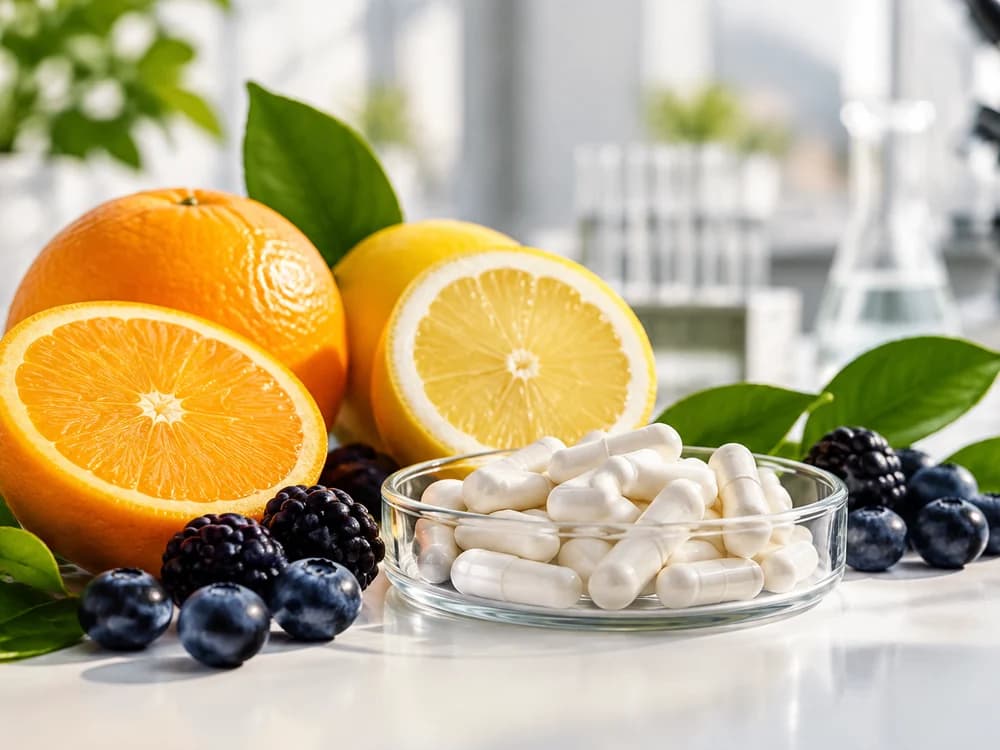
Immune Support Sachet Manufacturer for Global Brands
EUPHM produces immune support sachets in stick and pillow formats, from 1,000 units per SKU. GMP-certified lines handle vitamin C, zinc, elderberry and probiotic blends at fill weights from 2 g to 10 g.
Overview
Sachets suit immune products because they protect hygroscopic actives, travel well and give a precise single dose without water. This page covers what we make, how we formulate, and how we move from sample to shelf. For the wider format range, see our sachet manufacturer hub. Typical MOQ is 1,000 units per SKU, with lower thresholds for pilot runs.
| MOQ | 1,000 units per SKU; lower for pilot runs |
|---|---|
| Fill weight range | 2 g to 10 g per sachet |
| Sachet formats | Stick pack, 3-side seal, 4-side seal pillow |
| Sample lead time | 7-10 working days |
| Mass production | 20-35 working days after approval |
| Certifications | GMP, ISO 9001, ISO 22000, HACCP, NSF/ANSI 455-2, halal, FDA-registered |
Sachet Lines, Fill Accuracy and Output
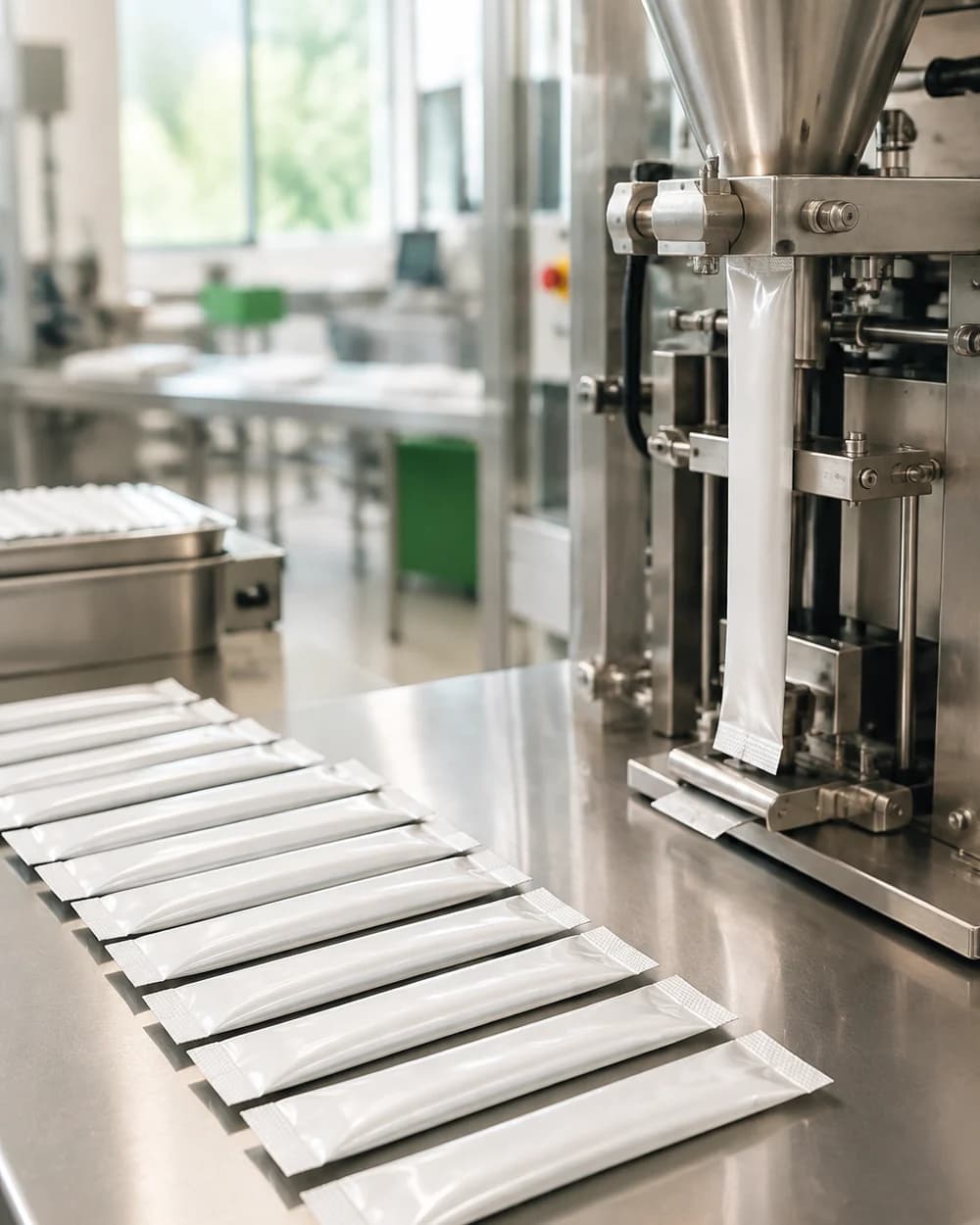
Our vertical form-fill-seal lines run stick packs at 40-60 cycles per minute and pillow sachets at 30-50 cycles per minute, depending on fill weight and powder flow. Fill accuracy is held to ±2% for most blends, which matters when a 3 g sachet carries 1,000 mg of vitamin C. We run low-humidity filling rooms for hygroscopic ingredients such as elderberry extract and ascorbic acid.
Each line handles a single SKU per run to avoid cross-contact. Changeover includes full auger and hopper cleaning, and we keep a line clearance record per batch. For brands scaling from 5,000 to 500,000 units, we schedule production in blocks so packaging film and lot numbers stay consistent. Lead times are quoted per run, not per line.
Formulating Immune Blends That Flow
Immune actives vary in particle size and density, so a blend that tastes fine in a capsule can bridge in a sachet hopper. We test angle of repose and bulk density before a run. Common actives include vitamin C at 250-1,000 mg, zinc at 5-15 mg, vitamin D3 at 400-2,000 IU, elderberry extract at 100-500 mg, and beta-glucan at 50-250 mg. Probiotic strains are dosed at 1-10 billion CFU.
Flavour systems matter more in a sachet than a tablet. We work with orange, berry, citrus and honey-lemon profiles, plus stevia, monk fruit and sucralose sweetening. For paediatric or sensitive-position products we can drop the flavour entirely and use a neutral base. Excipient choice is driven by dissolution speed, mouthfeel and hygroscopicity, not by habit.
Quality, Compliance and Shipping
Every batch is tested for identity, potency, microbial limits, heavy metals and moisture before release. We hold GMP, ISO 22000 and HACCP certification, and can supply halal or vegan documentation where the formula qualifies. Our facility is FDA-registered, which supports US import requirements. Certificates of analysis are issued per lot.
Finished sachets ship in food-grade cartons or display-ready cases. We handle desiccant placement, nitrogen flushing for oxygen-sensitive blends, and stability studies at 25°C/60% RH and 40°C/75% RH. For EU and UK buyers, we provide the technical file and labelling support for the supplement notification process.
Quality Control and Batch Documentation
Every immune support sachet batch is sampled at three points: incoming raw material, in-process powder blend, and finished sealed sachet. Identity and potency are confirmed by HPLC or UV spectrophotometry depending on the active, so vitamin C, zinc, elderberry extract markers and vitamin D3 are each verified against the specification before blending. Microbial testing covers total aerobic count, yeasts and moulds, E. coli and Salmonella, with results released before filling begins rather than after.
Heavy metals testing (lead, arsenic, cadmium, mercury) is run on each incoming lot of botanical extract and mineral source, with limits set to the destination market's requirements. Where the buyer's market requires it, we add pesticide residue screening for plant actives. Disintegration and dissolution checks apply where the sachet contains a granulated or compacted component, confirming the powder disperses cleanly in 100 to 150 ml of water without clumping or sediment.
The certificate of analysis issued with each batch lists batch number, manufacture and expiry dates, fill weight verification, assay results with the analytical method referenced, microbial and heavy metals results against specification, and a statement of conformity signed by the QC release officer. Retention samples of every batch are held for the shelf life plus six months, stored under the same conditions declared on the label.
Stability follows a standard protocol of accelerated conditions at 40 degrees Celsius and 75 percent relative humidity for three and six months, plus real-time data at 25 degrees Celsius and 60 percent relative humidity. Accelerated data supports the initial expiry claim; real-time data extends it. For hygroscopic immune blends, we also monitor moisture pick-up and seal integrity at each stability pull point, since sachet barrier performance is the main variable that affects shelf life.
Packaging, Labelling and Retail Readiness
Finished sachets are packed in stick pack, three-side seal or four-side seal pillow formats, then presented in retail cartons, display boxes or bulk polybags depending on the sales channel. Carton board weight, print finish and window options are confirmed at artwork stage. For Amazon and marketplace sellers we can apply FNSKU labels, polybag with the required suffocation warning, and cartonisation that matches the marketplace's inbound requirements, including box weight limits and label placement.
Labels are built to the destination market's rules. For the United States, that means the FDA dietary supplement label format: statement of identity, net quantity, supplement facts panel with percent daily value, other ingredients in descending order, allergen declaration, and the mandatory disclaimer. For the EU and UK, we follow the relevant nutrition and health claims rules and require the buyer to supply substantiation for any claim printed on pack. Lot number and expiry date are inkjet coded on each sachet and each carton, with the format agreed in writing before production.
Carton specifications are set per SKU: typically 20 to 50 sachets per retail carton, 12 to 24 retail cartons per shipper, with shipper dimensions and gross weight recorded on the packing list. Pallets are built to 1,200 by 1,000 mm or 1,200 by 800 mm depending on the destination, stretch wrapped, and corner-boarded. We photograph the finished pallet and provide the images with the shipping documents so the buyer can verify build before the container leaves.
Artwork proofing runs through a pre-press check covering barcode scannability, font size for net quantity, ingredient name consistency between the supplement facts panel and the formulation sheet, and country of origin marking. Buyers approve a signed proof and a physical pre-production sample before the print run starts. Changes after print approval are treated as a new print run, so the proofing stage is where label errors are cheapest to catch.
MOQ, Lead Times and Delivery
Sampling starts with a formulation brief and runs 7 to 10 working days for a standard immune blend, longer where a novel active or a specific flavour system needs development. The sample is sent with a draft specification sheet and a preliminary label layout so the buyer can review the product and the pack together. Sample cost is credited against the first production order in most cases, confirmed at quotation stage.
Mass production runs 20 to 35 working days after written approval of the sample, artwork and purchase order. The lower end applies to single-SKU orders with existing packaging; the upper end applies to multi-SKU orders, custom printed sachet film with a 15 to 20 day print lead time, or orders requiring halal certification review. We confirm the production window in the proforma invoice and update the buyer at three milestones: material arrival, filling start, and packing completion.
Shipping is quoted on EXW, FOB or DDP terms. FOB Shenzhen or Hong Kong is the most common for container loads; DDP is available for pallet and part-container volumes into the US, EU and UK, with duties and import clearance handled by our freight partner. Air freight suits pilot and launch orders of 50 to 200 kg, typically 5 to 8 days door to door; sea freight runs 18 to 35 days depending on port and is the default for full containers.
Each shipment is accompanied by the certificate of analysis for every batch in the consignment, a material safety data sheet where the formulation requires one, a free sale certificate issued for the manufacturing site, and a packing list with batch-to-carton traceability. Phytosanitary certificates are added where the destination requires them for plant-derived ingredients. Certificates of origin are available on request for preferential tariff treatment.
Formats and Packaging Options
Stick pack
Slim 2-6 g format for single-serve immune shots and travel packs. High barrier film options for vitamin C and probiotic blends.
3-side seal sachet
Standard 4-10 g pillow for retail cartons and pharmacy channels. Good print area for dosage and certification marks.
4-side seal sachet
Flat, premium look for higher-value immune blends. Suits 3-8 g fills and rigid carton presentation.
Custom film structure
PET/AL/PE, PET/PE or compostable laminates. Choice depends on oxygen and moisture sensitivity of the actives.
From Spec to Shipment
- 01
Send the brief
Share actives, target dose, fill weight, format and market. A one-page brief is enough to quote.
- 02
Quote and MOQ
You receive pricing at 1,000, 5,000 and 10,000 units, plus film and packaging costs separated out.
- 03
Sample production
We produce samples in 7-10 working days. You taste, test and confirm fill weight and flavour.
- 04
Formula lock
Specification, excipients, film structure and artwork are frozen. No changes after this point without requalification.
- 05
Mass production
Bulk run takes 20-35 working days. In-process checks run hourly on fill weight and seal integrity.
- 06
Release and ship
Batch testing, COA issue and export packing. We coordinate with your freight forwarder or ours.
Why EUPHM
Dose accuracy
A sachet delivers a fixed dose without scoops or capsules. Fill accuracy of ±2% keeps label claims defensible.
Stability
High-barrier film protects vitamin C, elderberry and probiotics from moisture and oxygen better than a jar.
Portability
Sachets travel in a pocket or bag. That drives repeat purchase in travel, sport and paediatric segments.
Questions buyers ask.
What is the MOQ for immune support sachets?+
Standard MOQ is 1,000 units per SKU for retail-ready sachets. Pilot runs below 1,000 are possible with a development fee and longer lead time. Film and print setup are quoted separately from the fill cost.
Can you make a sachet with 1,000 mg vitamin C and 10 mg zinc?+
Yes. That dose fits a 3-5 g stick pack. We adjust the excipient ratio to keep the blend free-flowing and test for moisture pick-up before production. Flavour and sweetener are matched to the actives.
Do you offer halal certification for sachets?+
We can produce to halal requirements where the formula and excipients qualify. Certification documents are issued per batch. Vegan and organic claims are also supported with the relevant supply chain records.
How long does a sachet order take from sample to delivery?+
Samples take 7-10 working days. Once the formula and artwork are locked, mass production runs 20-35 working days. Add shipping time from Guangdong, typically 18-30 days by sea to the US or EU.
What certifications does the facility hold?+
The plant holds GMP, ISO 22000 and HACCP certification. It is FDA-registered for US-bound supplements. Halal and vegan documentation is available where the product and supply chain meet the standard.
Can you match a competitor's sachet formulation from a label or a sample?+
We can reverse-engineer toward a target label or sample, but we work from the declared ingredient list and analytical testing rather than copying a proprietary formula. The process starts with a formulation brief, then a bench sample and a sensory and dispersion trial. Where a label omits carrier or processing aids, we propose a functional equivalent and confirm it with you before sampling. Expect 7 to 10 working days for a first bench sample.
What is the shelf life of an immune support sachet and how is it set?+
Shelf life is set from stability data, not assumed. A typical hygroscopic immune blend in aluminium-laminated film supports 18 to 24 months at ambient conditions, confirmed by accelerated testing at 40 degrees Celsius and 75 percent relative humidity plus real-time data. If your formula includes probiotics or sensitive botanicals, we test at shorter intervals and may recommend a lower moisture barrier or a desiccant. The final expiry claim is written into the specification sheet.
Do you handle the sachet film printing in-house or through a partner?+
Sachet film is printed by qualified converters to our specification, with print lead time of 15 to 20 working days for custom artwork. We manage the artwork transfer, colour proofing and film approval, and the printed roll is inspected on receipt for register, colour and sealant integrity before filling. Stock film in white or metallised finish is available for pilot runs, which removes the print lead time and shortens the production window.
Have a product in mind?
Send us the brief and we will come back with a formulation direction, indicative price and a realistic lead time — usually within one working day.