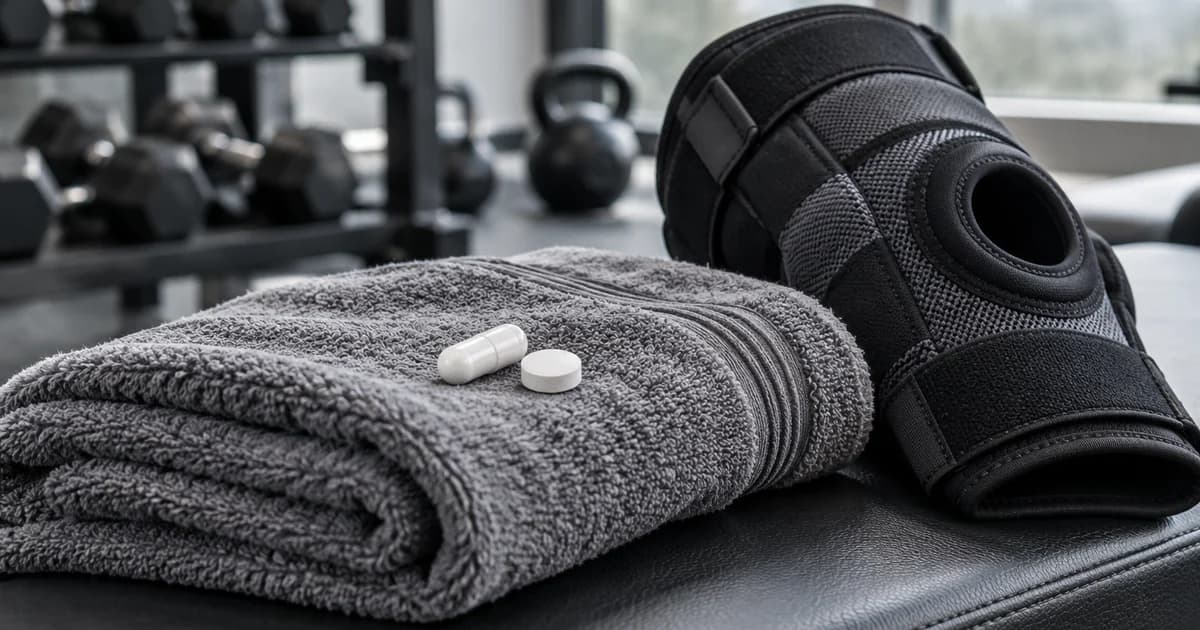
Glucosamine and Joint Health: A Sourcing Guide for Brands
Glucosamine remains a top-selling joint health ingredient. This guide covers formats, dosages, and manufacturing parameters for brands sourcing a contract partner in China.

Overview
Glucosamine and joint health products account for a significant share of the global supplements market. For brand owners, the key decisions are ingredient form, combination actives, and finding a manufacturer that can scale from pilot to retail volumes. This resource outlines practical specifications, MOQs, and lead times from a GMP-certified facility in Guangdong.
| MOQ (retail bottling) | 1,000 units per SKU |
|---|---|
| MOQ (pilot run) | 1,000 units per SKU |
| Sample lead time | 7–10 working days |
| Mass production | 20–35 working days |
| Certifications | GMP, ISO 9001, ISO 22000, HACCP, NSF/ANSI 455-2, halal, FDA-registered |
| Fill weights | Tablets 500–1,500 mg; capsules 400–800 mg; powders 5–20 g |
Manufacturing Capability for Joint Health
EUPHM operates tablet, capsule, and powder lines with capacity for 2–5 million units per month. For glucosamine, common formats include 500 mg and 750 mg tablets, 500 mg capsules, and powder blends for drink mixes. We handle both small pilot runs (1,000 units) and full retail bottling (1,000 units per SKU).
Our facility runs 20–35 working day mass production cycles after sample approval. We can source glucosamine sulfate, hydrochloride, and N-acetyl forms from qualified suppliers. Blending with chondroitin, MSM, turmeric, or boswellia is done in-house under controlled humidity to prevent clumping.
Formulation and Ingredient Details
Glucosamine sulfate is typically dosed at 1,500 mg per day, often split into two or three doses. Glucosamine HCl is more concentrated and stable in tablets. For capsules, HCl is preferred due to lower volume. We verify ingredient identity and potency via HPLC and FTIR before production.
Combination products are common. Chondroitin sulfate at 800–1,200 mg, MSM at 1,000–3,000 mg, and turmeric extract at 500 mg are typical. We can adjust ratios to match your label claims. Vegan glucosamine from fermentation is available for plant-based positioning.
Quality and Compliance for Export
Our facility is GMP-certified and holds ISO 22000, HACCP, halal certification. We are FDA-registered for dietary supplements. Every batch is tested for heavy metals, microbials, and potency. Certificates of analysis are provided per lot.
For EU and UK clients, we follow EU regulation 1169/2011 for labelling and can provide documentation for novel food status if needed. For Middle East markets, halal certification is maintained. Organic claims require USDA organic or EU organic certification, which we hold for select ingredients.
Quality Control and Batch Documentation
Every batch of glucosamine and joint health products is tested at three stages: incoming raw material, in-process, and finished goods. Raw material testing covers identity by FTIR, potency by HPLC or titration, microbial limits (total aerobic count, yeast and mould, E. coli, Salmonella), heavy metals (lead, arsenic, cadmium, mercury) and, where relevant, residual solvents. In-process checks monitor blend uniformity, tablet weight variation and hardness. Finished goods are tested for assay, disintegration, microbials and heavy metals before release.
A Certificate of Analysis (COA) accompanies each batch and includes the product name, batch number, manufacturing date, expiry date, specification limits and measured results for each test. It also states the test methods used and the release decision. COAs are issued in English as standard and can be provided in other languages on request. Retention samples of each batch are kept for at least two years beyond the expiry date, stored under labelled conditions.
Stability testing follows a standard protocol: accelerated conditions at 40°C/75% RH for six months and long-term conditions at 25°C/60% RH for up to 36 months. Parameters monitored include appearance, assay, disintegration, microbial limits and moisture. Where a customer requires a specific shelf life, we can run a dedicated stability study on the finished product in its retail packaging. Results are documented in a stability report available with the batch records.
Batch documentation is retained for five years and includes the executed batch record, raw material COAs, in-process checks, finished goods COA, packaging records and deviation reports if any. This documentation supports customer audits and regulatory submissions. For export markets, we can provide a free-sale certificate and a certificate of origin. Customers requiring additional testing, such as specific allergen screening or pesticide residues, can request it at quotation stage.
Packaging, Labelling and Retail Readiness
Glucosamine and joint health products are typically packed in HDPE bottles with induction seals and child-resistant caps, or in blisters and stick packs for unit-dose formats. Bottle sizes range from 60 to 180 counts, with fill weights from 500 mg to 1,500 mg per tablet. Powders are packed in jars or sachets from 5 g to 20 g. We can supply standard stock bottles or custom moulds, with labelling applied by machine and lot and expiry codes inkjet-printed or laser-etched on the bottle and carton.
For the US market, labels must include the statement of identity, net quantity of contents, supplement facts panel, ingredient list, allergen declaration, and the name and place of business of the manufacturer, packer or distributor. Structure/function claims require the standard disclaimer. We review customer-supplied artwork against these elements before printing. For EU markets, labels must comply with Regulation (EC) No 1169/2011 and the Food Supplements Directive, including nutrition declaration and recommended daily portion.
Cartons are specified with dimensions, board grade and print process. A typical 60-count bottle carton uses 300 gsm white board with matt lamination. Shippers are 5-ply corrugated with a maximum gross weight of 20 kg. Pallet configuration is standard 1200 x 1000 mm or 1200 x 800 mm, stretch-wrapped and corner-boarded. We can print Amazon FNSKU labels and apply them to each unit, and we can pack to Amazon's prep requirements, including poly-bagging and suffocation warning labels where required.
Retail-ready packaging includes lot and expiry coding, batch number, and where required, a QR code linking to the COA. We can also apply tamper-evident seals and security labels. For blister packs, we use PVC/PVDC or alu-alu depending on moisture sensitivity. Packaging materials are food-grade and comply with EU 10/2011 and FDA 21 CFR 174-190. Customer-supplied packaging is accepted subject to incoming inspection.
MOQ, Lead Times and Delivery
Sampling starts with a brief: ingredient form, combination actives, dosage form and target fill weight. We provide a quotation within three working days and, on acceptance, produce samples in 7 to 10 working days. Sample quantities are typically 5 to 10 units per SKU and are free of charge, with freight collect. If a new formulation requires stability testing before scale-up, add four to six weeks for accelerated results.
Mass production begins after sample approval, artwork sign-off and receipt of a 30% deposit. Standard production lead time is 20 to 35 working days for tablets and capsules, and 25 to 40 working days for powders and stick packs. This excludes Chinese public holidays and any customer-caused delays in artwork or packaging supply. We provide a production schedule with milestones and a weekly status update.
Shipping options are air freight, sea freight and express courier. Air freight to the US or EU takes 5 to 10 days door-to-door; sea freight takes 25 to 40 days port-to-port. We ship under EXW, FOB Shenzhen or Hong Kong, or DDP for customers who prefer a landed-cost price. DDP is available for the US, EU, UK and Australia. We provide a packing list, commercial invoice, bill of lading or air waybill, COA, MSDS, free-sale certificate and certificate of origin with each shipment.
For retail and Amazon sellers, we can deliver to a third-party warehouse or directly to an Amazon fulfilment centre. We handle FNSKU labelling and carton marking according to the customer's instructions. Where a phytosanitary certificate is required for plant-derived ingredients, we arrange it through the relevant authority; lead time is typically 5 to 7 working days. All documents are provided electronically before shipment and in hard copy with the goods.
What We Can Build
Tablets
500–1,500 mg. Suitable for high-dose glucosamine sulfate. Film coating available for ease of swallowing and taste masking.
Capsules
400–800 mg. Gelatin or HPMC (vegan). Ideal for glucosamine HCl and combination blends with turmeric or MSM.
Powders
5–20 g sachets or tubs. For joint health drink mixes. Can include flavourings and sweeteners.
Gummies
2–4 g per piece. Pectin or gelatin base. Lower glucosamine dose per unit; often combined with vitamin C.
From Enquiry to Delivery
- 01
Inquiry and brief
Send your target formula, dosage, and packaging requirements. We review feasibility and send a quote within 2 working days.
- 02
Sample development
We produce samples in 7–10 working days. You receive physical samples and a draft specification sheet for approval.
- 03
Quotation and PO
After sample approval, we finalise pricing, MOQ, and lead time. A proforma invoice is issued. Production starts on receipt of deposit.
- 04
Raw material sourcing
We order glucosamine and other actives from qualified suppliers. Incoming materials are quarantined and tested before release to production.
- 05
Production and QC
Mass production takes 20–35 working days. In-process checks and finished product testing ensure potency and safety.
- 06
Packaging and shipping
Bottling, labelling, and cartoning. We coordinate with your freight forwarder or arrange shipping from Shenzhen or Hong Kong ports.
Why EUPHM
Flexible moqs
Start with 1,000 units for pilot runs, scale to 5,000+ for retail. No minimum order on raw materials for samples.
Certified facility
GMP, ISO 9001, ISO 22000, HACCP, NSF/ANSI 455-2 and halal certification; FDA facility registration for US-bound shipments.
Formulation support
In-house R&D can adjust dosages, combine actives, and match your label claims. Vegan and organic options available.
Questions buyers ask.
What is the typical MOQ for glucosamine tablets?+
For retail bottling, MOQ is 1,000 units per SKU. For pilot runs to test the market, we can produce 1,000 units. MOQ depends on tablet size and packaging. We can advise on the most cost-effective batch size for your first order.
Can you produce vegan glucosamine?+
Yes. We offer vegan glucosamine produced by fermentation. It is available in capsules (HPMC) and tablets. Certification for vegan claims can be provided. Note that vegan glucosamine may have a different cost structure than shellfish-derived material.
What certifications do you hold for joint health products?+
Our facility holds GMP, ISO 22000, HACCP, halal certification. We are FDA-registered for dietary supplements. For organic claims, we can arrange USDA organic or EU organic certification for select ingredients. Certificates are available on request.
How long does shipping take to the US or EU?+
Production takes 20–35 working days after sample approval. Sea freight to the US West Coast is approximately 18–25 days; to Europe, 25–35 days. Air freight is 5–10 days. We can ship FOB Shenzhen or Hong Kong, or arrange door-to-door delivery.
Can you combine glucosamine with chondroitin and MSM?+
Yes. We regularly produce combination formulas. Typical ratios are glucosamine 1,500 mg, chondroitin 1,200 mg, and MSM 1,000 mg per daily dose. We can adjust to your target label. All actives are tested for identity and potency before blending.
What is the shelf life of your glucosamine tablets and capsules?+
Standard shelf life is 24 months from the date of manufacture for tablets and capsules, and 18 months for powders, based on long-term stability data at 25°C/60% RH. If you require a longer shelf life, we can run a dedicated stability study in your retail packaging. The expiry date is printed on the bottle and carton, and the COA states the shelf life assigned to each batch.
Can you manufacture glucosamine products under our own brand label?+
Yes. We operate as a private-label and OEM manufacturer. You supply the brand name, artwork and label content; we handle sourcing, production, packaging and labelling. We can use your existing formula or develop one with you. Minimum order is 1,000 units for a pilot run and 1,000 units for retail bottling. We do not use your brand on any other products.
What is the process for getting a quotation and placing a first order?+
Send your specification: ingredient form, combination actives, dosage form, fill weight, packaging type and target quantity. We respond with a quotation within three working days, including unit price, MOQ, lead time and Incoterm. On acceptance, we produce samples in 7 to 10 working days. After sample approval and artwork sign-off, we issue a proforma invoice; production starts on receipt of a 30% deposit.
Xu Wei writes the manufacturing, quality and regulatory guides on EUPHM. He works directly with the plant's production and QA teams to document how each dosage form is made, tested and released, so every claim on the site can be traced back to a batch record or a certificate on file.
More guides in this category.
See all →
Top Supplement Trends for Brand Owners and Procurement Teams
Demand is shifting toward functional formats, traceable ingredients and labels that clear multiple markets. This guide covers the trends that affect your MOQ, fill weight and lead time decisions.
Read the guide →
Probiotics CFU Guide for Brands: Count, Overage, Stability
CFU counts drive cost, label claims and shelf life. This guide covers strain selection, overage, moisture control and realistic MOQ for retail bottling, so you can brief a contract manufacturer without guesswork.
Read the guide →
How to Read a Supplement Label
A supplement label is a legal document, not marketing copy. Learn to read serving size, %NRV, ingredient forms, and certifications before you source or buy any product.
Read the guide →Have a product in mind?
Send us the brief and we will come back with a formulation direction, indicative price and a realistic lead time — usually within one working day.