Immune Support Gummy Manufacturer
EUPHM produces immune support gummies in Guangdong, China. MOQ 1,000 units per SKU, samples in 7–10 working days, mass production in 20–35 working days. GMP, ISO 22000, HACCP, halal and organic certified.
Overview
Sourcing an immune support gummy manufacturer means matching actives to a pectin or gelatin base that holds stability through 18–24 months. This page covers formulation, dose per gummy, line capacity and compliance for brands selling in the US, EU, UK and Middle East. EUPHM runs pilot runs from 1,000 units and full retail bottling from 1,000 units per SKU.
- MOQ retail bottling
- 1,000 units per SKU
- Pilot run minimum
- 1,000 units
- Sample lead time
- 7–10 working days
- Mass production
- 20–35 working days
- Gummy fill weight
- 2.5 g–5.0 g per piece
- Certifications
- GMP, ISO 9001, ISO 22000, HACCP, NSF/ANSI 455-2, halal, FDA-registered
Production capacity and formats
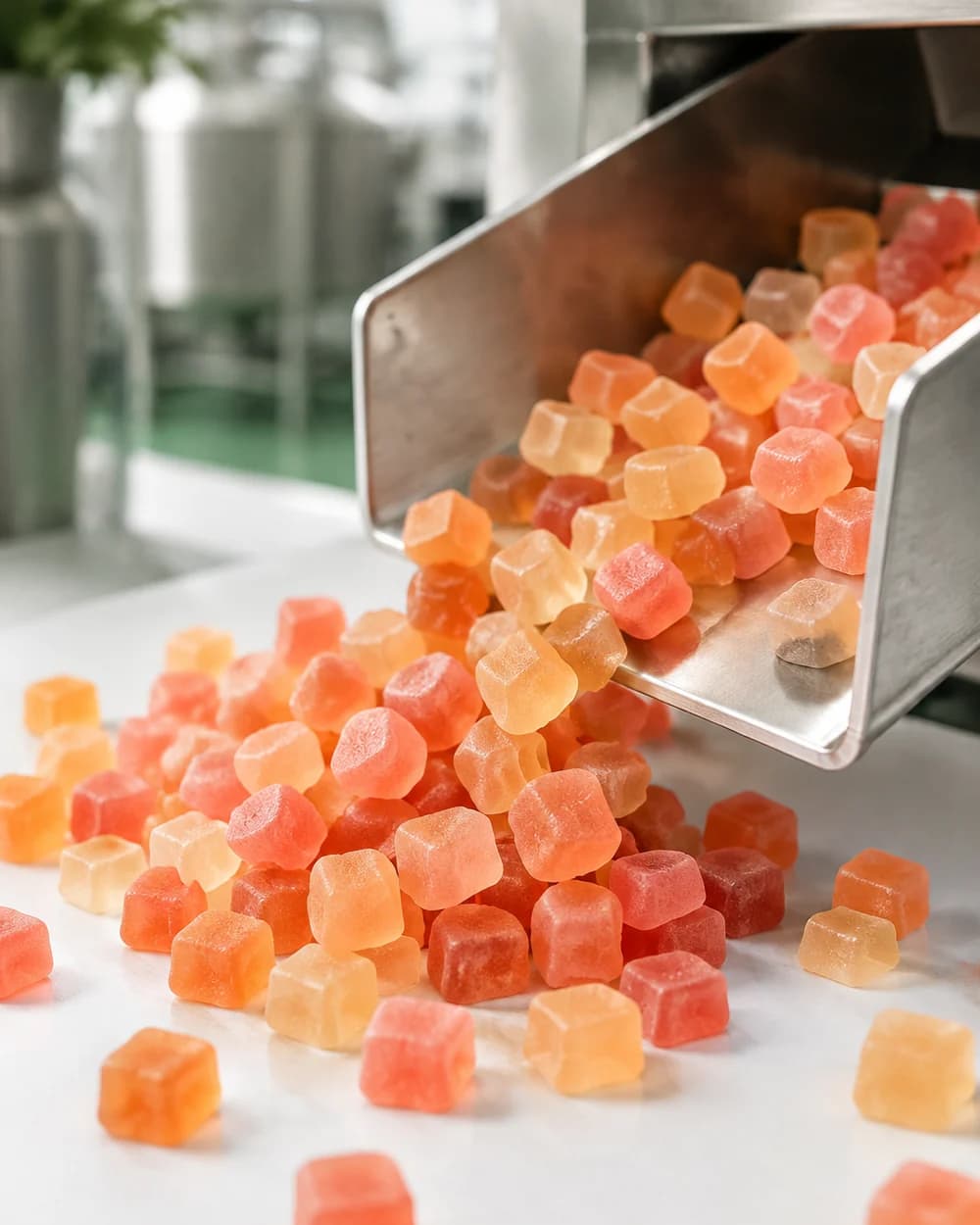
EUPHM operates four depositing lines with a combined output of 12–18 million gummies per month. Standard moulds cover 2.5 g, 3.5 g and 5.0 g pieces in bear, round, square and bottle shapes. Changeover between SKUs takes 4–6 hours, which keeps small retail runs practical. Bottling runs on two lines for 60 cc, 120 cc, 180 cc and 300 cc HDPE or PET containers, with induction seals, child-resistant caps and lot coding. Bulk bag options are available for repackers.
Lead times assume approved artwork and released raw materials. For a 5,000-unit order, expect 3–5 working days for base preparation, 10–15 working days for depositing and curing, and 5–8 working days for bottling, labelling and QC release. Air freight from Shenzhen or Hong Kong reaches Los Angeles in 3–5 days and Rotterdam in 5–7 days. Sea freight adds 18–32 days depending on port.
Immune actives and formulation limits
Common immune actives include vitamin C (60–250 mg), zinc (5–15 mg), elderberry extract (100–500 mg), beta-glucan (50–250 mg), echinacea (50–200 mg), vitamin D3 (10–50 mcg) and propolis (25–100 mg). Each has a practical ceiling in a 3.5 g gummy. Vitamin C above 250 mg turns sour and can mask fruit notes. Zinc above 15 mg leaves a metallic finish. Elderberry above 500 mg darkens the piece and shortens shelf life unless buffered.
Pectin bases suit vegan, halal claims and hold up in warm climates. Gelatin bases give a chewier bite and better clarity for translucent colours. Sugar-free versions use maltitol, sorbitol or allulose with 0–2 g sugar per piece. Natural colours come from black carrot, spirulina, turmeric and beetroot. Flavours include orange, berry, cherry, lemon and mixed fruit. Stability testing runs at 25°C/60% RH and 40°C/75% RH for 6 months accelerated and 24 months real time.
Quality, testing and export compliance
Every batch is tested for identity, potency, microbial limits, heavy metals and disintegration. Certificates of analysis are issued per lot with raw material traceability back to the supplier. The facility is FDA-registered and holds GMP, ISO 22000 and HACCP certification. Halal certificates cover the pectin and gelatin lines separately. Organic production uses certified organic fruit powders and is audited to and EU organic standards.
For US retail, labels follow FDA 21 CFR 101 with supplement facts panels, allergen statements and country of origin. EU labels meet Regulation 1169/2011 and EFSA health claim rules. UK labels follow the same framework post-Brexit. Middle East shipments include halal certificates and Arabic labelling on request. EUPHM provides documentation packs for customs, including free sale certificates, GMP certificates and ingredient breakdowns.
Quality Control and Batch Documentation
Every immune gummy batch is tested at three stages: incoming raw materials, in-process gel and finished goods. Raw actives such as vitamin C, zinc and elderberry extract are sampled for identity by FTIR and assayed by HPLC or ICP-MS before release to production. In-process checks cover Brix, pH, setting temperature and piece weight at 30-minute intervals. Finished gummies are tested for potency of each declared active, total aerobic count, yeast and mould, E. coli and Salmonella, lead, cadmium, arsenic and mercury, and disintegration time. Testing follows AOAC and USP methods where applicable, and results are recorded against the batch number.
A certificate of analysis (COA) is issued for each batch and includes the product name, batch number, manufacturing date, expiry date, active content per gummy, microbial results, heavy metals results, disintegration result and a statement of conformity to the agreed specification. Where a customer supplies a target specification, the COA is written against that specification rather than a generic one. Certificates for halal and organic status are issued by the relevant certifying body and reference the specific production run. COAs are provided in PDF and can be issued in the customer's template if required.
Retention samples of at least 200 g per batch are held for the full shelf life plus six months. Stability is run on the first three production batches and then annually, or whenever a formulation or packaging change occurs. The protocol typically covers 0, 3, 6, 12, 18 and 24 months at 25°C/60% RH and 30°C/65% RH, with accelerated conditions at 40°C/75% RH for six months. Parameters tested are appearance, texture, potency, moisture migration, microbial count and, for pectin gummies, water activity. Results are summarised in a stability report shared with the brand owner.
Batch records are retained for five years and include the master formula, actual weights, equipment logs, line clearance records, in-process results and deviation reports. If a batch falls outside specification, it is placed on hold and a non-conformance report is raised before any rework or rejection decision. For export markets, the batch documentation package can include a certificate of free sale, a health certificate and a GMP statement. These documents are prepared per shipment and reference the invoice and batch numbers so that customs and import authorities can trace the goods.
Packaging, Labelling and Retail Readiness
Immune gummies are packed in HDPE bottles, PET jars, blister packs, stick packs or sachets. Bottles are the most common for retail and are available in 60, 90, 120 and 150 count sizes with induction seals, desiccant sachets where needed and child-resistant or standard caps. Blisters suit pharmacy channels and sample packs, while stick packs and sachets suit single-serve or travel formats. Bottle dimensions and cap torque are recorded in the packaging specification, and artwork is checked against a signed dieline before printing. Packaging components are sampled for seal integrity and moisture barrier before the run.
For the US market, the label must carry a supplement facts panel with serving size, amount per serving and % daily value where applicable, a list of ingredients, allergen statements, the net quantity of contents and the name and place of business of the manufacturer or distributor. Structure-function claims are limited to those permitted for dietary supplements and must carry the standard disclaimer. For the EU and UK, the label follows the relevant food supplement regulations with nutrition labelling, permitted health claims and a best-before date. Middle East markets may require Arabic labelling and a halal mark.
Lot and expiry coding is applied by inkjet or laser on the bottle, carton and, where required, the foil. The format is agreed with the brand owner and typically includes the batch number, manufacturing date and best-before date. Cartons are specified with dimensions, board grade and print finish, and are packed in shippers sized to the retail case pack. Pallet specifications include pallet type, dimensions, gross weight and layers per pallet, and can be configured for Amazon FNSKU labelling, retail compliance or direct-to-consumer fulfilment. FNSKU labels, polybags and suffocation warnings are applied on request.
Artwork approval is a formal step: the brand owner signs off a PDF proof and a physical sample before mass production. Any change to artwork after approval restarts the proofing cycle and may affect the production window. Packaging materials are ordered against the approved specification and are inspected on receipt for print defects, colour variation and dimensional accuracy. Where the brand owner supplies packaging, a component receipt inspection is still carried out and any non-conforming material is reported before use. This keeps retail compliance issues visible before goods leave the factory.
MOQ, Lead Times and Delivery
Sampling starts with a formulation brief and a target dose per gummy. Pilot runs begin at 1,000 units per SKU and are used to confirm texture, taste, potency and packaging fit. Sample lead time is 7–10 working days from receipt of a signed brief and any customer-supplied actives. Samples are sent by courier with a preliminary specification sheet and a COA for the pilot batch. If the sample requires adjustment, one revision round is included; further rounds are quoted separately. Sample costs are credited against the first mass production order.
Mass production runs 20–35 working days after artwork approval, packaging receipt and a 30% deposit. The window covers actives testing, gummy production, curing, packaging and finished-goods testing. Peak season from August to November can extend the window, so booking production slots early is advised. The MOQ for retail bottling is 1,000 units per SKU, depending on bottle size and label complexity. Larger volumes are scheduled across multiple runs to keep batch sizes within equipment capacity and to protect stability.
Delivery is quoted EXW, FOB or DDP. Air freight is used for samples and urgent launches and typically takes 5–10 days door to door. Sea freight is used for full container loads and takes 25–40 days depending on destination port. DDP terms include customs clearance and final-mile delivery, with duties and taxes shown separately on the quotation. Shipments are booked against the confirmed production completion date, and the forwarder is instructed once the finished-goods COA is approved.
The export document pack includes the commercial invoice, packing list, bill of lading or airway bill, COA, MSDS where applicable, certificate of free sale, health certificate and, for plant-based ingredients, a phytosanitary certificate if the destination requires one. Halal certificates are provided for certified runs. Origin certificates can be issued on request. Documents are checked against the destination country's import requirements before dispatch, and a copy of the full pack is sent to the brand owner for review before the shipment leaves the factory.
Options for Your Format
Pectin base
Vegan, halal suitable. Holds shape at 30°C. Sets in 12–18 hours. Works with fruit pectins and buffers for high-acid actives.
Gelatin base
Chewier texture and clearer finish. Bovine or porcine sources. Halal versions available on separate certified lines.
Sugar-free base
Maltitol, sorbitol or allulose. 0–2 g sugar per piece. Calorie count 5–10 kcal per gummy. Suitable for diabetic-friendly positioning.
Organic base
Certified organic fruit powders and cane sugar. and EU organic documentation. MOQ 5,000 units per SKU.
From Enquiry to Delivery
- 01
Brief and quote
Send target actives, dose per gummy, base preference, bottle size and market. Quote returned in 2–3 working days with MOQ and unit price.
- 02
Sample production
Samples made in 7–10 working days. Includes 2–3 flavour and colour variants. Client approves texture, taste and appearance before deposit.
- 03
Artwork and compliance
Label files checked against FDA, EU or UK rules. Supplement facts, allergen and health claim review completed in 3–5 working days.
- 04
Raw material release
Actives and bases tested for identity and potency. Certificates of analysis issued. Production slot confirmed 5–7 days ahead.
- 05
Production and QC
Depositing, curing, bottling and labelling over 20–35 working days. In-process checks every 2 hours. Final batch testing before release.
- 06
Shipping and documents
Air or sea freight from Shenzhen or Hong Kong. Documents include commercial invoice, packing list, COA, GMP certificate and free sale certificate.
Why EUPHM
Low MOQ for retail
1,000 units per SKU for bottled retail. Pilot runs from 1,000 units. Lets brands test immune SKUs before scaling.
Certified for export
GMP, ISO 9001, ISO 22000, HACCP, NSF/ANSI 455-2 and halal certification; FDA facility registration for US-bound shipments.
Stable actives
Formulation support to keep vitamin C, zinc and elderberry within label claim through 24-month shelf life.
Questions buyers ask.
What is the MOQ for immune support gummies?+
MOQ is 1,000 units per SKU for retail bottling. Pilot runs start at 1,000 units. Bulk bag orders are quoted separately. MOQ depends on bottle size, base type and whether the formula is new or matched to an existing product.
How long do samples take?+
Samples ship in 7–10 working days after brief approval. The sample pack includes 2–3 flavour and colour variants, a specification sheet and a label mock-up. Courier delivery to the US or EU adds 3–5 days.
Can you make vegan, halal immune gummies?+
Yes. Pectin bases are vegan, halal by default. Gelatin lines are certified halal on separate runs. Organic versions use certified organic fruit powders and carry and EU organic documentation.
What actives work in a 3.5 g gummy?+
Vitamin C up to 250 mg, zinc up to 15 mg, elderberry extract up to 500 mg, beta-glucan up to 250 mg, echinacea up to 200 mg and vitamin D3 up to 50 mcg. Above these levels taste, colour or stability suffers. Formulation support is included.
Do you provide certificates for export?+
Yes. Each lot ships with a certificate of analysis covering identity, potency, microbials, heavy metals and disintegration. GMP, ISO 22000, HACCP, halal and organic certificates are provided. Free sale certificates and ingredient breakdowns are issued on request.
How do you handle potency overage in immune gummies?+
Overage is set per active based on stability data, typically 10–30% above label claim at the end of shelf life. Vitamin C in pectin gummies may require a higher overage than zinc due to degradation during curing. The overage is agreed in the specification and confirmed by the first three stability batches. The COA reports both the initial assay and the projected end-of-shelf-life value.
Can you match a competitor's immune gummy texture and flavour?+
Yes, within limits. We analyse a supplied sample for texture, Brix, pH and flavour profile, then build a trial formula on pectin or gelatin. Flavour matching is done with our flavour house partners and usually takes one to two revision rounds. We do not copy a competitor's exact formula or label, but we can match the eating experience and active profile while keeping the formulation distinct.
What is your policy on allergens and cross-contact?+
Allergen control is managed through a documented allergen matrix, dedicated colour-coded utensils and a validated cleaning procedure between runs. Gummies containing milk, soy or tree nuts are scheduled at the end of the production day where possible. The label declares all allergens present in the finished product, and a cross-contact statement is included where shared equipment is used. Customer-specific allergen restrictions are written into the specification.
Have a product in mind?
Send us the brief and we will come back with a formulation direction, indicative price and a realistic lead time — usually within one working day.