Psyllium Fiber Gummy Manufacturer for Your Brand
EUPHM produces psyllium fiber gummies at 1,000 unit MOQ. We handle formulation, pectin or gelatin bases, and 20–35 day mass production. Certifications include GMP, ISO 22000, and HACCP.
Overview
Psyllium husk delivers 70–80% soluble fiber by weight, but its water absorption and mild earthy taste make gummy formulation tricky. As a contract manufacturer, we adjust pectin or gelatin ratios, use masked psyllium powder, and control curing to keep texture stable. Our Guangdong plant runs pilot batches from 1,000 units and full retail runs from 1,000 units per SKU. Every batch ships with a Certificate of Analysis.
- MOQ
- 1,000 units per SKU (retail); 1,000 units for pilot runs
- Sample lead time
- 7–10 working days
- Mass production
- 20–35 working days after sample approval
- Fill weight range
- 2.5–4.5 g per gummy
- Certifications
- GMP, ISO 9001, ISO 22000, HACCP, NSF/ANSI 455-2, halal, FDA-registered
- Line capacity
- Up to 1.2 million gummies per day across two lines
Psyllium Gummy Production Capability
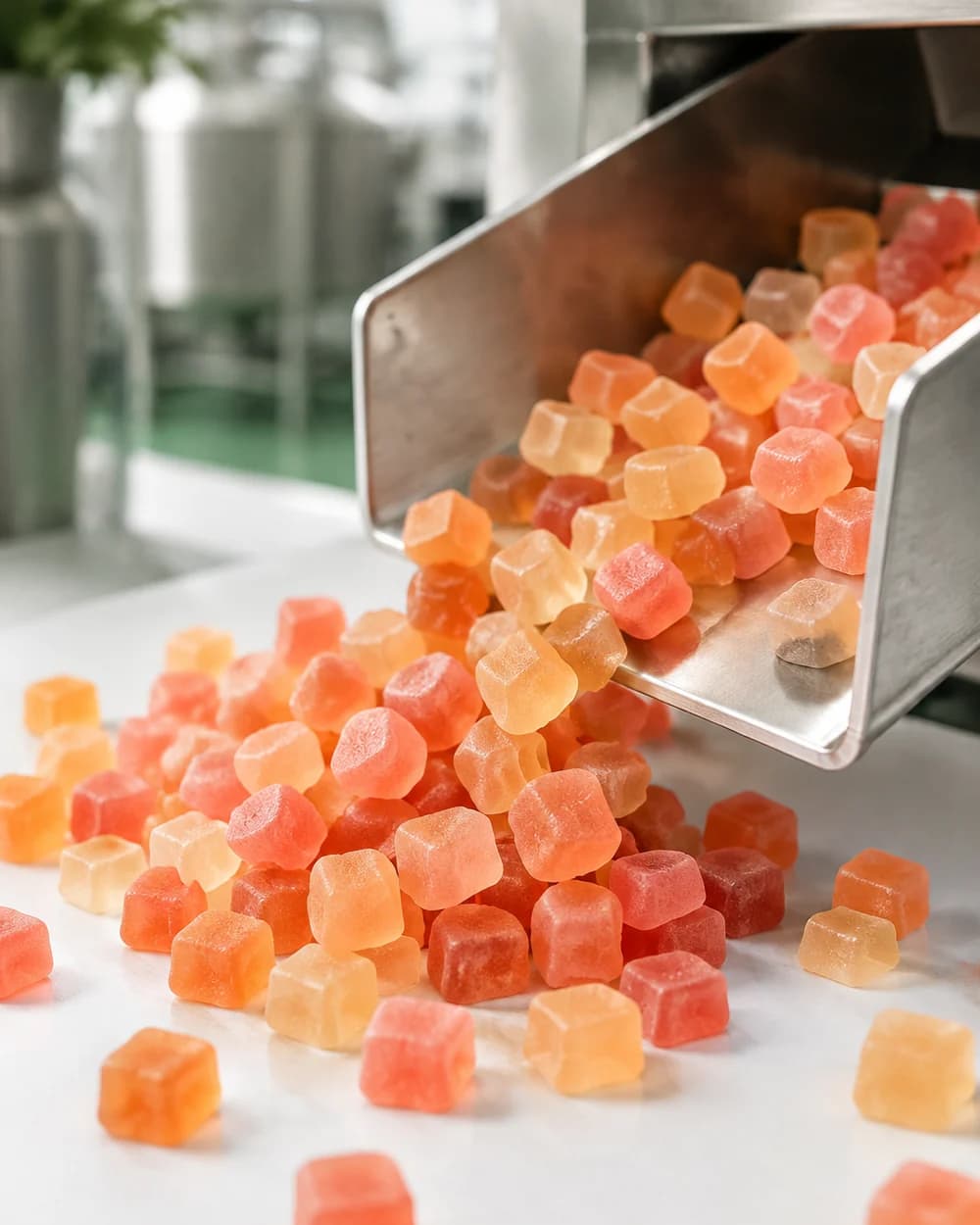
Our two gummy lines handle both pectin and gelatin bases. For psyllium, we use a cold-blend step to avoid premature gelling, then deposit into starch moulds. Each line runs 600,000 gummies per day at 3 g fill weight. We can produce sugar-coated, sour-sanded, or plain matte finishes. Changeover between SKUs takes 4–6 hours, which keeps small batch runs practical.
We maintain a dedicated mixing room for fiber ingredients to prevent cross-contact with nutraceutical actives. Psyllium powder is stored at 18–22°C and below 50% relative humidity. Incoming lots are tested for viscosity and microbial load before release to production. This matters because psyllium quality varies widely by crop year.
Formulating Psyllium into a Stable Gummy
Psyllium husk absorbs up to 10 times its weight in water. In a gummy, that can cause hardening or syneresis within 4–6 weeks. We pre-hydrate psyllium in a 1:3 ratio with glycerin and water, then blend it into the base at 1.5–2.5 g per gummy. That delivers 1.2–2.0 g of soluble fiber per piece, depending on the final weight.
Flavour systems use citrus, berry, or tropical profiles with stevia or allulose. A 0.3–0.5% citric acid addition helps mask the earthy note. We test texture at 0, 4, 8, and 12 weeks at 25°C/60% RH and 40°C/75% RH. Shelf life is typically 18–24 months in a sealed HDPE bottle with a desiccant canister.
Quality, Compliance, and Shipping
The facility is FDA-registered and holds GMP, ISO 22000, and HACCP certifications. Halal certificates are available for gelatin-free or bovine gelatin versions. Organic and psyllium can be sourced with a 6–8 week lead time. Every batch is tested for heavy metals, microbials, and label claim accuracy. We release a Certificate of Analysis before shipment.
We ship FOB Shenzhen or Yantian. Standard retail bottling uses 60, 90, or 120 count HDPE bottles with induction seals. Cartons are 12–24 bottles per shipper. Air freight samples take 3–5 days; sea freight to US East Coast runs 28–35 days. We handle export documentation for the EU, UK, and Middle East.
Psyllium Fiber Gummy Quality Control and Batch Documentation
Every psyllium fiber gummy batch is sampled at three points: incoming psyllium husk powder, the cooked gummy mass before depositing, and the finished cured gummy. Incoming husk is tested for identity by microscopy and for viscosity, since psyllium quality varies with growing season and milling grade. Finished gummies are tested for fibre content by AOAC 991.43 or the client's declared method, plus microbials (total plate count, yeast and mould, E. coli, Salmonella), heavy metals (lead, arsenic, cadmium, mercury) and disintegration time. We release nothing without a signed specification sheet matching the approved sample.
Potency and fibre claims are the most common audit points, so we test the finished gummy rather than relying on input weight. Psyllium absorbs water heavily, and some fibre can be bound in the matrix, so we verify the labelled fibre figure against the finished product. Where a client claims a specific gram amount per serving, we confirm it batch by batch and flag any drift above five percent. Microbiological testing follows a 48 to 72 hour incubation cycle, which is why release testing adds two to three working days to the production window.
Each Certificate of Analysis lists the product name, batch number, manufacture and expiry dates, the tests performed, specification limits, results and the analyst and QA sign-off. It also states the packaging format and quantity released. We retain samples from every batch for 24 months in a temperature-controlled retention room, which covers the shelf life of most retail gummy SKUs. If a client needs a specific retention period for a market, we record it in the quality agreement before the first batch runs.
Stability follows a standard protocol of accelerated conditions at 40 degrees Celsius and 75 percent relative humidity for three and six months, with real-time testing at 25 degrees Celsius alongside. Gummies are checked for texture, colour, moisture migration, fibre content and microbial count at each interval. Psyllium gummies are prone to hardening as moisture moves, so texture is scored on a calibrated scale rather than by eye. Clients receive the stability report as a PDF alongside the COA, and we can run a client-specific protocol if the destination market requires it.
Packaging, Labelling and Retail Readiness
We fill psyllium fiber gummies into HDPE bottles from 60 to 180 count, PET jars, blister packs, single-serve stick packs and sachets. Bottles take induction seals and desiccant where the formula needs it, and we can run child-resistant closures for markets that require them. Stick packs suit daily-dose positioning and are filled on a separate line at up to 400 packs per minute. Carton board, label stock and shrink wrap are sourced to the client's artwork, and we hold approved components in a segregated area until the batch is released for packing.
For US-bound product, labels must carry the statement of identity, net quantity, supplement facts panel with serving size and percent daily value, other ingredients list, and the manufacturer or distributor address with a domestic phone or email. We check that the fibre claim matches the tested value and that structure-function statements carry the required disclaimer. Allergen declarations follow the destination market rules, and psyllium is flagged where cross-contact controls apply. Our QA team reviews artwork before plates are made, and we return a marked-up proof rather than approving on the client's word alone.
Lot and expiry coding is applied by inkjet or laser at packing, with the format agreed in writing before the run. We use a Julian date code plus the batch number, and expiry is set from the stability data, typically 18 to 24 months for pectin-based psyllium gummies. Cartons are specified with gross weight, dimensions and case count, and pallets are built to a standard 1,200 by 1,000 mm footprint or to the client's retailer requirement, stretch-wrapped and labelled with SSCC barcodes where needed.
Amazon sellers frequently ask for FNSKU labels applied at carton level, poly-bagged units and cartons that meet the marketplace's weight limits. We can apply FNSKU labels, insert hang tags and pack to Amazon's prep requirements, though the seller remains responsible for the listing and compliance documents. For retail chains we build to the buyer's case pack, shelf-ready tray or display-ready carton specification. We ask for final artwork and barcode files at least ten working days before packing so labels can be printed and checked against the approved proof.
Psyllium Fiber Gummy MOQ, Lead Times and Delivery Terms
Sampling starts with a brief covering the target fibre dose per gummy, sweetener system, flavour, colour and packaging format. We send a formulation proposal within three working days, then produce the sample in seven to ten working days after approval of the brief. Sample cost is quoted per project and credited against the first mass-production order above 5,000 units. Clients receive the sample with a draft specification and a preliminary COA so the formulation can be reviewed before committing to a production slot.
Mass production runs 20 to 35 working days after sample approval and receipt of components. The lower end applies to stock flavours and bottle formats; the upper end covers custom stick packs, new label print runs or stability testing before release. We confirm the production window in writing once the purchase order and deposit are received, and we book the line slot at that point. Changes to artwork or formula after the slot is booked typically push the ship date by one to two weeks.
Air freight from Guangdong to the US or EU takes five to eight days door to door and suits pilot or launch volumes where speed matters. Sea freight takes 25 to 40 days depending on port and routing, and is the normal choice for full pallets. We quote EXW, FOB Shenzhen or Hong Kong, and DDP where the client wants a landed cost. DDP quotes include duties and clearance but exclude destination storage beyond the agreed free days.
Documents issued with each shipment include the commercial invoice, packing list, Certificate of Analysis, material safety data sheet where applicable, and a free-sale certificate. For plant-derived ingredients some destinations request a phytosanitary certificate or a non-GMO statement, and we arrange these on request with the lead time stated in the quote. Certificates of origin can be issued for preferential tariff treatment where the trade agreement applies. We send scanned copies before dispatch so the client's customs broker can pre-clear the shipment.
Manufacturing Options to Compare
Pectin or gelatin base
Pectin for vegan and halal markets; gelatin for a firmer, chewier bite. Both work with psyllium at 1.5–2.5 g per gummy.
Sugar-free sweetening
Allulose, stevia, or monk fruit. Sugar-free versions need extra humectant to prevent hardening over 12 months.
Coated or sanded finish
Sour sanding with citric acid, or a thin carnauba wax coat to reduce stickiness in warm climates.
Custom bottle sizes
60, 90, or 120 count HDPE bottles. Induction seal and child-resistant caps available for US and EU retail.
How We Work
- 01
Brief and quote
Send your target fill weight, fiber per gummy, MOQ, and certifications. We reply with pricing and a formulation proposal in 2–3 working days.
- 02
Sample development
We produce a 1,000-unit pilot batch. You receive samples in 7–10 working days for texture, taste, and label review.
- 03
Sample approval
You confirm flavour, colour, and fill weight. We lock the formula and issue a final specification sheet.
- 04
Mass production
Full run of 1,000+ units per SKU. Production takes 20–35 working days, including curing and QA testing.
- 05
Quality release
Batch testing for microbials, heavy metals, and fiber content. Certificate of Analysis issued before packing.
- 06
Pack and ship
Bottling, sealing, and cartoning. We ship FOB Shenzhen or arrange air/sea freight to your warehouse.
Why EUPHM
Low MOQ for testing
Start at 1,000 units for a pilot, then scale to 1,000 units per SKU. No need to commit to 20,000 units upfront.
Fiber-specific expertise
We have run psyllium, inulin, and acacia fiber gummies since 2018. Our team knows the hydration and texture pitfalls.
Certified for global retail
GMP, ISO 9001, ISO 22000, HACCP, NSF/ANSI 455-2 and halal certification; FDA facility registration for US-bound shipments.
Questions buyers ask.
What is the MOQ for psyllium fiber gummies?+
Standard retail MOQ is 1,000 units per SKU. For pilot runs or first-time orders, we can produce 1,000 units. This lets you test the market before committing to a full production batch.
How much psyllium can you put in one gummy?+
Typical fill is 1.5–2.5 g of psyllium husk powder per 3–4 g gummy. That delivers 1.2–2.0 g of soluble fiber. Higher loads affect texture and shelf life, so we test each formula over 12 weeks.
Are your psyllium gummies vegan and halal?+
Yes, when made with a pectin base. We also offer bovine gelatin versions with halal certification. Vegan, halal, certificates are available on request. Organic psyllium requires a 6–8 week sourcing lead time.
What is the lead time for samples and mass production?+
Samples ship in 7–10 working days after formula approval. Mass production takes 20–35 working days, depending on batch size and packaging. Add 3–5 days for air freight or 28–35 days for sea freight to the US East Coast.
Can you help with label compliance for the US and EU?+
We provide a Certificate of Analysis and a specification sheet for each batch. Our team can review your supplement facts panel and allergen statements. We do not provide legal advice, but we flag common issues before production.
Can you match a psyllium gummy sample I already have from another supplier?+
Yes, provided you send at least 200 g of the reference sample and any available specification. We analyse texture, sweetness, fibre content and moisture, then build a matching formulation. Where the original uses an ingredient we cannot source, we propose the closest alternative and explain the difference in writing. Matching typically takes one to two sample rounds, each within seven to ten working days.
Do psyllium fiber gummies need a health claim or can they carry a fibre content claim only?+
A fibre content claim such as 3 g of soluble fibre per serving is generally acceptable where the tested value supports it. Health claims are market-specific: the US allows certain soluble fibre and heart health claims only for specified fibres, and psyllium is among them, subject to the required wording. The EU regulates claims under its own register. We supply the analytical data and defer claim wording to your regulatory adviser.
How do you stop psyllium gummies from hardening or sweating in transit?+
We control the curing room at 20 to 25 degrees Celsius and 45 to 55 percent relative humidity, and we adjust the humectant system so the gummy holds moisture without becoming sticky. Bottles can include a desiccant canister where the destination climate is humid. We also run a transit simulation at 40 degrees Celsius for seven days on request, and report texture and moisture results before the shipment is released.
Have a product in mind?
Send us the brief and we will come back with a formulation direction, indicative price and a realistic lead time — usually within one working day.