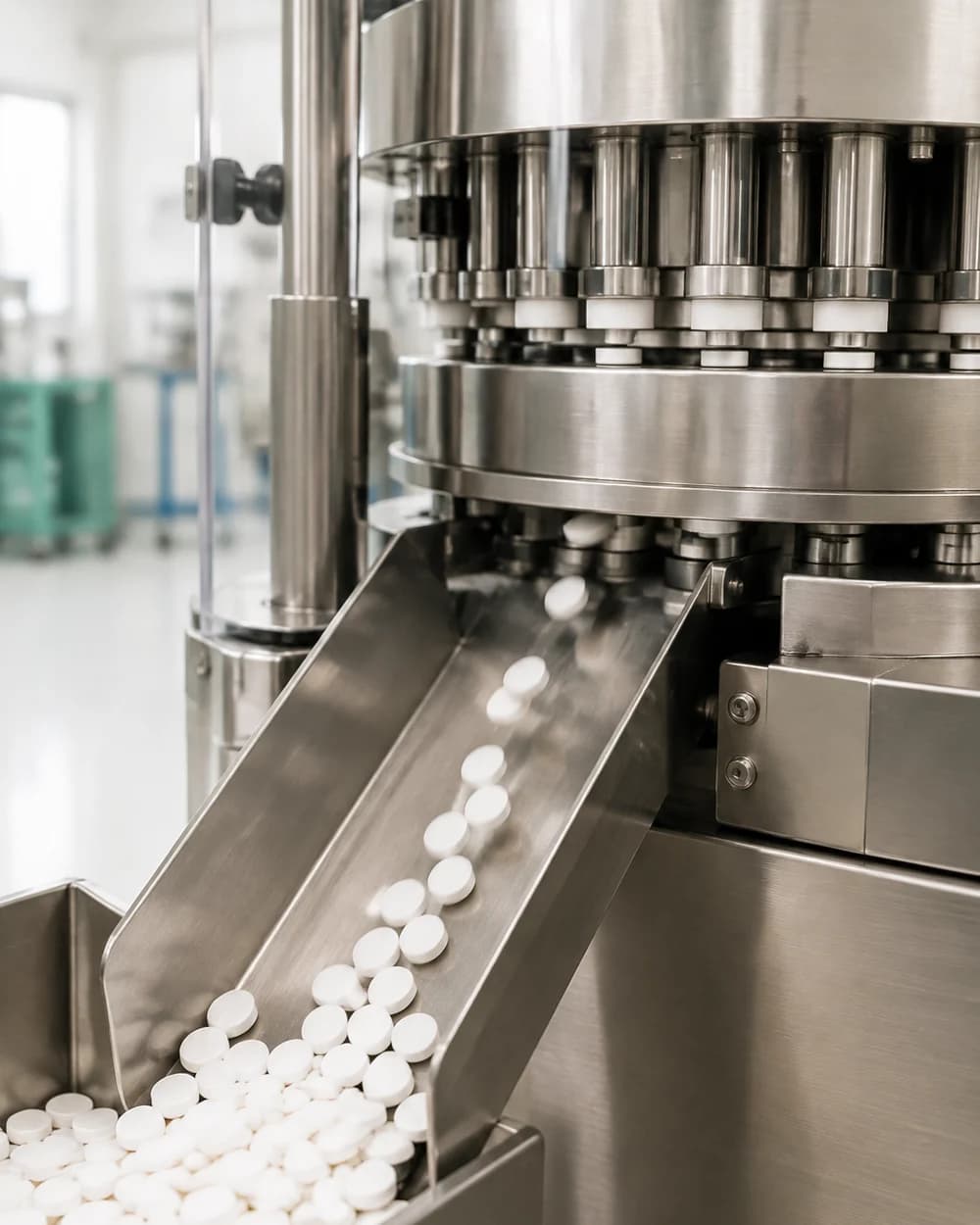
Selenium Tablet Manufacturer for Private Label and Contract Supply
EUPHM produces selenium tablets in a GMP-certified facility in Guangdong, China. We work from 1,000 units and retail bottling from 5,000 units per SKU, with sample lead times of 7–10 working days.
Overview
Selenium is a narrow therapeutic index mineral: the gap between a useful daily dose and the upper limit is small. That makes the tablet form, the salt choice and the blend uniformity the parts that matter. As a selenium tablet manufacturer, we work with sodium selenite, sodium selenate, selenomethionine and selenium-enriched yeast across 50 mcg to 200 mcg per tablet. This page covers the specifications, formulation routes and compliance documents you will need before placing a purchase order.

- MOQ
- 1,000 units per SKU for retail bottling; lower for pilot runs
- Tablet fill weight
- 150–1,200 mg, depending on actives and excipients
- Selenium actives
- Sodium selenite, sodium selenate, selenomethionine, selenium yeast
- Sample lead time
- 7–10 working days
- Mass production
- 20–35 working days after artwork and deposit
- Certifications
- GMP, ISO 9001, ISO 22000, HACCP, NSF/ANSI 455-2, halal, FDA-registered
Tablet Compression Capacity and Tooling
Our rotary tablet presses run at 30–60 strokes per minute depending on tablet size and hardness. For selenium tablets, we typically target a hardness of 8–12 kp and a friability below 0.8 percent, which keeps the tablet intact through bottling, shipping and consumer handling. Tooling is available in round, oval, caplet and custom shapes, with embossing or debossing on one or both faces. We can produce coated or uncoated tablets, and we run a separate line for organic-certified batches to avoid cross-contact.
Changeover between SKUs takes 4–6 hours, including full dismantling, cleaning and line clearance. That is why we set the MOQ at 1,000 units: below that, the cleaning and setup cost per unit rises sharply. If you are testing a new selenium SKU, we recommend a pilot run of 1,000 units in a single bottle size, then scaling to full retail bottling once the formula and artwork are locked.
Selenium Forms and Formulation Choices
The selenium source determines the label claim, the stability profile and the cost per tablet. Sodium selenite is the most economical and is fully water-soluble, but it has a narrower overage window. Selenomethionine and selenium-enriched yeast are better suited to premium positioning and can carry a 'yeast-bound' or 'organic selenium' claim where regulations allow. We hold overage at 5–15 percent above label claim, based on 24-month real-time and accelerated stability data.
Excipient selection matters more than most buyers expect. Microcrystalline cellulose and dicalcium phosphate are the usual diluents; croscarmellose sodium or sodium starch glycolate handle disintegration; magnesium stearate or vegetable stearate is the lubricant. For a 200 mcg selenium tablet at 300 mg fill weight, the active is a very small fraction of the blend, so we run a pre-blend step and validate blend uniformity by sampling at 6–10 points. We can also combine selenium with vitamins C and E, zinc, or iodine in a single tablet.
Quality Control, Documentation and Shipping
Every selenium batch is tested for assay, uniformity of dosage units, disintegration, hardness, friability and microbial limits before release. Heavy metals and residual solvents are tested where the ingredient supplier's COA does not cover them. We retain samples for 24 months and can provide a certificate of analysis per batch, plus a full stability protocol if you need one for your market. The facility is FDA-registered and holds GMP, ISO 22000 and HACCP certification.
For export, we ship FOB Shenzhen or Yantian, with DDP available to US, EU, UK and Middle East addresses. Standard retail packaging is 30, 60, 90 or 120 count in HDPE bottles with induction seals, or blister packs at 10–30 tablets per card. Cartons are export-grade, with desiccant where humidity is a risk. Lead time from purchase order to ex-works is 20–35 working days, and we provide artwork templates sized to your bottle and label dimensions.
Quality Control and Batch Documentation
Every selenium tablet batch is tested against a written specification before release. Identity is confirmed by HPLC or ICP-MS for selenium species, and potency is assayed to ensure the label claim falls within 95–105% for selenomethionine or 90–110% for yeast-based selenium. Microbial limits follow USP <2021> or <2022> with total aerobic count below 3,000 cfu/g, yeast and mould below 300 cfu/g, and absence of E. coli and Salmonella. Heavy metals are screened by ICP-MS with lead below 0.5 ppm, arsenic below 1.0 ppm, cadmium below 0.5 ppm and mercury below 0.1 ppm. Disintegration testing uses USP <701> at 37°C in water, with uncoated tablets required to disintegrate within 15 minutes and coated tablets within 60 minutes.
In-process checks run at compression every 30 minutes: weight variation (individual tablet weight within ±5% of target), hardness (typically 4–10 kp for selenium tablets), thickness and friability (below 1.0% after 100 revolutions). At the end of compression, a composite sample is taken for full finished-product testing. Each batch retains a minimum of two retention samples at 2–8°C and 25°C/60% RH for the shelf life plus 12 months. The certificate of analysis (COA) issued with each batch lists batch number, manufacture date, expiry date, active ingredient assay, microbial results, heavy metals, disintegration, appearance, and a statement of compliance with the agreed specification. A signed and stamped COA is provided in PDF and a hard copy can be included in the shipment.
Stability follows ICH Q1A(R2) guidelines. Accelerated conditions at 40°C/75% RH for six months and long-term conditions at 25°C/60% RH for up to 36 months are run on at least three batches. For selenium yeast tablets, additional testing for selenium speciation is performed at 0, 3, 6, 12, 24 and 36 months to confirm the organic selenium fraction remains stable. We provide stability protocols and summary reports for your regulatory filings. If you require real-time stability data before launch, we can share existing data from similar formulations or initiate a study with a 12-week lead time for the first time point.
Packaging, Labelling and Retail Readiness
Selenium tablets can be packed in high-density polyethylene (HDPE) bottles with induction seals and child-resistant caps, in blister packs using PVC/PVDC or alu-alu for moisture-sensitive formulations, in stick packs of 10–20 tablets, or in single-dose sachets. Bottle sizes range from 30 cc to 500 cc, with standard counts of 60, 90, 120 or 180 tablets. We can apply desiccant canisters or silica gel sachets where required. Blister cards can be printed with lot and expiry coding via inkjet or laser. Cartons are made from 300–350 gsm recycled board with a matt or gloss finish. Pallet specifications are 1,200 mm × 1,000 mm or 1,200 mm × 800 mm, with a maximum height of 1,800 mm including the pallet, and stretch-wrapped with corner boards.
For the US market, labels must include a supplement facts panel with the selenium amount per serving, % daily value based on the 55 mcg reference intake, a list of ingredients, allergen statement, net quantity of contents, name and place of business of the manufacturer, packer or distributor, and a domestic address or phone number for reporting serious adverse events. We can generate print-ready artwork from your copy or work with your designer. Lot and expiry codes are applied to the bottle, carton and shipper in a legible format, typically as Julian date or YYYYMMDD, with a minimum character height of 1.5 mm. We also support Amazon FNSKU labelling, poly-bagging with a suffocation warning, and retail-ready carton markings including ITF-14 barcodes.
Before production, we provide a packaging specification sheet that lists bottle material, cap type, liner, label dimensions, adhesive type and carton dimensions. Label proofs are sent for your written approval, and we retain a signed proof for traceability. For blister packs, we can supply a sample card for your stability or marketing review. If you sell in the EU, we can add the responsible person address and the EC batch number. For halal markets, the packaging line is segregated and documented. We do not print certifications on labels unless you hold a valid certificate and provide a copy for our records.
MOQ, Lead Times and Delivery
The minimum order quantity for selenium tablets is 1,000 units per SKU for retail bottling; smaller pilot runs can be discussed case by case. Samples are prepared in 7–10 working days after receipt of your specification and label artwork. Sample costs are credited against the first production order. Mass production takes 20–35 working days after artwork approval and deposit receipt, depending on tablet count, packaging format and whether the selenium active is a standard grade or a custom blend. We confirm the production window in the proforma invoice. For repeat orders, lead time can reduce to 15–25 working days if raw materials are in stock.
We ship from Guangdong, China, via air freight or sea freight. Air freight to the US or EU typically takes 5–8 days door-to-door for 100–500 kg, while sea freight takes 25–35 days port-to-port. We quote EXW, FOB Shenzhen or Hong Kong, and DDP for most destinations. DDP includes customs clearance and duties but requires a valid importer of record. For DDP shipments, we handle the logistics and provide a delivery note. We recommend air freight for initial launches and sea freight for replenishment orders above 500 kg. All shipments are palletised and shrink-wrapped, with a packing list inside the container.
Documents provided with each shipment include the certificate of analysis, material safety data sheet (MSDS) for the finished product, free-sale certificate, and phytosanitary certificate where applicable for plant-derived excipients. We also provide a certificate of origin and a halal certificate if the batch is produced under those programmes. For EU deliveries, we can issue a declaration of compliance for food contact materials. Shipping documents are sent by email within 48 hours of dispatch, and original documents are couriered if a letter of credit requires them. We do not release shipments without full payment unless credit terms are agreed in advance.
Formats and Packaging Options
Selenium yeast 200 mcg
Yeast-bound selenium for premium labels. 200 mcg per tablet, 300–500 mg fill weight. Suitable for organic certification when the yeast supplier is certified.
Sodium selenite 50–200 mcg
Low-cost inorganic route. Fully water-soluble, good for high-volume retail. Overage held at 5–10 percent above label claim.
Selenomethionine 100–200 mcg
Amino-acid chelated form. Higher bioavailability data and a clean label position. Often paired with vitamin E.
Combination tablets
Selenium with zinc, iodine, vitamin C or vitamin E in one tablet. Custom ratios from 50 mcg selenium upward, subject to compatibility testing.
How a Project Runs
- 01
Brief and quote
Send your selenium form, dose, tablet count and target market. We return a quote with MOQ, unit cost and lead time within 2 working days.
- 02
Formulation review
We check compatibility, overage and excipient route against your label claim. You approve the formula and fill weight before sampling.
- 03
Samples
We produce 50–200 sample tablets in 7–10 working days. Samples ship with a draft COA and a specification sheet for your review.
- 04
Artwork and compliance
You supply label artwork. We check dieline, supplement facts panel and market-specific claims before print. Print proofs take 3–5 working days.
- 05
Mass production
After deposit and artwork sign-off, production runs 20–35 working days. In-process checks run every 30 minutes on hardness and weight.
- 06
QC release and shipping
Final QC releases the batch with a COA. We pack to your carton spec and ship FOB Shenzhen or DDP to your warehouse.
Why EUPHM
Low MOQ for testing
Pilot runs from 1,000 units let you validate a selenium SKU before committing to a full retail order. No tooling fee on standard shapes.
Documentation ready
COA, stability data, halal and vegan certificates are available on request. We support your market's regulatory filing.
One plant, many forms
Tablets, capsules, softgels and powders under one roof. If selenium moves to a capsule later, the supplier relationship stays the same.
Questions buyers ask.
What is the MOQ for selenium tablets?+
1,000 units per SKU for retail bottling. Pilot runs below 1,000 units are possible but carry a higher per-unit setup cost. If you need multiple bottle sizes, each size is a separate SKU and counts toward the MOQ.
Which selenium form should I choose?+
Sodium selenite is the lowest-cost option and works for value retail. Selenomethionine and selenium yeast support premium and organic positioning. If your label needs a specific claim, check your market's rules first, then we match the form to the claim.
How long do samples take?+
7–10 working days for standard selenium formulas. Custom combinations or new tooling can add 3–5 working days. Samples ship with a draft COA and specification sheet.
Can you make organic-certified selenium tablets?+
Yes, where the selenium yeast supplier holds organic certification. We run organic batches on a separated line with dedicated cleaning and line clearance. and EU organic documentation is available. Non-organic selenium forms cannot carry an organic claim.
What is the production lead time?+
20–35 working days after deposit and artwork sign-off. This covers blending, compression, coating where needed, QC release and packing. Shipping transit adds 7–35 days depending on destination and freight mode.
What selenium speciation testing do you perform on selenium yeast tablets?+
For selenium-enriched yeast, we test the proportion of organic selenium (selenomethionine and selenocysteine) versus inorganic selenium using HPLC-ICP-MS. The specification typically requires at least 90% organic selenium. We also test for residual yeast and microbial contamination. This testing is performed on each batch of raw yeast and on the finished tablets at release. Results are included in the COA. If you need a specific speciation profile, we can adjust the yeast source or blend with selenomethionine.
Can you supply selenium tablets in blister packs for pharmacy or retail?+
Yes. We offer PVC/PVDC and alu-alu blister packs in 10, 14, 21 or 30 tablets per card. Alu-alu is recommended for selenium yeast tablets because it provides a high moisture barrier. Blister cards can be printed with lot and expiry coding, and we can include a patient information leaflet in the carton. Minimum order for blister packing is 10,000 tablets. We provide a sample card for your approval before production.
What is the shelf life of your selenium tablets and how is it determined?+
Shelf life is typically 24 months for selenium tablets and 36 months for selenium yeast tablets when stored below 25°C in the original sealed container. It is based on real-time stability data at 25°C/60% RH and accelerated data at 40°C/75% RH. We assign the expiry date from the batch manufacture date and print it on the label. If you require a longer shelf life, we can discuss formulation changes or packaging options such as alu-alu blisters.
Have a product in mind?
Send us the brief and we will come back with a formulation direction, indicative price and a realistic lead time — usually within one working day.