Vitamin D3 Gummy Manufacturer for Private Label Brands
EUPHM produces vitamin D3 gummies in a GMP-certified facility in Guangdong, China. MOQ is 1,000 units per SKU, with lower pilot-run volumes. Samples ship in 7–10 working days. Mass production runs 20–35 working days.
Overview
Vitamin D3 gummies are one of the highest-volume supplement formats for US, EU, UK and Middle East retail. Brands need a manufacturer that can hold 1,000–5,000 IU per gummy, match flavour and pectin or gelatin base, and keep labels compliant. EUPHM runs dedicated gummy lines for vitamin D3, with in-house pectin and gelatin cooking, depositing, curing and bottling. This page covers specifications, formulation options, quality checks and logistics for D3 gummy projects.
- MOQ
- 1,000 units per SKU
- D3 potency
- 400 IU, 1,000 IU, 2,000 IU, 5,000 IU per gummy
- Base
- Pectin (vegan) or gelatin; 2.5–4.0 g per gummy
- Sample lead time
- 7–10 working days
- Mass production
- 20–35 working days after PO and artwork approval
- Certifications
- GMP, ISO 9001, ISO 22000, HACCP, NSF/ANSI 455-2, halal, FDA-registered
Gummy production capability
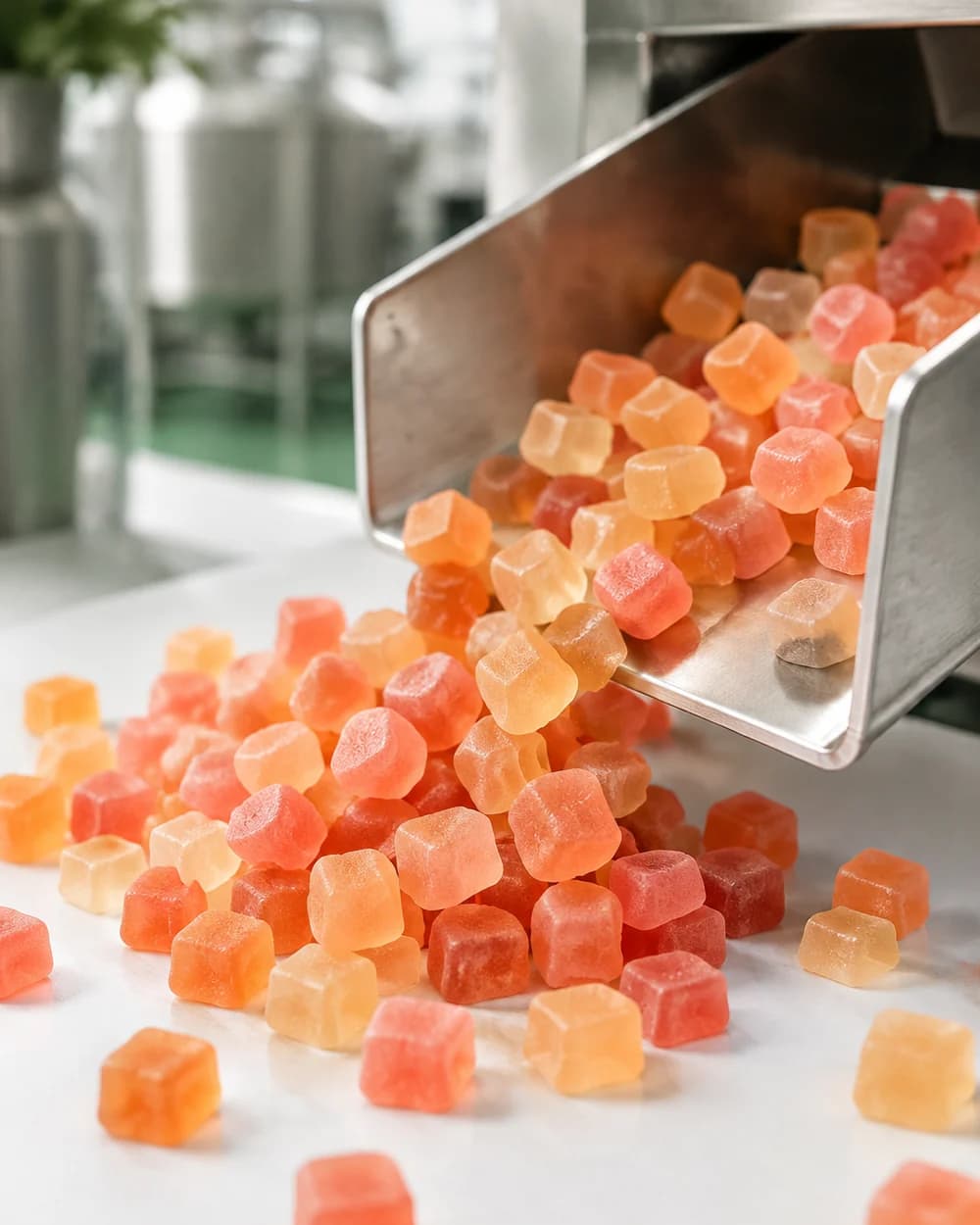
EUPHM operates three gummy lines with a combined capacity of 12 million gummies per month. Each line runs pectin and gelatin bases on separate changeovers. Depositing accuracy is ±3% of target fill weight. Curing rooms hold 20–25°C and 25–35% relative humidity for 48–72 hours, which controls final texture and water activity. Bottling runs on the same site, so D3 gummies move from curing to 60, 90 or 120-count HDPE or PET bottles without external transport.
The plant handles vitamin D3 in two forms: cholecalciferol from lanolin and vegan D3 from lichen. Both are oil-suspended and emulsified into the gummy base before depositing. We run 400 IU to 5,000 IU per gummy. For high-potency SKUs above 2,000 IU, the formulation uses a tighter oil-to-emulsifier ratio to prevent bloom and potency drift. Line changeover between D3 and non-D3 products includes full wash-down and allergen screening.
Formulation details for D3 gummies
Vitamin D3 is fat-soluble, so the gummy base must carry an oil phase without separation. EUPHM uses a pre-emulsion step: cholecalciferol or lichen D3 is mixed with medium-chain triglycerides and a food-grade emulsifier, then folded into the cooked syrup at 75–80°C. This keeps potency uniform across the batch. Typical overage is 10–15% at production to meet label claim through 24-month shelf life. We verify potency by HPLC at three points: raw material, post-mix and finished goods.
Flavour and colour options include orange, strawberry, lemon, mixed berry and unflavoured. Natural colours come from carrot, beetroot and turmeric; synthetic options are also available. Pectin gummies suit vegan, halal claims. Gelatin gummies give a chewier bite and are common in US retail. Sugar-free versions use maltitol or allulose with soluble corn fibre. Each formula is adjusted for pH 3.2–3.8, which affects both taste and D3 stability.
Quality, compliance and logistics
Every D3 gummy batch is tested for potency, microbial limits, heavy metals, water activity and texture. The facility is GMP-certified and holds ISO 22000 and HACCP. Halal and vegan certifications are available depending on the formula and ingredient sources. We provide a Certificate of Analysis per batch. For US-bound products, the facility is FDA-registered. Labels can carry structure-function claims where the brand holds substantiation. We do not claim FDA approval of any product.
Shipping runs from Shenzhen and Hong Kong ports. Typical transit is 18–25 days to US West Coast, 25–35 days to EU and UK, and 12–20 days to Middle East ports. We handle FOB, CIF and DDP terms. Bottles are packed in shippers with desiccant where humidity is a risk. Carton dimensions and pallet configurations are shared before production so brands can plan warehouse slots. Air freight is available for pilot runs and launch quantities.
Quality Control and Batch Documentation
Every vitamin D3 gummy batch is tested at three points: incoming raw materials, in-process gummy samples after curing, and finished packed goods. Vitamin D3 (as cholecalciferol or vegan D3 from lichen) is assayed by HPLC to confirm 100–115% of label claim. Pectin and gelatin are checked for gel strength and moisture. Microbial testing covers total aerobic count, yeast and mould, E. coli, Salmonella and Staphylococcus aureus. Heavy metals (lead, arsenic, cadmium, mercury) are tested per ICP-MS against EU and US limits. Disintegration testing follows USP <2040> for gummies, typically 30–45 minutes in purified water at 37°C.
A Certificate of Analysis (COA) is issued for each batch and includes batch number, production date, expiry date, D3 potency result, microbial results, heavy metals results, disintegration time, appearance, flavour and net weight. COAs are available in English and can be formatted to your specification. Retention samples of every batch are held for the full shelf life plus six months, stored at 25°C/60% RH and 30°C/65% RH. Stability protocols cover 0, 3, 6, 12, 18 and 24 months for potency, microbials and organoleptic properties. Accelerated stability at 40°C/75% RH for six months is available on request.
In-process checks run every 30 minutes during depositing: gummy weight (target ±5%), D3 suspension uniformity, colour and flavour intensity, and metal detection at the end of the line. Each batch is assigned a unique lot number that links raw material COAs, production records, packaging records and finished-goods COA. If a deviation occurs, a non-conformance report is raised and the batch is placed on hold pending investigation. Documentation packages for retail customers typically include the finished-goods COA, raw material COAs for D3 and gelling agents, a declaration of allergen status, and a GMO-free statement.
Packaging and retail-ready labelling for vitamin D3 gummies
Vitamin D3 gummies can be packed in HDPE bottles (60, 90, 120, 150 or 180 count) with induction seal and child-resistant or standard caps, in blister packs (10 or 12 gummies per blister), in stick packs (single-serve 2.5–4.0 g), or in sachets for sample and travel formats. Bottle diameters and heights are standardised to fit common retail shelf sets. Labelling options include direct print, pressure-sensitive labels and shrink sleeves. We can apply tamper-evident seals and lot/expiry codes by inkjet or laser on bottle, label and carton.
For US dietary supplements, labels must carry the Supplement Facts panel with vitamin D3 declared in IU and mcg per gummy, serving size, other ingredients, allergen statement, and the standard domestic address and phone number. EU labels require nutrition declaration per 100 g and per portion, plus the health claim wording permitted under Regulation (EC) No 1924/2006. UK labels follow the same structure with UK address. We can review your artwork for mandatory elements and flag missing items, but final label compliance remains the brand owner's responsibility. Lot and expiry coding follows your format, typically YYMMDD and best-before date.
Carton specifications: standard export carton is 5-ply corrugated, with gummies in bottles or blisters protected by dividers. Carton dimensions and weight are confirmed at artwork stage; typical bottle cartons hold 12–24 units. Palletisation is 1,000–1,200 mm × 1,200 mm or 1,000 mm × 1,200 mm, stretch-wrapped and corner-boarded, with a maximum height of 1,800 mm including pallet. For Amazon FBA, we can print and apply FNSKU labels, poly-bag units where required, and prepare cartons to Amazon's weight and dimension limits. Retail compliance for supermarkets may require specific carton markings, SSCC labels and advance shipping notices.
MOQ, Lead Times and Delivery
Sample timeline for a vitamin D3 gummy project is 7–10 working days from receipt of your specification and flavour brief. Samples are produced on the same depositing line as mass production, not in a lab, so texture and potency are representative. Sample cost is quoted per project and can be credited against the mass-production order. Once you approve the sample and artwork, mass production runs 20–35 working days after purchase order and artwork approval, depending on bottle or blister format and whether custom packaging is used.
Shipping options are air freight (5–10 days door to door) and sea freight (25–40 days port to port, depending on destination). For small pilot orders, air freight is usually more economical per unit; for orders above 500 kg, sea freight reduces landed cost. Incoterms offered are EXW, FOB Shenzhen or Hong Kong, and DDP for selected destinations. DDP includes customs clearance and duties but requires accurate HS codes and product descriptions. We provide commercial invoice, packing list, bill of lading or air waybill, COA, MSDS, free-sale certificate and, where required, phytosanitary certificate for plant-derived ingredients.
Delivery documentation is prepared within 3 working days of shipment. The free-sale certificate confirms the product is manufactured under GMP and is freely sold in China. MSDS is provided for transport and customs. For halal claims, certificates are issued by the relevant certification body and are batch-specific. If you use your own freight forwarder, we coordinate collection from the factory. For DDP, we use nominated forwarders and provide a tracking number once the shipment is booked. Lead times are confirmed in the proforma invoice and are counted from the later of PO date or artwork approval.
What We Can Build
Pectin vegan base
Plant-based pectin gummies suited to vegan, halal labels. Firmer chew, stable at 25°C. Typical fill weight 2.5–3.5 g.
Gelatin base
Porcine or bovine gelatin for a softer, chewier texture common in US retail. Fill weight 3.0–4.0 g. Not suitable for halal unless certified.
Sugar-free formula
Maltitol, allulose or soluble corn fibre replace sucrose and glucose syrup. Lower glycemic impact. Texture adjustment needed for D3 oil dispersion.
High-potency 5,000 IU
For therapeutic or adult daily-dose SKUs. Requires tighter emulsion and overage control. HPLC potency testing at three production stages.
How a Project Runs
- 01
Brief and quote
Send target potency, base, flavour, bottle count and market. EUPHM returns a quote with MOQ, unit price and lead time within 2 working days.
- 02
Sample development
Formulation team prepares 2–3 sample variants. Samples ship in 7–10 working days. Client reviews taste, texture and potency.
- 03
Sample approval
Client signs off on formula, colour, flavour and bottle. EUPHM locks the master batch record and issues a spec sheet.
- 04
Artwork and compliance
Brand provides label artwork. EUPHM checks ingredient naming, allergen statements and claim wording against destination market rules.
- 05
Mass production
Production runs 20–35 working days after PO and artwork approval. In-process checks every 30 minutes. Batch COA issued at release.
- 06
Shipping and release
Bottles are packed, palletised and shipped FOB, CIF or DDP. Documents include COA, packing list, commercial invoice and certificate of origin.
Why EUPHM
Low MOQ 1,000
1,000 units per SKU for retail bottling. Pilot runs from 1,000 units for market testing before scale-up.
In-house D3 emulsion
Oil-phase pre-emulsion and HPLC potency testing at three stages. Overage 10–15% to meet label claim through 24-month shelf life.
Multi-certified plant
GMP, ISO 9001, ISO 22000, HACCP, NSF/ANSI 455-2 and halal certification; FDA facility registration for US-bound shipments.
Questions buyers ask.
What is the MOQ for vitamin D3 gummies?+
MOQ is 1,000 units per SKU for standard retail bottling. Pilot runs can start from 1,000 units, though unit cost is higher. MOQ depends on bottle count, base type and whether the formula is stock or custom. A 90-count bottle at 2,000 IU is a common first order.
Can you make vegan vitamin D3 gummies?+
Yes. We use lichen-derived D3 with a pectin base. This combination supports vegan, halal claims. The potency range is 400–5,000 IU per gummy. Vegan D3 costs more than lanolin D3, typically 15–25% higher on raw material, which affects unit price.
What is the lead time for samples and mass production?+
Samples ship in 7–10 working days after brief confirmation. Mass production runs 20–35 working days after PO and artwork approval. Peak season from August to November can add 5–7 days. We confirm dates in writing before you place the order.
Which certifications does the facility hold?+
The plant is GMP-certified and holds ISO 22000 and HACCP. Halal and vegan certifications are available depending on the formula and ingredient sources. Certificates are shared before production. The facility is FDA-registered for US-bound products; this is not an FDA approval of any finished product.
Can you match a competitor's D3 gummy texture and flavour?+
In most cases, yes. Send 5–10 units of the target product. We analyse texture, fill weight, pH, flavour profile and potency, then build 2–3 sample variants. Matching a pectin or gelatin base is straightforward. Exact flavour duplication depends on proprietary flavour houses, so we may propose a close alternative.
What is the shelf life of your vitamin D3 gummies and how is it supported?+
Shelf life is typically 18–24 months from production date, depending on base and packaging. It is supported by real-time stability data at 25°C/60% RH and accelerated data at 40°C/75% RH for six months. Potency, microbials and organoleptic properties are tested at 0, 3, 6, 12, 18 and 24 months. We provide a stability summary with the COA so you can set your own best-before date with confidence.
Can you produce vitamin D3 gummies with a sugar-free or reduced-sugar claim?+
Yes. We can formulate with maltitol, xylitol, erythritol or isomalt, alone or in combination, to support sugar-free or reduced-sugar claims. Texture and laxative threshold vary by polyol, so we recommend a sample trial before committing to mass production. Sugar-free gummies require specific process controls for crystallisation and moisture. Label claims must meet the destination market's rules, for example EU Regulation (EC) No 1924/2006.
How do you handle flavour and colour matching for repeat orders?+
We retain a approved reference sample and the formulation record for every SKU. On repeat orders, the same flavour supplier, colour supplier and dosage are used, and the first production batch is compared against the retained sample for colour, flavour and texture. If a raw material lot changes, we run a bench trial before production. You can request a pre-production sample from the new lot for approval before the full run.
Have a product in mind?
Send us the brief and we will come back with a formulation direction, indicative price and a realistic lead time — usually within one working day.