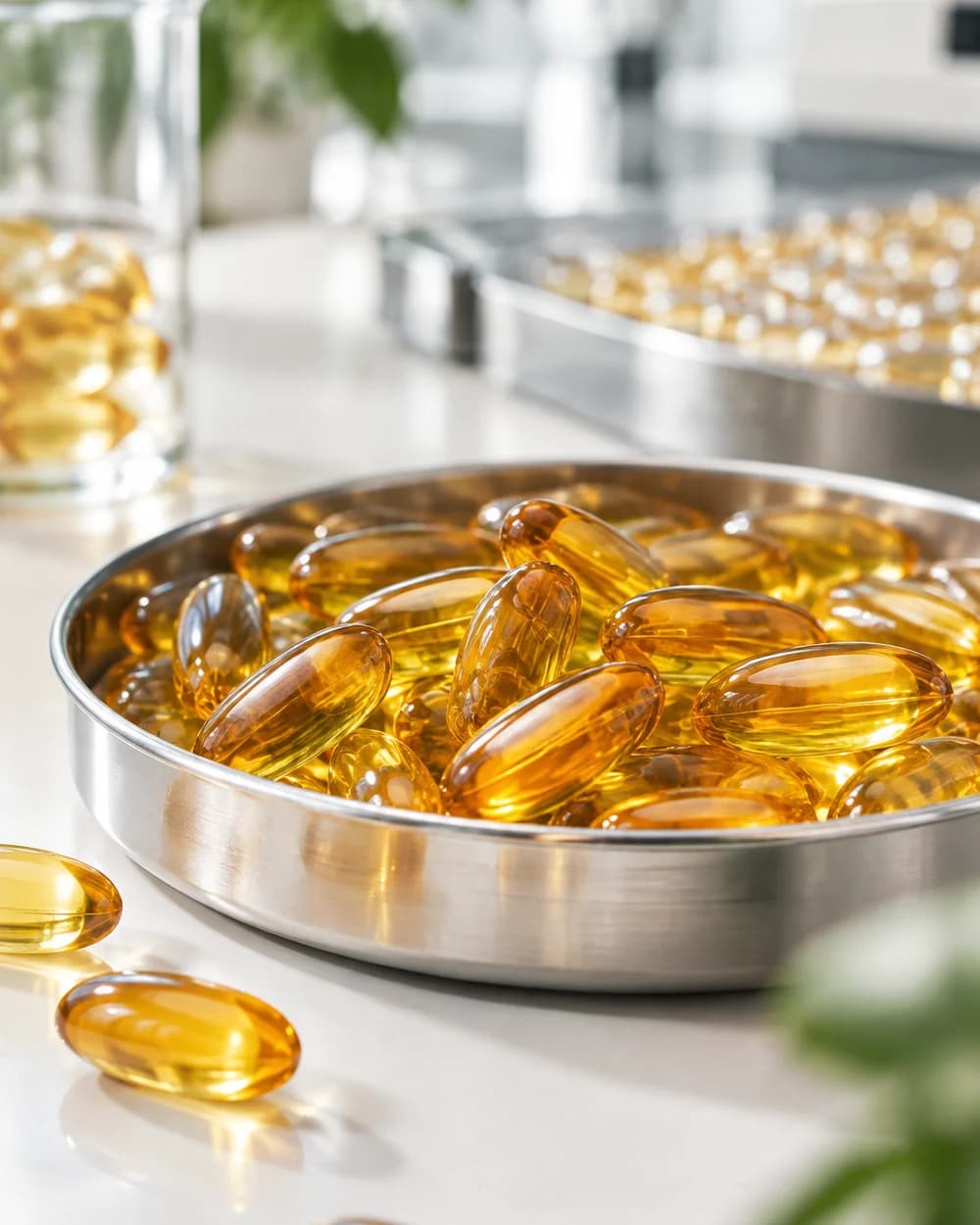
MCT Oil Softgel Manufacturer for Custom Supplement Brands
Source MCT oil softgels from a GMP-certified plant in Guangdong. MOQ from 1,000 units per SKU, samples in 7-10 working days, and mass production in 20-35 working days. Fill weights from 300 mg to 1,200 mg.

Overview
MCT oil softgels are a stable, tasteless format for C8 and C10 medium-chain triglycerides, popular in keto, sports nutrition and functional wellness ranges. As a contract manufacturer, EUPHM handles formulation, softgel encapsulation, drying, polishing and retail bottling under one roof. This page covers fill options, shell systems, quality checks and logistics for buyers sourcing at commercial scale. For broader softgel capabilities, see our softgel manufacturer page.
| MOQ | 1,000 units per SKU; lower for pilot runs |
|---|---|
| Fill weight range | 300 mg to 1,200 mg MCT oil per softgel |
| Sample lead time | 7-10 working days |
| Mass production | 20-35 working days after sample approval |
| Certifications | GMP, ISO 9001, ISO 22000, HACCP, NSF/ANSI 455-2, halal, FDA-registered |
| Bottling formats | 30, 60, 90, 120, 180 count; bulk pouches on request |
Softgel Production Capacity and Formats
The plant runs rotary die encapsulation lines for oil-based fills, with typical output of 1.2 to 1.8 million softgels per day across shifts. MCT oil is handled in temperature-controlled tanks and dosed by positive displacement pumps, which keeps fill weight variation within +/- 3% for most 500 mg to 1,000 mg formats. Oblong, oval and round dies are available in standard sizes; custom tooling can be quoted for volumes above 500,000 units.
Finishing includes tumble drying, polishing and optional enteric or delayed-release coatings. Softgels can be packed into HDPE bottles with induction seals, child-resistant caps or standard screw caps. Bulk packing in 20 kg or 25 kg food-grade liners is available for buyers who bottle in their own facility. Line capacity is planned around 20-35 working day production windows, so seasonal launches should be booked 8-12 weeks ahead.
MCT Oil Grades and Shell Formulation
MCT oil is specified by C8 (caprylic) and C10 (capric) content. Common commercial grades include 60/40 C8/C10, 70/30 and high-C8 95%+ fractions. Each grade changes cost, mouthfeel and oxidative stability, and all three can be run on the same encapsulation line. Carrier oils such as sunflower or coconut oil can be blended to adjust viscosity or to standardise the label claim. Typical fill weights are 500 mg, 750 mg and 1,000 mg.
The gelatin shell can be bovine, porcine or fish-derived, and vegan softgels using modified starch or carrageenan are available. Shell plasticisers include glycerin and sorbitol, with water content controlled to 6-10% for a soft, stable capsule. Opacifiers such as titanium dioxide and natural colours from annatto, caramel or spirulina can be added. If the product is aimed at halal markets, the shell source and processing aids are documented accordingly.
Quality Control and Export Documentation
Every MCT oil lot is tested for peroxide value, acid value, fatty acid profile and microbial limits before release. In-process checks cover fill weight, seam thickness, shell hardness and leakage. Finished softgels are tested for assay, disintegration and, where required, heavy metals and residual solvents. Batch records, certificates of analysis and retention samples are kept for traceability. The facility is GMP-certified and registered with the relevant food safety authorities; it is not an FDA-approved drug facility.
For export, the team prepares commercial invoices, packing lists, certificates of origin, health certificates, halal certificates and, where applicable, organic transaction certificates. Shipping is typically by sea from Shenzhen or Hong Kong, with air freight for pilot batches. Incoterms such as FOB, CIF and DDP can be quoted. Lead times assume cleared artwork and approved samples; label changes after production starts may add 5-10 working days.
Quality Control and Batch Documentation
Every MCT oil softgel batch is tested at three stages: incoming raw material, in-process encapsulation, and finished goods. Incoming MCT oil is checked for identity by fatty acid profile (C8 and C10 content), peroxide value, and acid value. Gelatin or vegan shell materials are tested for bloom strength and microbial limits. In-process checks include fill weight variation (target ±5%), seam integrity by visual inspection, and shell thickness. Finished softgels are tested for potency (mg MCT per capsule), microbials (total aerobic count, yeast and mould, E. coli, Salmonella), heavy metals (lead, cadmium, arsenic, mercury), and disintegration time (typically under 30 minutes in purified water at 37°C).
Batch documentation follows a fixed template. The certificate of analysis (COA) lists test parameters, specifications, results, and test methods, with a batch number and release date. Retention samples of every batch are kept for 24 months under controlled temperature and humidity. Stability testing follows a standard protocol: accelerated conditions at 40°C/75% RH for 6 months, and real-time conditions at 25°C/60% RH for up to 24 months. Results are documented in a stability report available to buyers on request.
Microbial testing uses USP <61> and <62> methods, and heavy metals are tested by ICP-MS. Disintegration testing follows USP <701>. All testing is performed in-house or at a third-party ISO 17025 laboratory, depending on the parameter. Buyers receive a full COA per batch, and can request raw data for any test. For MCT oil softgels, we also monitor for rancidity over shelf life by measuring peroxide value at 0, 3, 6, 12, and 24 months.
Packaging, Labelling and Retail Readiness
MCT oil softgels can be packed in HDPE bottles (30, 60, 90, 120, 180 count), blister packs (10, 12, or 15 softgels per blister), stick packs (single softgel per stick), or sachets (2-5 softgels per sachet). Bottles are induction-sealed and fitted with child-resistant or standard caps. Labelling follows FDA dietary supplement requirements: statement of identity, net quantity, supplement facts panel, ingredient list, allergen declaration, and manufacturer/distributor information. We print lot numbers and expiry dates by inkjet or laser coding on the bottle, carton, and shipper.
Carton specifications: each bottle is packed in a retail carton with a minimum 300 gsm board, and shippers are 5-ply corrugated. Standard pallet configuration is 48 x 40 inches (US) or 1200 x 1000 mm (EU), with a maximum height of 1.8 m including pallet. We provide Amazon FNSKU labelling and poly-bagging for FBA shipments, and can apply retail-ready packaging such as shelf-ready trays or display cases. For private-label brands, we offer artwork review and can advise on claims compliance for the US, EU, and UK markets.
All packaging materials are food-grade and meet FDA 21 CFR 174-190 for indirect food additives. We can source bottles, caps, and cartons from approved suppliers or use buyer-supplied components. Labelling checks are performed at three points: pre-production artwork approval, first-off inspection, and final random sampling. Retail compliance documentation, including a packaging specification sheet and a certificate of compliance for food-contact materials, is provided with each shipment.
MOQ, Lead Times and Delivery
The minimum order quantity for MCT oil softgels is 1,000 units per SKU, with lower quantities (from 1,000 units) for pilot runs. Sample lead time is 7-10 working days after formulation and shell specification are confirmed. Mass production takes 20-35 working days after sample approval, depending on fill weight, shell type, and packaging format. For repeat orders with unchanged specifications, production can be scheduled within 15-20 working days.
Shipping options include air freight (5-10 days door-to-door) and sea freight (25-40 days port-to-port). We quote EXW, FOB, and DDP terms. For DDP, we handle customs clearance and delivery to your warehouse in the US, EU, UK, or Australia. Air shipments are typically used for samples and urgent orders under 500 kg, while sea shipments are cost-effective for full pallets. We provide a packing list, commercial invoice, and bill of lading for every shipment.
Documents provided with each order include COA, material safety data sheet (MSDS), free-sale certificate, and phytosanitary certificate where applicable. For halal, or organic claims, we supply the relevant certificates from the certifying body. We also provide a certificate of origin and, on request, a GMP certificate for the manufacturing facility. All documents are issued in English and can be legalised or apostilled for specific markets if required.
Manufacturing Options to Compare
C8/C10 60/40 blend
Cost-effective standard grade for everyday keto and energy products. Balanced caprylic and capric content, good oxidative stability.
High-C8 95% fraction
Higher caprylic acid content for premium positioning. Faster absorption claims and a cleaner taste profile, at a higher raw material cost.
Vegan softgel shell
Modified starch or carrageenan shell for plant-based labels. Suitable for EU and UK vegan certification, with no gelatin in the formulation.
Enteric or delayed release
Coating applied after drying to reduce stomach breakdown. Useful for products positioned around digestion comfort or targeted release.
How We Work
- 01
Send your brief
Share target fill weight, grade, shell type, bottle count and estimated annual volume. A short call clarifies feasibility.
- 02
Receive a quote
Pricing is based on fill weight, oil grade, shell, packaging and order quantity. Quotes are valid for 30 days.
- 03
Approve samples
Samples ship in 7-10 working days. You check appearance, fill weight, smell and label fit before mass production.
- 04
Confirm artwork
Final label files, barcodes and regulatory text are checked against the destination market before printing.
- 05
Mass production
Production runs in 20-35 working days. In-process checks cover fill weight, seam and leakage throughout the batch.
- 06
QC and dispatch
Finished goods are tested, released and packed for sea or air freight. Documents are issued with the shipment.
Why EUPHM
Low MOQ for testing
Start at 1,000 units per SKU to validate a market before scaling. Pilot runs below this can be discussed for new formulations.
Documented compliance
GMP, ISO 9001, ISO 22000, HACCP, NSF/ANSI 455-2 and halal certification; FDA facility registration for US-bound shipments.
One-site finishing
Encapsulation, drying, polishing and bottling happen under one roof, which shortens lead times and reduces handling risk.
Questions buyers ask.
What is the MOQ for MCT oil softgels?+
Standard MOQ is 1,000 units per SKU for retail bottling. Lower quantities can be quoted for pilot runs, especially for new brands testing a single bottle size. MOQ applies per SKU, so a 60-count and a 120-count bottle count as two SKUs.
Can you make vegan MCT softgels?+
Yes. Vegan shells use modified starch or carrageenan instead of gelatin. These are suitable for vegan certification and for markets where gelatin is restricted. Fill weights and drying parameters are adjusted because vegan shells behave differently from gelatin during drying.
How long does production take?+
Samples ship in 7-10 working days after the brief and raw materials are confirmed. Mass production takes 20-35 working days after sample approval and artwork sign-off. Add 5-10 working days if labels change after production starts.
Which certificates are provided?+
Each shipment includes a certificate of analysis, batch record reference, health certificate and certificate of origin. Halal and organic certificates are issued where the product and supply chain qualify. The facility holds GMP, ISO 22000 and HACCP certification.
Can you bottle under our brand?+
Yes. Bottling is done in 30, 60, 90, 120 and 180 count HDPE bottles with induction seals and child-resistant or standard caps. Bulk packing in food-grade liners is also available if you bottle in your own facility.
What is the shelf life of your MCT oil softgels and how is it determined?+
Shelf life is typically 24 months from the date of manufacture when stored below 25°C in a dry place. We determine shelf life through accelerated stability testing at 40°C/75% RH for 6 months and real-time testing at 25°C/60% RH. Peroxide value, fill weight, disintegration, and microbial counts are monitored at set intervals. A stability report is available for each formulation.
Can you supply MCT oil softgels in bulk without retail packaging?+
Yes. We offer bulk packaging in food-grade polyethylene bags inside fibre drums or corrugated shippers. Bulk softgels are typically supplied in 5 kg or 10 kg units. This option reduces packaging cost and is suitable for buyers who repack locally or use the softgels as ingredients in other products. We provide the same COA and batch documentation for bulk orders.
Do you offer custom formulations with additional ingredients such as vitamins or electrolytes?+
Yes. We can combine MCT oil with fat-soluble vitamins (A, D, E, K), CoQ10, electrolytes, or herbal extracts in a single softgel. Compatibility and stability testing are required for each custom formulation. We recommend a pilot run of 1,000–1,000 units to confirm fill homogeneity and shell integrity before scaling to commercial volumes. Formulation support is included in the sample process.
Have a product in mind?
Send us the brief and we will come back with a formulation direction, indicative price and a realistic lead time — usually within one working day.