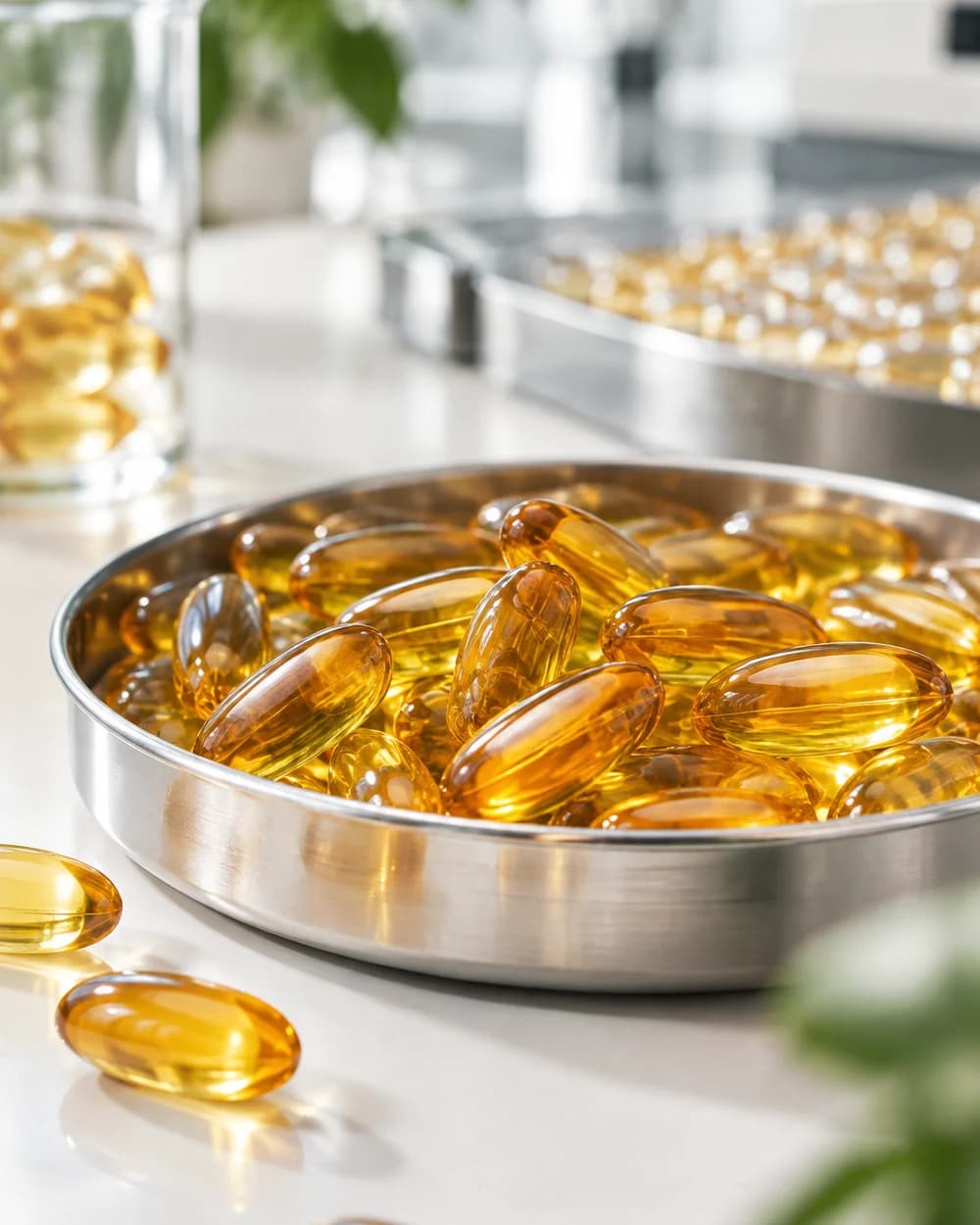
Mini Softgel Manufacturer for Compact-Dose Brands
EUPHM produces mini softgels from 50 mg to 300 mg fill weight on high-precision lines in Guangdong. MOQ starts at 1,000 units per SKU, with pilot runs available. Certifications include GMP, ISO 22000, HACCP, halal and organic where applicable.
Overview
Mini softgels suit paediatric, senior and sports nutrition brands that need an easy-to-swallow dose without losing active potency. This page covers the formats, fill weights and compliance documentation available for small softgel runs. It sits under the broader softgel manufacturing service, which covers standard and large softgels. Buyers sourcing a mini softgel partner can compare line capability, formulation limits and lead times before requesting samples.

- MOQ
- 1,000 units per SKU
- Fill weight range
- 50 mg to 300 mg per mini softgel
- Sample lead time
- 7–10 working days
- Mass production
- 20–35 working days after sample approval
- Certifications
- GMP, ISO 9001, ISO 22000, HACCP, NSF/ANSI 455-2, halal, FDA-registered
- Line capacity
- Up to 180,000 mini softgels per shift
Small-Format Capability and Fill Precision
Mini softgels typically run between 50 mg and 300 mg fill weight, with shell thickness from 0.25 mm to 0.40 mm. Our rotary die lines hold fill-weight variance within ±3% for oil-based actives and ±5% for suspensions. That matters for products where a 10 mg difference in a 100 mg dose changes the label claim. We run 6 mm to 11 mm oblong and round dies, and can produce enteric or vegetarian shells on the same platform.
Capacity reaches 180,000 mini softgels per shift across two lines. That covers pilot batches of 1,000 units and recurring retail runs of 500,000 units per SKU. For brands moving from a standard 500 mg softgel to a 150 mg mini format, we adjust fill weight and shell formulation together to keep the active dose identical. Drying and polishing take 18–24 hours before packing.
Formulation Options for Mini Dosage
Mini softgels handle oils, suspensions and paste-like actives. Common fills include vitamins A, D, E and K, CoQ10, omega-3 concentrates, lutein, zeaxanthin and astaxanthin. For 50 mg to 150 mg doses, we often use medium-chain triglycerides as the carrier and add lecithin to keep suspensions stable. Antioxidants such as mixed tocopherols protect oxidation-sensitive fills. We test viscosity before filling to avoid shell deformation on small dies.
The shell can be bovine, porcine, fish or vegan (modified starch or carrageenan). For halal certification, we source gelatin from approved suppliers and retain chain-of-custody documents. Organic claims require certified actives and a separate production clean-down. We can produce two-piece or seamless mini softgels depending on the fill. Flavour masking is limited in small formats, so we recommend coated or enteric shells for bitter actives.
Quality Control and Export Logistics
Every mini softgel batch is tested for fill weight, shell thickness, disintegration, microbial limits and heavy metals. We retain samples for 24 months. Certificates of analysis include assay results for each active. The facility is GMP-certified, ISO 22000 and HACCP compliant. Halal certificates are available per batch. certification covers specific lines. We do not claim FDA approval; the facility is FDA-registered for dietary supplements.
Export packing runs from 30-count to 180-count HDPE bottles, blister packs and sachets. We ship from Shenzhen and Hong Kong ports. Standard lead time for mass production is 20–35 working days after sample approval. Air freight samples arrive in 3–5 working days. Documentation includes commercial invoice, packing list, certificate of origin, health certificate and certificate of analysis. MOQ for retail bottling is 1,000 units per SKU.
Quality Control and Batch Documentation
Every mini softgel batch is tested against a written specification before release. Identity and potency are confirmed by HPLC for actives such as vitamins, CoQ10 or herbal extracts, with results compared to the approved formula. Microbial testing covers total aerobic count, yeast and mould, E. coli and Salmonella. Heavy metals (lead, arsenic, cadmium, mercury) are screened by ICP-MS. Disintegration testing follows the USP <2040> method for softgels, with a typical limit of 30 minutes in purified water at 37°C. These tests run on the bulk blend where relevant and on the finished softgel.
A certificate of analysis (COA) accompanies each batch and lists the product name, lot number, manufacture and expiry dates, fill weight, appearance, identification result, assay value as a percentage of label claim, microbial results, heavy metals results and disintegration time. Where a customer requires it, the COA can also include residual solvent and allergen statements. Retention samples of every batch are held for the shelf life plus six months, stored under labelled conditions. This allows re-testing if a market complaint or regulatory query arises after export.
Stability follows a protocol agreed at the quotation stage. Accelerated conditions at 40°C and 75% relative humidity are run for three and six months, with real-time data at 25°C and 60% relative humidity for the declared shelf life, typically 24 months for mini softgels. Tests at each interval cover assay, disintegration, microbial limits and appearance. For markets requiring a specific shelf life, such as 18 months at 30°C, the protocol is adjusted before production. Stability data is shared with the brand owner and kept on file for audit.
Packaging, Labelling and Retail Readiness
Mini softgels can be packed in HDPE bottles from 30 cc to 250 cc, blisters of 10 to 30 cavities, stick packs or sachets. Bottle fills are checked by weight and count, with induction sealing and a desiccant option for hygroscopic fills. Blister material is typically PVC/PVDC or alu-alu for moisture-sensitive actives. Cartons are printed to the artwork supplied by the brand owner, and each unit carries a lot number and expiry date in the format agreed at order confirmation. Case packs and pallet configurations are specified before production so that the retail unit matches the shelf and shipping plan.
For the US market, the label must include the supplement facts panel, serving size, amount per serving, percent daily value where applicable, ingredient list, allergen statement, and the manufacturer or distributor address. The FDA does not pre-approve labels, so the brand owner is responsible for claims and structure-function statements. EUPHM can review artwork for obvious omissions such as missing lot fields or incorrect net quantity, but final label compliance remains with the brand. For Amazon, the FNSKU label can be applied in-house, and units can be poly-bagged or shrink-wrapped to meet retail requirements.
Carton and pallet specifications are confirmed with each order. A typical shipper is a five-ply corrugated carton with a net weight of 8 to 12 kg, and pallets are 1,200 x 1,000 mm or 1,200 x 800 mm depending on the destination. Pallet height is kept below 1.8 m for container loading, and each pallet carries a label with lot number, quantity and carton count. For retail buyers, EUPHM can provide a packaging specification sheet listing dimensions, materials and barcode placement. These details are checked against the approved artwork before the first carton is printed.
MOQ, Lead Times and Delivery
Sample requests for mini softgels are handled within 7 to 10 working days from receipt of the formula and fill weight. If a stock formulation is used, samples can be dispatched sooner. The sample pack includes the softgel in a labelled bottle, a draft COA and a specification sheet. Buyers should confirm the fill weight, capsule size and target shelf life at this stage, because changes after sample approval can add 5 to 10 working days to the production window. Pilot runs from 1,000 units are available for brands that need to test the market before committing to 1,000 units.
Mass production runs 20 to 35 working days after sample approval, depending on the number of SKUs and whether packaging is stock or custom printed. Custom cartons and labels add 7 to 12 working days for print and approval. For a 5,000-unit mini softgel order, the typical production window is 25 working days, with dispatch from Guangdong within 3 working days of final release. Line capacity of up to 180,000 mini softgels per shift means larger repeat orders can be scheduled without changing the formulation or the approved packaging.
Delivery terms are quoted as EXW, FOB or DDP. FOB Shenzhen or Hong Kong is common for buyers with their own freight forwarder, while DDP is used for Amazon FBA and small retail orders where the brand owner prefers a delivered price. Air freight takes 5 to 8 days door to door for urgent launches, and sea freight takes 25 to 40 days depending on the port. Documents provided with each shipment include the commercial invoice, packing list, COA, MSDS, free-sale certificate and, where relevant, phytosanitary certificate for botanical ingredients. Certificates of origin can be arranged on request.
What We Can Build
Round 6–8 mm
Best for doses from 50 mg to 150 mg. Smooth surface, easy to swallow for paediatric and senior products. Available in opaque or clear shell.
Oblong 9–11 mm
Suits 150 mg to 300 mg fills. Common for omega-3, CoQ10 and vitamin D3. Can be printed or banded for brand recognition.
Enteric-coated mini
Delays release for sensitive actives. Shell thickness adjusted to survive stomach acid. Typical fill weight 100–250 mg.
Vegan shell mini
Modified starch or carrageenan shell for plant-based claims. Fill weight 50–200 mg. Certified vegan where required.
How We Work
- 01
Send your brief
Share target fill weight, active dose, shell preference and certification needs. We confirm feasibility within 2 working days.
- 02
Receive a quote
We quote per unit at your MOQ, including shell, fill, testing and packing. MOQ starts at 1,000 units per SKU.
- 03
Approve samples
We produce samples in 7–10 working days. You test fill weight, appearance, disintegration and label claim.
- 04
Confirm formulation
We lock the master formula, shell composition and testing plan. You sign off on the specification sheet.
- 05
Mass production
Production runs 20–35 working days after sample approval. We send batch records and in-process checks.
- 06
QC and shipping
Final QC includes assay, microbial and heavy metal tests. We release certificates of analysis and ship from Shenzhen or Hong Kong.
Why EUPHM
Easier to swallow
Mini softgels from 50 mg to 300 mg suit children, seniors and anyone who avoids large pills. Higher compliance on daily regimens.
Lower fill cost
Smaller fill weights reduce active and carrier use per unit. At 1,000 units MOQ, you control cost before scaling to 500,000 units.
Certified supply
GMP, ISO 9001, ISO 22000, HACCP, NSF/ANSI 455-2 and halal certification; FDA facility registration for US-bound shipments.
Questions buyers ask.
What is the smallest fill weight you can produce for mini softgels?+
We produce mini softgels from 50 mg to 300 mg fill weight. Below 50 mg, dose accuracy drops and shell integrity becomes harder to control. For doses under 50 mg, we recommend a standard softgel or a different dosage form. We test fill weight variance on every batch and reject anything outside ±5%.
Can I order a pilot run before committing to 1,000 units?+
Yes. Pilot runs start from 1,000 units per SKU. Pilot pricing is higher per unit because setup and cleaning costs are spread over fewer bottles. We credit part of the pilot cost toward your first mass production order of 1,000 units or more. Pilot lead time is 7–10 working days for samples, then 20–35 working days for production.
Are mini softgels available with halal certification?+
Yes. We source bovine, porcine or fish gelatin from approved suppliers and retain chain-of-custody documents. Halal certificates are issued per batch. For vegan shells, we use modified starch or carrageenan and hold vegan certification. Tell us your target market at the brief stage so we select the correct shell and cleaning protocol.
What is the lead time for 5,000 units of a mini softgel SKU?+
Samples take 7–10 working days. After you approve the sample and formulation, mass production runs 20–35 working days. That includes fill, drying, polishing, QC testing and packing. Bottling adds 3–5 working days. Air freight from Shenzhen or Hong Kong takes 3–5 working days. Sea freight to the US or EU takes 18–30 days.
Do you provide certificates of analysis for each batch?+
Yes. Each batch ships with a certificate of analysis covering fill weight, shell thickness, disintegration, microbial limits, heavy metals and assay for each active. We retain samples for 24 months. Additional testing for pesticides, residual solvents or allergens is available on request. The facility is GMP-certified, ISO 22000 and HACCP compliant and FDA-registered for dietary supplements.
What capsule sizes are used for mini softgels and how does that affect fill weight?+
Mini softgels typically use oblong or round moulds in the 5 to 8 mm range, which correspond to fill weights of 50 mg to 300 mg depending on the fill density. A 5 mm round mould holds about 50 to 80 mg of oil, while an 8 mm oblong can hold up to 300 mg. The mould size is fixed at sample stage, so the fill weight and the active concentration must be agreed before production.
Can you produce mini softgels with enteric coating or delayed release?+
Enteric coating is available for mini softgels where the active is acid-sensitive, such as certain enzymes or probiotics. The coating adds a process step and typically increases the minimum order to 5,000 units because of the extra handling. Release testing includes acid resistance for two hours followed by disintegration in buffer at pH 6.8. Stability data for coated mini softgels is generated on the coated finished product, not the uncoated core.
How do you handle allergen and cross-contamination controls for mini softgel lines?+
Lines are cleaned between products using a validated cleaning procedure, and changeover swabs are taken for the previous active where the following product is allergen-free. For products containing allergens such as fish oil or soy lecithin, the label carries the required allergen statement. EUPHM does not run gluten-containing or peanut ingredients on the same line without a full cleaning validation. Buyers should declare all allergens in the formula at quotation stage so that the cleaning and labelling plan is set correctly.
Other versions built in this dosage form.
- Softgel Manufacturer
- Enteric-Coated Softgel Manufacturer
- Vegetarian Softgel Manufacturer
- Halal Softgel Manufacturer
- Liquid-Filled Softgel Manufacturer
- Chewable Softgel Manufacturer
- Gelatin-Free Softgel Manufacturer
- Non-GMO Softgel Manufacturer
- Vegan Softgel Manufacturer
- Vitamin D3 Softgel Manufacturer
- Vitamin K2 Softgel Manufacturer
- Vitamin E Softgel Manufacturer
- Multivitamin Softgel Manufacturer
- Omega-3 Softgel Manufacturer
- Fish Oil Softgel Manufacturer
- Krill Oil Softgel Manufacturer
- Algae Oil Softgel Manufacturer
- Cod Liver Oil Softgel Manufacturer
- MCT Oil Softgel Manufacturer
- CoQ10 Softgel Manufacturer
- Biotin Softgel Manufacturer
- Lutein Softgel Manufacturer
- Zeaxanthin Softgel Manufacturer
- Astaxanthin Softgel Manufacturer
- Ginger Softgel Manufacturer
- Hair Skin & Nails Softgel Manufacturer
- Prostate Softgel Manufacturer
Have a product in mind?
Send us the brief and we will come back with a formulation direction, indicative price and a realistic lead time — usually within one working day.