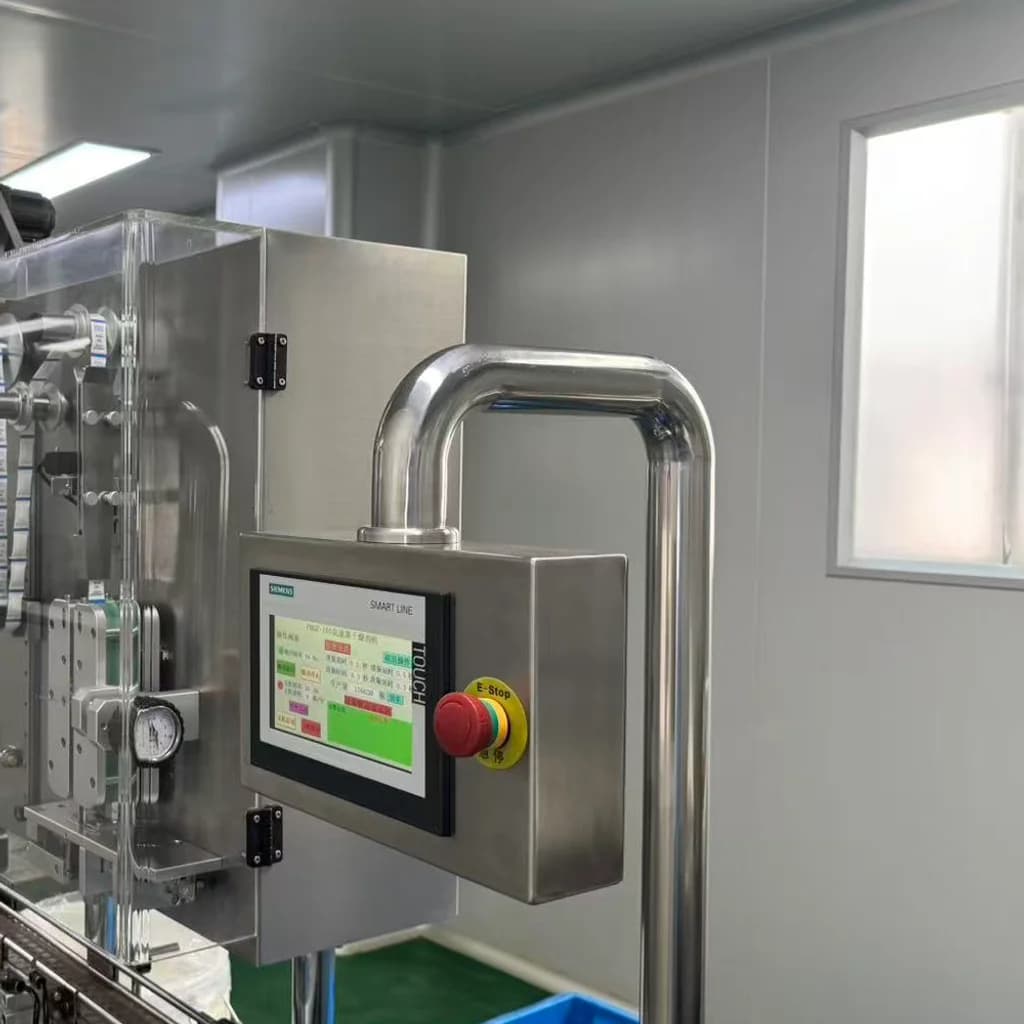
Liquid-Filled Softgel Manufacturer for Your Brand
Liquid-filled softgels deliver oils, suspensions and pastes in a sealed shell. EUPHM runs rotary die encapsulation across three lines, from 1,000-unit pilot batches to multi-million unit runs, with GMP, ISO 22000 and HACCP in place.
Overview
Sourcing a liquid-filled softgel manufacturer means matching fill viscosity to shell formulation, then proving stability under real storage. EUPHM handles both. We encapsulate fish and algal oils, vitamin D3, CoQ10, curcumin and custom blends into gelatin or vegetarian shells. Dosing runs from 250 mg to 1,500 mg fill weight, with oblong, oval and round dies. MOQ is 1,000 units per SKU for retail bottling, lower for pilot runs. Samples ship in 7–10 working days; mass production takes 20–35 working days. The plant is FDA-registered for dietary supplements. Full documentation supports US, EU, UK and Middle East market entry.
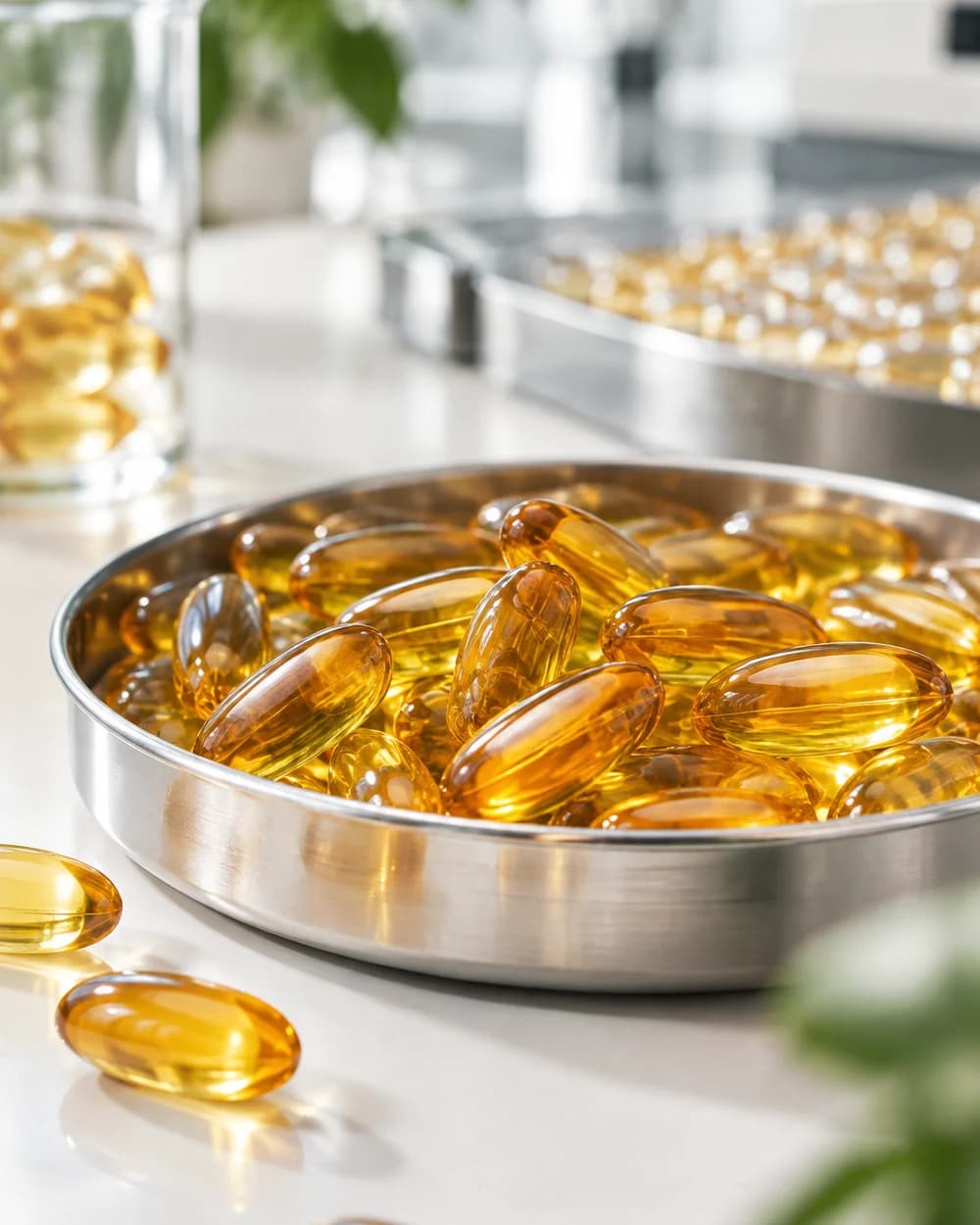
- MOQ (retail bottling)
- 1,000 units per SKU; lower for pilot runs
- Fill weight range
- 250 mg to 1,500 mg per softgel
- Shell options
- Gelatin, fish gelatin, modified starch (vegan), enteric
- Die shapes
- Oblong, oval, round, custom tooling available
- Lead times
- Samples 7–10 working days; mass production 20–35 working days
- Certifications
- GMP, ISO 9001, ISO 22000, HACCP, NSF/ANSI 455-2, halal, FDA-registered
Encapsulation Capacity and Tooling
EUPHM operates three rotary die encapsulation lines with a combined capacity above 50 million softgels per month. Standard dies cover 5, 8, 10, 12 and 20 oblongs, plus oval and round formats. Changeover between dies is typically 4–6 hours, which keeps multi-SKU orders on schedule. Drying tunnels run 24–36 hours depending on shell thickness, after which softgels pass through a tumble dryer and sorting stage.
For brands moving from pilot to launch, we hold tooling for repeat runs at no extra charge after the first production order. Fill weights are verified in-process every 30 minutes using a calibrated balance; deviations beyond ±5% trigger line adjustment. If your formula needs a custom die, tooling takes 15–20 working days and a one-time fee. The parent /softgel-manufacturer page covers the full dosage-form range, including enteric and chewable formats.
Fill Materials and Shell Compatibility
Liquid fills fall into three practical groups: true oils, oil suspensions and paste-like extracts. Fish oil, MCT, algal DHA, vitamin D3 in oil and CBD isolate suspensions all run cleanly at 250–1,000 mg. Curcumin and CoQ10 often need a suspension carrier to hold uniformity. We test viscosity, density and water activity on every incoming batch before encapsulation, and we can adjust the carrier ratio to hit your label claim.
Shell formulation matters as much as the fill. Gelatin shells suit most oil-based products; modified starch shells support vegan and vegetarian claims. For ingredients that degrade in stomach acid, enteric shells release in the intestine. We run accelerated stability at 40°C/75% RH for 3 months and real-time studies at 25°C/60% RH for 24 months. Where relevant, we source organic or non-GMO actives and hold the corresponding certificates.
Quality Systems and Export Documentation
Every batch is manufactured under GMP, ISO 22000 and HACCP. Incoming raw materials are quarantined until identity testing, heavy metals, microbials and, where applicable, pesticide residues clear. In-process checks cover shell thickness, fill weight, seam integrity and leakage. Finished softgels are tested for disintegration, assay, peroxide value and microbial limits. Batch records and certificates of analysis are retained for 5 years and issued with each shipment.
Export paperwork is prepared in parallel with production. We supply COA, MSDS, halal certificates, organic transaction certificates and a certificate of origin. Labels can be printed in English, Arabic, German or French, and we support US supplement facts panels, EU nutrition declarations and UK labelling rules. The facility is FDA-registered for dietary supplements. Shipments leave via Shenzhen or Hong Kong, with air freight in 5–8 days and sea freight in 18–30 days to major ports.
Quality Control and Batch Documentation
Every liquid-filled softgel batch is sampled at three points: incoming raw materials, in-process fill and shell checks, and finished goods. Identity testing uses FTIR or HPLC against reference standards for each active, including fish oil, vitamin D3, CoQ10 and curcumin. Potency assays confirm fill weight uniformity within ±5% of label claim. Microbial testing covers total aerobic count, yeast and mould, E. coli and Salmonella, with limits set to USP <2021> and <2022>. Heavy metals are screened by ICP-MS for lead, arsenic, cadmium and mercury at thresholds below 0.1 ppm for lead in the finished softgel.
Disintegration testing follows USP <2040> for softgels, with a target of full rupture within 30 minutes in purified water at 37°C. For enteric shells, acid resistance is verified in 0.1N HCl for 2 hours before intestinal buffer testing. Each batch retains a certificate of analysis (COA) listing test parameters, specifications, results and pass/fail status. The COA also records batch number, fill weight, shell composition, die shape and expiry date. A retention sample of at least 100 softgels per batch is stored at 25°C/60% RH and 30°C/65% RH for the full shelf life plus six months.
Stability protocols follow ICH Q1A(R2) accelerated conditions at 40°C/75% RH for six months and long-term conditions at 25°C/60% RH for up to 36 months. Real-time data is generated for every new formulation before commercial release. If a customer requires a specific market claim, such as 24-month shelf life, the stability programme is designed to support that claim with data at the 0, 3, 6, 9, 12, 18 and 24-month intervals. Microbiological stability is also monitored at each interval, particularly for gelatin shells where water activity can shift over time.
Packaging, Labelling and Retail Readiness
Liquid-filled softgels can be packed in HDPE bottles from 30 cc to 500 cc, blister packs with 10 to 30 cavities per card, stick packs for single-dose formats, and sachets for sample or travel sizes. Bottle closures include induction seals, pressure-sensitive liners and child-resistant caps where required. Standard bottle counts are 30, 60, 90, 120 and 180 softgels, with custom counts available. Labelling follows FDA dietary supplement requirements: statement of identity, net quantity, supplement facts panel, ingredient list, allergen declarations, and a 'Keep out of reach of children' warning. Lot and expiry codes are inkjet-printed on the bottle base and outer carton in a format agreed with the brand owner.
Carton specifications are built to survive export transit. Standard export cartons are 5-ply corrugated with a burst strength of at least 1,200 kPa, and each carton is labelled with SKU, lot number, quantity, gross weight and country of origin. Palletisation follows a 1,200 x 1,000 mm footprint with a maximum height of 1,800 mm including the pallet, and stretch-wrapped with corner boards. For Amazon FBA shipments, the factory can apply FNSKU labels, poly-bag each unit where required, and print expiration dates in the format Amazon accepts. Retail compliance for US chains often requires a GS1 barcode on the primary label, which is verified against the brand owner's GTIN database before printing.
Label artwork is reviewed against the target market before production. For the EU, the nutrition declaration and health claim wording must comply with Regulation (EC) No 1924/2006, and the address of the food business operator must appear on pack. For the Middle East, Arabic labelling is added alongside English, and halal certification marks are placed according to the importing country's requirements. The factory provides a digital proof for sign-off and retains a signed master copy for each SKU. Any change to artwork, formula or fill weight triggers a new proof and a new batch record, so traceability remains intact from raw material to retail unit.
MOQ, Lead Times and Delivery
Sample requests for a liquid-filled softgel typically move through a 7 to 10 working day window. This covers formula review, shell selection, a small pilot encapsulation run and dispatch by courier. If custom tooling is needed for a new die shape, add 15 to 20 working days for tooling fabrication and first-article approval. Samples are supplied with a preliminary COA and a fill weight specification so the brand owner can verify appearance, odour and disintegration before committing to a production order. Sample costs are quoted per SKU and are not usually credited against the first bulk order unless agreed in writing.
Mass production runs 20 to 35 working days from written purchase order and approved artwork, depending on fill material lead times and shell drying requirements. Gelatin shells need 5 to 7 days of controlled drying before packaging, which is built into the quoted window. For repeat orders with existing tooling and approved artwork, the lower end of the range is realistic. Pilot runs below the standard MOQ of 1,000 units per SKU are possible but carry a higher per-unit cost because setup and cleaning time is the same as a full batch.
Shipping terms are quoted as EXW, FOB Shenzhen or Hong Kong, or DDP to the destination warehouse. Air freight is used for samples and urgent launches, with transit times of 3 to 7 days depending on destination and customs clearance. Sea freight is standard for full pallet orders, with transit times of 18 to 35 days to US and EU ports. The factory provides a commercial invoice, packing list, COA, material safety data sheet (MSDS), free-sale certificate and, where relevant, phytosanitary certificate for botanical ingredients. Halal certificates are issued per batch on request. All documents are shared electronically before shipment so the importer can pre-clear customs.
Formats and Packaging Options
Standard gelatin oblong
The workhorse format for fish oil, vitamin D and CoQ10. Available in 500 mg, 1,000 mg and 1,200 mg fill weights. Good barrier properties at low cost.
Vegetarian modified starch
Plant-based shell for vegan and vegetarian labels. Slightly higher unit cost and longer drying time, but comparable shelf life when stored below 25°C.
Enteric-coated softgel
Designed to resist stomach acid and release in the small intestine. Common for probiotics, enzymes and sensitive oils. Adds one coating step and 3–5 days to lead time.
Custom fill and die
For novel blends or unusual fill weights. We test viscosity and shell compatibility first, then cut tooling. Tooling takes 15–20 working days; MOQ applies to the first run.
From Brief to Batch
- 01
Send your brief
Share fill ingredients, target dose, shell preference, bottle count and destination market. We confirm feasibility within 2 working days.
- 02
Quotation and sample
You receive a costed quote with MOQ, lead time and packaging options. Sample production starts on approval and ships in 7–10 working days.
- 03
Sample review
Test appearance, smell, swallowability and stability data. We adjust the fill or shell if needed and re-sample once at no charge.
- 04
Order confirmation
Sign off the specification, label artwork and purchase order. We book raw materials and schedule the encapsulation line.
- 05
Production and QC
Mass production runs 20–35 working days. In-process checks and finished testing generate a COA for your batch.
- 06
Packaging and shipping
Bottles are filled, capped, labelled and cartoned. We arrange air or sea freight and send documents ahead of arrival.
Why EUPHM
Pilot-friendly minimums
Start at 1,000 units for retail bottling, with lower thresholds for pilot runs. Move to full production once the formula and label are proven.
Documentation for 4 regions
COA, halal, organic and origin certificates prepared for US, EU, UK and Middle East import. Labels formatted to local rules.
Stability before scale
Accelerated and real-time stability data generated before mass production, so shelf-life claims are supported and reformulation risk drops.
Questions buyers ask.
What is the MOQ for liquid-filled softgels?+
MOQ is 1,000 units per SKU for retail bottling. For pilot runs or first-time orders, we can go lower, though unit cost rises. Once tooling and formulation are set, repeat orders follow the same minimum.
Can you produce vegetarian softgels?+
Yes. We run modified starch and fish gelatin shells alongside standard gelatin. Vegetarian shells suit vegan and vegetarian claims. Drying takes 6–12 hours longer, which adds 2–3 days to production.
How long do samples take?+
Sample lead time is 7–10 working days after we receive your brief and confirm the fill. Samples include a preliminary COA. We re-sample once at no charge if you request a fill or shell adjustment.
What certifications do you hold?+
The facility holds GMP, ISO 22000 and HACCP. Halal certificates are available for relevant lines. vegan documentation can be arranged when ingredients and processes meet the standard.
Do you ship to the US, EU and Middle East?+
Yes. We ship from Shenzhen or Hong Kong by air in 5–8 days or sea in 18–30 days. Documents including COA, MSDS, halal certificates and certificate of origin are prepared before dispatch to support customs clearance.
What is the shelf life of your liquid-filled softgels and how is it validated?+
Shelf life is set by real-time stability data, not assumption. For a standard gelatin softgel with a fish oil or vitamin fill, we typically support 24 months at 25°C/60% RH, with accelerated data at 40°C/75% RH for six months used as an early indicator. The final expiry is confirmed only after the long-term study reaches the claimed interval. If you need 36 months, we design the stability programme accordingly and share interim data at each pull point.
Can you handle custom die shapes and fill weights outside your standard range?+
Yes, custom tooling is available for oblong, oval, round and novel shapes. Fill weights from 250 mg to 1,500 mg are standard; outside that range we review shell thickness and seam integrity before quoting. New tooling takes 15 to 20 working days for fabrication and first-article approval. We supply a drawing for sign-off and a small pilot batch so you can check appearance and disintegration before committing to production tooling.
What payment terms and order documentation do you provide for first-time buyers?+
For first orders, we typically work on a 50% deposit with the balance due before shipment, against a proforma invoice. The document pack includes the commercial invoice, packing list, COA, MSDS, free-sale certificate and, where applicable, halal certificates. We can also provide a certificate of origin for preferential tariff treatment. All documents are issued electronically before dispatch so your customs broker can review them in advance.
Other versions built in this dosage form.
- Softgel Manufacturer
- Enteric-Coated Softgel Manufacturer
- Vegetarian Softgel Manufacturer
- Halal Softgel Manufacturer
- Mini Softgel Manufacturer
- Chewable Softgel Manufacturer
- Gelatin-Free Softgel Manufacturer
- Non-GMO Softgel Manufacturer
- Vegan Softgel Manufacturer
- Vitamin D3 Softgel Manufacturer
- Vitamin K2 Softgel Manufacturer
- Vitamin E Softgel Manufacturer
- Multivitamin Softgel Manufacturer
- Omega-3 Softgel Manufacturer
- Fish Oil Softgel Manufacturer
- Krill Oil Softgel Manufacturer
- Algae Oil Softgel Manufacturer
- Cod Liver Oil Softgel Manufacturer
- MCT Oil Softgel Manufacturer
- CoQ10 Softgel Manufacturer
- Biotin Softgel Manufacturer
- Lutein Softgel Manufacturer
- Zeaxanthin Softgel Manufacturer
- Astaxanthin Softgel Manufacturer
- Ginger Softgel Manufacturer
- Hair Skin & Nails Softgel Manufacturer
- Prostate Softgel Manufacturer
Have a product in mind?
Send us the brief and we will come back with a formulation direction, indicative price and a realistic lead time — usually within one working day.