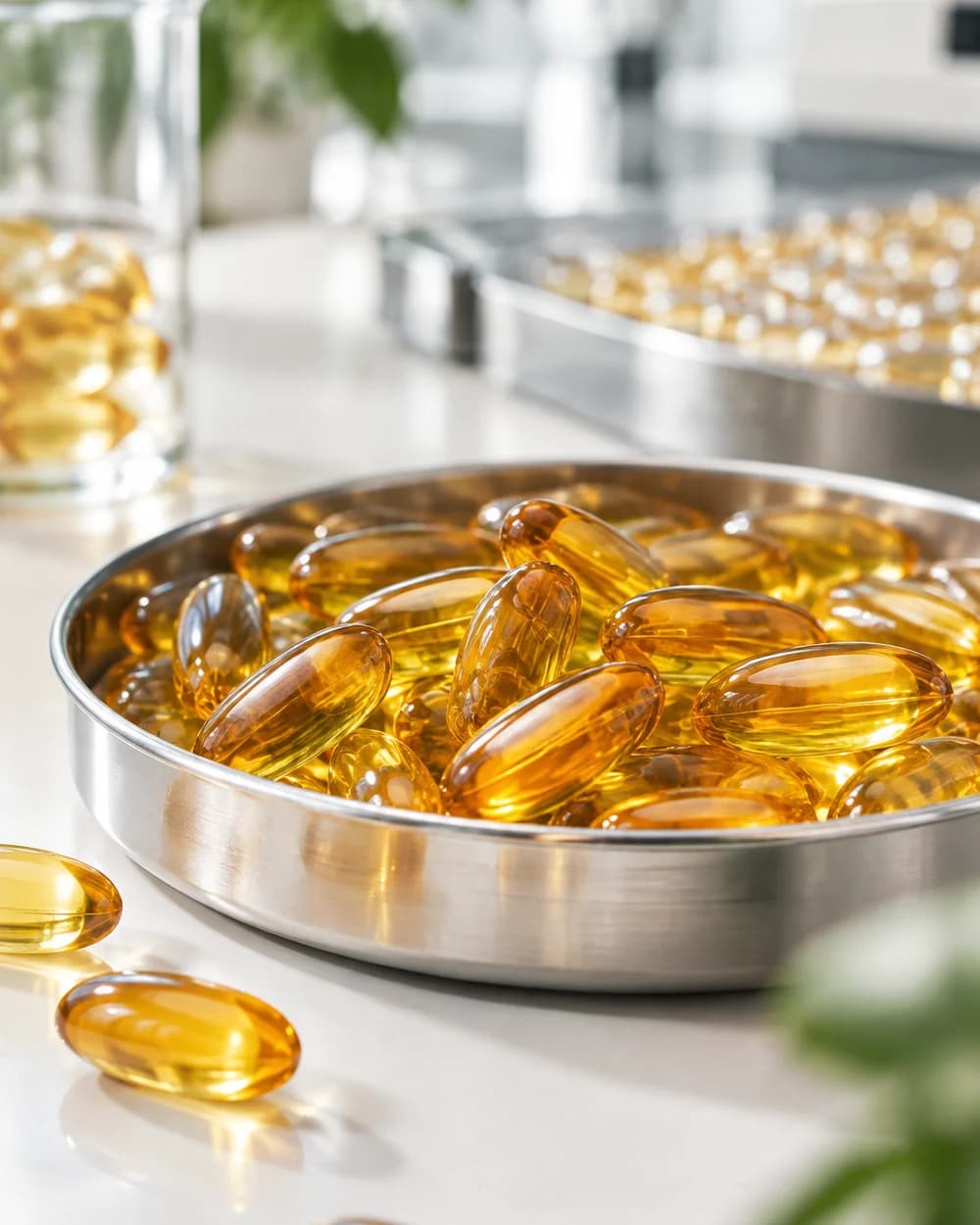
Vegan Softgel Manufacturer for Plant-Based Supplement Brands
EUPHM produces vegan softgels using tapioca starch and carrageenan shells. MOQ starts at 1,000 units per SKU. Sample lead time is 7-10 working days. Mass production runs 20-35 working days.
Overview
Vegan softgels replace gelatin with plant-derived gelling agents. The shell is typically a blend of modified tapioca starch, carrageenan and a plasticiser such as glycerol. This format suits oil-soluble actives including vitamins D3, K2, omega-3 from algae, CoQ10 and curcumin. EUPHM runs dedicated vegan softgel lines at its Guangdong facility, which holds GMP, ISO 22000 and HACCP certification. Halal and options are available depending on the fill material.
- MOQ
- 1,000 units per SKU for retail bottling; pilot runs from 500 units
- Fill weights
- 150 mg to 1,200 mg per softgel
- Softgel sizes
- 5 oval to 20 oblong; custom shapes from 10,000 units
- Sample lead time
- 7-10 working days
- Mass production
- 20-35 working days after sample approval
- Certifications
- GMP, ISO 9001, ISO 22000, HACCP, NSF/ANSI 455-2, halal, FDA-registered
Vegan Softgel Production Capacity and Equipment
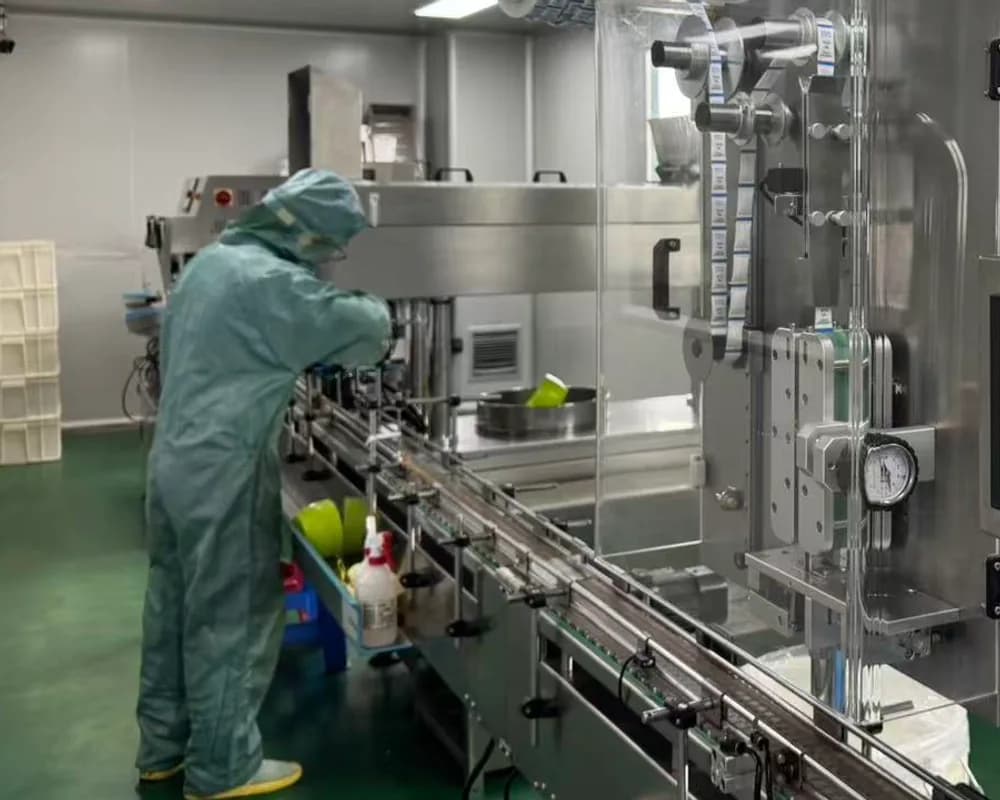
EUPHM operates three rotary die softgel lines dedicated to plant-based shells. Each line runs at 60,000 to 90,000 softgels per hour, depending on fill viscosity and shell thickness. We handle batch sizes from 500 units for pilot runs up to 2 million units per SKU for established brands. The facility maintains separate material handling for vegan and gelatin-based production to prevent cross-contact. Cleaning validation between runs follows a documented SOP with swab testing for gelatin residue.
Drying is the critical step for vegan shells. Tapioca and carrageenan require longer and more controlled drying than gelatin. Our drying tunnels hold 22-25 degrees Celsius and 25-35 percent relative humidity for 48 to 72 hours. This reduces the risk of shell brittleness and fill leakage. Incoming tapioca starch and carrageenan are tested for viscosity, moisture and microbial load before release to production.
Formulation Options for Plant-Based Softgels
Not every active works well in a vegan shell. We recommend tapioca-carrageenan for oils and oil suspensions, and modified corn starch for emulsified fills. Common projects include algal omega-3 DHA and EPA, vitamin D3 from lichen, vitamin K2 as MK-7, CoQ10, lutein esters and curcuminoids. Fill weights from 150 mg to 1,200 mg are achievable. Higher fill weights may require a larger oblong shell and a plasticiser adjustment to maintain shell elasticity.
Taste and odour masking is available for ingredients such as algal oil and curcumin. We can add natural flavour systems or use a nitrogen flush during encapsulation to reduce oxidation. Enteric vegan softgels are also possible using a cellulose-based coating. This is useful for probiotics and sensitive peptides that need to bypass stomach acid. We provide a formulation feasibility report within 5 working days of receiving your active ingredient specifications.
Quality Control and Compliance
Every vegan softgel batch is tested for appearance, fill weight, shell thickness, disintegration and microbial limits. Disintegration testing follows USP <2040> for dietary supplements. We also run accelerated stability studies at 40 degrees Celsius and 75 percent relative humidity for 3 months, and real-time studies for 24 months. Certificates of analysis are issued per batch. The facility is FDA-registered and holds GMP, ISO 22000 and HACCP certification.
For halal claims, we source carrageenan and tapioca starch from approved suppliers with valid certificates. Vegan status is verified through supplier declarations and internal audits. We do not run gelatin on the same lines without a full cleaning and swab validation. Documentation for EU, UK and Middle East import includes certificate of origin, health certificate and allergen statements. Lead time for full export documentation is 3-5 working days after batch release.
Batch Testing, COAs and Retention Samples
Every vegan softgel batch is tested at three stages: incoming raw materials, in-process fill and shell checks, and finished product release. Incoming tests cover identity and potency by HPLC or GC, microbial limits by USP <61>/<62>, heavy metals by ICP-MS, and for the shell, gelling agent viscosity and moisture. In-process checks include fill weight variation (target ±5%), seam integrity by visual and pressure testing, and shell thickness. Finished softgels are tested for disintegration per USP <2040> (typically under 30 minutes for non-enteric), potency, microbials, and where relevant, residual solvents.
A Certificate of Analysis (COA) is issued for each batch and includes: product name, batch number, manufacturing date, expiry date, tests performed, specification limits, results, and a pass/fail statement. It also lists the reference methods used. Retention samples from each batch are kept for the full shelf life plus six months, stored under labelled conditions. Stability protocols follow ICH Q1A(R2) guidelines: 25°C/60% RH for long-term and 40°C/75% RH for accelerated, with testing at 0, 3, 6, 9, 12, 18 and 24 months for long-term and 0, 1, 2, 3 and 6 months for accelerated.
For vegan claims, we maintain segregation of plant-derived shell materials from gelatin lines. Cleaning validation records and allergen cross-contact assessments are available on request. Each batch's documentation pack includes the COA, batch record summary, and deviation reports if any. This supports your own quality agreement and audit trail. We do not release a batch until all tests meet specification and the QA team has signed off.
Packaging, Labelling and Retail Readiness
We offer primary packaging in HDPE bottles (30, 60, 90, 120, 180 and 240 count), blister packs (PVC/PVDC or alu-alu for moisture-sensitive fills), stick packs and sachets. Bottles can be supplied with induction seals, desiccant canisters and child-resistant closures. Labelling follows FDA dietary supplement requirements: statement of identity, net quantity, supplement facts panel with serving size and % Daily Value where applicable, ingredient list, allergen statement, and manufacturer/distributor contact. We print lot numbers and expiry dates by inkjet or laser, with format matching your specification.
Carton and pallet specifications are agreed per order. Standard export cartons are 5-ply corrugated with a 20 kg maximum gross weight. Pallets are 1200 x 1000 mm or 1200 x 800 mm, stretch-wrapped and strapped, with a maximum height of 1.8 m including pallet. We can print your Amazon FNSKU barcodes and apply them to each unit, and we can provide retail-ready cartons with scannable GS1-128 labels. For Amazon FBA, we follow your packing instructions including poly-bagging and suffocation warning labels where required.
Before production, we provide a labelling proof for your approval. This includes dieline, font sizes, and placement of mandatory statements. We recommend a third-party label review if you are launching in the US or EU. Our team can also advise on vegan logo usage and the substantiation you need to keep on file. Packaging materials are food-grade and meet EU 10/2011 and FDA 21 CFR 174-186 requirements where applicable.
MOQ, Lead Times and Delivery
Sample production for vegan softgels takes 7-10 working days after formulation and shell specification are agreed. Samples are supplied free of charge for standard formulations; you cover courier costs. Mass production runs 20-35 working days after sample approval and receipt of deposit. MOQ is 1,000 units per SKU for retail bottling, with pilot runs from 500 units. For custom shapes, MOQ is 10,000 units. Lead times are confirmed at order acknowledgement and are subject to raw material availability.
We ship by air or sea. Air freight typically takes 5-10 days door to door, while sea freight takes 25-40 days depending on destination port. We offer EXW, FOB Shenzhen or Hong Kong, and DDP for selected markets. DDP includes customs clearance and duties, but you remain responsible for product compliance in your market. For each shipment we provide a commercial invoice, packing list, bill of lading or airway bill, COA, MSDS, and a free-sale certificate. Phytosanitary certificates are provided only when plant-derived materials require them for your destination.
We recommend booking freight at least two weeks before production completion to avoid storage charges. Our logistics team can coordinate with your forwarder or arrange door-to-door delivery. For repeat orders, we keep a production slot reserved if you provide a 12-week forecast. Payment terms are typically 30% deposit with balance against copy of shipping documents, though terms can be discussed for established customers.
Formats and Packaging Options
Tapioca-carrageenan shell
Standard vegan shell for oil-based fills. Good elasticity and 24-month shelf life. Suitable for omega-3, vitamin D3 and CoQ10.
Modified corn starch shell
Lower cost alternative for emulsified fills. Slightly lower elasticity. Best for water-dispersible powders and some botanical extracts.
Enteric cellulose coating
Delays release until the small intestine. Adds 2-3 working days to production. Suitable for probiotics and acid-sensitive compounds.
Organic-certified shell
Certified organic and EU organic options available. Requires organic fill ingredients and separate batch records. Minimum 5,000 units per SKU.
From Brief to Batch
- 01
Send your specification
Share active ingredient, target fill weight, dosage count and any certification needs. We confirm feasibility within 5 working days.
- 02
Approve sample
We produce a 7-10 working day sample batch. You test appearance, disintegration and fill weight. Two revision rounds are included.
- 03
Sign supply agreement
We issue a proforma invoice with MOQ, unit price, lead time and payment terms. Deposit is 30 percent; balance before shipment.
- 04
Production run
Mass production takes 20-35 working days after sample approval. We send weekly progress updates with batch numbers.
- 05
Quality release
QC tests each batch for fill weight, disintegration, microbial limits and shell integrity. Certificate of analysis is issued before packing.
- 06
Shipping and documents
We pack in HDPE bottles or bulk bags. Export documents include certificate of origin, health certificate and allergen statement.
Why EUPHM
Dedicated vegan lines
Separate material handling and cleaning validation prevent gelatin cross-contact. Swab testing is documented per batch.
Low MOQ for trials
Pilot runs from 500 units let you test market response before committing to 1,000-unit retail batches.
Export-ready documentation
We provide halal and vegan certificates plus health certificates for EU, UK and Middle East import.
Questions buyers ask.
What is the minimum order quantity for vegan softgels?+
MOQ is 1,000 units per SKU for retail bottling. Pilot runs start at 500 units with a higher per-unit cost. Custom shapes and organic-certified shells require 5,000 to 10,000 units. MOQ applies per fill weight and shell size combination.
How long does sample production take?+
Sample lead time is 7-10 working days after we receive your active ingredient and specification. This includes shell formulation, encapsulation and basic QC testing. Shipping the sample to you takes another 3-5 working days by express courier.
Are your vegan softgels halal certified?+
Yes, when the fill material and shell ingredients meet the requirements. We source carrageenan, tapioca starch and glycerol from suppliers with valid halal certificates. Final certification is issued per batch. Not all actives qualify, so we review your formula before quoting.
Can you produce enteric vegan softgels?+
Yes. We apply a cellulose-based enteric coating that resists stomach acid and dissolves in the small intestine. This adds 2-3 working days to production and increases unit cost by 8-12 percent. Enteric coating is suitable for probiotics, enzymes and acid-sensitive peptides.
What is the shelf life of your vegan softgels?+
Typically 24 months when stored below 25 degrees Celsius and 60 percent relative humidity. We run accelerated stability at 40 degrees Celsius and 75 percent relative humidity for 3 months, plus real-time studies. Shell brittleness and fill leakage are monitored at 0, 3, 6, 12 and 24 months.
Can you provide a free-sale certificate for vegan softgels?+
Yes, we issue a free-sale certificate for each product upon request. It confirms that the product is manufactured in a GMP-certified facility and is freely sold in China. The certificate is typically required for registration in some export markets. We can also provide a certificate of origin and a halal certificate if applicable. Allow 3-5 working days for document preparation.
What is the shelf life of your vegan softgels and how is it determined?+
Shelf life is typically 24 months when stored below 25°C in the original sealed container. We assign shelf life based on real-time and accelerated stability data following ICH guidelines. For new formulations, we start with a 12-month provisional shelf life and extend it as stability data accumulates. The expiry date is printed on each unit and carton. We recommend you confirm storage conditions with your distributor.
Do you offer low-moisture or enteric vegan softgel options?+
Yes, we can produce enteric vegan softgels using plant-derived enteric polymers. These are designed to resist stomach acid and release in the intestine. We also offer low-moisture shells for hygroscopic fills. Both options require formulation development and may increase MOQ to 10,000 units. Disintegration and release testing are performed per USP <711> for enteric dosage forms. Please share your target release profile for a feasibility assessment.
Other versions built in this dosage form.
- Softgel Manufacturer
- Enteric-Coated Softgel Manufacturer
- Vegetarian Softgel Manufacturer
- Halal Softgel Manufacturer
- Mini Softgel Manufacturer
- Liquid-Filled Softgel Manufacturer
- Chewable Softgel Manufacturer
- Gelatin-Free Softgel Manufacturer
- Non-GMO Softgel Manufacturer
- Vitamin D3 Softgel Manufacturer
- Vitamin K2 Softgel Manufacturer
- Vitamin E Softgel Manufacturer
- Multivitamin Softgel Manufacturer
- Omega-3 Softgel Manufacturer
- Fish Oil Softgel Manufacturer
- Krill Oil Softgel Manufacturer
- Algae Oil Softgel Manufacturer
- Cod Liver Oil Softgel Manufacturer
- MCT Oil Softgel Manufacturer
- CoQ10 Softgel Manufacturer
- Biotin Softgel Manufacturer
- Lutein Softgel Manufacturer
- Zeaxanthin Softgel Manufacturer
- Astaxanthin Softgel Manufacturer
- Ginger Softgel Manufacturer
- Hair Skin & Nails Softgel Manufacturer
- Prostate Softgel Manufacturer
Have a product in mind?
Send us the brief and we will come back with a formulation direction, indicative price and a realistic lead time — usually within one working day.