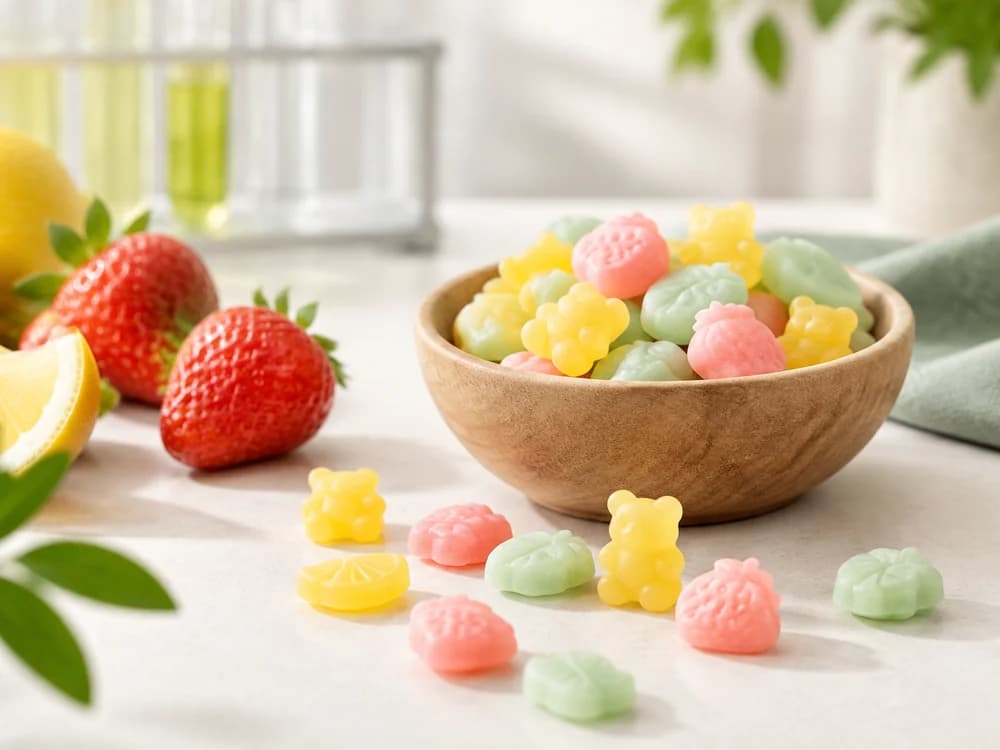
Multivitamin Gummy Manufacturer for Retail-Ready Brands
EUPHM produces multivitamin gummies in Guangdong for brands in the US, EU, UK and Middle East. MOQ 1,000 units per SKU, samples in 7–10 working days, mass production in 20–35 working days.
Overview
Sourcing a multivitamin gummy manufacturer means matching a formula to a market, then matching that formula to a line that can run it at your volume. This page covers what we make, how formulations are built, and what quality and logistics look like from first sample to repeat order. It sits under our broader gummy manufacturing capability, so you can compare formats before committing.
Line capability and realistic run sizes
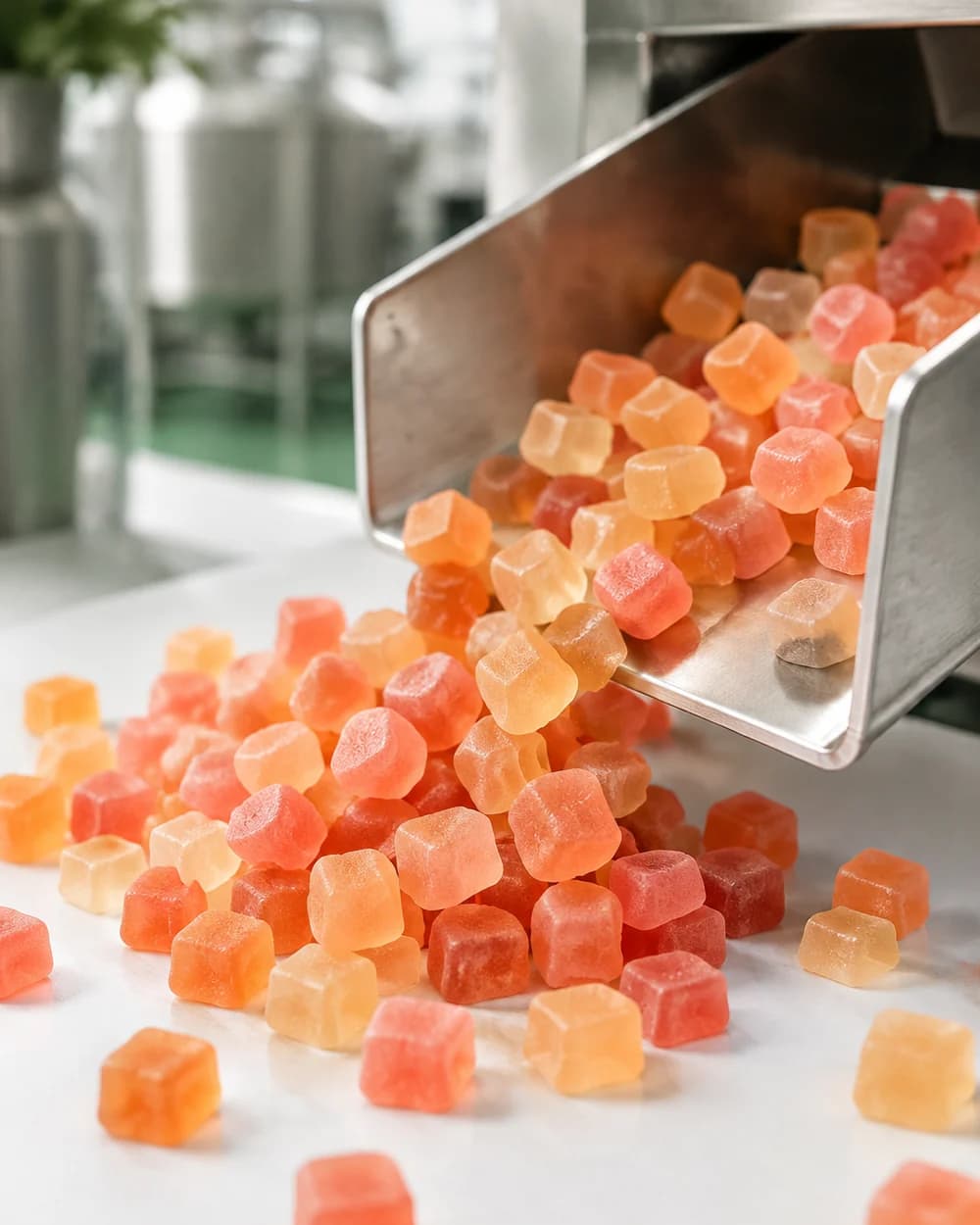
Multivitamin gummies are a high-mix format. A single SKU may carry 12 to 24 active ingredients, and each one affects mixing order, pH and set time. Our lines run pectin, gelatin and starch-moulded bases, with piece weights from 2 g to 5 g. Retail bottles typically hold 60, 90 or 120 gummies. For a first order, plan on 1,000 units per SKU; pilot runs below that are possible when the formula is already validated.
Depositing speed depends on the base and the active load. Pectin lines generally run slower than gelatin because the set is temperature-sensitive. If your formula includes oil-based actives such as vitamin D3 or vitamin E, we emulsify before depositing to avoid separation in the slurry. Capacity is quoted per project rather than per hour, because a 24-ingredient formula and a 6-ingredient formula do not run at the same rate.
Formulation: actives, masking and stability
The hard part of a multivitamin gummy is not the vitamin blend. It is making 12-plus actives taste neutral and stay stable for 18 to 24 months. B vitamins, iron and zinc carry bitter or metallic notes. We use natural masking systems, typically fruit purée, citric or malic acid, and stevia or monk fruit. Sugar-free versions use soluble fibre or maltitol, with a texture adjustment to compensate for the lower solids.
Overages matter. Vitamins degrade during cooking and storage, so we formulate with a target overage at end of shelf life, not at fill. A gummy labelled 100 percent NRV for vitamin C may start 20 to 40 percent higher. We test at 0, 3, 6 and 12 months on stability protocols. Colours come from fruit and vegetable concentrates where a clean label is required, or from approved synthetic lakes where colour matching is tighter.
Quality, documentation and export logistics
Every batch is produced under GMP and ISO 22000, with HACCP controls at mixing, depositing, curing and packing. Incoming raw materials are tested against specification before release. Finished gummies are checked for weight, hardness, water activity, microbial load and active content. Certificates of analysis are issued per batch. Halal and vegan documentation is available when the formula and the line support the claim.
For export, we pack in food-grade HDPE bottles with induction seals, or in pouches and stick packs. Cartons are labelled to your market: US supplement facts, EU nutrition declaration, or GCC bilingual labels. We ship FOB Shenzhen or Yantian, and can quote CIF or DDP for first orders. Air freight suits pilot runs; sea freight suits 20-foot and 40-foot volumes. Shelf life is typically 18 to 24 months from production.
Quality Control and Batch Documentation
Every multivitamin gummy batch is tested at three points: incoming raw materials, in-process syrup and finished product. Actives such as vitamins A, B-complex, C, D3, E and K2 are verified for identity and potency by HPLC or microbiological assay where applicable. Microbial testing covers total aerobic count, yeast and mould, E. coli and Salmonella. Heavy metals (lead, arsenic, cadmium, mercury) are screened against USP <2232> or EU 2023/915 limits. Disintegration is checked to USP <2040> for gelatin and pectin gummies, with typical targets of 20–30 minutes.
In-process checks occur at the depositing stage: weight variation per piece (target ±5%), colour and texture, and pH of the syrup. These are recorded every 30 minutes on the line log. Finished-product testing follows a sampling plan of √n+1 per batch, with a minimum of 12 pieces per lot for potency and 20 pieces for organoleptic review. Retained samples are stored at 25°C/60% RH and 30°C/65% RH for the full shelf life plus six months.
The certificate of analysis (COA) issued per batch lists batch number, manufacturing date, expiry date, active content as % of label claim (typically 95–105% at release), microbial results, heavy metals, disintegration time and appearance. It references the specification version and test methods used. A separate statement confirms the product is manufactured in a GMP and ISO 22000 facility and is free from undeclared allergens. COAs are available within 5 working days of batch release.
Stability follows a bracketed protocol: 0, 3, 6, 12, 18 and 24 months at 25°C/60% RH, with accelerated conditions at 40°C/75% RH for 6 months. Vitamin potency loss in gummies is monitored closely; typical overage at formulation is 10–20% for B vitamins and 5–10% for fat-soluble vitamins, adjusted to meet label claim at expiry. Stability data packages are shared under NDA for your dossier.
Packaging, Labelling and Retail Readiness
Multivitamin gummies are packed in HDPE bottles (60, 90, 120 or 150 count) with induction seals and child-resistant closures where required, or in blisters (10 or 12 gummies per blister, 3–6 blisters per carton). Stick packs and single-serve sachets are available for 2–5 gummies per stick. Bottle dimensions and label panel sizes are confirmed at artwork stage; typical label dimensions for a 120-count bottle are 90 × 120 mm with a 3 mm bleed.
Labels for the US market include the FDA dietary supplement facts panel, ingredient list, allergen statement, suggested use, net quantity, storage instructions, and the manufacturer/distributor address. Lot number and expiry date are inkjet-coded on the bottle base and outer carton in a YYMMDD format. For EU markets, labels follow Regulation (EU) 1169/2011 and the food supplement directive 2002/46/EC, with nutrition declaration per daily dose.
Cartons are specified as 5-ply corrugated with a minimum burst strength of 1,200 kPa; pallet configuration is 48 cartons per layer, 4 layers high (192 cartons per pallet) for standard 120-count bottles, shrink-wrapped and strapped. Amazon FNSKU labels can be applied per unit, and retail-ready packaging with a display-ready case is available on request. We do not apply FNSKU labels without your written authorisation and label file.
Artwork proofing includes a pre-press check for barcode scannability (GS1-128 or UPC-A), font size compliance (minimum 6 pt for nutrition text where required) and country-specific claims review. We provide a dieline and label placement guide for each pack format. If you supply your own labels, we require a 5% overage on label quantity to cover line waste and rework.
MOQ, Lead Times and Delivery
Sample requests are acknowledged within 2 working days. Stock-formula samples ship in 7–10 working days; custom-formula samples with new actives or flavours take 12–15 working days. Sample costs are quoted per SKU and are typically credited against the first bulk order above 10,000 units. Courier costs are at your account unless agreed otherwise. We provide a sample specification sheet with each sample so you can compare against your target label claim.
Mass production runs 20–35 working days after written approval of the sample, artwork and purchase order. This window includes raw material release, blending, depositing, curing (48–72 hours for pectin), packaging and QC release. Peak season (August–November) may extend lead times by 5–7 working days; we confirm the production slot at order acknowledgement. MOQ is 1,000 units per SKU, with pilot runs of 1,000–2,000 units available at a higher unit cost.
Shipping is quoted EXW, FOB Shenzhen/Yantian or DDP to your door. Air freight from Guangdong to the US or EU takes 5–8 days door-to-door for 100–500 kg; sea freight takes 28–35 days to the US West Coast and 30–38 days to Northern Europe. We provide commercial invoice, packing list, COA, MSDS (where applicable), free-sale certificate and, for plant-derived ingredients, phytosanitary certificate on request. DDP shipments include customs clearance and duties.
For repeat orders, we hold your approved formula, artwork and label files for 24 months. Reorder lead time is 15–25 working days from PO if raw materials are in stock. We recommend a 10–15% buffer on first orders to cover transit damage and retail chargebacks. Payment terms are 30% deposit with balance against copy of bill of lading, or LC at sight for orders above 50,000 units.
Manufacturing Options to Compare
Pectin-based gummies
Vegan, gelatin-free, stable at warm ambient temperatures. Slightly softer chew. Suits EU and Middle East markets where gelatin sourcing is a label concern.
Gelatin-based gummies
Classic chew and clarity. Best for high active loads and sugar-free systems. Not suitable for vegetarian or halal claims unless certified bovine or fish gelatin is used.
Starch-moulded gummies
Dense, low-moisture texture. Good for adult multivitamins and for actives that are sensitive to heat. Longer curing time than pectin or gelatin.
Sugar-free and reduced-sugar
Maltitol, sorbitol or soluble fibre bases. Typical sugar reduction of 90 percent or more. Texture and laxative thresholds are adjusted per formula.
Production in Six Steps
- 01
Brief and quote
Send target actives, piece weight, bottle count and market. We return a costed quote with MOQ and lead time, usually within 2 working days.
- 02
Sample development
We produce a bench sample for taste, texture and colour. Sample lead time is 7–10 working days. You approve or request one revision.
- 03
Formula lock
Once the sample is approved, we lock the formula, overages and label claims. You receive a specification sheet and a stability plan.
- 04
Pilot run
A small pilot batch confirms the formula on production equipment. This catches scale-up issues before a full run. Typically 3–5 working days.
- 05
Mass production
Full run of 1,000 units per SKU or more. Production takes 20–35 working days, including curing, testing and packing.
- 06
QC and shipping
Batch testing, certificate of analysis and label check. We book freight FOB, CIF or DDP and send documents for customs clearance.
Why EUPHM
One plant, one spec
Formulation, depositing, curing, testing and bottling happen on one site. That shortens the loop between sample feedback and the next production run.
Documentation for export
GMP, ISO 9001, ISO 22000, HACCP, NSF/ANSI 455-2 and halal certification; FDA facility registration for US-bound shipments.
Pilot runs that scale
You can start below the 1,000-unit MOQ to test a market, then move to full retail bottling without reformulating or changing lines.
Questions buyers ask.
What is the MOQ for multivitamin gummies?+
Standard MOQ is 1,000 units per SKU for retail bottling. Pilot runs below that are possible when the formula is already validated, though per-unit cost is higher. If you need two flavours or two bottle sizes, each is a separate SKU and a separate MOQ.
How long do samples and production take?+
Samples take 7–10 working days from brief to dispatch. Mass production takes 20–35 working days after sample approval and receipt of deposit. Add 3–5 working days for a pilot run if you want one. Sea freight to the US or EU adds 25–40 days.
Can you make sugar-free or vegan multivitamin gummies?+
Yes. Sugar-free bases use maltitol, sorbitol or soluble fibre, with sugar reduction of 90 percent or more. Vegan gummies use pectin or starch instead of gelatin. Both need a texture adjustment and a stability check, so allow one extra sample round for these formats.
Which certifications do you hold?+
The facility is GMP, ISO 22000 and HACCP certified, and FDA-registered. Halal and vegan documentation is available when the formula and line support the claim. Certificates are issued per batch with the certificate of analysis.
What is the shelf life of a multivitamin gummy?+
Typically 18 to 24 months from production when packed in HDPE bottles with induction seals and stored below 25°C. Vitamin potency is the limiting factor, not microbial stability. We formulate with end-of-shelf-life overages and confirm them on a 0, 3, 6 and 12-month stability protocol.
Can you match a competitor's multivitamin gummy formula?+
We can develop a formula to match a supplied nutrition panel or target label claim, but we do not reverse-engineer proprietary formulas. You provide the desired actives, dosage and any claims; our formulator proposes a base and overage. Bench samples are produced for sensory and analytical comparison. Matching a competitor's exact taste and texture is not guaranteed, as pectin and gelatin sources differ.
Do you provide stability data for my registration dossier?+
Yes. We run bracketed stability on your approved formula and share the protocol and results under NDA. Typical packages include 0, 3, 6, 12, 18 and 24-month real-time data at 25°C/60% RH and 6-month accelerated data at 40°C/75% RH. Potency, microbial, disintegration and organoleptic results are included. We do not issue regulatory dossiers, but the data is formatted for your consultant.
What payment terms and currencies do you accept?+
Standard terms are 30% deposit with balance against copy of bill of lading, or LC at sight for orders above 50,000 units. We invoice in USD or EUR. For first orders below 10,000 units, full payment is required before production. Bank charges are shared: sender pays originating bank fees, receiver pays intermediary and beneficiary fees. We do not accept credit cards for bulk orders.
Have a product in mind?
Send us the brief and we will come back with a formulation direction, indicative price and a realistic lead time — usually within one working day.