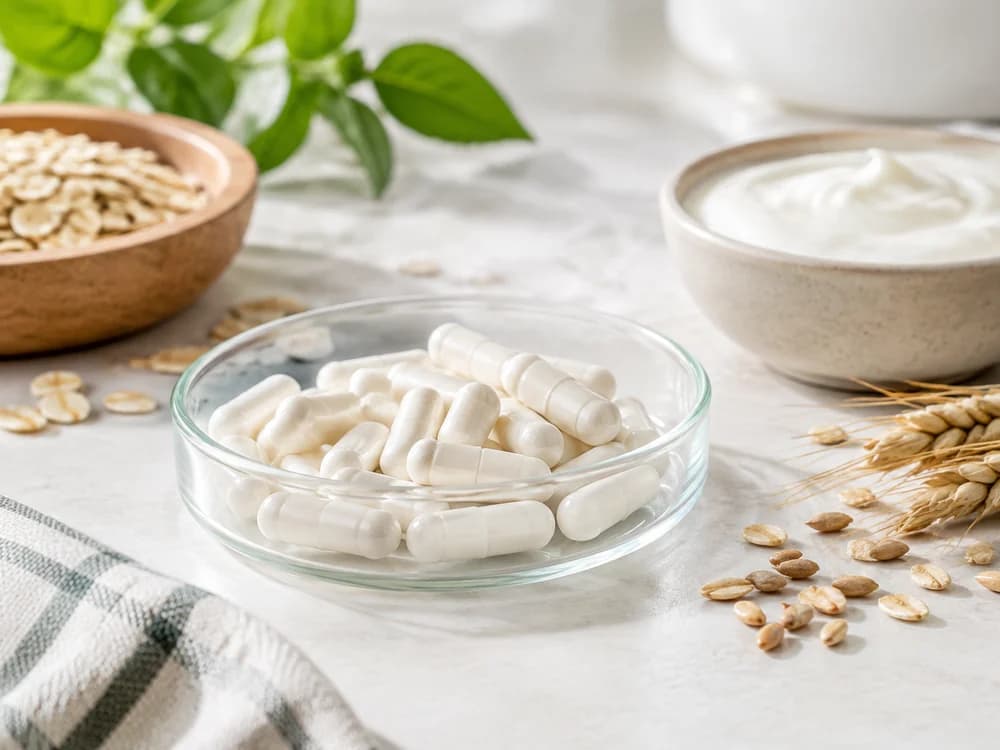
Prebiotics Capsule Manufacturer for Your Own Label
Source prebiotic capsules from a GMP-certified plant in Guangdong. We handle formula development, blending, encapsulation and retail bottling for brands in the US, EU, UK and Middle East.
Overview
Prebiotic capsules are a formulation business, not a commodity. Inulin, FOS, GOS, XOS and resistant starch behave differently in blending, hygroscopicity and capsule fill. This page covers how EUPHM runs prebiotics capsule manufacturing from pilot to shelf. It sits inside our broader capsule manufacturing capability, so you can compare formats before you commit to a fill weight, capsule shell or MOQ. Most retail projects start at 1,000 units per SKU, with lower volumes for pilot runs.
Prebiotic capsule production capability
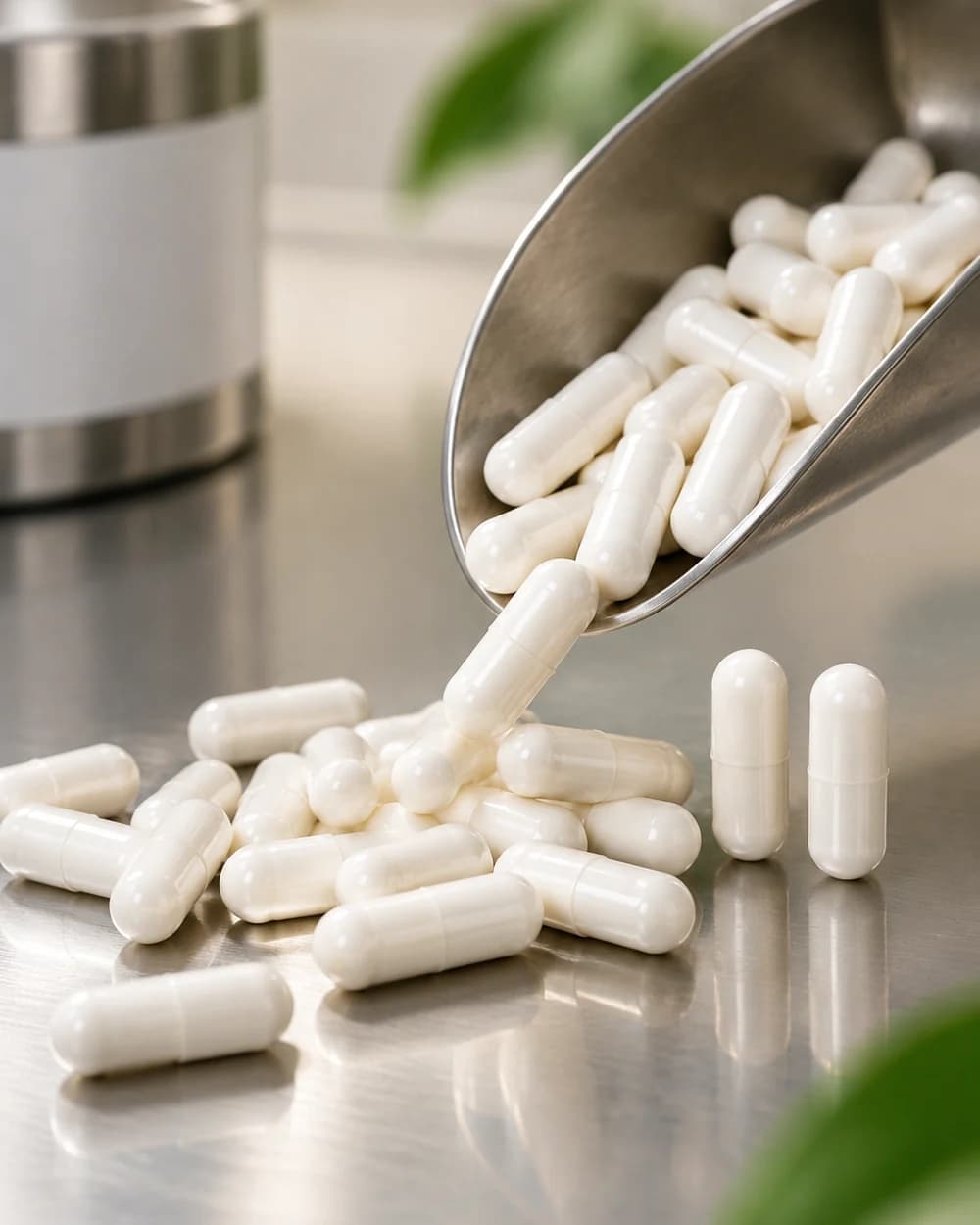
EUPHM runs encapsulation lines with a rated output of 120,000-200,000 capsules per shift, depending on fill weight and shell type. For prebiotics, we typically use HPMC shells for vegan and halal projects, and gelatin where cost per unit matters more. Size 0 and size 1 are the most common for 300-500 mg blends. We can run size 2 for lower-dose synbiotic concepts. Powder blends are blended in stainless steel ribbon or V-blenders with batch records, then encapsulated under controlled temperature and humidity. This matters because inulin and FOS absorb moisture quickly and can stick in the dosator if the room is not controlled.
For pilot runs, we can produce 1,000-2,000 units to support stability and label validation before a full retail batch. Pilot runs use the same equipment and batch documentation as mass production, so scale-up is a repeat of a known process rather than a new one. If you are comparing capsule formats, our capsule manufacturer page covers hard-shell, vegetarian and delayed-release options. Prebiotic blends are often paired with probiotic strains, digestive enzymes or botanical extracts. We keep those as separate blend steps to avoid moisture transfer between hygroscopic and sensitive ingredients.
Formulation details for prebiotic blends
Prebiotic ingredients vary widely in dose and flow. Inulin and oligofructose are usually dosed at 300-500 mg per capsule; GOS and XOS often sit at 200-400 mg; resistant dextrin can go higher but adds bulk. We adjust excipients to keep the blend free-flowing: typically 1-3% silicon dioxide or magnesium stearate, and in some cases microcrystalline cellulose. If you want a clean-label capsule, we can run without magnesium stearate, but expect slower line speeds and a higher fill-weight variance. We test angle of repose and bulk density on every incoming lot before it enters a formula.
Capsule shells also carry label claims. HPMC is suitable for vegan, halal positioning. Gelatin is not. For organic-certified projects, the prebiotic ingredient, capsule shell and any carrier must all be on the approved input list. We can source organic inulin and organic acacia fibre with documentation. Synbiotic concepts combine a prebiotic with a probiotic strain; in that case we recommend a separate probiotic blend step and a desiccant in the bottle. Common finished doses are 1-2 capsules per day, which usually means a 30, 60 or 90 count bottle.
Quality, compliance and shipping
Every prebiotic batch is tested for identity, moisture, microbial limits and fill weight. We retain samples for 24 months. Certificates of analysis are issued per batch and include the tests your market requires. For the EU and UK, we can test for heavy metals, pesticide residues and allergens. For the Middle East, halal certificates are available on request, depending on the capsule shell and ingredient sources. The facility is GMP-certified and holds ISO 22000 and HACCP. It is an FDA-registered facility for food and dietary supplement manufacturing, not an FDA-approved drug facility.
Lead times are 20-35 working days for mass production after you approve the sample and artwork. Bottling, labelling and cartoning run on the same site, so you avoid a second supplier for retail packaging. We ship FOB Shenzhen or Yantian, with air freight for pilot runs. Typical retail configurations are 30, 60, 90 and 120 count in HDPE or PET bottles with induction seals. If you need stick packs or sachets instead of capsules, we can quote those from the same prebiotic blend. Documentation packs include batch records, COA, MSDS, halal certificates and organic transaction certificates where applicable.
Quality Control and Batch Documentation
Every prebiotic capsule batch is sampled at three points: incoming raw material, in-process blend, and finished capsules. Identity testing by FTIR confirms inulin, FOS, GOS, XOS or resistant starch against reference spectra. Potency is assayed by HPLC or enzymatic methods depending on the prebiotic, with results expressed as percentage of label claim. Microbial testing covers total aerobic count, yeast and mould, E. coli, Salmonella and Staphylococcus aureus. Heavy metals (lead, arsenic, cadmium, mercury) are tested by ICP-MS against USP <232> limits. Disintegration testing follows USP <701> for the chosen capsule shell.
A certificate of analysis (COA) is issued per batch and includes the product name, batch number, manufacturing date, expiry date, tests performed, specification limits, results and pass/fail status. It also lists the capsule shell type and fill weight. Retention samples of each batch are kept for two years at 25°C/60% RH and 30°C/65% RH, with a third set at 40°C/75% RH for accelerated stability. Stability protocols run at 0, 3, 6, 12, 18 and 24 months, monitoring potency, microbials, moisture and disintegration.
Microbial limits for prebiotic capsules are set at total aerobic count ≤10,000 cfu/g, yeast and mould ≤100 cfu/g, and absence of pathogens in 10 g. Moisture content is controlled to ≤5% for hygroscopic prebiotics such as FOS and XOS, using sealed capsule shells and desiccant sachets in the finished bottle where needed. Water activity of the blend is checked before encapsulation to avoid shell softening. If you require custom specifications, such as tighter heavy metal limits or additional pesticide screening for plant-derived inulin, these are added to the batch record and COA.
Batch records are retained for five years and are available for audit by appointment. Deviations are documented with root cause and corrective action. For prebiotic blends containing multiple ingredients, each component is tested individually before blending, and the final blend is verified for uniformity by sampling from top, middle and bottom of the mixer. This ensures that low-dose prebiotics such as XOS are evenly distributed.
Packaging, Labelling and Retail Readiness
Prebiotic capsules can be packed in HDPE bottles (30, 60, 90, 120 or 180 count), blister packs (10, 14 or 21 capsules per card), stick packs (single-dose powder, if you switch format) or sachets. Bottles are induction-sealed and fitted with child-resistant or standard caps. Desiccant canisters or silica gel sachets are added for hygroscopic formulas. Labels can be supplied by you or printed by us; we hold FDA dietary supplement label templates and can review your artwork for the required elements: statement of identity, net quantity, supplement facts panel, other ingredients, directions, warnings, and manufacturer/distributor details.
Lot and expiry coding is applied by inkjet or laser on the bottle, carton and shipper. Expiry is set at 24 months from manufacture for standard prebiotic capsules, supported by stability data. Cartons are made from 300-350 gsm board, printed up to six colours, and can include a leaflet. Shipper cartons are 5-ply corrugated, with a maximum weight of 15 kg for manual handling. Palletisation follows standard 1200 x 1000 mm or 1200 x 800 mm pallets, with stretch wrap and edge protectors; we provide a packing list with carton dimensions, net and gross weights, and pallet count.
For Amazon FBA or retail compliance, we can apply FNSKU labels, poly-bag the bottles with a suffocation warning, and print the carton labels to your specification. We do not provide Amazon seller support, but we can prepare the shipment so it meets FBA requirements. Retail-ready packaging such as display cartons or shelf-ready trays can be quoted separately. All packaging materials are food-grade and meet EU 10/2011 and FDA 21 CFR 174-190 requirements for indirect food contact.
If you sell in the EU, we can include the required allergen statement and the name and address of the responsible person. For the US, we follow FDA 21 CFR 101.36 for supplement facts. We do not provide legal review of claims; you are responsible for ensuring that structure/function claims comply with the DSHEA and FTC rules. We can provide a template label for your regulatory team to complete.
MOQ, Lead Times and Delivery
The sample timeline starts with a brief: you provide the formula, capsule size, shell type and packaging. We confirm feasibility within two working days. If raw materials are in stock, samples are produced in 7-10 working days and shipped by courier at your cost. Sample quantities are typically 50-100 capsules per SKU, packed in labelled bottles. If custom raw materials are needed, add 5-7 days for sourcing. Sample fees are credited against the first production order above 5,000 units.
Mass production lead time is 20-35 working days after approval of the sample and receipt of the deposit. This includes raw material testing, blending, encapsulation, packaging and QC release. If you need printed cartons or custom bottles, add 10-15 days for packaging production. We provide a production schedule with milestones. For rush orders, we can compress to 15-20 working days subject to capacity and raw material availability, with a surcharge.
Shipping options include air freight (5-10 days to major hubs) and sea freight (25-40 days depending on destination). We quote EXW, FOB Shenzhen or Hong Kong, and DDP for most countries. DDP includes customs clearance and delivery to your door, with duties and taxes paid by us; we will confirm the DDP rate based on your postcode. Documents provided with each shipment: commercial invoice, packing list, bill of lading or airway bill, certificate of analysis, material safety data sheet (MSDS) if applicable, free-sale certificate, and phytosanitary certificate for plant-derived prebiotics where required by the destination country.
For prebiotic capsules, the MSDS is usually not required for air freight as they are not classified as dangerous goods. However, some carriers request a non-hazardous declaration, which we provide. We also provide a certificate of origin for countries with preferential tariffs. Payment terms are 30% deposit, 70% before shipment, or a letter of credit at sight for orders above 20,000 units. All lead times are estimates and confirmed at order acceptance.
Manufacturing Options to Compare
Single prebiotic
Inulin, FOS, GOS, XOS or resistant dextrin as the lead ingredient. Simple label, lower cost, 300-500 mg fill.
Synbiotic blend
Prebiotic plus probiotic strain in one capsule or a paired capsule. Requires moisture control and desiccant.
Prebiotic plus fibre
Combines prebiotic with acacia, psyllium or bamboo fibre for a higher total fibre claim per serving.
Organic certified
Organic inulin or acacia with organic capsule shell and full transaction certificate for EU and US retail.
From Spec to Shipment
- 01
Brief and quote
Send your target dose, capsule count, market and label claims. We return a quote with MOQ, fill weight and lead time within 2 working days.
- 02
Sample development
We produce 7-10 day samples using your formula or a proposed blend. You receive capsules, a COA and a label draft for review.
- 03
Sample approval
You approve fill weight, shell type, bottle size and artwork. We lock the specification and issue a proforma invoice for the deposit.
- 04
Mass production
Blending, encapsulation, bottling and labelling run over 20-35 working days. You receive batch records and in-process checks.
- 05
QC and release
Finished goods are tested for fill weight, moisture, microbial limits and label compliance. COA and certificates are issued before shipment.
- 06
Shipping and reorder
We ship FOB Shenzhen or Yantian, or by air for pilot volumes. Reorders use the same approved specification and batch records.
Why EUPHM
Low MOQ for pilots
Start at 1,000-2,000 units for a pilot, then scale to 1,000 units per SKU for retail bottling.
Moisture-controlled encapsulation
Temperature and humidity control reduces sticking and fill-weight variance with hygroscopic prebiotic powders.
One site for bottling
Encapsulation, bottling, labelling and cartoning run on the same site, cutting one supplier and one freight leg.
Questions buyers ask.
What is the MOQ for prebiotics capsules?+
Retail bottling starts at 1,000 units per SKU. Pilot runs can be lower, typically 1,000-2,000 units, so you can validate the formula and label before a full batch. MOQ depends on capsule size, fill weight and whether the shell is standard or custom.
Can you make vegan prebiotic capsules?+
Yes. We use HPMC capsules for vegan, halal projects. HPMC is plant-derived and works with inulin, FOS, GOS, XOS and resistant dextrin. Gelatin is also available if cost per unit is the priority and the label does not require a vegan claim.
How long do samples take?+
Sample lead time is 7-10 working days after we receive your formula or brief. Samples include capsules, a draft label and a certificate of analysis. If you need a custom capsule colour or print, add 3-5 working days for tooling and approval.
What certifications do you hold?+
The facility is GMP-certified and holds ISO 22000 and HACCP. halal and vegan certificates are available depending on ingredient and shell sources. We are an FDA-registered facility for dietary supplement manufacturing. We do not claim FDA approval for any product.
Can you combine prebiotics with probiotics?+
Yes, as a synbiotic. We blend the prebiotic and probiotic in separate steps to protect strain viability, then encapsulate under low-humidity conditions. A desiccant sachet in the bottle is recommended. Viability testing at 0, 3, 6 and 12 months can be arranged before you finalise the shelf-life claim.
Do you test every batch of prebiotic capsules for potency and microbials?+
Yes. Every batch is tested for identity, potency, microbials, heavy metals and disintegration. Potency is assayed by HPLC or enzymatic methods depending on the prebiotic. Microbial tests cover total aerobic count, yeast and mould, and pathogens. Heavy metals are tested by ICP-MS. Disintegration follows USP <701>. Results are recorded on the COA, and retention samples are kept for two years. Custom specifications can be added, such as pesticide screening for plant-derived inulin.
Can you provide retail-ready packaging for Amazon FBA?+
Yes. We can apply FNSKU labels, poly-bag bottles with a suffocation warning, and print carton labels to your specification. We can also produce display cartons or shelf-ready trays. We do not manage your Amazon seller account, but we prepare the shipment so it meets FBA requirements. Packaging materials are food-grade and meet EU and FDA indirect food contact rules. Please provide your FNSKU and label artwork before production.
What shipping terms and documents do you provide for prebiotic capsule orders?+
We quote EXW, FOB Shenzhen or Hong Kong, and DDP for most countries. DDP includes customs clearance and delivery to your door. Documents provided: commercial invoice, packing list, bill of lading or airway bill, certificate of analysis, material safety data sheet if applicable, free-sale certificate, and phytosanitary certificate for plant-derived prebiotics where required. A certificate of origin is available for preferential tariffs. Payment terms are 30% deposit, 70% before shipment, or letter of credit for larger orders.
Have a product in mind?
Send us the brief and we will come back with a formulation direction, indicative price and a realistic lead time — usually within one working day.