Probiotics Tablet Manufacturer for Retail and Private Label
EUPHM produces probiotic tablets in a GMP-certified facility in Guangdong, China. We handle strain blending, tableting, coating and retail bottling for brands launching or scaling a probiotic line.
Overview
Probiotic tablets need tight control of moisture, temperature and compression force, because live cultures lose viability when those variables drift. As a contract manufacturer, we run dedicated low-humidity tableting suites and test CFU counts at release, not just at blending. This page covers our probiotic tablet capability, formulation options and the compliance documentation brand owners and procurement teams ask for before placing a first order.
| MOQ | 1,000 units per SKU for retail bottling; 1,000–2,000 for pilot runs |
|---|---|
| Tablet formats | Round, oval, caplet, chewable; 250–1,200 mg fill weight |
| Strain count | Single-strain to 12-strain blends; 1–50 billion CFU per tablet |
| Sample lead time | 7–10 working days |
| Mass production | 20–35 working days after sample approval |
| Certifications | GMP, ISO 9001, ISO 22000, HACCP, NSF/ANSI 455-2, halal, FDA-registered |
Low-Humidity Tableting Capacity
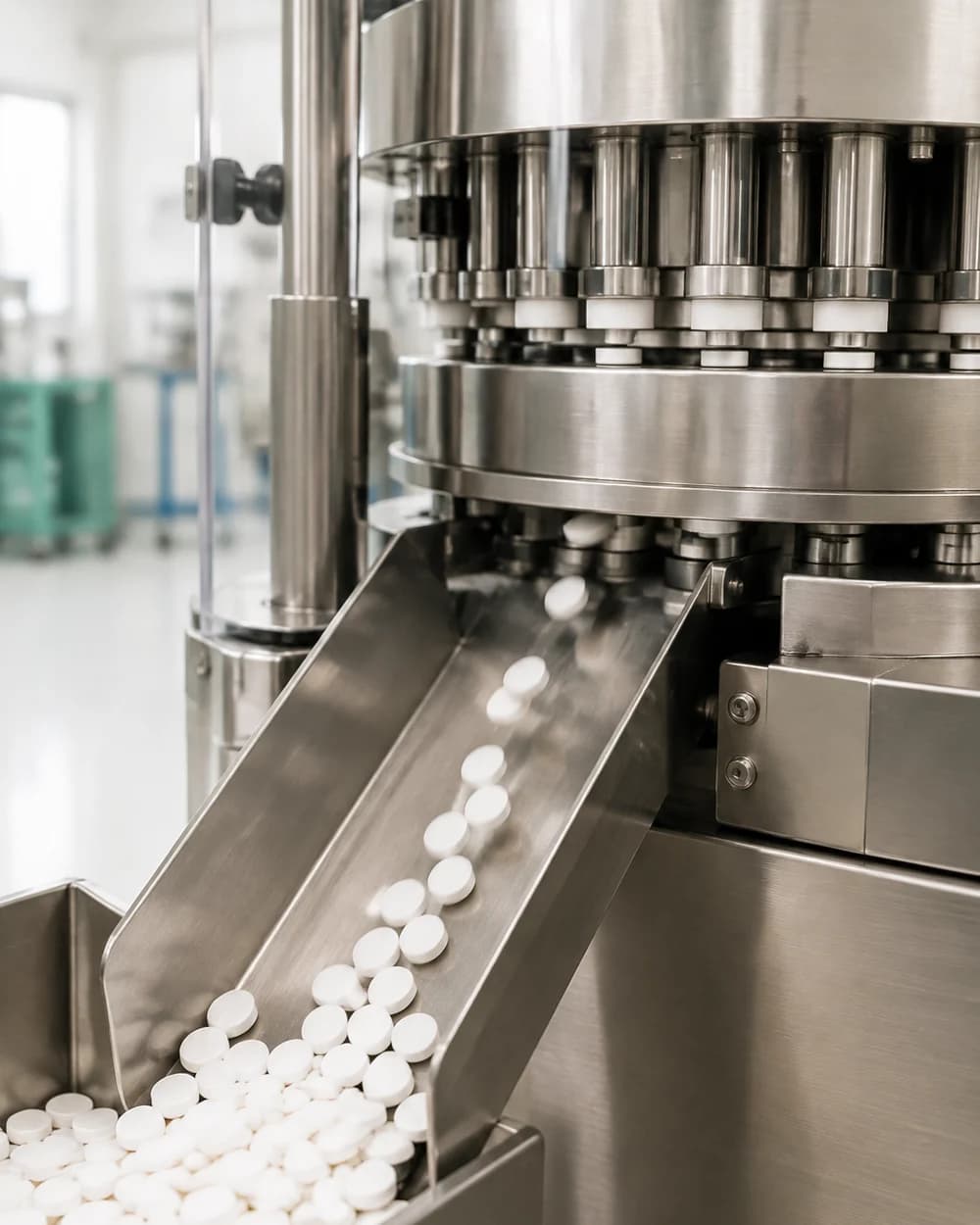
Probiotic powder is sensitive to moisture and heat, so we run tableting in a controlled suite held below 30% relative humidity. Two rotary tablet presses handle 250–1,200 mg fill weights, with output of 80,000–150,000 tablets per shift depending on size and hardness. Direct compression is standard for most strains; we use a granulation step only when a formula needs it for flow or content uniformity.
Every batch is weighed and blended under nitrogen where the formula allows. Compression force is logged per tablet, and we check weight variation, hardness, friability and disintegration against the agreed specification before the batch moves to coating or bottling. For chewable probiotics, we adjust the compression profile to keep the tablet soft enough to chew without crumbling in the bottle.
Strain Selection and Formulation Detail
We work with lyophilised probiotic powders from established suppliers, including Lactobacillus, Bifidobacterium, Streptococcus and Bacillus strains. Overages are standard practice: if the label claims 10 billion CFU at end of shelf life, the formula is built with 12–15 billion CFU at manufacture, depending on the strain and the stability data. We can also add prebiotics such as inulin or FOS, plus excipients like microcrystalline cellulose, magnesium stearate and silicon dioxide.
Flavour and sweetener systems for chewable tablets include natural fruit powders, stevia, monk fruit and xylitol. For coated tablets, we use a thin film coat to reduce moisture ingress and mask any fermented note from the strains. We do not use animal-derived gelatine in probiotic tablets unless a client specifically requests it; most formulas are vegan by default.
Quality Control and Export Documentation
Each probiotic tablet batch is tested for identity, potency, moisture content, microbial limits and heavy metals. CFU counts are run at release and again at intervals during stability testing, so the label claim holds through the declared shelf life. We retain samples for 24 months and can supply certificates of analysis, safety data sheets and allergen statements before shipment.
The facility is GMP-certified and holds ISO 22000 and HACCP. halal and vegan certifications are available depending on the ingredient list and the target market. For US and EU buyers, we provide documentation to support FDA-registered facility status and EU food contact compliance for bottles and closures. Shipping is arranged FOB Shenzhen or Yantian, with air freight for pilot runs.
Quality Control and Batch Documentation
Every probiotic tablet batch is tested at three stages: raw material receipt, in-process compression, and finished release. Identity testing by 16S rRNA sequencing or strain-specific PCR confirms each culture matches the declared strain. Potency is measured by plate count at release, with a specification of 100% of label claim at the time of manufacture. Microbial safety testing covers total aerobic count, yeast and mould, E. coli, Salmonella, and Staphylococcus aureus. Heavy metals (lead, cadmium, arsenic, mercury) are tested per ICP-MS against USP <232> limits. Disintegration testing follows USP <701> with a 30-minute limit for uncoated tablets.
The certificate of analysis (COA) for each batch lists strain identity, potency at release, microbial results, heavy metals, disintegration, appearance, average weight, hardness, and moisture content. Moisture is critical for probiotics and is specified at ≤3.0% for tablets. A retention sample of at least 200 tablets per batch is stored under controlled conditions (25°C/60% RH) for the shelf life plus one year. Stability protocols follow ICH Q1A(R2) with testing at 0, 3, 6, 12, 18, and 24 months under long-term conditions, and accelerated testing at 40°C/75% RH for six months. Potency overage is set at 30–50% above label claim to ensure the declared CFU count is maintained through expiry.
Documentation provided with each shipment includes the COA, a batch manufacturing record summary, and a declaration of allergen status. For markets requiring it, we supply a certificate of free sale and a phytosanitary certificate where applicable. All records are retained for five years and are available for audit by the brand owner or a third-party auditor. Our quality system is GMP and ISO 22000 certified, and we can provide a quality agreement covering testing responsibilities, deviation handling, and change control.
Packaging, Labelling and Retail Readiness
Probiotic tablets can be packed in HDPE bottles with induction seals and desiccant, blister packs (PVC/PVDC or alu-alu), stick packs, or sachets. Bottle sizes range from 30 to 120 tablets, with standard 60cc and 100cc HDPE bottles. Blister packs are available in 10, 14, or 21 tablet configurations. Stick packs and sachets are typically 2–5 g fill and are suited for powder or chewable formats. We can apply shrink bands, tamper-evident seals, and child-resistant closures where required. Desiccant options include silica gel canisters or molecular sieve sachets, with moisture barrier specifications provided for each format.
For the US market, labels must include the supplement facts panel with CFU counts at expiry, other ingredients, allergen declarations, and the DSHEA disclaimer. We can generate print-ready artwork from your content or work with your designer. Lot number and expiry date are inkjet-printed or laser-coded on the bottle, blister, or carton. Expiry dating is typically 18–24 months from manufacture, supported by stability data. Cartons are specified with dimensions, board grade (typically 300–350 gsm), and printing method (offset or digital). Pallet configurations are standard 1200x1000 mm or 1200x800 mm, with stretch wrapping and edge protectors.
For Amazon FBA, we apply FNSKU labels and poly-bag or shrink-wrap units as required. Retail compliance for the EU includes the address of the food business operator, nutrition declaration, and language requirements per member state. We do not provide regulatory advice but can supply the technical file and label review against your provided market requirements. Packaging materials are food-grade and meet EU 10/2011 and FDA 21 CFR 174-190 where applicable.
MOQ, Lead Times and Delivery
Sample lead time is 7–10 working days after receipt of a signed sample request and specification. Samples are provided free of charge for standard formulations; custom strain blends may incur a development fee, which is credited against the first production order. Mass production lead time is 20–35 working days after sample approval and receipt of a deposit. This window includes raw material procurement, tableting, coating (if applicable), packaging, and quality testing. Delays can occur if strain-specific raw materials are out of stock; we will notify you within 5 working days of order confirmation if this is the case.
Shipping options include air freight (5–10 days door-to-door) and sea freight (25–40 days port-to-port). We work with EXW, FOB Shenzhen or Hong Kong, and DDP terms. For DDP, we handle customs clearance and duties for most major markets, including the US, EU, UK, and Australia. Air shipments are typically used for pilot runs or urgent orders, while sea shipments are cost-effective for full container loads (FCL) or less-than-container loads (LCL). We provide a packing list and commercial invoice for each shipment.
Documents provided with each shipment include the COA, material safety data sheet (MSDS) if required, certificate of free sale, and phytosanitary certificate for relevant plant-derived ingredients. For halal certification, we provide the certificate from the certifying body. We do not provide a certificate of origin unless requested; this can be arranged through the local chamber of commerce. All shipments are palletised and stretch-wrapped, with desiccant added to containers for sea freight to control humidity.
What We Can Build
Single-strain tablets
One documented strain per tablet, typically 1–10 billion CFU. Simple label, straightforward stability data, lower cost per unit.
Multi-strain blends
Two to twelve strains in one tablet. We check compatibility and moisture sensitivity before blending to avoid viability loss.
Chewable probiotics
Soft, flavoured tablets for children or adults. Natural fruit powders, stevia or monk fruit. 250–600 mg fill weight.
Coated tablets
Film-coated for moisture barrier and taste masking. Suitable for higher CFU counts where raw powder has a fermented note.
How a Project Runs
- 01
Send your brief
Share target CFU, strains, tablet size, flavour, packaging format and destination market. We confirm feasibility and pricing within 2 working days.
- 02
Formulation review
We check strain compatibility, overage requirements and excipient list. You receive a draft formula and label claim recommendation.
- 03
Sample production
Samples are produced in 7–10 working days. You receive tablets in retail bottles or bulk, with a preliminary COA.
- 04
Sample approval
You test the samples, confirm flavour and hardness, and approve the final specification. We lock the formula and packaging artwork.
- 05
Mass production
Full batch runs in 20–35 working days. In-process checks cover weight, hardness, moisture and CFU count at release.
- 06
QC and shipping
Final testing, COA, packing list and export documents. We ship FOB Shenzhen or arrange air freight for smaller orders.
Why EUPHM
Low-humidity production
Tableting suites held below 30% relative humidity protect live cultures during compression and coating.
Documentation for export
COA, MSDS, allergen statements and certification files prepared for US, EU, UK and Middle East buyers.
Flexible order sizes
Pilot runs from 1,000 units, retail MOQ 1,000 units per SKU. Suitable for first launches and line extensions.
Questions buyers ask.
What is the MOQ for probiotic tablets?+
Retail bottling starts at 1,000 units per SKU. Pilot runs can go as low as 1,000 units for market testing. MOQ depends on tablet size, strain count and packaging format. We confirm exact numbers after reviewing your brief.
How do you protect CFU counts during tableting?+
We run tableting in a low-humidity suite, use direct compression where possible, and apply overages of 20–50% depending on the strain. CFU counts are tested at release and during stability studies, so the label claim holds through shelf life.
Can you make vegan or halal probiotic tablets?+
Yes. Most probiotic tablet formulas are vegan by default, using plant-based excipients. Halal certification is available for suitable ingredient lists. We provide the relevant certificates with the batch documentation.
What is the lead time for samples and mass production?+
Samples ship in 7–10 working days. Mass production takes 20–35 working days after sample approval, depending on batch size and packaging. Air freight can shorten transit for pilot runs.
Which certifications does the facility hold?+
The facility is GMP-certified and holds ISO 22000 and HACCP. halal and vegan certifications are available depending on the formula and target market. We provide certificates of analysis and compliance documents with each shipment.
What is the potency overage and how do you ensure CFU counts at expiry?+
We set a potency overage of 30–50% above label claim at manufacture, based on strain-specific stability data. Each batch is tested at release and during stability studies at 0, 3, 6, 12, 18, and 24 months. The overage ensures the declared CFU count is maintained through the stated shelf life under recommended storage conditions.
Can you provide a stability study specific to my formulation?+
Yes. We can run a real-time stability study for your formulation at 25°C/60% RH and 30°C/65% RH, with testing at 0, 3, 6, 12, 18, and 24 months. Accelerated testing at 40°C/75% RH for six months is also available. The study protocol and results are provided in a formal report suitable for regulatory submission.
What are the storage and shipping conditions for probiotic tablets?+
Finished tablets should be stored below 25°C and 60% RH, away from direct sunlight. For shipping, we recommend insulated containers with desiccant for air freight, and temperature-controlled containers for sea freight if the destination climate is hot and humid. We provide a temperature excursion report if data loggers are used.
Have a product in mind?
Send us the brief and we will come back with a formulation direction, indicative price and a realistic lead time — usually within one working day.