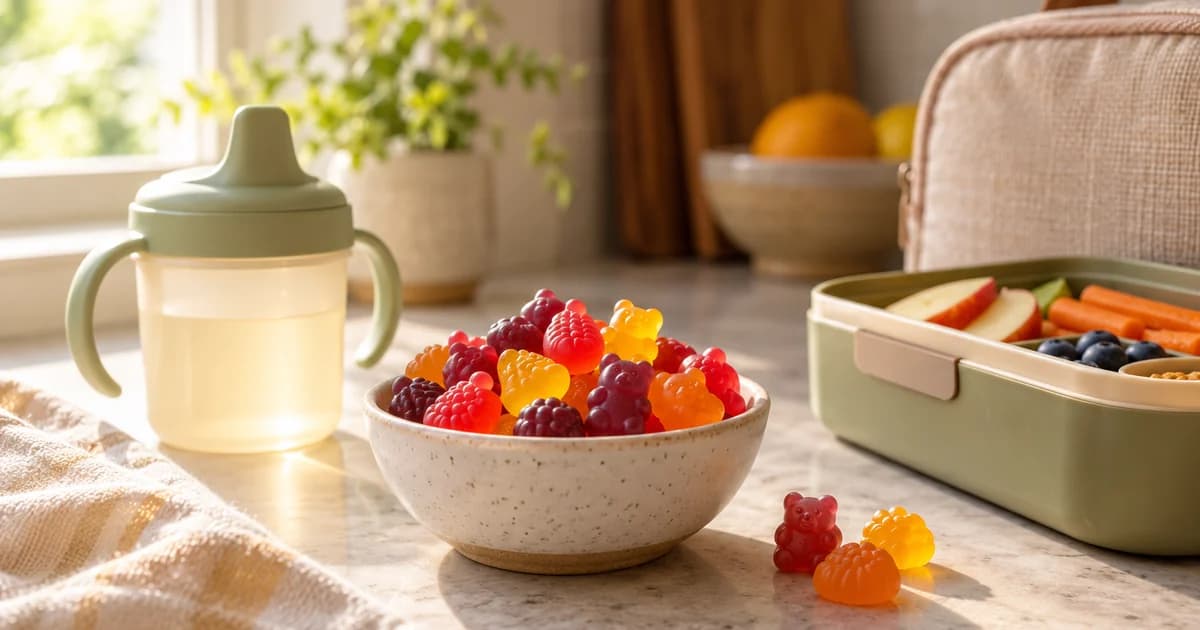
Kids Vitamin Gummies Guide for Brand Owners
A practical guide to sourcing kids vitamin gummies: fill weights, actives, pectin versus gelatin bases, MOQs from 1,000 units, and 20–35 working day production windows. Built for founders and procurement teams placing a first or repeat order.

Overview
Children's gummies sit in a stricter category than adult confectionery. Dosage must suit ages 4–12, texture must stay stable through summer transit, and labels must satisfy FDA, EU 1169/2011 or GCC standards depending on market. This guide covers what to specify before requesting a quote, what a GMP-certified plant in Guangdong can realistically run, and where costs and timelines move. For base formats, see our gummies resource library.
| MOQ (retail bottling) | 1,000 units per SKU |
|---|---|
| Pilot run MOQ | From 1,000 units, subject to formula |
| Sample lead time | 7–10 working days |
| Mass production | 20–35 working days after sample sign-off |
| Typical piece weight | 2.0–3.5 g per gummy |
| Certifications | GMP, ISO 9001, ISO 22000, HACCP, NSF/ANSI 455-2, halal, FDA-registered |
Production Capability and Line Formats
Kids gummies run on starch-mogul or depositing lines depending on base. Pectin and gelatin both deposit at 2.0–3.5 g per piece; a standard retail bottle holds 60, 90 or 120 count. A single line can output 8,000–12,000 bottles per shift at 90 count, so a 5,000-unit order is a short run. That matters if you plan three flavours and want them filled in one campaign rather than three separate slots.
Tooling is the constraint most buyers underestimate. Standard bear, star, dinosaur and round shapes carry no tooling fee. Custom shapes need a mould at roughly 15–20 days and a one-off cost, plus a minimum of 10,000–20,000 pieces per shape to justify the setup. For a first launch, pick an existing shape and put your differentiation into flavour, colour and label.
Formulation: Actives, Bases and Sweeteners
The base decides texture and shelf life. Gelatin gives a chewier bite and holds up well in warm climates; pectin is vegan, softer, and slightly more prone to sweating above 30°C. For US and EU retail, pectin is now the default request. Sweetener systems vary: cane sugar and glucose syrup at 1.5–2.5 g sugar per gummy, or maltitol and sorbitol for sugar-free lines, which need a laxative warning in several markets.
Actives are where overage matters. Vitamin D3, C, B6, B12, zinc and omega-3 are common in kids lines. Heat during depositing degrades some vitamins, so specify overage at 10–30% depending on the nutrient and target shelf life. Typical shelf life is 18–24 months. Natural colours from beetroot, turmeric and spirulina are stable enough for most formulas; synthetic colours remain cheaper but are restricted in the EU.
Quality, Compliance and Shipping
Every batch should ship with a certificate of analysis covering assay, microbiological limits and heavy metals. A GMP-certified plant with ISO 22000 and HACCP runs incoming raw material testing, in-process checks and finished goods release. If you sell into the Middle East or Israel, halal certification must be arranged before production, not after — the line and raw materials both need approval.
For the US, the facility must be FDA-registered and follow 21 CFR Part 111. For the EU, you need a responsible person and a label compliant with EU 1169/2011, including the nutrition declaration and allergen statement. Shipping from Guangdong to Los Angeles runs 18–25 days by sea; to Rotterdam, 28–35 days. Air freight is 5–8 days at roughly 4–6 times the sea rate. Plan bottling, labelling and cartoning as one operation to avoid a second pass.
Quality Control and Batch Documentation
Every batch of kids vitamin gummies is tested against the approved specification before release. Incoming raw materials are checked for identity and potency by HPLC or UV-Vis, and microbial limits are verified for gelatin, pectin and any fruit puree. During production, in-process checks cover piece weight, colour, texture and pH. Finished gummies are tested for the label-claimed vitamins, microbials (total plate count, yeast and mould, E. coli, Salmonella), heavy metals (lead, cadmium, arsenic, mercury) and disintegration time, typically under 30 minutes at 37°C.
A certificate of analysis (COA) is issued per batch and lists the test parameters, methods, specifications and results, plus the batch number, production date and expiry date. Retention samples of each batch are held for at least 24 months under controlled conditions, so any post-market query can be traced back to the retained material. Stability testing follows an accelerated protocol at 40°C and 75% relative humidity for six months, with real-time data at 25°C and 60% relative humidity for up to 24 months to support the declared shelf life.
Microbial testing is performed on every batch, not by exception. Heavy metals are tested at least once per raw material lot and on the finished gummy at a frequency agreed in the quality plan, typically every third batch or per SKU per quarter. Disintegration is checked because a gummy that does not break down within the declared window can fail consumer expectations and, in some markets, regulatory scrutiny. All records are retained for five years and are available for audit by the brand owner or their nominated third party.
Packaging, Labelling and Retail Readiness
Kids vitamin gummies are typically packed in HDPE bottles with induction seals and child-resistant closures, in counts from 30 to 180 gummies. Blister packs, stick packs and single-serve sachets are also available, with stick packs suiting lunchbox formats and sachets used for sample or travel packs. Bottle dimensions, cap type and label size are confirmed at the artwork stage. Cartons are specified with gross weight, dimensions and barcode, and pallet configurations are provided as a standard document for retail and distributor planning.
For the US market, the label must carry a supplement facts panel, serving size, amount per serving, percent daily value for children aged 4 and over, and the statement of identity. Allergen declarations, the 'keep out of reach of children' warning and storage instructions are required. Lot and expiry coding is applied by inkjet or laser on the bottle and carton, with the format agreed in writing. For EU 1169/2011, nutrition declaration, allergen highlighting and minimum font sizes apply. GCC labels follow GSO requirements.
Retail readiness includes Amazon FNSKU labelling, poly-bagging where required, and carton markings that meet marketplace inbound rules. We can apply FNSKU labels and provide carton weight and dimension data in the format required by the retailer. Artwork is checked against the destination market before printing, and a pre-production proof is issued for sign-off. Packaging components are specified with food-contact documentation, and any desiccant or oxygen absorber is declared.
MOQ, Lead Times and Delivery
Sampling starts with a brief covering age range, actives, base, sweetener, flavour, piece weight and packaging. Sample lead time is 7 to 10 working days from receipt of a complete brief and any required artwork. Sample costs are quoted per project and are typically credited against the first mass-production order. Once the sample is signed off, mass production runs 20 to 35 working days, depending on bottle count, label complexity and whether components are stock or custom.
Delivery is quoted EXW, FOB or DDP. Air freight is used for pilot runs and time-sensitive launches, typically 5 to 10 days door to door depending on destination. Sea freight is used for full-container orders, typically 25 to 40 days port to port. Incoterms are confirmed in the proforma invoice, and the named port or place is stated explicitly. For DDP, the importer of record and duty treatment are agreed before booking.
Documents provided with each shipment include the commercial invoice, packing list, certificate of analysis for the batch, material safety data sheet where applicable, and a free-sale certificate. Phytosanitary certificates are provided where the destination requires them for gelatine or pectin-based confectionery. halal and vegan certificates are available on request and are issued by the relevant certifying body, not by the factory. Origin certificates are provided for preferential tariff treatment where applicable.
Formats and Packaging Options
Pectin base
Vegan, softer texture, suits EU and US retail. Slightly more sensitive to heat above 30°C. Common for fruit-forward kids lines.
Gelatin base
Chewier bite, better heat stability, lower cost per kg. Not suitable for vegetarian, halal claims unless certified sources are used.
Sugar-free system
Maltitol or sorbitol replaces sucrose. Requires a laxative warning in the EU and several Gulf markets. Check local rules before committing.
Multi-layer or coated
Vitamin or mineral layer inside a fruit shell, or a sour coating. Adds 5–10 days to production and a small per-unit cost.
From Spec to Shipment
- 01
Brief and quote
Send target age, actives, count per bottle, market and volume. A costed quote with MOQ and lead time returns in 2–3 working days.
- 02
Sample development
Samples produced in 7–10 working days. You receive 2–3 flavour variants with a draft specification and nutrition panel.
- 03
Sample sign-off
Confirm flavour, texture, piece weight and label. Overages and shelf-life targets are locked at this stage, not later.
- 04
Raw material booking
Actives, pectin or gelatin and packaging are ordered. Long-lead vitamins can add 5–10 days if not held in stock.
- 05
Production and QC
Mass production runs 20–35 working days. In-process checks plus finished goods assay, micro and heavy metals testing.
- 06
Release and dispatch
Certificate of analysis issued, bottles cartoned, and shipment booked by sea or air. Documents prepared for your market.
Why EUPHM
Low MOQ for first runs
1,000 units per SKU keeps initial inventory and cash tied up low while you test the market.
Certified for multiple markets
GMP, ISO 9001, ISO 22000, HACCP, NSF/ANSI 455-2 and halal certification; FDA facility registration for US-bound shipments.
One plant, full process
Depositing, bottling, labelling and cartoning under one roof. Fewer handoffs, fewer delays, one point of accountability.
Questions buyers ask.
What is the MOQ for kids vitamin gummies?+
Retail bottling starts at 1,000 units per SKU. Pilot runs can go lower, from 1,000 units, but the per-unit cost rises and some shapes or actives may not be available. If you plan three flavours, each flavour is a separate SKU with its own MOQ.
How long does production take?+
Samples take 7–10 working days. Once you sign off the sample, mass production runs 20–35 working days depending on actives, packaging and current line loading. Add 5–10 days if a long-lead vitamin or a custom bottle needs ordering.
Can you make vegan or halal kids gummies?+
Yes. Pectin replaces gelatin for vegan lines, and halal certification can be arranged using certified gelatin or pectin. Certification must be confirmed before production begins, because both the raw materials and the line need approval.
What age range do kids gummies suit?+
Most formulas target ages 4–12, with piece weights of 2.0–3.5 g and one to two gummies per day. For ages 2–3, gummies are usually not recommended due to choking risk, and some markets require a label warning. Confirm the age band before finalising dosage.
Do you provide a certificate of analysis?+
Yes. Every batch ships with a certificate of analysis covering assay, microbiological limits and heavy metals. The facility is GMP-certified with ISO 22000 and HACCP, and is FDA-registered for US-bound product. Certificates are issued at release, before dispatch.
What testing is done on each batch of kids vitamin gummies?+
Each batch is tested for label-claimed vitamins by HPLC or UV-Vis, microbial limits including total plate count, yeast and mould, E. coli and Salmonella, heavy metals such as lead, cadmium, arsenic and mercury, and disintegration time. In-process checks cover piece weight, colour, texture and pH. Results are recorded on the batch record and summarised in the certificate of analysis issued with the shipment.
Can you apply Amazon FNSKU labels and retail-ready packaging?+
Yes. We can apply FNSKU labels, poly-bag bottles where required, and provide carton weight and dimension data in the format Amazon and other retailers request. Carton markings are checked against marketplace inbound rules before production. Artwork is proofed against the destination market, and a pre-production proof is issued for sign-off before printing.
What Incoterms and shipping documents do you provide?+
We quote EXW, FOB or DDP, with the named port or place stated in the proforma invoice. Documents include commercial invoice, packing list, batch certificate of analysis, material safety data sheet where applicable, free-sale certificate, and phytosanitary certificate where the destination requires it. halal and vegan certificates are available on request from the relevant certifying body.
Xu Wei writes the manufacturing, quality and regulatory guides on EUPHM. He works directly with the plant's production and QA teams to document how each dosage form is made, tested and released, so every claim on the site can be traced back to a batch record or a certificate on file.
More guides in this category.
See all →
Melatonin Gummies Guide for Brand Owners and Procurement Teams
Melatonin gummies are a fast-moving sleep supplement format, but they are harder to make than capsules. This guide covers realistic MOQs, fill weights, pectin versus gelatin bases, dosing, stability and the compliance documents buyers should request before placing a purchase order.
Read the guide →
Collagen Gummies Market Trends: What Buyers Need to Know
Collagen gummies are the fastest-growing delivery format in beauty-from-within. Retail buyers and brand owners now ask for 5g collagen per serving, halal certification, and clean-label pectin bases. This page covers demand data, formulation choices, and contract manufacturing parameters.
Read the guide →
Sugar-Free Gummy Formulation Guide for Supplement Brands
Sugar-free gummies are the fastest-growing supplement format in the US and EU, but they are harder to make than sugar-based ones. This guide covers polyol selection, gelling agents, moisture control and realistic production parameters.
Read the guide →Have a product in mind?
Send us the brief and we will come back with a formulation direction, indicative price and a realistic lead time — usually within one working day.