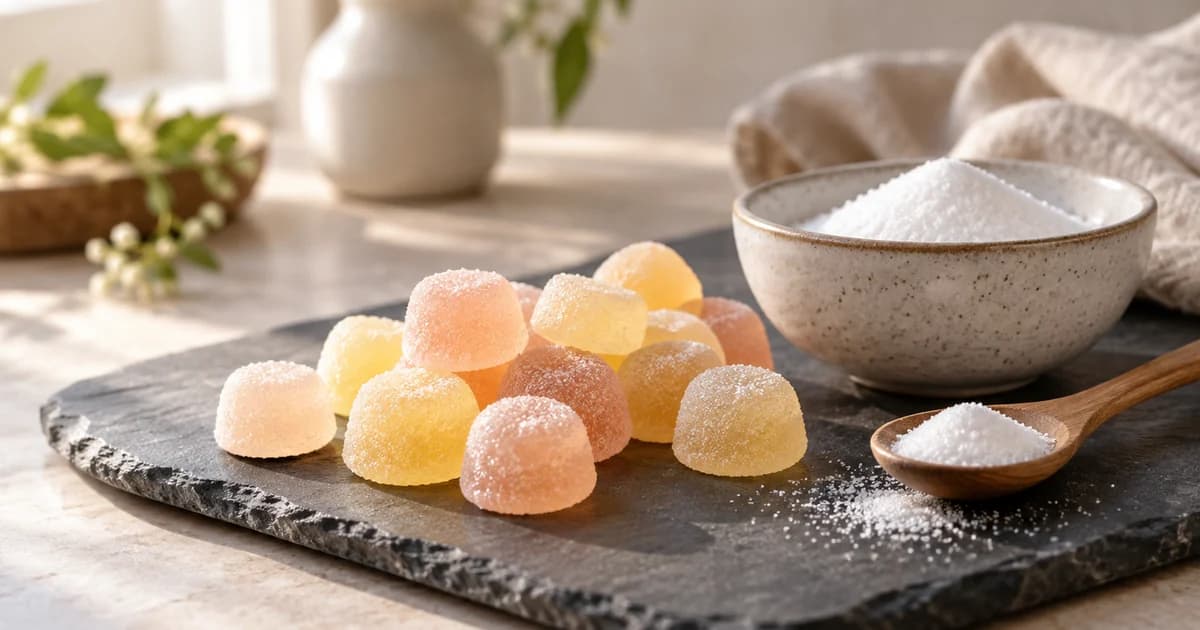
Sugar-Free Gummy Formulation Guide for Supplement Brands
Sugar-free gummies are the fastest-growing supplement format in the US and EU, but they are harder to make than sugar-based ones. This guide covers polyol selection, gelling agents, moisture control and realistic production parameters.
Overview
Sugar-free gummies replace sucrose and glucose syrup with polyols, soluble fibre or high-intensity sweeteners. The change affects texture, water activity, shelf life and process temperatures. A formulation that works on a lab bench often fails on a 200,000-unit line. This guide sets out the decisions a brand owner or procurement manager needs to make before requesting samples, and the parameters a GMP-certified contract manufacturer works to in practice.

Sweetener Systems and Their Trade-Offs
Maltitol gives the closest texture to sucrose and is the cheapest polyol at scale. It has a glycaemic index around 35 and can cause digestive discomfort above roughly 20 g per serving. Sorbitol is similar but more laxative. Erythritol has near-zero calories and a glycaemic index of 0, but it crystallises easily and produces a cooling mouthfeel. Allulose browns like sugar and behaves well in pectin systems, though it is not permitted in the EU as a sweetener. Stevia and monk fruit are 200–300 times sweeter than sucrose and are usually blended with a bulking agent such as soluble corn fibre or inulin.
The practical choice is rarely a single sweetener. Most commercial sugar-free gummies use a blend: erythritol or allulose for bulk and sweetness, a small amount of maltitol or sorbitol for elasticity, and stevia or monk fruit to round off the aftertaste. The blend ratio determines water activity, which should sit between 0.55 and 0.65 for a shelf-stable gummy. Above 0.70, mould risk rises sharply. Below 0.50, the gummy becomes hard and loses chew.
Gelling Agents: Pectin, Gelatin and Starch
Gelatin gives the springy, elastic bite most consumers associate with gummies. It sets at low temperatures and works well with polyols, but it is animal-derived, which rules out vegan and halal claims unless you use bovine gelatin certified halal. Pectin is plant-based and sets through a calcium reaction at a pH between 3.2 and 3.8. It produces a softer, shorter texture and is more sensitive to pH drift. Starch moulding is the cheapest route for high-volume production and works well with allulose, but the texture is more brittle and the drying time is longer.
For sugar-free formulations, pectin is often the better choice because it tolerates the low solids content of polyol systems. Gelatin can work, but you need to adjust the bloom strength and the curing regime. A typical pectin gummy uses 1.5–2.5% pectin by weight, 0.2–0.5% calcium citrate and a buffer to hold pH. Gelatin gummies usually use 6–10% gelatin with a bloom of 220–260. EUPHM runs both lines and can advise on which suits your label claims.
Quality Control and Shelf-Life Testing
Sugar-free gummies are more prone to moisture migration and crystallisation than sugar-based ones. Every batch should be tested for water activity, texture (hardness and elasticity), and microbial load. A standard shelf-life study runs at 25°C/60% RH and 40°C/75% RH for 3 and 6 months. If the gummy contains probiotics or vitamin C, you also need potency testing at each time point. Pectin gummies typically lose 10–15% of their vitamin C over 6 months at 25°C, so overage is required.
Compliance depends on the market. In the EU, erythritol requires a laxative warning if the product exceeds 10% polyols. In the US, the FDA does not approve supplements but does require cGMP compliance and accurate labelling. Halal certification must be verified for every ingredient, including the gelatin and the release agent. A GMP-certified plant should provide a certificate of analysis for each batch and retain samples for at least 2 years. Ask for the water activity specification before you approve a sample.
Quality Control and Batch Documentation
Every production batch of sugar-free gummies is tested against a written specification before release. Identity and potency testing confirms that the active ingredients match the formula declaration, typically by HPLC or UV-Vis methods. Microbial testing covers total aerobic count, yeast and mould, E. coli and Salmonella, with limits set to the destination market's requirements. Heavy metals testing screens lead, arsenic, cadmium and mercury against ICH Q3D or equivalent thresholds. Disintegration testing follows the pharmacopoeial method for the target market, which is particularly relevant for pectin and gelatin systems where polyol content affects hydration.
Sampling occurs at three points: incoming raw materials, in-process gel and finished packed product. In-process checks include Brix, pH, water activity and texture. Finished product is held for release testing, and a retention sample of at least two retail units per batch is stored under labelled conditions for the shelf life plus twelve months. The certificate of analysis issued with each shipment lists batch number, manufacture and expiry dates, test parameters, specifications, results and the analyst and QA sign-off. It also references the specification version and any deviation record.
Stability testing follows a bracketed protocol: accelerated conditions at 40 degrees Celsius and 75 percent relative humidity for six months, plus real-time conditions at 25 degrees Celsius and 60 percent relative humidity for the declared shelf life. Sugar-free gummies are monitored for moisture migration, hardness change, colour shift and sweetener recrystallisation. Where a brand requires a specific claim, such as no added sugar or suitable for diabetics, the stability data must support that claim across the full shelf life. Any reformulation triggers a new stability study before commercial release.
Packaging, Labelling and Retail Readiness
Packaging options for sugar-free gummies include HDPE or PET bottles with induction seals, blister packs, stick packs and single-serve sachets. Bottle sizes typically range from 60 to 120 count, with fill weights between 2.0 and 5.0 grams per gummy. Blisters suit pharmacy channels and travel retail, while stick packs and sachets are common for sample programmes and subscription models. Each format has different moisture barrier requirements, and the chosen format must be validated against the stability protocol to confirm the declared shelf life.
For the US market, the label must carry the statement of identity, net quantity of contents, nutrition facts panel, ingredient list, allergen declaration and the manufacturer or distributor name and address. The supplement facts panel must declare active ingredients per serving and percent daily value where established. Lot code and expiry date are printed or laser-coded on the primary package and the carton. Cartons are specified with dimensions, gross weight and pallet configuration, typically 48 to 60 cartons per pallet layer and up to five layers, depending on the case size.
Retail readiness extends to Amazon FNSKU labelling, polybagging requirements and carton weight limits for marketplace fulfilment centres. For EU retail, the label must comply with Regulation (EU) No 1169/2011, including the nutrition declaration and any authorised health claims. The contract manufacturer can apply client-supplied artwork and variable data, but the brand owner remains responsible for claim substantiation. Pre-production artwork proofs are signed off before printing, and a golden sample of the finished pack is retained for reference.
MOQ, Lead Times and Delivery
Sample development for sugar-free gummies typically takes 7 to 10 working days from receipt of a complete brief, including flavour, sweetener system, active ingredients and target market. Pilot runs of 1,000 units per SKU are available for retail bottling, with lower quantities possible for stability or sensory trials. Mass production follows 20 to 35 working days after sample approval, depending on the gelling agent, packaging format and whether new tooling is required. The production window starts when the deposit and approved artwork are received.
Shipping is arranged by air or sea. Air freight suits launches and replenishment, with transit times of 3 to 7 days to major hubs, while sea freight takes 18 to 35 days depending on the destination port. Incoterms offered include EXW, FOB and DDP. Under EXW, the buyer arranges collection from the factory; under FOB, the manufacturer handles export clearance and loading at the named Chinese port; under DDP, the manufacturer delivers to the buyer's named address with duties paid. The choice affects cost, risk transfer and customs documentation.
Each shipment is accompanied by a certificate of analysis, a material safety data sheet where applicable, a free-sale certificate and, for plant-derived ingredients, a phytosanitary certificate where the destination requires one. Halal, vegan and organic certificates are provided on request, subject to the relevant audit being in place. Commercial invoice, packing list and bill of lading are issued for customs clearance. The manufacturer retains shipping documents for at least three years to support any post-market query or recall traceability requirement.
Manufacturing Options to Compare
Erythritol + stevia
Zero-calorie, low glycaemic impact. Crystallises easily; best with pectin. Common in US keto and diabetic-friendly lines.
Maltitol + sucralose
Closest to sugar texture, lowest cost. Contains 2.1 kcal/g and carries a laxative warning above 20 g per serving in some markets.
Allulose + monk fruit
Browns like sugar, no cooling aftertaste. Not approved as a sweetener in the EU. Popular in US and Middle East markets.
Soluble fibre + pectin
Adds prebiotic fibre claim. Water activity is harder to control. Suitable for vegan and organic-certified lines.
From Spec to Shipment
- 01
Submit your brief
Send target market, claims, active ingredients, fill weight and packaging format. We confirm feasibility within 2 working days.
- 02
Formulation and sample
We develop a bench sample and ship it in 7–10 working days. You receive a specification sheet with water activity and texture data.
- 03
Sample approval
You test taste, texture and label claims. We adjust the blend up to 3 times at no extra cost before you sign off.
- 04
Pilot run
A 500–1,000 unit pilot run validates the formula on production equipment. This catches scaling issues before mass production.
- 05
Mass production
Full run of 1,000 units per SKU. Production takes 20–35 working days, depending on actives and packaging.
- 06
QC and dispatch
Each batch is tested for water activity, microbial load and potency. You receive a certificate of analysis and retain samples.
Why EUPHM
Low MOQ for pilot runs
Start at 1,000 units per SKU for retail bottling, or lower for a pilot. Scale to 200,000 units per line per day.
Certified for global retail
GMP, ISO 9001, ISO 22000, HACCP, NSF/ANSI 455-2 and halal certification; FDA facility registration for US-bound shipments.
Formulation support
In-house R&D adjusts polyol blends, gelling agents and overages to meet your label claims and shelf-life targets.
Questions buyers ask.
What is the minimum order quantity for sugar-free gummies?+
For retail bottling, MOQ is 1,000 units per SKU. Pilot runs can be lower, typically 500–1,000 units, so you can test the market before committing to a full production run. MOQ depends on the mould shape and packaging format.
How long does sample development take?+
Sample lead time is 7–10 working days from brief confirmation. This includes a bench sample, a specification sheet with water activity and texture data, and up to 3 reformulation rounds if needed. Shipping time is additional and depends on your location.
Can you make vegan sugar-free gummies?+
Yes. We use pectin or starch as the gelling agent instead of gelatin. Vegan certification is available. Note that some polyols and colours may not be permitted in organic-certified products, so we check your target market rules before formulation.
What is the shelf life of a sugar-free gummy?+
Typically 18–24 months when water activity is controlled between 0.55 and 0.65 and the product is stored below 25°C. We run accelerated shelf-life studies at 40°C/75% RH for 3 and 6 months to confirm. Actives like probiotics may shorten this.
Do you provide halal certification?+
Yes, on request. Certification applies to the finished product and requires that all ingredients, including gelatin and release agents, are certified. We provide the certificates before production starts. Additional lead time may apply for certification audits.
What is the difference between a retention sample and a stability sample?+
A retention sample is a representative unit from each batch, stored under labelled conditions for the shelf life plus twelve months, used to investigate complaints or verify identity. A stability sample is drawn for the formal stability protocol and tested at defined intervals under accelerated and real-time conditions. Both are kept separately, and neither is released for sale. The retention sample supports traceability, while the stability sample supports the declared shelf life and any on-pack claims.
Can you print lot codes and expiry dates on the primary package?+
Yes. Lot codes and expiry dates are printed or laser-coded on the primary package and the carton during packing. The format follows the brand owner's specification, and the coding is verified against the batch record before release. For blisters and sachets, coding is applied to the foil or film. The manufacturer retains a coded sample from each batch to confirm legibility and adhesion throughout the declared shelf life.
Which Incoterms do you recommend for a first order?+
For a first order, FOB is often the clearest choice because the manufacturer handles export clearance and loading at the named Chinese port, while the buyer controls freight and insurance. DDP suits buyers who want a delivered price and are less familiar with customs formalities, but it transfers more responsibility to the manufacturer. EXW is suitable only when the buyer has an established freight forwarder in China. The choice should be agreed in writing before production.
Xu Wei writes the manufacturing, quality and regulatory guides on EUPHM. He works directly with the plant's production and QA teams to document how each dosage form is made, tested and released, so every claim on the site can be traced back to a batch record or a certificate on file.
More guides in this category.
See all →
Kids Vitamin Gummies Guide for Brand Owners
A practical guide to sourcing kids vitamin gummies: fill weights, actives, pectin versus gelatin bases, MOQs from 1,000 units, and 20–35 working day production windows. Built for founders and procurement teams placing a first or repeat order.
Read the guide →
Melatonin Gummies Guide for Brand Owners and Procurement Teams
Melatonin gummies are a fast-moving sleep supplement format, but they are harder to make than capsules. This guide covers realistic MOQs, fill weights, pectin versus gelatin bases, dosing, stability and the compliance documents buyers should request before placing a purchase order.
Read the guide →
Collagen Gummies Market Trends: What Buyers Need to Know
Collagen gummies are the fastest-growing delivery format in beauty-from-within. Retail buyers and brand owners now ask for 5g collagen per serving, halal certification, and clean-label pectin bases. This page covers demand data, formulation choices, and contract manufacturing parameters.
Read the guide →Have a product in mind?
Send us the brief and we will come back with a formulation direction, indicative price and a realistic lead time — usually within one working day.