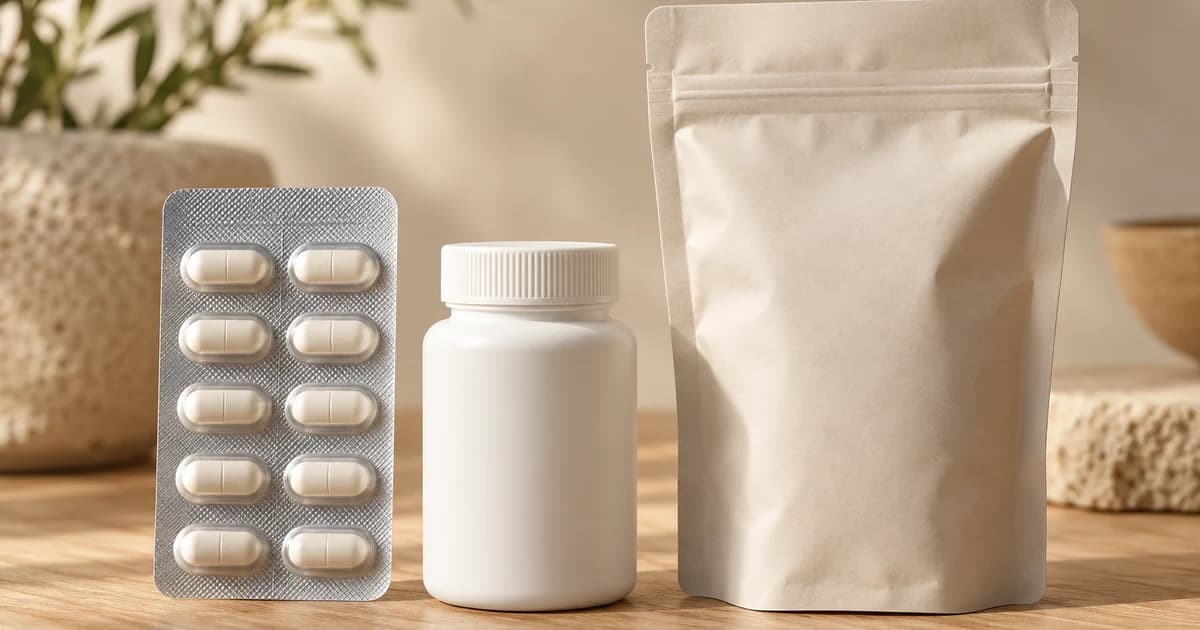
Blister vs Bottle vs Pouch: Choosing a Supplement Format
Blister, bottle and pouch each impose different minimum order quantities, tooling costs and barrier performance. This guide compares fill weights, line speeds and lead times so you can match format to product and market.
Overview
Format choice affects unit cost, shelf life and retail listing. A 60-count HDPE bottle suits capsules at 500 mg; a 30-tablet blister card protects hygroscopic actives; a 250 g pouch works for powders. Tooling, MOQ and filling speed vary by line. EUPHM runs all three formats across GMP, ISO 22000 and HACCP certified lines in Guangdong, with halal options where required.
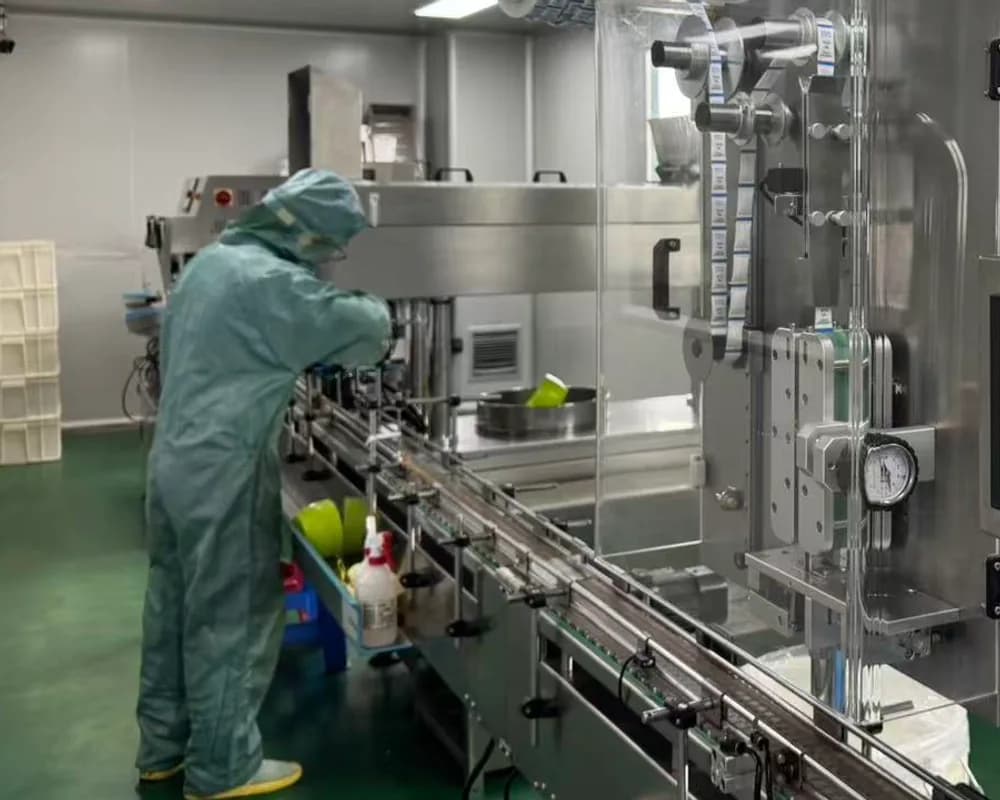
Line Capability and Format Tooling
Bottle lines fill 60 to 200 counts at 80-120 bottles per minute, depending on cap type and desiccant demand. Blister lines run 150-300 tablets per minute on a 10-cavity tool. Pouch fillers handle 100-500 g at 40-60 pouches per minute. Tooling cost for a new blister cavity runs USD 3,000-6,000; bottle and pouch change parts are usually under USD 800. That difference matters for pilot runs.
Changeover time between SKUs is 4-8 hours for bottles, 6-12 hours for blisters and 2-4 hours for pouches. If you plan multiple SKUs in one production window, pouch and bottle lines absorb the switch faster. Blister lines reward long, single-SKU runs. For a 1,000-unit pilot, bottle or pouch is almost always the lower-risk start.
Barrier Needs by Formulation
Hygroscopic actives such as probiotics, certain botanicals and effervescent blends lose potency when exposed to moisture. Blister with aluminium lidding delivers moisture vapour transmission rate below 0.1 g/m²/day and suits 30-90 count cards. Bottles need a desiccant canister or liner; without one, 60-count HDPE bottles can see 3-5% moisture uptake over 24 months in humid markets. Pouches with foil laminates reach similar barrier to blister at lower unit cost for powders.
Oil-based softgels and liquid-filled capsules travel best in bottles with induction seals or in blisters with cold-form foil. Powders and granulates suit stand-up pouches at 100-500 g. If your formula contains vitamin C, probiotics or enzymes, test two formats in accelerated stability before committing. A 3-month 40°C/75% RH study costs less than a rework batch.
Compliance, Logistics and Retail Fit
Blister cards are child-resistant and tamper-evident by design, which suits US and EU pharmacy channels. Bottles need child-resistant closures for most markets and a foil induction seal for tamper evidence. Pouches require a resealable zipper or a single-use stick pack if the product is a daily dose. Labelling space differs: a 60-count bottle offers about 90 cm² of wrap; a blister carton offers 120 cm²; a 250 g pouch offers 200 cm².
Freight cost per unit favours pouch and blister. A 30-tablet blister carton weighs 18-22 g; a 60-count bottle weighs 55-70 g. For air freight to the Middle East or US, that gap changes landed cost by 8-15%. Bottles are easier to re-label for private label launches. Blisters and pouches usually need new print plates or film artwork, adding 10-15 days to the first run.
Quality Control and Batch Documentation
Every batch released from our Guangdong lines is tested against a written specification before filling. Incoming raw materials are sampled at 100% of containers for identity by FTIR or HPLC, and each lot is screened for potency, microbial limits (TAMC, TYMC, E. coli, Salmonella), heavy metals (lead, cadmium, arsenic, mercury) and, where relevant, residual solvents. For tablets and capsules, we also run disintegration and, if requested, dissolution testing. Testing occurs at three points: raw material receipt, bulk blend or granulate, and finished packaged goods.
The certificate of analysis (COA) issued with each batch lists the product name, batch number, manufacture and expiry dates, specification parameters, test methods, results and pass/fail status. It is signed by the QC manager and references the retained sample. Retention samples are kept for the shelf life plus 12 months, stored under labelled conditions. Stability protocols follow ICH Q1A(R2) where applicable: 25°C/60% RH long-term and 40°C/75% RH accelerated, with 0, 3, 6, 12, 18 and 24-month pull points for bottle and blister formats.
For blister cards, additional checks cover seal integrity, pocket dimensions and perforation strength. Pouch formats are tested for heat-seal strength, leak rate and moisture transmission. These format-specific tests are recorded on the batch record and summarised in the packaging section of the COA. If a buyer requires third-party verification, we can arrange independent laboratory testing at an accredited facility and include the external report with the shipment.
Packaging, Labelling and Retail Readiness
Beyond the primary container, we supply secondary packaging that meets retail and e-commerce requirements. Bottles can be fitted with induction seals, desiccant canisters and child-resistant closures. Blister cards are available in PVC/PVDC or alu-alu formats, with or without perforated tear-off sections. Stick packs and sachets are offered in 3-side seal or 4-side seal styles, with fill weights from 2 g to 30 g. Cartons are printed to buyer artwork with lot and expiry coding applied by inkjet or laser.
For the US market, labels must include the statement of identity, net quantity of contents, supplement facts panel, ingredient list, allergen declaration where applicable, and the manufacturer or distributor name and address. We can review buyer-supplied artwork for these elements before printing. Lot and expiry coding follows the buyer's format, typically Julian or YYYYMMDD, and is applied to the primary container and the carton. Carton specifications are agreed per SKU: corrugated B-flute or E-flute, with pallet configurations of 1,200 to 2,400 units per pallet depending on carton size.
For Amazon FNSKU and retail compliance, we apply FNSKU labels, poly-bagging and suffocation warnings where required, and can print retail-ready cartons with GS1 barcodes. We do not provide Amazon seller accounts or listing support, but we do prepare shipment-ready cartons that meet FBA weight and dimension limits. All packaging materials are food-grade and supported by migration test reports on request.
MOQ, Lead Times and Delivery
Sample timelines start with a 7-10 working day window for stock formulations in standard packaging. Custom tooling for blisters or stick packs adds 15-20 working days for tool fabrication and first-article approval. Mass production runs 20-35 working days after sample approval and receipt of deposit, depending on format and line availability. Bottle and pouch lines typically schedule faster than blister lines because blister tooling changes take longer to validate.
Shipping is arranged by air or sea. Air freight from Guangdong to the US or EU typically takes 5-8 days door-to-door, while sea freight takes 25-35 days port-to-port. We quote EXW, FOB Shenzhen or Hong Kong, and DDP where the destination country allows. DDP quotes include duties and customs clearance but exclude any destination taxes that the buyer must remit. For sea shipments, we provide a packing list, commercial invoice and bill of lading; for air, an air waybill.
Documents supplied with each shipment include the COA, material safety data sheet (MSDS) where applicable, free-sale certificate, and phytosanitary certificate for botanical ingredients where the destination requires it. Certificates of origin can be issued on request. We do not provide import licences or product registrations for the destination country; those remain the buyer's responsibility. All documents are issued in English and can be legalised or apostilled for an additional fee and lead time.
Manufacturing Options to Compare
HDPE bottle, 60-180 count
Best for capsules and softgels. MOQ 1,000 units. Add desiccant for hygroscopic actives. Child-resistant cap and induction seal available. Unit cost falls above 10,000 units.
Aluminium blister, 10-30 cavity
Best for tablets and hygroscopic actives. MOQ 5,000 units. Tooling USD 3,000-6,000. Child-resistant and tamper-evident. Higher unit cost at low volumes.
Stand-up pouch, 100-500 g
Best for powders and granulates. MOQ 1,000 units. Foil laminate barrier. Resealable zipper or stick pack. Lowest freight weight per unit.
Stick pack, 5-15 g
Best for single-dose powders and effervescents. MOQ 5,000 units. Runs on pouch line with a stick attachment. Good for sampling and travel retail.
Production in Six Steps
- 01
Confirm dose and count
Define daily dose, fill weight and count per unit. A 500 mg capsule at 60 count suits a 100 cc bottle. A 1,000 mg tablet at 30 count suits a 10-cavity blister.
- 02
Test barrier need
Review hygroscopicity and target shelf life. Request a 3-month accelerated stability test at 40°C/75% RH for two candidate formats before tooling.
- 03
Request format quote
Share count, fill weight and target market. Expect tooling, unit cost and MOQ for bottle, blister and pouch. Sample lead time is 7-10 working days.
- 04
Approve artwork and tooling
Confirm label panel, carton dimensions and blister cavity layout. New blister tooling adds 10-15 days. Bottle and pouch change parts add 3-5 days.
- 05
Run pilot batch
Produce 1,000 units on the chosen line. Check fill weight, seal integrity and moisture uptake. Adjust desiccant or laminate if needed.
- 06
Scale to mass production
After pilot approval, schedule mass production at 20-35 working days. Book line time 4-6 weeks ahead for Q4 and Ramadan shipping windows.
Why EUPHM
Lower landed cost
Pouch and blister cut freight weight by 60-70% versus bottle. On air freight to the US or Middle East, that saves 8-15% per unit at 10,000 units.
Faster pilot to shelf
Bottle and pouch change parts are under USD 800 and 3-5 days. Blister tooling is USD 3,000-6,000 and 10-15 days. Match format to launch timeline.
Right barrier for actives
Blister and foil pouch reach below 0.1 g/m²/day moisture vapour transmission. Bottles need desiccant. Choose by formulation, not habit.
Questions buyers ask.
What is the MOQ for blister versus bottle versus pouch?+
Bottle and pouch start at 1,000 units per SKU. Blister starts at 5,000 units per SKU because of tooling setup. Pilot runs below these volumes are possible on a case-by-case basis, usually at 1,000-2,000 units with higher unit cost. Confirm with your manufacturer before committing to artwork.
Which format is cheapest at 5,000 units?+
At 5,000 units, pouch is often lowest per unit for powders, followed by bottle for capsules. Blister carries tooling of USD 3,000-6,000 plus higher unit cost at this volume. Above 20,000 units, blister unit cost falls and can match bottle. Request a quote at your actual volume, not a generic tier.
Can I switch format after the pilot batch?+
Yes, but expect new tooling, new artwork and a new stability test. A bottle-to-pouch switch for the same powder may keep the formula and fill weight, but the packaging line changes. Budget 10-15 working days for new print plates and 7-10 working days for a new sample. Plan the switch before mass production, not after.
Do blisters and pouches need child-resistant features?+
For US and EU pharmacy channels, child-resistant packaging is expected for most supplements. Blister cards can be child-resistant by design. Pouches need a child-resistant zipper or a carton. Bottles use a child-resistant cap. Confirm the target market's regulation before finalising the format, as requirements differ between US, EU, UK and Middle East.
How does format affect shelf life?+
Blister with aluminium lidding and foil pouch laminate reach moisture vapour transmission below 0.1 g/m²/day, supporting 24-month shelf life for most actives. HDPE bottles without desiccant can see 3-5% moisture uptake over 24 months in humid markets. Add a desiccant canister or liner for hygroscopic formulas. Run a 3-month accelerated test to confirm.
What testing is included in the COA for each batch?+
The COA covers identity, potency, microbial limits, heavy metals and, for solid dosage forms, disintegration. Additional tests such as dissolution, residual solvents or moisture content are included when the specification requires them. Each result is tied to a method reference and a pass/fail limit. Third-party testing can be arranged on request and the external report is supplied with the batch documentation.
Can you apply Amazon FNSKU labels and retail-ready cartons?+
Yes. We apply FNSKU labels, poly-bagging and suffocation warnings where required, and print GS1 barcodes on retail-ready cartons. Carton dimensions and pallet configurations are agreed per SKU to meet FBA weight and size limits. We do not manage Amazon seller accounts or listings, but we prepare shipment-ready cartons that comply with FBA inbound requirements.
What Incoterms do you quote and which documents are provided?+
We quote EXW, FOB Shenzhen or Hong Kong, and DDP where the destination allows. Each shipment includes the COA, MSDS where applicable, free-sale certificate and, for botanical ingredients, a phytosanitary certificate if the destination requires it. Certificates of origin can be issued on request. Import licences and product registrations remain the buyer's responsibility. Documents are issued in English and can be legalised for an additional fee.
Xu Wei writes the manufacturing, quality and regulatory guides on EUPHM. He works directly with the plant's production and QA teams to document how each dosage form is made, tested and released, so every claim on the site can be traced back to a batch record or a certificate on file.
More guides in this category.
See all →
Have a product in mind?
Send us the brief and we will come back with a formulation direction, indicative price and a realistic lead time — usually within one working day.