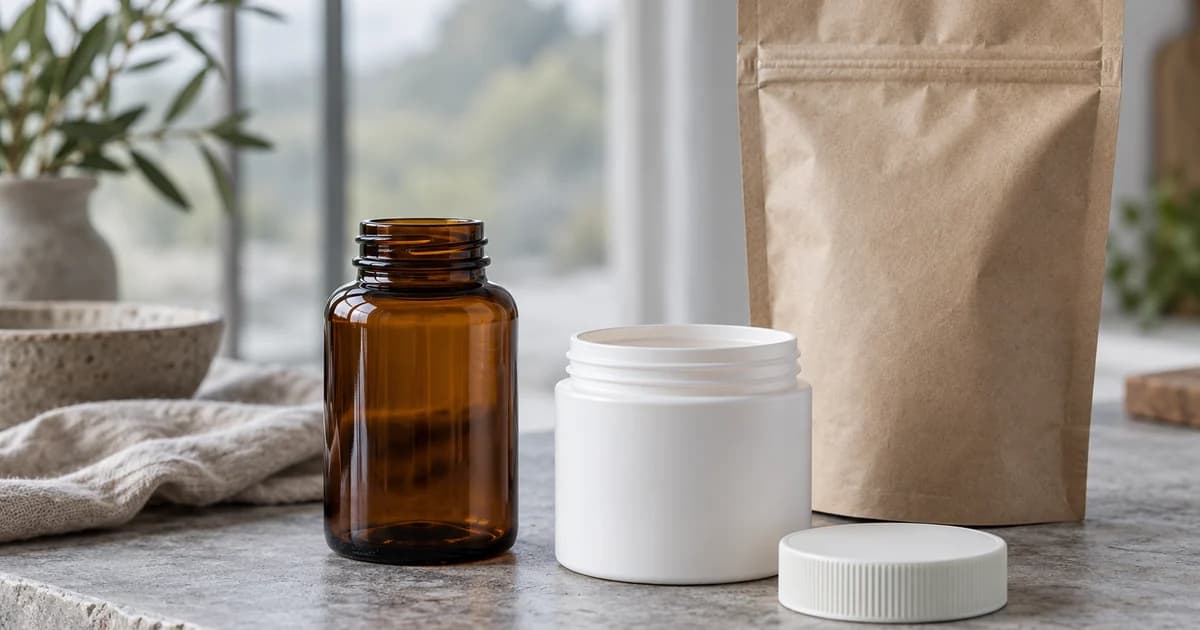
How to Choose Supplement Packaging for Your Brand
Packaging choices lock in your unit cost, shelf life, and retail listing. This guide covers bottle formats, MOQs from 1,000 units, and the certifications buyers ask for first.

Overview
Most supplement brands finalise the formula before the packaging, then discover the bottle drives 20-40% of landed cost. The decisions that matter are fill weight, closure type, label substrate, and carton configuration. Each one affects MOQ, tooling, and lead time. This resource walks through the practical checks: what a contract manufacturer can run on standard lines, what needs custom tooling, and how to sequence sampling so you do not pay for a mould twice.
| MOQ (retail bottling) | 1,000 units per SKU; lower for pilot runs |
|---|---|
| Sample lead time | 7-10 working days |
| Mass production | 20-35 working days after artwork approval |
| Fill weights | 30-500 capsules or 100-1,000 g powder per bottle |
| Certifications | GMP, ISO 9001, ISO 22000, HACCP, NSF/ANSI 455-2, halal, FDA-registered |
| Label options | Pressure-sensitive, shrink sleeve, direct print; 2-8 panel configurations |
Bottle formats and line capability
Standard HDPE and PET rounds cover most capsule and tablet lines. A 60 cc, 100 cc, or 120 cc bottle with a 38-400 mm neck runs on high-speed counters at 80-120 bottles per minute. That speed keeps unit cost down, but only if your fill weight matches the bottle. A 500 mg capsule at 120 count needs roughly 100 cc of internal volume with desiccant. Oversizing by one bottle size adds 8-12% to resin cost and freight.
Powders behave differently. A 300 g scoop-in-jar format needs a wider mouth, typically 53-400 mm, and a induction seal. Gummies require a child-resistant closure and often a wider 53 mm opening for pourability. If you plan two SKUs in one bottle family, confirm the line can switch neck sizes without a full changeover. Changeover between 38 mm and 53 mm typically adds 45-90 minutes of downtime.
Ingredient and label compatibility
Hygroscopic ingredients such as creatine, certain probiotics, and botanical extracts pull moisture through standard HDPE. For those, specify a high-barrier bottle or add a 1 g desiccant canister. Oil-based softgels need opaque HDPE or amber PET to protect against light degradation. If your formula includes a fish oil or a carotenoid, clear PET is a poor choice unless you use a UV-blocking label.
Label substrate matters as much as the bottle. Pressure-sensitive labels with a matte finish resist scuffing in transit. Shrink sleeves give 360-degree coverage and work well for complex regulatory panels, but they add 5-9 days to the print lead time. Direct print on the bottle removes the label cost entirely at volumes above 10,000 units, though artwork changes then require a new print plate. Match the substrate to how the product is stored and shipped, not just how it looks on a shelf.
Quality checks and shipping logistics
Every packaging run should include a line clearance, a fill-weight check at start, middle, and end, and a seal integrity test. For bottles, that means a torque test on the closure and a vacuum leak test on a sample of 10-20 units per batch. For pouches, a burst test at 0.5-1.0 bar. These checks catch the two most common failures: underfilled bottles and loose caps that leak in transit. Ask for the batch record before the goods leave the facility.
Shipping configuration affects cost more than most buyers expect. A 100 cc bottle at 120 count fits 48 units per shipper carton. Adding a display carton or a retail-ready tray changes the pallet count and can add 10-15% to freight. For EU and UK orders, confirm that the outer carton carries the recycling mark and the importer address. For Middle East shipments, halal certification on the finished goods must match the packaging artwork. Plan the carton spec at the same time as the bottle spec, not after.
Quality Control and Batch Documentation
Every batch run on a supplement packaging line is tied to a retained sample and a certificate of analysis. Incoming capsules or powder are tested for identity, potency, microbials, heavy metals and disintegration before release to packaging. Finished packs are checked for fill weight, seal integrity, label placement and lot coding at start-up, mid-run and end of run. Sampling follows an AQL plan, typically 0.65 for major defects and 2.5 for minor defects, with results recorded against the batch record.
The COA issued with each shipment lists the tests performed, specification limits, results and the release decision. It names the batch number, production date, expiry date and the testing laboratory, whether in-house or third party. Where a customer needs an accredited certificate, samples are sent to an external ISO 17025 laboratory and the report is appended. Retention samples are kept for the shelf life plus 12 months, stored under label conditions, so any market complaint can be traced back to a physical pack.
Stability follows a defined protocol rather than a single end-of-run check. Accelerated conditions at 40°C and 75% relative humidity run for six months, with real-time data at 25°C and 60% relative humidity for the declared shelf life. Tests cover appearance, moisture, potency and microbial counts at 0, 3, 6, 12, 18 and 24 months. Packaging components such as the bottle, closure and induction seal are included, because a failed seal often shows up as moisture ingress before the formula itself changes.
Packaging formats and retail readiness for supplement brands
The format decision drives both the filling line and the retail channel. High-density polyethylene bottles suit capsules and tablets at 30 to 500 counts, while blisters are chosen where unit-dose traceability matters, such as pharmacy or travel packs. Stick packs and sachets fit powders at 5 to 30 g per unit and run on vertical form-fill-seal lines. Each format has its own tooling, MOQ and line speed, so the choice should be made before artwork is finalised rather than after.
For the US market, the label must carry a statement of identity, net quantity, a supplement facts panel, ingredient list, directions for use and the name and place of business of the distributor. Allergen declarations and the required disclaimer for structure-function claims must appear exactly as written. Lot number and expiry date are applied by inkjet or laser at filling, with a check that the code is legible and matches the batch record. The same pack may need a different label for the EU, where the nutrition declaration format differs.
Carton and pallet specifications are agreed before production so the pack survives the journey. A typical retail carton uses B-flute corrugated board with a compression strength suited to 12 to 24 bottles, stacked 40 to 60 cases per pallet and stretch-wrapped. Amazon sellers need the FNSKU applied over the barcode, poly-bagged units where the bottle is prone to leakage, and a carton weight under 22.7 kg for manual handling. Retail compliance checks are run at packing, not after the pallet is sealed.
MOQ, Lead Times and Delivery
Sampling starts with a brief and a stock or custom component choice. Stock bottles and closures can be sampled in 7 to 10 working days, while a custom mould adds 15 to 25 working days for tooling before the first sample. Artwork proofs are returned within 3 to 5 working days. A pilot run of 500 to 1,000 units is possible for market testing, but the retail MOQ of 1,000 units per SKU applies once the pack is confirmed.
Mass production runs 20 to 35 working days after artwork approval and component arrival, with the longer window applying to custom labels or imported closures. Air freight takes 5 to 8 days door to door and suits pilot or launch volumes where the cost per kilogram is acceptable. Sea freight takes 25 to 40 days port to port and is the usual choice above 500 kg. The Incoterm should be fixed in the quotation: EXW leaves the factory, FOB covers export clearance and loading, and DDP places the goods at the buyer's door with duty paid.
Each shipment is accompanied by a document pack: the commercial invoice and packing list, the COA for the batch, a material safety data sheet where the product is classified, and a free-sale certificate for markets that request it. Phytosanitary certificates apply only to plant-derived raw materials and are issued by the relevant authority, not the factory. The buyer should confirm which documents the destination customs broker requires before booking freight, because a missing certificate can hold a container for a week or more.
Packaging and Format Choices
HDPE round bottle
Lowest unit cost for capsules and tablets. Available in 60-250 cc. Works with standard 38-400 mm closures and induction seals.
PET or glass bottle
Better clarity for oils and softgels. Glass adds 15-25% to freight and needs a protective shipper. PET is lighter and shatter-resistant.
Stick pack or sachet
Single-serve powder format. MOQ often higher due to film tooling. Good for travel and sample packs. Fill range 2-30 g.
Gummy jar with CR cap
Child-resistant closure required in most markets. Wider 53 mm mouth. Needs a desiccant or a moisture-barrier liner.
Production in Six Steps
- 01
Define fill weight
Calculate total capsule or powder volume. Add 15-20% headspace for desiccant and settling. This determines the minimum bottle size.
- 02
Pick the closure
Child-resistant, induction-sealed, or standard screw cap. CR caps add 4-7% to unit cost but are mandatory for many gummy and liquid products.
- 03
Select label substrate
Pressure-sensitive for speed, shrink sleeve for full coverage, direct print for high volume. Confirm regulatory panel size before artwork.
- 04
Confirm MOQ and tooling
Standard bottles start at 1,000 units. Custom moulds raise MOQ to 10,000-20,000 and add 15-25 days for tooling.
- 05
Request a sample
Ask for a filled and labelled sample in the exact bottle. Sample lead time is 7-10 working days. Test the cap torque and label adhesion.
- 06
Validate the shipper
Order one shipper carton and run a drop test. Confirm pallet count and that the outer carton meets the destination market's labelling rules.
Why EUPHM
Lower unit cost
A one-size-down bottle switch can cut resin and freight by 8-12% without changing the fill count.
Faster retail listing
Standard 38-400 mm bottles and pressure-sensitive labels avoid custom tooling delays and keep the launch on schedule.
Fewer transit failures
Correct closure torque and a tested shipper reduce leaks and returns, which protects your retail margin.
Questions buyers ask.
What is the minimum order quantity for custom supplement packaging?+
For standard HDPE or PET bottles with a stock closure, MOQ is 1,000 units per SKU. Custom bottle moulds raise MOQ to 10,000-20,000 units and add 15-25 days for tooling. Pilot runs below 1,000 units are possible on some lines but carry a higher per-unit cost.
How long does it take to get a packaging sample?+
A filled and labelled sample in your chosen bottle takes 7-10 working days after artwork approval. If the bottle is a stock item, that timeline holds. Custom moulds add 15-25 days before the first sample. Always test cap torque and label adhesion on the sample before approving mass production.
Do I need child-resistant packaging for gummies?+
In the US, the Poison Prevention Packaging Act requires child-resistant closures for most edible gummy products. The EU and UK have similar rules under CLP and general product safety law. CR caps add 4-7% to unit cost. Confirm the requirement for your destination market before finalising the bottle spec.
What certifications should a packaging supplier hold?+
At minimum, GMP and ISO 22000 for the filling and packaging lines. HACCP covers food safety controls. For specific markets, halal certification may be required on the finished goods. vegan claims need documented supply chain verification. Ask for current certificates, not just a list.
How does packaging affect shipping cost?+
Bottle size and shipper carton configuration drive freight. A 100 cc bottle at 120 count fits 48 units per shipper. Adding a display tray can change the pallet count and add 10-15% to freight. Confirm the outer carton labelling for the destination market before the goods ship.
Can you pack our existing stock bottles and labels?+
Yes, where the components are compatible with our filling lines. We ask for a sample of the bottle, closure and label so we can check neck finish, label size and line speed before quoting. Customer-supplied components are inspected on arrival, and any damaged or out-of-spec stock is reported before production starts. We do not reprint or alter customer labels without written approval.
What is the shelf life of a packaged supplement and who sets it?+
Shelf life is set by stability data, not by the packaging alone. A typical capsule or powder pack carries 18 to 24 months from the production date, supported by accelerated and real-time testing. The expiry date printed on the pack must not exceed the tested period. If a customer wants a longer date, additional stability data at the declared storage conditions is required before the label can be approved.
How do you handle label changes after production has started?+
Label artwork is frozen at approval, and any change after that point triggers a new proof and a line stop. Minor text corrections can sometimes be handled within the same run if caught before printing, but a new label version usually means new plates or digital files and a fresh start-up check. We recommend signing off artwork at least 10 working days before the planned production date to avoid rescheduling.
Xu Wei writes the manufacturing, quality and regulatory guides on EUPHM. He works directly with the plant's production and QA teams to document how each dosage form is made, tested and released, so every claim on the site can be traced back to a batch record or a certificate on file.
More guides in this category.
See all →
Have a product in mind?
Send us the brief and we will come back with a formulation direction, indicative price and a realistic lead time — usually within one working day.