Apple Cider Vinegar Liquid Manufacturer for Private Label
EUPHM fills apple cider vinegar liquids at 5% to 12% acidity in 250ml to 1L formats. MOQ starts at 1,000 units per SKU, with pilot runs from 500 units. Samples ship in 7-10 working days.
Overview
Apple cider vinegar is a low-pH liquid that punishes weak packaging and rushed filling. As a liquid manufacturer, EUPHM runs dedicated filling lines for acidic beverages and tinctures, with pH monitoring at intake and post-fill. We bottle with the mother, without the mother, or as a concentrated shot. Retail-ready labels, shrink sleeves and cartons are handled in-house. Mass production runs 20-35 working days after sample approval, depending on bottle format and label complexity.
- MOQ
- 1,000 units per SKU; pilot runs from 500 units
- Fill sizes
- 250ml, 375ml, 500ml, 750ml, 1L; 30ml-60ml shots
- Acidity range
- 5% to 12% acetic acid; pH 2.8-3.4 typical
- Sample lead time
- 7-10 working days
- Mass production
- 20-35 working days after sample approval
- Certifications
- GMP, ISO 9001, ISO 22000, HACCP, NSF/ANSI 455-2, halal, FDA-registered
Filling lines built for acidic liquids
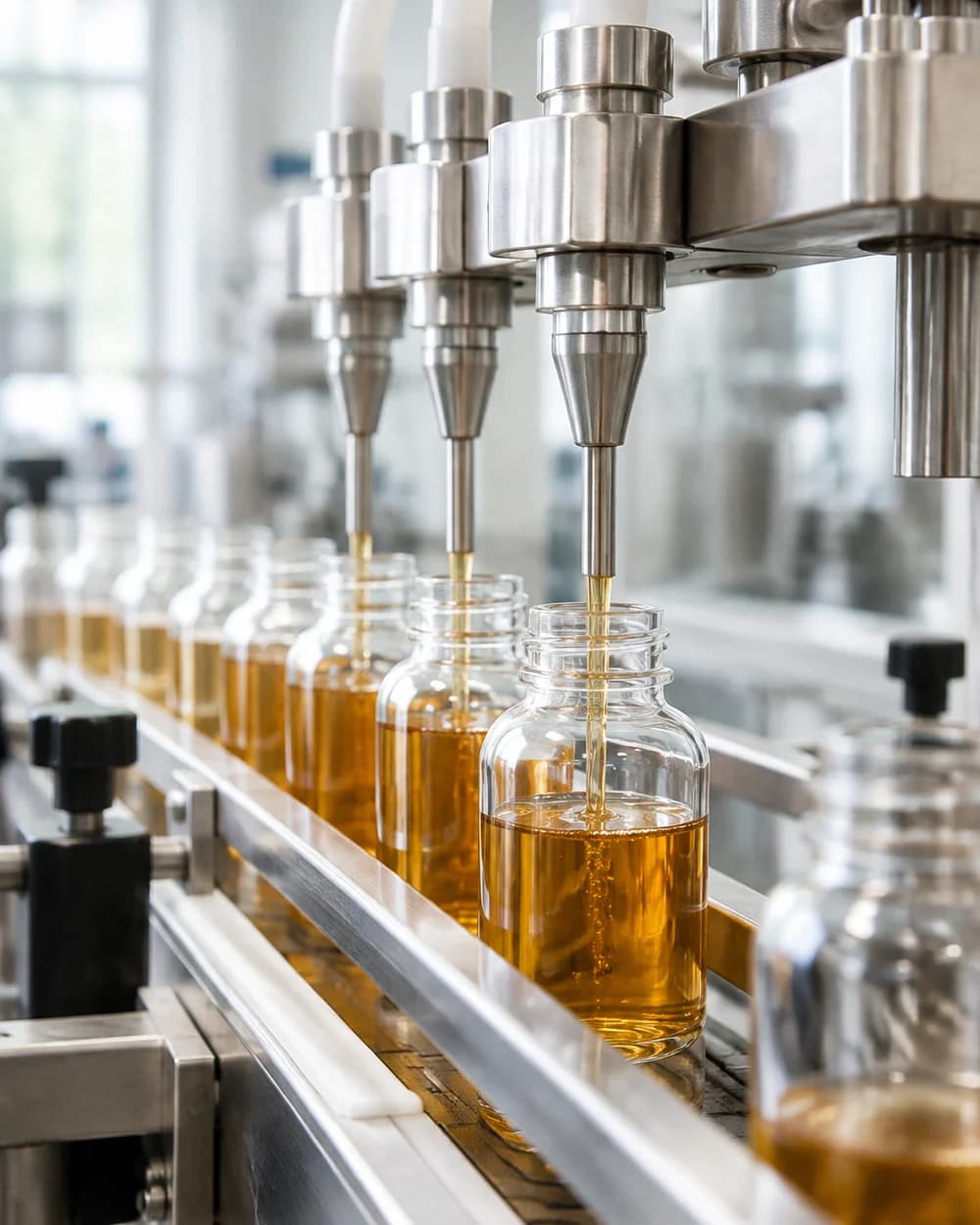
Apple cider vinegar corrodes standard fill nozzles and wears seals faster than neutral beverages. EUPHM uses 316L stainless steel contact parts and peristaltic or piston fillers rated for low-pH product. Two lines handle 250ml to 1L bottles at 4,000 to 6,000 units per hour. A separate line fills 30ml to 60ml shot formats at 8,000 units per hour. Fill accuracy holds within ±1.5% by weight, checked every 30 minutes during a run.
Bottle formats include PET, glass and aluminium. For glass, we run a nitrogen purge before capping to limit oxidation of the mother culture. Caps are induction-sealed where the format allows. If your retail channel needs a tamper-evident band, that is applied inline. Changeover between SKUs takes 2-4 hours, which matters when you scale from one flavour to three.
Formulation options for ACV liquids
The base liquid is fermented apple cider vinegar, typically 5% acetic acid. We can dilute to 4% for a softer taste or concentrate to 12% for shots. If you want the mother, we keep it in suspension and set a minimum turbidity spec so the bottle does not look clear on shelf. If you want a clear liquid, we filter at 1 micron and adjust the colour with caramel or fruit concentrate.
Flavour systems are water-soluble and acid-stable. Common builds include honey and lemon, ginger, turmeric, cranberry, and apple. Sweeteners range from cane sugar and agave to stevia and monk fruit. For a 500ml bottle, a typical formula uses 5-15g of sweetener per litre, depending on the target Brix. Preservatives are usually potassium sorbate at 0.1% and sodium benzoate at 0.1%, though a hot-fill at 85°C can reduce or remove that need.
Quality checks and export paperwork
Every incoming vinegar lot is tested for acetic acid strength, pH, and microbial load before it enters the tank farm. During filling, we record fill weight, cap torque, and seal integrity every 30 minutes. Finished bottles go through a 48-hour hold for microbial testing, then a visual inspection for sediment, fill level, and label placement. Retained samples are kept for 24 months.
For export, EUPHM provides a certificate of analysis, certificate of origin, and GMP certificate. Halal certificates are available for the relevant SKUs. If you ship to the EU, we can supply the necessary statements for the food contact materials and a shelf-life declaration. Shipping documents are prepared within 5 working days of production completion. We work with freight forwarders for FOB Shenzhen or Yantian, and can quote CIF for US and EU ports.
Quality Control and Batch Documentation
Every incoming lot of apple cider vinegar is sampled at intake and tested for identity by acetic acid content and pH before it reaches a filling line. We run titratable acidity to confirm the declared 5% to 12% range, check pH against the 2.8 to 3.4 specification, and screen for microbials including total plate count, yeast and mould, and acetic acid bacteria levels. Heavy metals are tested by an accredited third-party laboratory on a per-lot basis for lead, arsenic, cadmium and mercury, with results filed against the batch number.
During filling, in-process checks cover fill weight at the start, middle and end of each run, cap torque, and pH after the product has equilibrated with any added mother or flavouring. Post-fill, retained samples from every batch are held at ambient and at accelerated conditions for the declared shelf life plus six months. A stability protocol typically runs at 25°C and 40°C, with pH, clarity, sediment and microbial checks at zero, one, three, six and twelve months, so any drift in acidity or mother settling is caught before a repeat order.
The certificate of analysis issued with each shipment lists batch number, production date, best-before date, acetic acid content, pH, microbial results, heavy metals and the packaging format used. Where a buyer needs organic, halal claims, the relevant certificate number is referenced on the COA and a copy of the supplier certificate is attached. Retention samples are stored for the shelf life plus twelve months, so a query on a two-year-old batch can still be answered with a physical reference.
Documentation is prepared in English as standard, with bilingual or buyer-specified formats available. Each batch file includes the intake record, filling log, in-process check sheet, third-party heavy metals report, retention sample location and the final COA. This file is what supports a retail audit or an Amazon compliance request, and it is retained for five years. Buyers who need a specific test method, such as HPLC for acetic acid or ICP-MS for metals, should state this at quotation so the laboratory panel is set correctly.
Packaging, Labelling and Retail Readiness
Apple cider vinegar liquid is filled into glass or PET bottles in 250ml, 375ml, 500ml, 750ml and 1L formats, and into 30ml to 60ml shot bottles for concentrated or ginger-infused lines. Closures are typically aluminium or plastic screw caps with a tamper-evident band, and shrink sleeves are applied in-house for full-body decoration. For shot formats we also run single-serve sachets and stick packs where the buyer wants a travel or sample SKU, with fill volumes from 15ml to 30ml.
Labels are printed to the buyer's artwork and checked against the US FDA dietary supplement label requirements before a run: statement of identity, net quantity, supplement facts panel with serving size and percent daily value, ingredient list in descending order, and the manufacturer or distributor address with a contact method. For EU retail, the nutrition declaration, allergen statement and the name and address of the food business operator are verified at proof stage. Lot number and best-before date are inkjet-coded on the bottle shoulder or base and repeated on the carton, with the format agreed at artwork approval.
Cartons are specified to the buyer's retail channel. Standard export cartons are 12, 24 or 48 bottles, with dividers for glass formats to limit movement in transit. Pallet configurations are built to 1,000 by 1,200mm or 1,200 by 800mm depending on destination, with stretch wrap and corner boards as standard. For Amazon sellers, we can print and apply FNSKU labels, pack to the carton quantity the seller requires, and confirm carton weight and dimensions so the shipment meets FBA inbound requirements.
Retail-ready work also covers the checks a buyer cannot easily do after the container leaves. We verify barcode scannability at 100% on the first carton of each run, check label placement against the approved proof, and photograph the first production carton for buyer sign-off. Where a buyer supplies their own bottles or caps, we inspect incoming packaging for damage and dimensional fit before filling. Packaging lead time is quoted separately from production, since custom bottles or printed sleeves can add 15 to 25 working days to the schedule.
MOQ, Lead Times and Delivery
Sampling starts with a brief covering fill size, acidity, mother status, label artwork and destination market. Stock-formula samples are typically ready in 7 to 10 working days, and custom formulation or new packaging samples take 12 to 18 working days. Sample cost is quoted per project and is credited against the first mass-production order where the buyer proceeds. Artwork proofing runs in parallel with sampling so that label approval does not become the critical path once the sample is signed off.
Mass production runs 20 to 35 working days after sample approval, depending on bottle format, label complexity and whether packaging is stock or custom. A 1,000 unit SKU order in a stock 500ml bottle with a printed label typically sits at the lower end of that range, while a custom-moulded bottle with a shrink sleeve sits at the upper end. Pilot runs from 500 units are available for market testing, with the same quality checks applied as for full production.
Shipping is quoted by air or sea depending on volume and urgency. Air freight is used for samples and pilot runs, typically 5 to 10 days door to door, while full containers move by sea in 25 to 40 days depending on port and routing. We quote EXW, FOB and DDP terms; DDP is common for Amazon sellers who want the shipment delivered to a warehouse or fulfilment centre with duties handled. The Incoterm, port of loading and destination address should be confirmed at quotation so freight is priced correctly.
Each shipment is accompanied by a commercial invoice, packing list, certificate of analysis for the batch, material safety data sheet for the liquid, and a free-sale certificate where the destination authority requires one. For plant-based ingredients, a phytosanitary certificate can be arranged where the importing country asks for it. Certificates of origin are issued on request. Buyers should confirm any destination-specific document, such as a health certificate or import permit reference, before production starts, since some documents require inspection lead time that runs alongside the production window.
Manufacturing Options to Compare
Glass Boston round
250ml to 1L amber or clear glass. Standard 28-400 neck. Induction seal and continuous thread cap. Suitable for premium retail.
PET square bottle
500ml and 750ml clear or amber PET. Lightweight for e-commerce. 28-410 neck with flip-top or screw cap.
Aluminium shot bottle
30ml and 60ml aluminium. Fully recyclable. Ideal for single-serve shots and travel retail.
Pouch with spout
500ml and 1L stand-up pouch. Lower shipping weight. Cap spout for repeat use. Good for club stores.
From Spec to Shipment
- 01
Send your brief
Share target acidity, fill size, flavour direction, and label status. If you have a reference sample, send it. We reply within 1 working day with questions.
- 02
Quote and sample
We quote MOQ, unit cost, and lead time. Sample lead time is 7-10 working days. You receive 2-3 bottles per variant for sensory and stability review.
- 03
Approve sample
You sign off on taste, colour, fill weight, and packaging. We lock the specification and issue a final cost sheet. Deposit triggers production scheduling.
- 04
Production run
Mass production takes 20-35 working days. We share photos at filling, capping, and labelling stages. Any deviation from the approved sample is flagged before shipping.
- 05
Quality release
Finished goods pass microbial and fill checks. We issue the certificate of analysis and retain samples. You approve the release or request a re-test.
- 06
Ship and document
We book freight, prepare export documents, and load within 5 working days of release. You receive tracking and a full document pack by email.
Why EUPHM
Low MOQ for testing
Start at 1,000 units per SKU, or 500 units for a pilot run. Test the market before committing to a full container.
Acid-safe equipment
316L contact parts and low-pH seals prevent corrosion and off-taste. Fill accuracy stays within ±1.5% across the run.
Export-ready documents
COA, origin certificate, GMP, halal paperwork prepared in-house. No third-party delays before shipping.
Questions buyers ask.
What is the MOQ for apple cider vinegar liquid?+
MOQ is 1,000 units per SKU for retail bottling. For pilot runs, we can go as low as 500 units, though unit cost is higher. MOQ depends on bottle format, label type, and whether the formula is custom or existing.
Can you keep the mother in the finished bottle?+
Yes. We set a minimum turbidity spec and use a gentle fill process to keep the mother in suspension. You will see sediment over time, which is normal. If you prefer a clear liquid, we filter at 1 micron and adjust colour separately.
What is the shelf life of your ACV liquids?+
Typically 18 to 24 months from production date when stored below 25°C and away from direct sunlight. We run accelerated stability testing at 40°C for 3 months to confirm the formula. Preservative levels and hot-fill temperature affect the final shelf life.
Do you offer organic or halal certified ACV?+
Yes. We source organic apple cider vinegar from certified suppliers and sources organic-certified inputs for qualifying projects. Halal certificates are available for the relevant SKUs. Tell us your target market and we will confirm which certificates apply.
How do you ship to the US or EU?+
We ship FOB Shenzhen or Yantian, or CIF to major US and EU ports. Freight forwarders are booked after production release. Export documents are ready within 5 working days. For small pilot runs, we can arrange air freight or courier.
Can you supply apple cider vinegar liquid in bulk rather than bottled?+
Yes. We supply bulk apple cider vinegar in food-grade IBC totes of 1,000 litres or in 200-litre drums, with the same intake testing and COA as bottled runs. Bulk orders typically start at one tote and are quoted FOB or EXW. Buyers who bottle in their own market should confirm the acidity and pH specification at quotation, since bulk liquid is not adjusted after filling.
How do you prevent the mother from settling or blocking the cap during filling?+
Mother-containing liquid is gently agitated in the holding tank before filling, and lines are run with a wider nozzle and short fill cycle to limit shear. Settling after filling is normal for mother products and is declared on the label as a natural characteristic. If a buyer wants a clear liquid, we filter before filling and state the filtration method on the COA.
What is your policy on label artwork errors found after production?+
Artwork is approved by the buyer in writing before printing, and we supply a digital proof and, where needed, a physical label proof for sign-off. Once approved, the buyer is responsible for the content. If we print a label that differs from the approved proof, we reprint and rework at our cost. This is why we build a proof approval step into every order.
Have a product in mind?
Send us the brief and we will come back with a formulation direction, indicative price and a realistic lead time — usually within one working day.