
Ashwagandha Capsule Manufacturer for Global Brands
EUPHM produces ashwagandha capsules at 1,000 unit MOQ. GMP, ISO 22000, HACCP certified. Standard lead time 20–35 working days. Request samples in 7–10 days.
Overview
Ashwagandha root extract is sensitive to heat, moisture and oxidation. Capsule manufacturing therefore depends on controlled blending, precise fill weights and stable packaging. As a contract manufacturer in Guangdong, EUPHM handles extraction-standardised ashwagandha, excipient selection and capsule filling under one roof. This page covers the specifications, options and quality checks buyers need before placing a purchase order.
Capsule filling capability and capacity
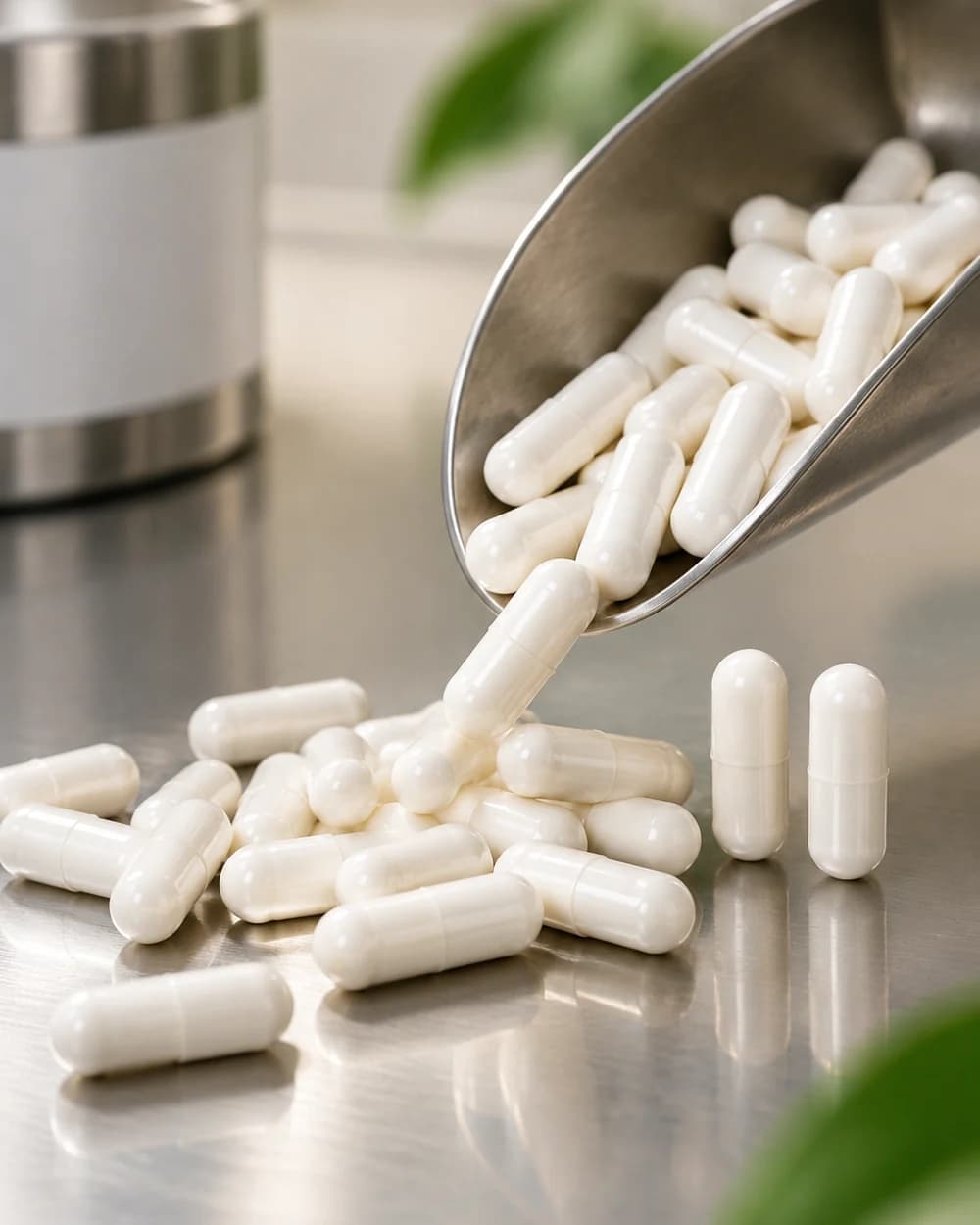
EUPHM operates automatic capsule filling lines with an output of 80,000–120,000 capsules per shift. We handle powder, pellet and granule fills. For ashwagandha, the standard fill is 500 mg in a size 0 capsule, though 300 mg and 800 mg are available. Our in-process checks weigh every capsule to ±3% of target. This keeps dosage consistent across the batch.
We produce both pilot runs (from 1,000 units) and full retail batches. Changeover between capsule sizes takes 2–4 hours, so multi-SKU orders can share a production window. If you need a specific capsule colour or print, we source from approved suppliers with 5–7 day lead times. Bottling, induction sealing and labelling are done on the same site.
Formulation and raw material control
Ashwagandha root extract is standardised to withanolides, typically 2.5% to 10%. We test every incoming lot for withanolide content, heavy metals, pesticides and microbial load. Our suppliers provide organic or conventional grades. For vegan capsules, we use HPMC or pullulan shells. Excipients such as magnesium stearate or silicon dioxide are added only when needed for flow.
We can blend ashwagandha with other adaptogens, vitamins or minerals. Common combinations include ashwagandha with L-theanine, rhodiola or black pepper extract. Blending takes place in a 500 L ribbon blender with 15–20 minutes of mixing. Homogeneity is verified by taking 10 samples across the batch. We do not use irradiation or ethylene oxide on any ashwagandha raw material.
Quality, compliance and logistics
EUPHM is a GMP-certified facility, also holding ISO 22000 and HACCP. We are FDA-registered for dietary supplements. Each batch comes with a certificate of analysis covering assay, heavy metals, microbiology and disintegration. Third-party lab testing is available on request. Retain samples are kept for 2 years. Documentation for halal and vegan claims is provided per order.
We ship from Shenzhen and Hong Kong ports. Standard packaging is 60 cc, 100 cc or 120 cc HDPE bottles with induction seals and child-resistant caps. Bulk capsules in double polyethylene bags inside fibre drums are also available. Air freight takes 5–8 days to the US or EU; sea freight 18–28 days. We handle export documents, including health certificates and free sale certificates.
Quality Control and Batch Documentation
Every ashwagandha capsule batch is tested at three stages: incoming raw material, in-process blend, and finished capsules. Identity is confirmed by HPLC fingerprint against a withanolide reference standard, with potency assayed to the declared withanolide percentage (typically 2.5% to 5%). Microbial testing covers total aerobic count, yeast and mould, E. coli, Salmonella and Staphylococcus aureus. Heavy metals (lead, arsenic, cadmium, mercury) are screened against USP <232> limits, and disintegration is checked to USP <701> for gelatin and HPMC capsules alike.
A certificate of analysis (COA) is issued per batch and includes lot number, manufacture and expiry dates, appearance, fill weight, withanolide content, microbial results, heavy metals, disintegration time, and a statement of conformity to the agreed specification. Where a buyer requires it, we add pesticide residue screening (EU MRL or USDA NOP list) and residual solvent testing. COAs are available in PDF and can be pre-shipped for buyer review before release.
Retention samples of every batch are held for 24 months from the date of manufacture in controlled conditions (25°C ± 2°C, 60% RH ± 5%). Stability follows a bracketed protocol: 0, 3, 6, 12, 18 and 24 months for real-time, with accelerated data at 40°C/75% RH for 6 months. We provide stability summaries on request, and buyers can specify a shorter or longer retention period in the quality agreement.
In-process controls include blend uniformity (three-point sampling, acceptance ±5% of label claim), capsule weight variation (every 30 minutes, ±5% of target fill), and visual inspection for defects. Environmental monitoring of the filling room is performed monthly for non-viable particles and quarterly for viable counts. All records are retained for five years and are available for buyer audit.
Packaging, Labelling and Retail Readiness
Ashwagandha capsules can be packed in HDPE bottles (60, 90, 120, 180 or 240 count), blister packs (10 or 12 capsules per blister, up to 10 blisters per carton), stick packs (single-dose powder or capsule-in-stick), or sachets. Bottles are induction-sealed with a desiccant canister or silica gel sachet, then labelled with a wraparound or pressure-sensitive label. Capsule colours and sizes (0, 00, 1) are specified at sample stage; HPMC capsules are available in clear, white or opaque colours.
For US retail, labels must include the FDA dietary-supplement panel: statement of identity, net quantity, supplement facts (with withanolide content per serving), other ingredients, directions, warnings, and the manufacturer/distributor name and address. We can print lot number and expiry date by inkjet or laser, with a minimum 2 mm character height, and apply a best-before date in DD/MM/YYYY or MM/YYYY format as required. All artwork is checked against a signed proof before printing.
Cartons are specified to buyer requirements: typical dimensions for a 60-count bottle are 65 x 65 x 110 mm, with 12 to 24 bottles per shipper carton. Palletisation follows a standard 1200 x 1000 mm pallet, stretch-wrapped and corner-boarded, with a maximum height of 1.8 m. We can apply Amazon FNSKU barcodes, polybag the bottles, and print expiration dates in Amazon-specified format. For EU retail, we can add the EC responsible person address and the recycling symbol.
Label compliance checks are performed by our in-house regulatory team against the target market. We do not provide legal advice, but we flag missing mandatory elements and can supply a template supplement facts panel for buyer completion. Buyers remain responsible for final label approval and for any structure/function claims.
MOQ, Lead Times and Delivery
Sample lead time is 7 to 10 working days after receipt of a signed sample request and specification. Samples are provided free of charge for standard formulations; buyer pays courier costs. Once the sample is approved in writing, mass production begins. Standard production lead time is 20 to 35 working days for orders up to 50,000 units, depending on capsule type and packaging complexity. Orders above 50,000 units are scheduled individually.
Shipping is arranged by air or sea. Air freight typically takes 5 to 10 days door-to-door and is suitable for pilot orders or urgent replenishment; sea freight takes 25 to 40 days depending on destination port. We work with EXW, FOB Shenzhen or Hong Kong, and DDP terms for selected markets. For DDP, we handle customs clearance and deliver to the buyer's warehouse; duties and taxes are quoted separately.
Documents provided with each shipment include commercial invoice, packing list, bill of lading or airway bill, certificate of analysis, material safety data sheet (MSDS), and a free-sale certificate where required. For plant-based products, a phytosanitary certificate can be arranged if the destination country requires it. Certificates of origin (Form A, Form E, or general CO) are available on request. All documents are issued in English; translation into other languages can be arranged.
Payment terms are 30% deposit with the balance against copy of shipping documents, or irrevocable L/C at sight for orders above USD 50,000. We recommend buyers confirm import requirements with their customs broker before placing the order, as some markets require pre-market notification or specific labelling.
Manufacturing Options to Compare
Capsule shell material
HPMC (vegan), bovine gelatin, or pullulan. HPMC is standard for vegan and halal claims. Shell colours: white, clear, or custom opaque.
Fill weight and size
300 mg, 500 mg, 600 mg or 800 mg. Size 1, 0, 00 or 000 capsules. Fill weight tolerance ±3%.
Bottle sizes and counts
30, 60, 90, 120 or 180 capsules per bottle. Bottle volumes: 60 cc, 100 cc, 120 cc, 150 cc. Induction seal and child-resistant cap included.
Labelling and artwork
We print and apply labels to your artwork. Supports FDA and EU supplement facts panels. Variable data printing for batch and expiry dates.
From Enquiry to Delivery
- 01
Send your specification
Share target fill weight, capsule type, withanolide percentage, bottle size and order quantity. We confirm feasibility within 1 working day.
- 02
Quotation and sample
Receive a quote with unit price, MOQ and lead time. Request samples: 7–10 working days for standard formulations.
- 03
Sample approval
Review sample for appearance, fill weight, disintegration and label. Adjust formulation or capsule if needed. One revision round included.
- 04
Place purchase order
Confirm PO with 30% deposit. We lock raw material lots and schedule production. Balance due before shipment.
- 05
Production and QC
Mass production runs 20–35 working days. In-process checks every 30 minutes. Batch record and COA prepared.
- 06
Shipping and documents
We pack, label and palletise. Air or sea freight from Shenzhen/Hong Kong. Export documents sent by courier and email.
Why EUPHM
Low MOQ for pilots
Start with 1,000 units for pilot runs. Scale to 1,000 units for retail bottling. No minimum on capsule sizes.
Full documentation
COA, batch record, heavy metal and microbial test reports. halal and vegan certificates available per order.
One-site production
Blending, encapsulation, bottling and labelling under one GMP roof. Reduces lead time and third-party handling.
Questions buyers ask.
What is the MOQ for ashwagandha capsules?+
For retail bottling, MOQ is 1,000 units per SKU. Pilot runs start at 1,000 units with a higher unit cost. Bulk capsules in drums have a lower MOQ of 500 units. MOQ depends on capsule size and fill weight.
Can you produce vegan or organic ashwagandha capsules?+
Yes. We use HPMC or pullulan shells for vegan capsules. Organic grades are available with or EU organic certification. Provide your target market so we match the correct documentation.
What is the lead time for mass production?+
Standard lead time is 20–35 working days after sample approval and deposit. Complex formulations or custom packaging may add 5–7 days. Air freight adds 5–8 days to the US or EU; sea freight 18–28 days.
Do you provide third-party testing?+
Yes. We can send samples to Eurofins, SGS or Intertek for independent testing. Typical tests include withanolide assay, heavy metals, pesticides, microbiology and disintegration. Third-party testing adds 5–10 working days.
What certifications does your facility hold?+
EUPHM holds GMP, ISO 22000 and HACCP. We are FDA-registered for dietary supplements. halal and vegan certificates are available for specific orders. Certificates are shared before production.
Can you supply ashwagandha capsules with a specific withanolide percentage?+
Yes. We standardise ashwagandha root extract to the withanolide content agreed in the specification, typically 2.5%, 5% or 10% by HPLC. The raw material is tested on receipt, and the final blend is assayed to confirm the declared potency. If you require a specific ratio (for example 10:1 or 30:1), we can source accordingly and provide a COA showing the marker compounds.
Do you offer low-moq private label for startups?+
Yes. For pilot runs we can produce from 1,000 units per SKU, using stock capsule shells and standard bottle sizes. A low-MOQ order typically uses our existing label template, with your artwork applied. Lead time for low-MOQ orders is 15 to 20 working days after sample approval. Once volumes increase, unit costs reduce and custom capsule colours become available.
What is your policy on stability testing and shelf life?+
We assign a shelf life of 24 months for standard ashwagandha capsules in HDPE bottles, supported by real-time and accelerated stability data. If you require a longer shelf life, we can run an extended protocol at additional cost. Stability summaries are provided with the COA on request, and we retain samples for the full shelf-life period plus six months.
Have a product in mind?
Send us the brief and we will come back with a formulation direction, indicative price and a realistic lead time — usually within one working day.