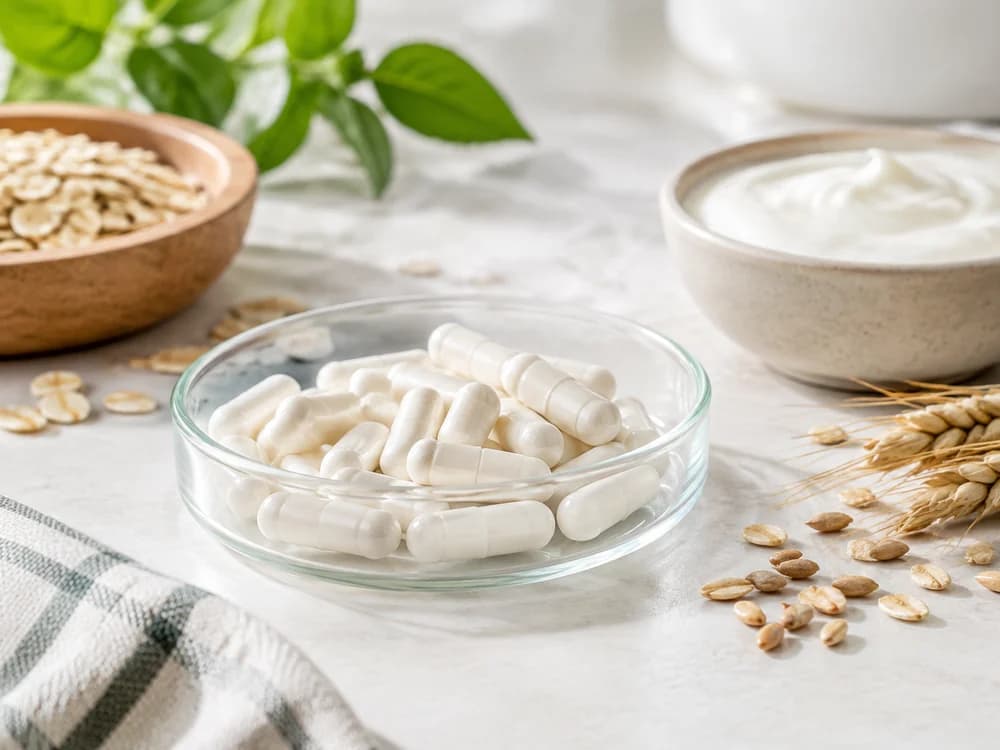
Berberine Capsule Manufacturer for Retail-Ready SKUs
EUPHM produces berberine HCl and berberine extract capsules at 1,000 unit MOQs. Fill weights from 250 mg to 1,000 mg, 7–10 day samples, 20–35 day mass production, and full documentation for US, EU, UK and Middle East retail.
Overview
Berberine is a yellow alkaloid extracted from Berberis species, standardised to 97% berberine HCl or 5:1 to 20:1 whole-herb ratios. It is hygroscopic, bitter and light-sensitive, so capsule manufacturing requires controlled humidity, opaque shells and tight blend times. This page covers how EUPHM handles those constraints on commercial-scale lines, from pilot batches to 500,000-unit runs.
| MOQ | 1,000 units per SKU |
|---|---|
| Fill weights | 250 mg, 300 mg, 500 mg, 600 mg, 1,000 mg |
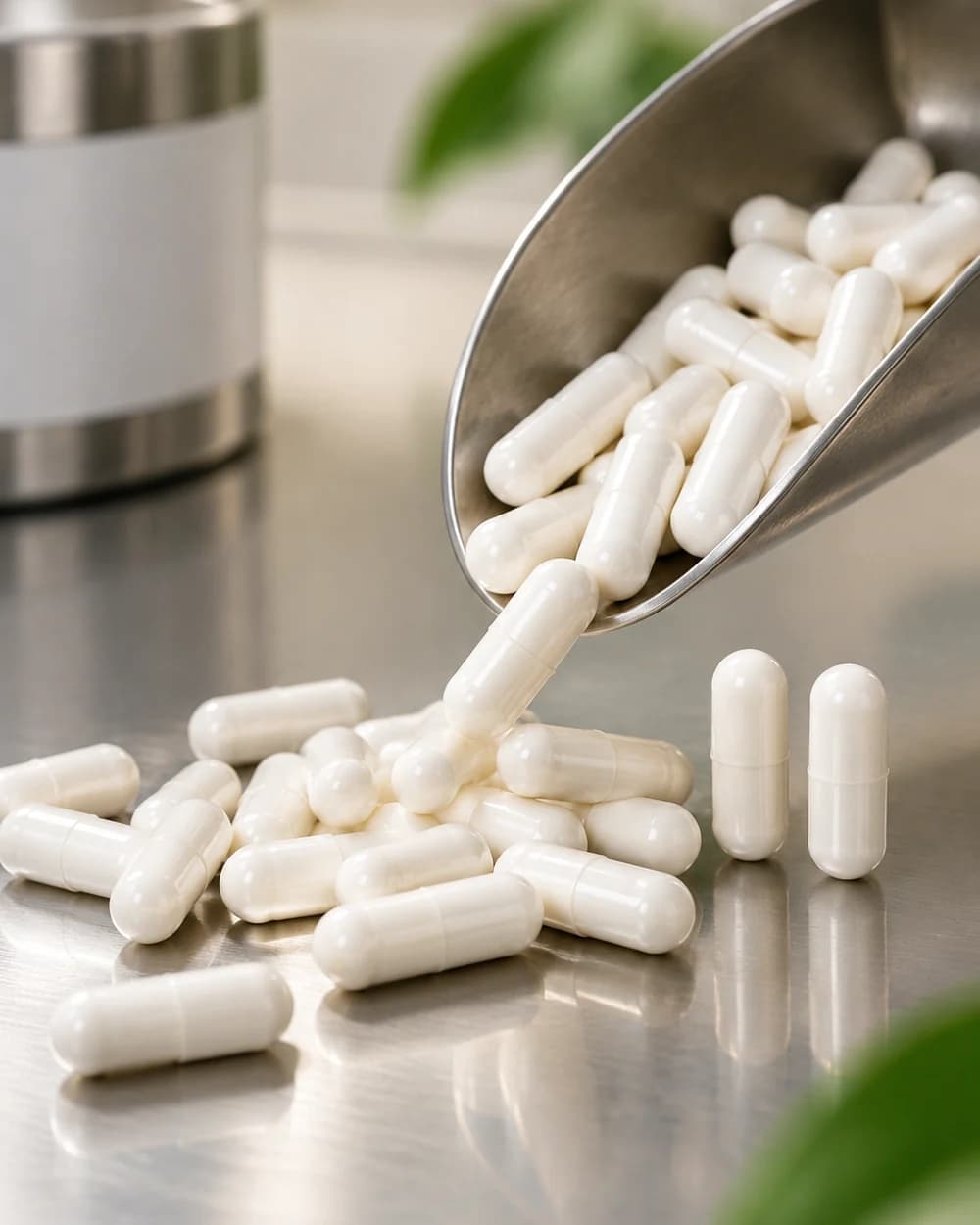
| Capsule formats | Size 0 and 00 HPMC or bovine gelatin, opaque |
| Sample lead time | 7–10 working days |
| Mass production | 20–35 working days after approved sample |
| Certifications | GMP, ISO 9001, ISO 22000, HACCP, NSF/ANSI 455-2, halal, FDA-registered |
Production capability for berberine capsules
The plant runs two encapsulating lines with a combined capacity of 120,000 capsules per hour, plus a third line reserved for small batches. Berberine blends are processed in a 300 kg ribbon mixer under 35% relative humidity to limit caking. Standard fill weights are 250 mg, 300 mg, 500 mg, 600 mg and 1,000 mg, with a fill tolerance of ±3% for 500 mg and above. Larger capsules use size 00; smaller doses use size 0.
Batch sizes start at 1,000 units for pilot runs and scale to 500,000 units per SKU. Changeover between berberine and other botanical actives follows a validated cleaning protocol with swab testing for cross-contamination. If you need a second SKU — for example 500 mg plus a 1,000 mg version — both can run in the same production window to reduce lead time.
Formulation and ingredient handling
Berberine HCl is bitter and hygroscopic. Most retail formats use 97% berberine HCl, but we also handle 5:1, 10:1 and 20:1 extracts, and berberine sulfate where a lower chloride load is preferred. Excipients are kept minimal: magnesium stearate at 1–2%, silicon dioxide at 0.5–1% as a flow agent, and microcrystalline cellulose for fill weight adjustment. No titanium dioxide is used in HPMC shells.
Opaque shells are standard because berberine degrades under UV light. We can also add a cellulose-based enteric coating for release profiles, though this increases lead time by 5–7 days. Common co-ingredients include chromium picolinate, cinnamon extract, bitter melon and alpha-lipoic acid. Blends are tested for uniformity at three points in the batch, and assay results are provided before encapsulation.
Quality, compliance and shipping
Every batch is tested for assay, heavy metals, microbial limits and residual solvents. Certificates of analysis are issued per batch, and stability data is available for 24 months at 25°C/60% RH and 6 months at 40°C/75% RH. The facility is GMP-certified, ISO 22000 and HACCP compliant. Halal and certifications are held for relevant materials, and vegan HPMC shells are available.
For US-bound orders, we provide FDA-registered facility documentation and prior notice support. EU orders include a food safety declaration and allergen statement. Middle East shipments can be halal-certified with Arabic labelling. Shipping is by air or sea from Shenzhen or Hong Kong; air freight for 10,000 units takes 5–8 days to the US East Coast, sea freight 18–25 days. Labelling can be printed and applied in-house.
Quality Control and Batch Documentation
Each berberine capsule batch is tested at three stages: incoming raw material, in-process blend, and finished capsules. Raw berberine HCl or extract is sampled per lot for identity by HPLC or TLC, potency assay, microbial limits (total aerobic count, yeast and mould, E. coli, Salmonella), heavy metals (lead, arsenic, cadmium, mercury) and residual solvents where applicable. In-process checks cover blend uniformity and moisture content. Finished capsules are tested for disintegration, weight variation and potency to confirm label claim.
The certificate of analysis (COA) issued with each batch lists the product name, lot number, manufacture and expiry dates, specifications, test methods and results. It is signed by the QC manager and references the retained sample. Retention samples of every batch are stored under labelled conditions for at least two years beyond expiry, allowing re-testing if a customer query arises. Stability testing follows an accelerated protocol at 40°C/75% RH for six months, with real-time data at 25°C/60% RH for up to 24 months to support the assigned shelf life.
Packaging, Labelling and Retail Readiness
Berberine capsules can be packed in HDPE bottles with induction seals, blister packs (PVC/PVDC or alu-alu), stick packs or sachets. Bottle sizes typically range from 60 to 180 counts, with desiccant options for hygroscopic fills. Blister and stick formats suit unit-dose or travel retail. Cartons are specified with lot number, expiry date and, where required, a GTIN. We can apply FDA dietary-supplement label elements including the supplement facts panel, ingredient list, allergen statement and 'Keep out of reach of children' warning, subject to your approved artwork.
Lot and expiry coding is applied by inkjet or laser on the primary container and outer carton. Cartons are packed in corrugated shippers with a maximum gross weight of 20 kg for manual handling, or 25 kg where palletised. Standard pallet footprints are 1200 x 1000 mm or 1200 x 800 mm, stretch-wrapped and labelled with SSCC if needed. For Amazon FNSKU and retail compliance, we can print and apply FNSKU labels, poly-bag units with suffocation warnings, and prepare cartons to your marketplace's inbound requirements.
MOQ, Lead Times and Delivery
Sampling starts with a 7–10 working day turnaround for a pilot batch of 1,000 units, which allows you to confirm fill weight, shell type and packaging. Mass production runs 20–35 working days after sample approval, depending on capsule size, fill weight and packaging format. MOQ is 1,000 units per SKU, with lower pilot quantities available for market testing. Scheduling is confirmed once artwork and specifications are signed off.
Delivery can be arranged by air or sea. Air freight typically takes 5–8 days door to door for urgent launches, while sea freight takes 25–40 days depending on destination port. We quote EXW, FOB or DDP terms; DDP is available for selected markets and includes customs clearance and duty. Shipping documents provided include COA, MSDS, free-sale certificate and, where relevant, phytosanitary certificate for plant-derived ingredients. Commercial invoice, packing list and bill of lading or airway bill are issued per shipment.
Options for Your Format
HPMC or gelatin shells
Vegan HPMC in opaque white or custom colours; bovine gelatin for lower cost. Both available in size 0 and 00.
Dose per capsule
250 mg to 1,000 mg. Higher doses reduce capsule count per serving but increase fill weight variation risk.
Bottle or pouch
HDPE bottles with induction seal, or stand-up pouches. Bottle sizes: 30, 60, 90, 120 and 180 counts.
Label and carton
In-house label printing with your artwork. Cartons and inserts can be packed for retail-ready delivery.
From Spec to Shipment
- 01
Send your specification
Share dose, shell type, bottle count, target market and certifications. We confirm feasibility within 1 working day.
- 02
Quotation and sample
You receive a quote with MOQ, unit price and lead time. Samples ship in 7–10 working days.
- 03
Sample approval
Test the sample for taste, fill weight and appearance. Request adjustments if needed; one revision round is included.
- 04
Purchase order
Confirm PO with 30% deposit. We book production slots and order raw materials with batch traceability.
- 05
Production and QC
Blending, encapsulation, polishing and testing take 20–35 working days. You receive COA and stability data before release.
- 06
Shipping and documents
We arrange air or sea freight from Shenzhen or Hong Kong. Full export documents, halal certificates and labelling are included.
Why EUPHM
Low MOQ for testing
Start at 1,000 units per SKU, or 1,000 for pilot runs. Scale to 500,000 units without changing suppliers.
Documentation for retail
COA, stability data, allergen statements and halal/organic certificates are standard, not add-ons.
Controlled lead times
7–10 day samples and 20–35 day production. Air freight adds 5–8 days to the US or EU.
Questions buyers ask.
What is the MOQ for berberine capsules?+
Standard MOQ is 1,000 units per SKU for retail bottling. Pilot runs start at 1,000 units, though unit pricing is higher. If you need two doses, such as 500 mg and 1,000 mg, both can be produced in the same batch window to meet the combined MOQ.
Do you provide berberine HCl or extract?+
Both. We handle 97% berberine HCl, berberine sulfate, and 5:1 to 20:1 whole-herb extracts. The choice depends on your label claims and target market. HCl is more common for standardised doses; extracts suit whole-plant positioning. We can advise on assay and excipient compatibility.
What certifications are available?+
The facility holds GMP, ISO 22000 and HACCP. Halal and vegan certifications are available for relevant materials and shells. Certificates are issued per batch. For EU orders, we provide a food safety declaration and allergen statement. For US orders, we supply FDA-registered facility documentation.
How long does production take?+
Samples ship in 7–10 working days. Mass production takes 20–35 working days after you approve the sample and pay the deposit. Enteric coating adds 5–7 days. Air freight to the US or EU takes 5–8 days; sea freight takes 18–25 days. We confirm dates in the quotation.
Can you handle custom formulations?+
Yes. We can blend berberine with chromium picolinate, cinnamon extract, bitter melon, alpha-lipoic acid and other actives. Excipient levels are kept minimal. Send your target dose and claims; we check compatibility and provide a formulation sheet before sampling. One revision round is included in the sample stage.
What is the shelf life of your berberine capsules and how is it supported?+
Shelf life is typically 24 months from the date of manufacture when stored below 25°C in a dry place, away from direct light. It is supported by accelerated stability data at 40°C/75% RH for six months and real-time data at 25°C/60% RH. The assigned expiry date appears on the COA and primary label. Customers can request the stability summary for their specific fill weight and capsule shell.
Can you produce berberine capsules with vegan claims?+
Vegan claims are possible using HPMC capsules, which are plant-derived and contain no gelatin. Organic claims depend on the organic status of the berberine raw material; we can source organic-certified extract where available and provide the relevant certificate. Certification is handled on a per-project basis, and the claim must be supported by valid documentation before it appears on the label.
Do you offer low-MOQ pilot runs for new berberine SKUs?+
Yes. Pilot runs start from 1,000 units per SKU, which is below the standard 1,000 unit MOQ. Pilot batches use the same production line and quality checks as commercial runs, so the sample reflects the final product. Lead time for a pilot is 7–10 working days after specifications and artwork are confirmed. Pilot quantities are intended for testing and validation, not for full retail launch.
What is the difference between berberine HCl and berberine extract in capsule manufacturing?+
Berberine HCl is a purified alkaloid salt, typically standardised to 97% and dosed at 250 to 500 mg per capsule. Berberine extract is a whole-herb preparation standardised to a ratio such as 5:1 or 20:1, which contains other plant compounds. HCl is more hygroscopic and bitter, so it needs opaque shells and tight humidity control. Extract flows more easily in encapsulation. The choice depends on the label claim and the target market's rules.
Can you encapsulate berberine together with other ingredients such as chromium or cinnamon?+
Yes. Berberine is commonly combined with chromium picolinate, cinnamon extract, or alpha-lipoic acid. We run blend trials to check flowability, uniformity and compatibility, and we test the finished blend for potency of each active. Some combinations require a larger capsule size or a split dose. We will confirm the maximum active load per capsule during formulation so the fill weight stays within the size 0 or 00 limit.
How do you control moisture during berberine capsule production?+
The encapsulation room is held at 20 to 25°C and below 45% relative humidity. Berberine raw material is stored in sealed containers with desiccant and is only opened immediately before blending. Blend times are kept under 15 minutes to limit moisture uptake. Opaque HPMC or gelatin shells are used, and finished bottles include a desiccant where the shelf-life study supports it. In-process moisture checks are taken at the start and end of each shift.
Have a product in mind?
Send us the brief and we will come back with a formulation direction, indicative price and a realistic lead time — usually within one working day.