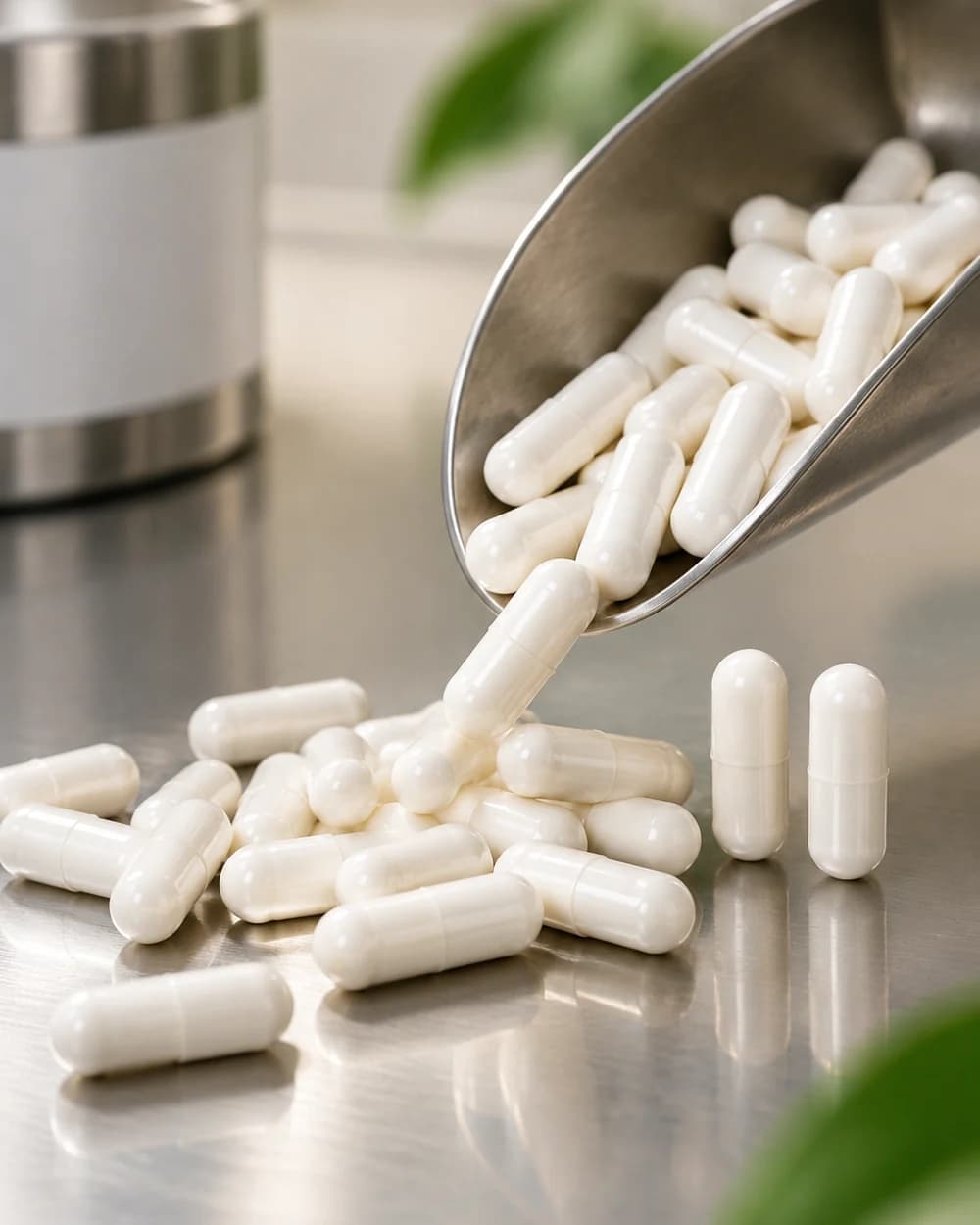
Chromium Capsule Manufacturer for Retail-Ready Supplements
EUPHM produces chromium picolinate and chromium polynicotinate capsules in HPMC or gelatin shells. MOQ from 1,000 units per SKU. Samples in 7-10 working days. Full documentation for US, EU and Middle East markets.
Overview
Chromium is a small-dose mineral. Most retail SKUs sit between 200 mcg and 1,000 mcg per capsule. That means your carrier, capsule shell and blend uniformity matter more than the active itself. This page covers how we run chromium capsule projects: fill weights, capsule sizes, pilot runs, analytical testing and the paperwork your importer will ask for. It sits under our broader /capsule-manufacturer capability, so you can compare chromium against other single-ingredient capsule lines.

Chromium Capsule Production Capability
Our encapsulation line runs at up to 120,000 capsules per hour on a single shift. For chromium, most orders are small-dose and low-volume, so we schedule them on the same equipment used for other mineral capsules. That keeps changeover costs down and lets you place a 5,000-unit run without paying for a full production day. We can also run 500-1,000 unit pilot batches for market testing before you commit to a retail MOQ.
Capsule size is usually driven by your label claim and your chosen excipients. A 200 mcg chromium picolinate dose with microcrystalline cellulose and magnesium stearate fills comfortably into a size 3 or size 2 capsule. If you want a larger visual capsule for shelf presence, we can use size 0 or 00 with additional carrier. We will confirm the exact fill weight and shell dimensions in your sample approval sheet before mass production.
Chromium Forms, Blends and Label Claims
We work with chromium picolinate, chromium polynicotinate (GTF), chromium chloride and chromium yeast. Picolinate is the most common for retail weight-management and blood sugar support SKUs. Polynicotinate is often chosen for sports nutrition. Each form has different flow characteristics, so we adjust the blending sequence and mixing time to avoid segregation. If your formula combines chromium with other actives, such as berberine, cinnamon extract or alpha-lipoic acid, we run a pre-blend compatibility check first.
Label claims depend on your market. In the US, chromium capsules are typically sold as a dietary supplement with a structure-function claim. In the EU, chromium contributes to normal macronutrient metabolism and maintenance of normal blood glucose levels, but only at 40 mcg or more per serving. We can format your supplement facts panel or EU nutrition declaration to match the dosage in the finished capsule. We do not write claims for you, but we check that the dose supports what your label says.
Quality Testing and Export Documentation
Every chromium batch is tested for identity, assay, heavy metals, microbial limits and capsule shell integrity. We hold retained samples for 24 months. If you need a certificate of analysis for a specific lot, we issue it against the batch number on your bottles. For vegan claims, we source HPMC shells and organic chromium where available, and we keep the supplier certificates on file for your auditor.
For export, we provide commercial invoice, packing list, certificate of origin, GMP certificate, ISO 22000 certificate, HACCP plan summary and halal certificates where relevant. We ship FOB Shenzhen or Hong Kong, and we can arrange air freight for pilot runs. Typical documentation turnaround is 3-5 working days after production. If your importer needs a specific format, send the template and we will complete it before the shipment leaves the plant.
Quality Control and Batch Documentation
For each production run, the batch record includes the formula, lot numbers of all ingredients, fill weight checks every 15 minutes, capsule shell lot, machine parameters, environmental monitoring data for the encapsulation room, and reconciliation of yield. Deviations are documented and investigated. This documentation package is what your importer needs for a dietary supplement GMP audit or for a customer quality questionnaire. We do not release a batch without a completed and signed batch record and COA. If you require third-party testing at an external laboratory, we can arrange it and include the external report in the shipment documents.
Packaging, Labelling and Retail Readiness
Retail-ready packaging includes a tamper-evident seal, a lot number that is traceable to the batch record, and an expiry date calculated from stability data. We can insert a desiccant sachet and a cotton plug for bottles, and we can apply a shrink band for extra security. For blister packs, we use alu-alu for moisture-sensitive forms or PVC/PVDC for standard runs. Stick packs are typically 5 g to 10 g and are filled on vertical form-fill-seal machines. We can also pack capsules into amber glass bottles for premium positioning. All packaging components are checked against your approved artwork before production, and we retain a signed proof.
MOQ, Lead Times and Delivery
We ship under EXW, FOB Shenzhen or Hong Kong, or DDP to your door. Air freight takes 5 to 10 days door-to-door, while sea freight takes 25 to 40 days depending on the destination port. For DDP shipments, we handle customs clearance and duties, and we provide a commercial invoice, packing list, bill of lading or airway bill, COA, MSDS, free-sale certificate, and phytosanitary certificate where applicable. We also provide a certificate of origin if you need it for tariff purposes. Shipping documents are sent electronically within 48 hours of departure.
Chromium Capsule Quality Control and Batch Documentation
Every chromium capsule batch is tested at three points: incoming raw material, in-process blend, and finished capsules. Identity and potency are confirmed by HPLC or ICP-MS depending on the chromium form. Microbial limits follow USP <2021> and <2022> for total aerobic count, yeast and mould, E. coli and Salmonella. Heavy metals (lead, arsenic, cadmium, mercury) are screened against EU and US pharmacopoeial limits. Disintegration testing is run on a six-station apparatus to confirm capsules break down within 30 minutes for gelatin and 45 minutes for HPMC.
The certificate of analysis (COA) issued with each batch lists the product name, batch number, manufacturing date, expiry date, tests performed, specification limits, results and the analyst and QA sign-off. It also references the retained sample location. We retain a minimum of two finished samples per batch for the full shelf life plus six months, stored under labelled conditions. Stability protocols follow ICH Q1A(R2) with accelerated (40°C/75% RH) and long-term (25°C/60% RH) conditions tested at 0, 3, 6, 12, 18 and 24 months for chromium capsules.
Blend uniformity is verified by taking ten samples across the mixer and assaying each for chromium content. The relative standard deviation must be within 5% for a pass. Capsule fill weight is checked every 15 minutes during encapsulation, with a target of ±5% of the nominal fill. Any batch that fails a specification is placed on hold, investigated and either reworked under a deviation report or rejected. Batch records are kept for five years and are available for importer audits.
For chromium capsule projects, we also test the capsule shell for residual solvents where HPMC is used and confirm the absence of banned azo dyes in any coloured shells. If your market requires it, we can add chromium speciation testing to distinguish picolinate from chloride or polynicotinate. These additional tests add three to five working days to the release timeline and are quoted separately.
Chromium Capsule Packaging, Labelling and Retail Readiness
Chromium capsules can be packed in HDPE bottles (30, 60, 90, 120 or 180 count), blister packs (10 or 12 capsules per blister, up to 10 blisters per carton), stick packs (single-dose) or sachets (2 to 5 g). Bottles are induction-sealed and fitted with a child-resistant or standard screw cap. We print lot number and expiry date on the bottle, carton and shipper in a single coding pass. Expiry dating is typically 24 months from the date of manufacture, supported by the stability protocol described above.
For the US market, the supplement facts panel must include the serving size, amount per serving of chromium (in mcg), percent daily value based on 35 mcg for adults and children 4 years and older, and a list of other ingredients in descending order of predominance. The label also needs the product name, net quantity, directions for use, and the manufacturer or distributor name and address. We can prepare print-ready artwork from your copy or work with your designer; final label approval remains with your brand.
Cartons are specified as 350 gsm greyboard with matt or gloss lamination, and shippers are 5-ply corrugated. A standard pallet holds 48 to 60 cartons depending on bottle size, with a maximum height of 1.8 m including the pallet. For Amazon FBA, we apply FNSKU labels over the barcode and pack in poly bags with a suffocation warning where required. Retailer-specific compliance (for example Tesco or Boots in the UK) is handled case by case; we ask for the retailer's packaging specification before printing.
We do not print claims on your behalf without substantiation. Structure-function claims, health claims and nutrient content claims must be supplied by you with the supporting evidence. For EU markets, we check that the label includes the nutrition declaration, the required minimum font size (1.2 mm x-height for most text) and the allergen statement where applicable. All packaging components are food-grade and supplied with migration test reports on request.
Chromium Capsule MOQ, Lead Times and Delivery
The sample timeline starts when you approve the formula and pay the sample fee. We dispatch samples within 7 to 10 working days. If you need a custom-coloured capsule or a printed bottle, add 5 working days. Sample fees are credited against the first mass-production order. For a pilot run of 500 to 1,000 units, production takes 15 to 20 working days after sample sign-off and deposit; for a standard 1,000-unit SKU, allow 20 to 35 working days. Larger orders above 50,000 units are scheduled in campaigns and quoted individually.
We ship under EXW, FOB Shenzhen or Hong Kong, or DDP to your door. Air freight takes 5 to 8 days door to door for 100 to 500 kg; sea freight takes 25 to 35 days to Europe or the US West Coast. For chromium capsules, air is common for pilot runs and sea for repeat orders above 500 kg. We provide a packing list, commercial invoice, certificate of origin, COA, MSDS (where required by the carrier), free-sale certificate and, for plant-derived capsule shells, a phytosanitary certificate if your country asks for one.
Deposit terms are 30% on order confirmation and 70% before shipment, or a letter of credit for orders above USD 50,000. We accept T/T and can work with your freight forwarder. For DDP shipments, we handle import clearance and pay duties and taxes, then invoice them back at cost. Lead times are quoted from the date of deposit and artwork approval, not from the date of enquiry. Delays in artwork approval are the most common cause of missed ship dates, so we recommend locking the label before the pilot run begins.
If you need to split a shipment across multiple destinations, we can palletise by SKU and provide separate carton markings for each consignee. Storage before shipment is free for 14 days; after that, a daily storage fee applies. All shipments are photographed and weighed before dispatch, and the photos are sent to you with the shipping documents so you can verify the pallet count and condition before the container leaves the factory.
Options for Your Format
Chromium picolinate
Most common retail form. 200 mcg to 1,000 mcg per capsule. Good flow for high-speed encapsulation. Suitable for weight management and glucose support SKUs.
Chromium polynicotinate
GTF form often used in sports nutrition. 200 mcg to 500 mcg per capsule. Slightly darker powder. We adjust blending to keep colour consistent between batches.
HPMC vegan shell
Plant-based capsule for vegan and vegetarian labels. No animal derivatives. Same fill weights as gelatin. Slightly higher unit cost at low MOQs.
Blended mineral capsules
Chromium combined with zinc, magnesium or berberine. We run a compatibility check first. MOQ stays at 1,000 units per SKU for the finished blend.
Production in Six Steps
- 01
Send your spec
Share target dose, capsule size, shell type, label claim and market. We confirm feasibility and quote within 2 working days.
- 02
Approve formula
We send a formula sheet with excipients, fill weight and capsule dimensions. You sign off before sampling begins.
- 03
Receive samples
We produce a pilot batch and ship samples in 7-10 working days. You test appearance, fill weight and label fit.
- 04
Confirm order
You place the mass production order with a 30-50% deposit. We lock the production slot and raw material lot numbers.
- 05
Production run
Encapsulation, polishing, metal detection and QC testing take 20-35 working days. We send batch records on request.
- 06
Ship and document
We pack into your retail bottles or bulk bags, then release shipping documents within 3-5 working days of production.
Why EUPHM
Low MOQ pilot runs
Start at 500–1,000 units to test the market. Scale to 1,000+ for retail bottling without changing supplier or formula.
Small-dose accuracy
Chromium doses are measured in micrograms. We validate blend uniformity so every capsule stays within your label claim tolerance.
Export-ready paperwork
GMP, ISO 9001, ISO 22000, HACCP, NSF/ANSI 455-2 and halal certification; FDA facility registration for US-bound shipments.
Questions buyers ask.
What is the MOQ for chromium capsules?+
1,000 units per SKU for retail bottling. For pilot runs we can go as low as 500–1,000 units, depending on capsule size and shell type. The pilot price per unit is higher because we still run a full clean-down and QC batch.
Can you make vegan chromium capsules?+
Yes. We use HPMC (hypromellose) shells for vegan and vegetarian labels. HPMC is plant-derived and contains no gelatin. Fill weights are the same as gelatin capsules in the same size. Certificates for the shell material are available on request.
How long does production take?+
Samples ship in 7-10 working days after formula approval. Mass production takes 20-35 working days after sample sign-off and deposit. Timelines assume raw materials are in stock. We confirm the schedule in writing before you pay.
Do you provide a certificate of analysis?+
Yes. Every batch gets a COA covering identity, assay, heavy metals, microbial limits and capsule shell integrity. We issue it against your batch number. Retained samples are kept for 24 months in case your importer asks for re-testing.
Can you match my existing chromium formula?+
In most cases, yes. Send your current supplement facts panel, capsule size and excipient list. We check whether the actives and carriers are available, then quote. If a specific excipient is not stocked, we propose a functional alternative and send a sample for comparison.
What is the shelf life of your chromium capsules and how is it determined?+
Shelf life is based on stability studies. For chromium capsules, we typically assign 24 months from the date of manufacture when stored below 25°C in the original sealed container. The expiry date is supported by real-time and accelerated stability data. If you need a longer shelf life, we can discuss a custom stability protocol. We do not assign a shelf life beyond the tested period without supporting data.
Can you provide the supplement facts panel and label artwork for my chromium product?+
We can format the supplement facts panel to your specification and provide a print-ready dieline. However, we do not provide regulatory advice or guarantee label compliance. The brand owner is responsible for ensuring the label meets the regulations of the destination market. We can review your artwork for print feasibility and packaging compatibility, and we retain a signed proof before production.
How do you handle shipping and customs documents for chromium capsule orders?+
For each shipment, we provide a commercial invoice, packing list, bill of lading or airway bill, certificate of analysis, MSDS, and a free-sale certificate. Where required, we also provide a phytosanitary certificate and certificate of origin. We ship under EXW, FOB, or DDP terms. For DDP, we handle customs clearance and duties. Documents are sent electronically within 48 hours of departure so your broker can pre-clear the shipment.
Do you offer low-moisture or moisture-resistant chromium capsules for hot climates?+
Yes. For markets with high humidity, we can use HPMC capsules with a moisture content below 5% and add a desiccant to the bottle. We also offer aluminium blister packs that provide a stronger moisture barrier than PVC. The choice depends on your shelf-life target and storage conditions. We can run accelerated stability at 30°C/65% RH to support a 24-month claim in Zone IVb climates.
Can you supply chromium capsules in bulk without bottles for repackaging in my country?+
Yes. We supply bulk capsules in double polyethylene bags inside a fibre drum, with a net weight of 10 to 25 kg per drum. The drum is labelled with the product name, batch number, quantity and expiry date. Bulk supply reduces packaging cost and shipping volume. We recommend a desiccant sachet inside the bag and a moisture-barrier liner for long sea transits. A COA and retention sample are provided with each drum.
What is your policy on chromium capsule deviations and out-of-specification results?+
Any out-of-specification result triggers a formal deviation report within 24 hours. We notify you before any rework or rejection decision. The report includes the test result, root cause investigation and proposed disposition. You receive a copy of the deviation report with the batch record. We do not ship a batch that has failed a specification without your written approval, and we never substitute a different batch without informing you.
Have a product in mind?
Send us the brief and we will come back with a formulation direction, indicative price and a realistic lead time — usually within one working day.