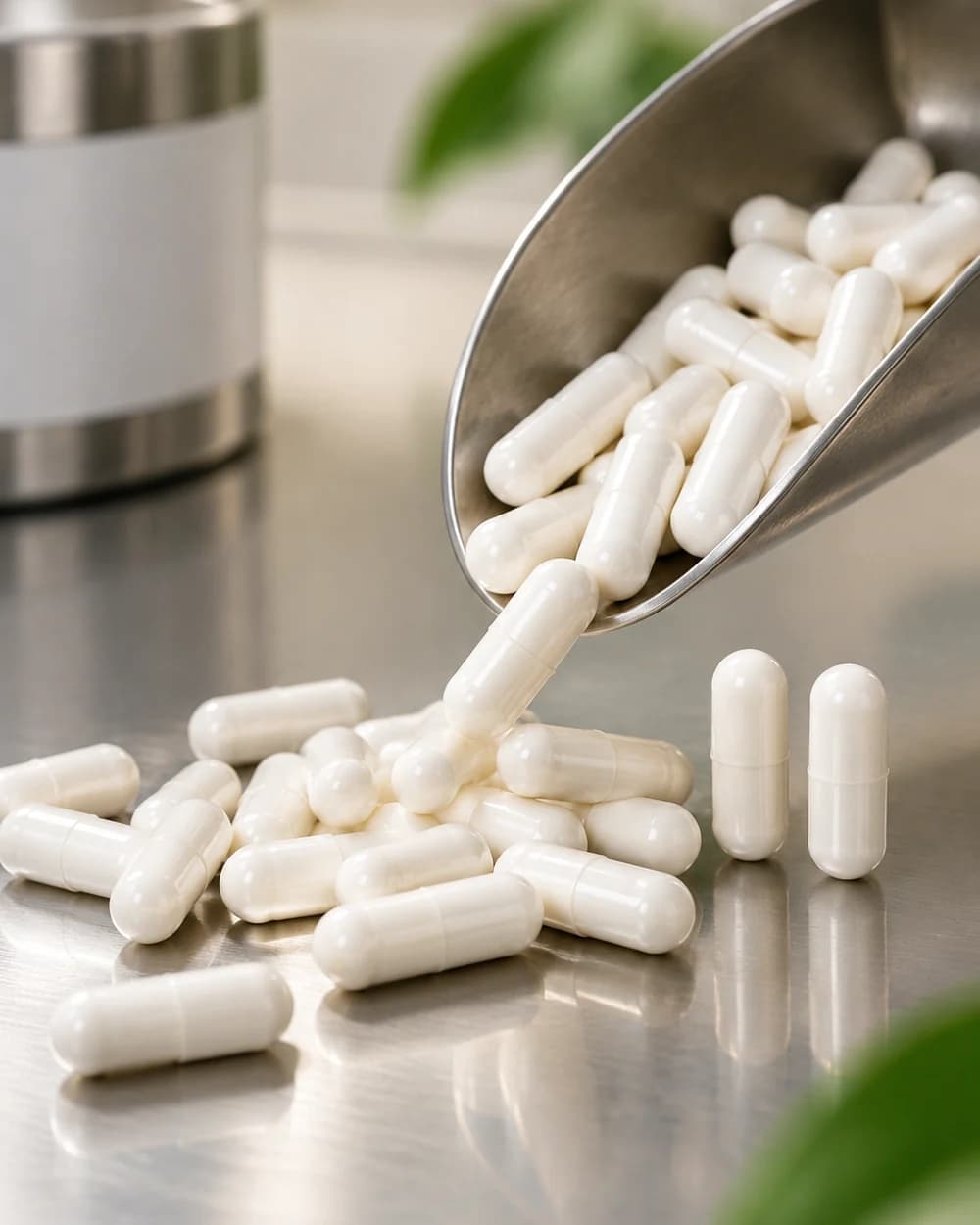
Enteric Capsule Manufacturer for Dietary Supplements
EUPHM produces enteric-coated and enteric capsule supplements in Guangdong. We handle formulation, coating, filling, and packing for brands in the US, EU, UK, and Middle East. MOQ from 1,000 units per SKU.

Overview
Enteric capsules protect sensitive ingredients from stomach acid and release them in the small intestine. This matters for probiotics, enzymes, and compounds that irritate the stomach. As a contract manufacturer, we produce both enteric-coated capsules and capsules filled with enteric-coated pellets. The parent process sits under our /capsule-manufacturer capability, so you get one team for coating, filling, and QC.
| MOQ | 1,000 units per SKU; lower for pilot runs |
|---|---|
| Capsule sizes | Size 0, 1, 2, 3; enteric-coated or pellet-filled |
| Fill weights | 150 mg to 800 mg depending on size and density |
| Sample lead time | 7-10 working days |
| Mass production | 20-35 working days after sample approval |
| Certifications | GMP, ISO 9001, ISO 22000, HACCP, NSF/ANSI 455-2, halal, FDA-registered |
Enteric Coating and Capsule Capability
We run two enteric formats. First, enteric-coated hard capsules: the capsule shell is coated with a polymer that resists gastric fluid for up to 2 hours. Second, capsules filled with enteric-coated pellets: the pellets are coated first, then filled into a standard or vegetarian capsule. Both routes are produced on automated lines with in-process weight and coating thickness checks. We can coat up to 300,000 capsules per batch.
For pellet-filled capsules, we use fluid-bed coating with Eudragit or cellulose-based polymers. Coating weight gain is typically 8-15% depending on the active. You can choose a single-layer or dual-layer coat. We test disintegration in simulated gastric fluid (0.1N HCl, pH 1.2) and simulated intestinal fluid (pH 6.8). Release profiles are documented per batch. If your formula needs a specific pH trigger, we adjust the polymer ratio at pilot scale.
Formulation and Ingredient Compatibility
Not every ingredient suits enteric delivery. Probiotics like Lactobacillus and Bifidobacterium benefit because the capsule bypasses stomach acid. Enzymes such as bromelain and pancreatin also work well. Compounds that irritate the stomach, including NSAIDs, potassium chloride, and some plant extracts, are common candidates. We review your active's pH stability, moisture sensitivity, and dose per capsule before quoting. If enteric is not suitable, we say so.
We can combine enteric pellets with immediate-release granules in the same capsule for biphasic release. Excipients include microcrystalline cellulose, magnesium stearate, and silicon dioxide. For vegan capsules, we use HPMC shells. For halal projects, we source certified shells and document the supply chain. Organic projects require USDA organic or EU organic certification for every ingredient, and we schedule those runs separately to avoid cross-contact.
Quality Control and Logistics
Every enteric batch is tested for disintegration, coating uniformity, and moisture content. We hold GMP, ISO 22000, and HACCP certifications. Our facility is FDA-registered for dietary supplements. Third-party lab testing is available for potency, heavy metals, and microbial limits. We keep retain samples for 2 years. Batch records and certificates of analysis are provided before shipment. For US and EU clients, we can arrange testing through local labs.
Shipping is from Shenzhen or Hong Kong. We handle export documents, certificates of origin, and halal certificates. Air freight takes 5-8 days to the US or EU; sea freight takes 18-25 days. MOQ is 1,000 units per SKU for retail bottling. Pilot runs start at 1,000 units. Packaging options include HDPE bottles, blister packs, and bulk bags. We label in English, Arabic, or French. Lead time for mass production is 20-35 working days after sample approval.
Quality Control and Batch Documentation
Every enteric capsule batch is tested against a written specification before release. Incoming raw materials are checked for identity by FTIR and assay by HPLC where applicable. During encapsulation, in-process checks cover capsule weight variation at ±5%, fill weight, and visual defects at a sampling rate of one capsule per 1,000. After coating or pellet filling, we test enteric performance using USP <701> disintegration testing in simulated gastric fluid for two hours followed by simulated intestinal fluid, with a specification of no release in acid and full release within 60 minutes at pH 6.8.
Finished-product testing includes potency by HPLC or microbiological assay for probiotics, microbial limits (total aerobic count, yeast and mould, E. coli, Salmonella), heavy metals by ICP-MS against EU and US limits, and moisture content. We retain samples from every batch for 24 months at controlled conditions. Stability protocols follow ICH Q1A(R2) with accelerated conditions at 40°C/75% RH for six months and long-term at 25°C/60% RH for 24 months, with testing at 0, 3, 6, 12, 18, and 24 months.
A certificate of analysis (COA) is issued per batch and includes the product name, batch number, manufacturing date, expiry date, specification results for each test, and the analyst and QA sign-off. We also provide a statement of composition, allergen declaration, and a non-GMO statement where required. Batch records and analytical raw data are retained for five years and are available for audit by appointment. If a specification is not met, the batch is quarantined and an out-of-specification investigation is opened before any disposition decision.
Packaging, Labelling and Retail Readiness
Enteric capsules are moisture and acid sensitive, so packaging must provide a barrier. We offer HDPE bottles with induction seals and desiccant, blister packs with aluminium lidding, stick packs, and sachets. Bottle sizes range from 30 to 180 capsules. Blister cards can be printed with a maximum of six colours. For stick packs, fill weights are typically 2 to 5 g. We can apply child-resistant closures and tamper-evident bands on request. Carton board is 300 to 350 gsm with a maximum print area of 250 x 180 mm.
For the US market, we set up labels to include the supplement facts panel, serving size, amount per serving, percent daily value where applicable, other ingredients, and the mandatory allergen statement. We also add the domestic address and phone number of the distributor, net quantity, and the disclaimer for structure/function claims. Lot and expiry coding is applied by inkjet or laser at the filling line, with a format agreed in the packaging specification. We do not print claims that require notification unless you provide the substantiation and regulatory sign-off.
For retail and e-commerce, we can apply Amazon FNSKU labels, poly-bag units, and prepare cartons to Amazon's prep requirements. Cartons are typically 5-ply corrugated with a maximum weight of 20 kg. Pallet specifications follow standard 1200 x 1000 mm or 1200 x 800 mm footprints, with stretch wrap and edge protectors. We provide a packing list and pallet manifest for each shipment. If you sell in the EU, we can include the responsible person address and the EC declaration where the product is a food supplement.
MOQ, Lead Times and Delivery
Our standard MOQ for enteric capsules is 1,000 units per SKU, with lower quantities accepted for pilot runs subject to a setup fee. Samples are produced in 7 to 10 working days after formulation and packaging specifications are approved. Sample quantities are typically 100 to 300 capsules. Mass production runs 20 to 35 working days after sample approval, depending on capsule size, coating requirement, and packaging format. We confirm the production window in writing once the purchase order and artwork are finalised.
For delivery, we offer EXW, FOB Shenzhen or Hong Kong, and DDP for select destinations. Air freight is used for samples and urgent orders, with transit times of 3 to 7 days to the US and EU. Sea freight is used for full container loads and takes 25 to 40 days depending on the port. We provide a commercial invoice, packing list, certificate of origin, COA, MSDS, and a free-sale certificate. Where relevant, we arrange phytosanitary certificates for herbal ingredients. We do not ship without a signed specification and approved artwork.
We recommend booking production at least 60 days before your retail launch to allow for sample approval, label review, and freight. For repeat orders, we keep the approved specification and artwork on file, which reduces the lead time by about 5 working days. If you use a third-party logistics provider, we can ship to their warehouse and provide the required ASN data. All shipments are recorded with batch numbers and quantities to support traceability and recall procedures.
Manufacturing Options to Compare
Coated hard capsules
Enteric polymer coated on the outside of HPMC or gelatin capsules. Simple, cost-effective for acid-sensitive actives. Typical coating weight gain 6-10%.
Pellet-filled capsules
Enteric-coated pellets inside a capsule. Better for controlled release and biphasic profiles. Coating weight gain 8-15% per pellet batch.
Vegetarian and vegan
HPMC shells with enteric coating. No animal derivatives. Suitable for vegan and halal claims when certified.
Organic certified
Certified organic or EU organic enteric capsules. All ingredients and coatings must be certified. Separate production runs to avoid cross-contact.
From Enquiry to Delivery
- 01
Send your formula
Share active ingredients, dose per capsule, target release profile, and quantity. We confirm enteric feasibility within 2 working days.
- 02
Quotation and MOQ
We quote per unit, including coating, filling, and packaging. MOQ is 1,000 units per SKU. Pilot runs from 1,000 units.
- 03
Sample production
We produce enteric capsules at pilot scale. Sample lead time is 7-10 working days. You test disintegration and release.
- 04
Sample approval
You approve the sample or request adjustments. We revise coating weight, shell type, or fill weight until it meets your spec.
- 05
Mass production
Full batch production runs 20-35 working days after approval. In-process checks at coating, filling, and packing stages.
- 06
QC and shipping
Final QC includes disintegration, potency, and microbial tests. We ship from Shenzhen or Hong Kong with all export documents.
Why EUPHM
Low MOQ for testing
Start at 1,000 units per SKU. Pilot runs from 1,000 units. Test the market before scaling to full production.
In-house enteric coating
We coat capsules and pellets on site. No third-party coating delays. Batch capacity up to 300,000 capsules.
Certified for export
GMP, ISO 9001, ISO 22000, HACCP, NSF/ANSI 455-2 and halal certification; FDA facility registration for US-bound shipments.
Questions buyers ask.
What is the difference between enteric-coated capsules and enteric capsules?+
Enteric-coated capsules have a polymer coating on the outside of the capsule shell. Enteric capsules often refer to capsules filled with enteric-coated pellets. Both protect actives from stomach acid. Coated capsules are simpler; pellet-filled capsules allow biphasic release. We produce both.
What is your MOQ for enteric capsules?+
MOQ is 1,000 units per SKU for retail bottling. For pilot runs, we can go as low as 1,000 units. The exact MOQ depends on capsule size, coating type, and packaging. We confirm at quotation.
How long does sample production take?+
Sample lead time is 7-10 working days after we receive your formula and confirm feasibility. This includes coating, filling, and initial disintegration testing. You receive samples with a certificate of analysis.
Do you offer halal enteric capsules?+
Yes. We source halal certified capsule shells and coatings. Certificates are provided per batch. For projects, we schedule production on dedicated lines. Vegan options use HPMC shells with no animal derivatives.
Can you ship enteric capsules to the US and EU?+
Yes. We ship from Shenzhen or Hong Kong. Air freight takes 5-8 days; sea freight 18-25 days. We handle export documents, certificates of origin, and third-party lab testing for US and EU clients. FDA-registered facility.
What is the shelf life of your enteric capsules and how is it validated?+
Shelf life is assigned based on stability data for the specific formulation and packaging. For enteric capsules in HDPE bottles with desiccant, we typically support 24 months at controlled room temperature. We run accelerated stability at 40°C/75% RH for six months and long-term studies at 25°C/60% RH. The final shelf life is confirmed by the long-term data and is stated on the COA and label.
Can you supply enteric capsules in blister packs for pharmacy or retail?+
Yes. We offer blister packs with aluminium lidding and PVC/PVDC or alu-alu forming film. Alu-alu is used where moisture protection is critical. Blister cards can be printed with up to six colours and include lot and expiry coding. We can also apply pharmacy-specific requirements such as child-resistant features and tamper evidence. Minimum order quantities for blister packs are higher than for bottles, typically 10,000 units.
Do you provide a free-sale certificate and what other export documents are included?+
Yes, a free-sale certificate is provided on request for shipments to the EU and other markets. The standard document pack includes the commercial invoice, packing list, certificate of origin, certificate of analysis, and material safety data sheet. For herbal ingredients, we can arrange a phytosanitary certificate. We do not issue documents that require statements we cannot substantiate, such as organic certificates unless the ingredient is certified.
Other versions built in this dosage form.
- Capsule Manufacturer
- Vegan Capsule Manufacturer
- HPMC Capsule Manufacturer
- Two-Piece Capsule Manufacturer
- Pullulan Capsule Manufacturer
- Delayed-Release Capsule Manufacturer
- Two-in-One Capsule Manufacturer
- Hard Gelatin Capsule Manufacturer
- Vitamin B Complex Capsule Manufacturer
- Vitamin K2 Capsule Manufacturer
- Vitamin E Capsule Manufacturer
- CoQ10 Capsule Manufacturer
- Probiotics Capsule Manufacturer
- Prebiotics Capsule Manufacturer
- Hyaluronic Acid Capsule Manufacturer
- Selenium Capsule Manufacturer
- Chromium Capsule Manufacturer
- Ashwagandha Capsule Manufacturer
- Turmeric Capsule Manufacturer
- Apple Cider Vinegar Capsule Manufacturer
- Glutathione Capsule Manufacturer
- NMN Capsule Manufacturer
- NAD+ Capsule Manufacturer
- Berberine Capsule Manufacturer
- Milk Thistle Capsule Manufacturer
- Mushroom Extract Capsule Manufacturer
- Maca Capsule Manufacturer
- Ginseng Capsule Manufacturer
- Propolis Capsule Manufacturer
- Royal Jelly Capsule Manufacturer
- Glucosamine Capsule Manufacturer
- MSM Capsule Manufacturer
- Psyllium Fiber Capsule Manufacturer
- Taurine Capsule Manufacturer
- L-Theanine Capsule Manufacturer
- GABA Capsule Manufacturer
- 5-HTP Capsule Manufacturer
- Weight Management Capsule Manufacturer
- Menopause Capsule Manufacturer
- Prostate Capsule Manufacturer
- Joint Health Capsule Manufacturer
- Detox Capsule Manufacturer
Have a product in mind?
Send us the brief and we will come back with a formulation direction, indicative price and a realistic lead time — usually within one working day.