Two-Piece Capsule Manufacturer for Supplement Brands
Run two-piece hard-shell capsules from 1,000 units per SKU. EUPHM supplies gelatin, HPMC and pullulan shells, with fill weights from 50 mg to 1,200 mg and mass production in 20–35 working days.
Overview
Two-piece capsules remain the default format for powders, granules, pellets and self-emulsifying systems. They tolerate high fill weights, need no heat during filling, and suit both standard and delayed-release profiles. This page covers shell options, fill parameters, tooling and the compliance documents buyers request. For the wider format set, including softgels and enteric systems, see the parent capsule manufacturing overview at /capsule-manufacturer.
- MOQ (retail bottling)
- 1,000 units per SKU
- MOQ (pilot run)
- From 500 units, subject to shell stock
- Fill weight range
- 50 mg to 1,200 mg per capsule
- Sample lead time
- 7–10 working days
- Mass production
- 20–35 working days after approval
- Certifications
- GMP, ISO 9001, ISO 22000, HACCP, NSF/ANSI 455-2, halal, FDA-registered
Shell formats, sizes and tooling
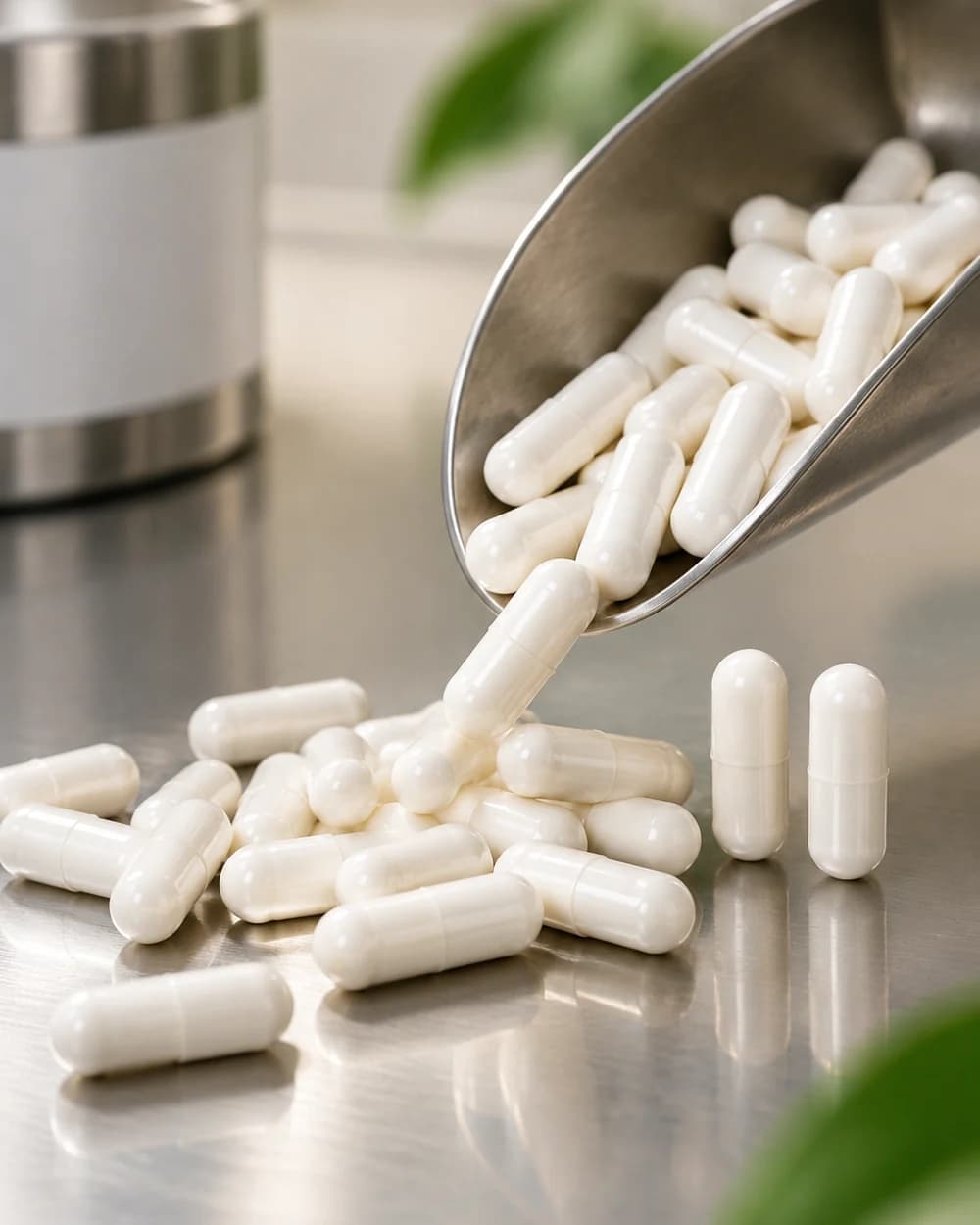
Capsule sizes run from 5 to 000, with 0, 00 and 1 covering most retail SKUs. Size 00 holds roughly 500–700 mg of a medium-density powder at a tap density near 0.6 g/mL; size 0 holds 350–500 mg. Tooling is available for standard round ends, self-locking, and snap-fit closures. Vegetarian shells use HPMC or pullulan. Pullulan has lower oxygen permeability and suits oxygen-sensitive actives. Colours can be opaque, transparent or two-tone, with optional titanium dioxide-free white.
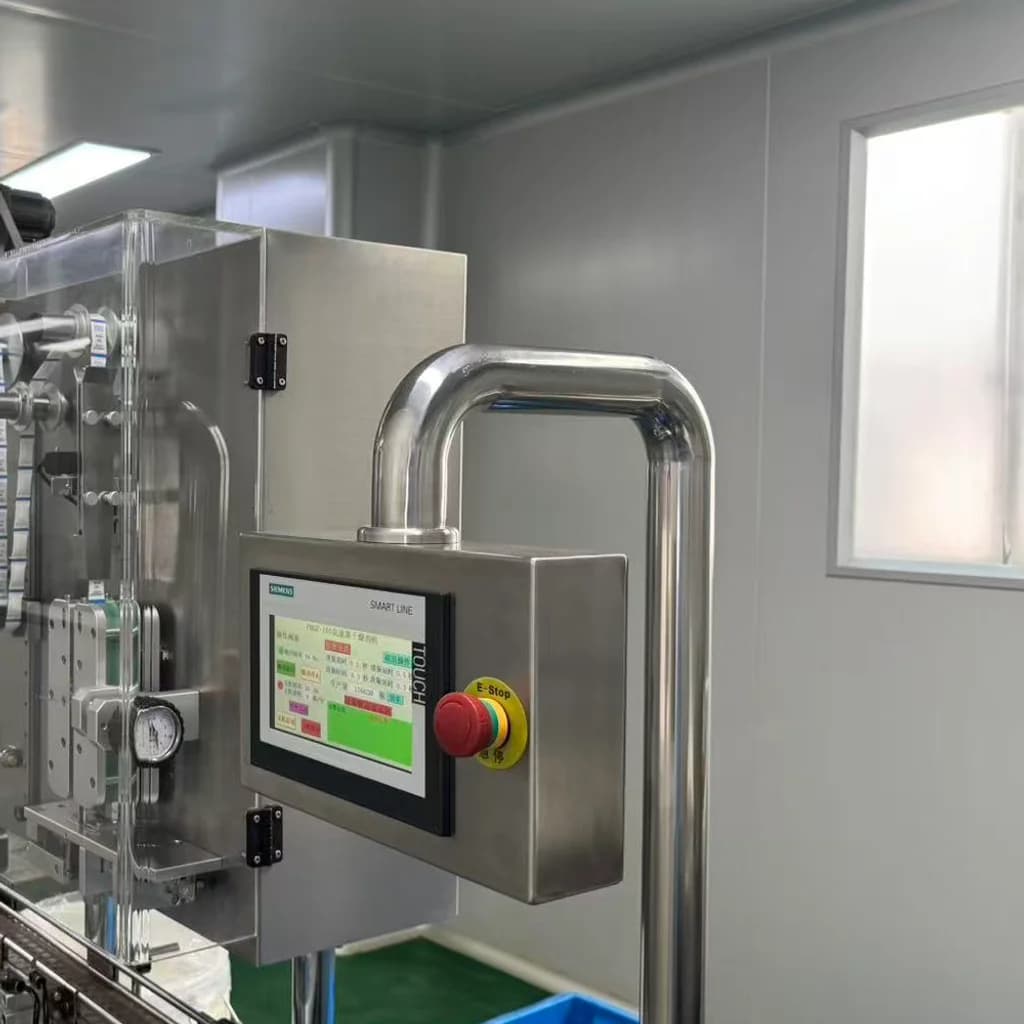
Filling runs on automatic Bosch and IMA lines at 60,000–120,000 capsules per shift, depending on fill weight and powder flow. Banding is available for volatile fills or where tamper evidence is required. For banded or printed shells, add 3–5 working days to the production window. Shell stock in natural and white is held on site; custom colours take 10–15 working days to arrive before filling starts.
Fill types, blends and release profiles
Two-piece shells accept dry powders, granules, pellets, mini-tablets and semi-solids. Common actives include botanical extracts, amino acids, probiotics at 10–50 billion CFU, enzymes, minerals and vitamin premixes. Powder blends are blended in 500 kg and 1,000 kg ribbon mixers, then screened at 20–40 mesh before filling. For hygroscopic or deliquescent ingredients, we recommend HPMC shells with a desiccant or a low-moisture fill below 3% water activity.
Delayed-release and enteric options use Eudragit coatings on pellets or a banded shell with an enteric band. Pellets can be blended at different release rates in one capsule, giving a biphasic profile without a second dosage form. For probiotic and enzyme blends, we run filling at 18–22°C and below 30% relative humidity. Stability data is generated at 25°C/60% RH and 40°C/75% RH for 6 months accelerated, with real-time data at 12 and 24 months.
Quality, documentation and shipping
Every batch is tested for fill weight uniformity, disintegration, and microbial limits. Identity testing of incoming raw materials uses HPLC, GC, FTIR or TLC as appropriate. Heavy metals, pesticide residues and solvent residues are tested against USP, EP or in-house limits. Certificates of analysis are issued per lot, alongside a certificate of conformity and a material safety data sheet. Allergen and GMO statements are provided where relevant.
Finished bottles ship in 60, 90, 120 or 180 count, with induction seals, child-resistant caps and desiccant sachets. Cartons are palletised and stretch-wrapped for sea or air freight. Documentation for EU and UK importers includes a statement of compliance with EC 1924/2006 for claims review, plus halal certificates if the shell or fill requires them. For US-bound orders, the facility is FDA-registered and can provide a prior notice confirmation.
Quality Control and Batch Documentation
Every two-piece capsule batch is tested against a written specification before release. Incoming raw materials are sampled and checked for identity by FTIR or HPLC, and potency is assayed against a validated method. Microbial testing covers total aerobic count, yeast and mould, E. coli and Salmonella, with limits set to the relevant pharmacopoeial or customer standard. Heavy metals are screened by ICP-MS to lead, arsenic, cadmium and mercury limits. Disintegration testing follows USP <701> or the equivalent method, with typical results under 15 minutes for standard gelatin shells and under 30 minutes for HPMC.
In-process checks run at defined intervals during filling. Capsule weight is verified every 15 to 30 minutes, with individual weights monitored against the target fill plus or minus 5 percent, and the average checked against the label claim. Locking quality is inspected visually for dents, splits and telescoping defects. At the end of the run, a composite sample is taken for the finished-product assay and microbial testing, and retention samples are held for the shelf life plus 12 months. Retention storage is at controlled temperature and humidity, typically 25 degrees Celsius and 60 percent relative humidity, or 30 degrees Celsius and 65 percent relative humidity for Zone IVb markets.
The certificate of analysis issued with each batch lists the product name, batch number, manufacturing date, expiry date, specification parameters, test methods, results and pass or fail status. It is signed by the QC manager and references the retained sample location. Where a customer needs a specific format for their own quality system, the COA can be issued against the customer's specification number. Stability testing follows ICH Q1A(R2) conditions, with accelerated data at 40 degrees Celsius and 75 percent relative humidity for six months and long-term data at 25 degrees Celsius and 60 percent relative humidity or 30 degrees Celsius and 65 percent relative humidity for up to 24 months.
For two-piece capsule manufacturing, the shell and fill are treated as separate quality inputs. Gelatin or HPMC shells are checked for colour, dimensions, moisture content and, where relevant, enteric or delayed-release coating integrity. Fill blends are checked for uniformity before encapsulation, and homogeneity is confirmed by sampling from the top, middle and bottom of the blender. Any out-of-specification result triggers a documented investigation, and the batch is held until the investigation is closed. This record set is what buyers typically review during a supplier audit.
Packaging, Labelling and Retail Readiness
Two-piece capsules can be packed in HDPE bottles, blisters, stick packs or sachets. Bottles are the most common for retail supplements, typically 60, 90, 120 or 180 count, with induction seals and child-resistant closures where required. Blister packs suit unit-dose or sample formats, and stick packs or sachets suit powder blends or single-serve capsule combinations. Desiccant canisters or silica gel sachets are added where humidity sensitivity is a concern. Bottle dimensions and carton configurations are confirmed at the artwork stage so that the retail carton, shipper and pallet plan are fixed before production.
For the US market, the label must carry the statement of identity, net quantity of contents, nutrition or supplement facts panel, ingredient list, allergen declaration where applicable, and the name and place of business of the manufacturer, packer or distributor. Structure or function claims must carry the standard disclaimer. Lot number and expiry date are printed or laser-coded on the bottle and the carton, with the same code used across the batch record. For EU markets, the label follows the Food Supplements Directive and local language requirements, and the responsible person address must be shown.
Carton and pallet specifications are agreed before the run. A typical retail carton is printed on 300 to 350 gsm board, with shipper cartons holding 12, 24 or 48 retail units. Pallets are normally 1,200 by 1,000 mm or 1,200 by 800 mm, stretch-wrapped and labelled with batch, quantity and handling marks. For Amazon FBA, the factory can apply FNSKU labels, poly-bag or shrink-wrap units where required, and print the carton labels to the seller's specification. Retail compliance checks include barcode verification to GS1 standards and artwork proofing against the approved dieline.
Artwork approval is a formal step. The customer signs off a PDF proof that shows every panel, the exact font sizes for net quantity and supplement facts, and the placement of lot and expiry codes. Once approved, printing plates or digital files are locked to that version. Any later change requires a new proof and may affect lead time. This step is where most retail compliance issues are caught, so it is worth building two to three working days into the schedule for proofing and sign-off before two-piece capsule manufacturing begins.
MOQ, Lead Times and Delivery
Sampling starts with a brief covering capsule size, shell type, fill formula, target dose and packaging format. If the formula is already fixed, a sample can be produced in 7 to 10 working days using stock shells. If a new blend or a new shell colour is needed, allow 10 to 15 working days. Samples are sent by courier with a preliminary COA and a packaging mock-up where relevant. The sample stage is also when fill weight, shell size and disintegration profile are confirmed, so changes after this point usually require a new sample round.
Mass production runs 20 to 35 working days after sample approval and receipt of deposit. The window depends on shell stock, fill complexity and packaging. Standard gelatin or HPMC shells in common sizes are usually in stock; custom colours, enteric shells or printed capsules add time. Bottling, labelling and cartoning add three to five working days to the capsule production itself. The production schedule is confirmed in writing once the purchase order, artwork approval and deposit are all in place, and any delay in artwork sign-off moves the ship date accordingly.
Shipping is by air or sea. Air freight suits pilot runs and urgent replenishment, typically 5 to 10 days door to door depending on route. Sea freight is the default for full container loads and larger retail orders, typically 25 to 40 days port to port. Incoterms are agreed per order: EXW for buyers with their own freight forwarder, FOB for the named Chinese port, and DDP where the buyer wants a delivered price with duties and taxes handled. The chosen term determines who arranges insurance and customs clearance.
Documents issued with each shipment include the commercial invoice, packing list, certificate of analysis, material safety data sheet where relevant, and a free-sale certificate for markets that request one. Phytosanitary certificates are provided where the destination requires them for plant-derived ingredients. For two-piece capsule manufacturing, the batch number on the COA matches the batch number on the bottle, carton and shipping documents, which is what customs and retail quality teams check first. Certificates of origin can be arranged on request.
Options for Your Format
Gelatin shells
Standard bovine or porcine gelatin in sizes 5 to 000. Low cost, high fill weight, good for powders and pellets. Not suitable for vegan or halal claims unless a certified source is used.
HPMC vegetarian shells
Plant-based hydroxypropyl methylcellulose. Lower moisture content than gelatin, stable at higher temperatures, and suitable for hygroscopic fills. Vegan and halal friendly.
Pullulan shells
Low oxygen permeability, starch-derived, suitable for probiotics and oxygen-sensitive botanicals. Higher unit cost than HPMC, but often removes the need for nitrogen flushing or desiccant.
Pellet and mini-tablet fills
Coated pellets for delayed or enteric release, or mini-tablets for high-dose actives. Can be blended in one capsule to create immediate and extended release phases.
How a Project Runs
- 01
Send your brief
Share target fill weight, active ingredients, shell type, capsule size, bottle count and destination market. Include any certification needs such as halal or vegan.
- 02
Formulation review
We check compatibility, flow, density and moisture. If the fill is sticky or hygroscopic, we propose glidants, moisture barriers or a switch to HPMC or pullulan shells.
- 03
Sample run
7–10 working days for a pilot batch. You receive filled capsules in labelled bottles with a draft specification and a certificate of analysis for the sample lot.
- 04
Quotation and PO
Pricing is per unit at your MOQ, with tooling, shell and packaging costs itemised. Lead time is confirmed once the PO and artwork are approved.
- 05
Mass production
20–35 working days from approval. In-process checks run every 30 minutes for fill weight, and a retained sample is held for 24 months.
- 06
Release and ship
Final QC, certificate of analysis, packing list and commercial invoice. We book sea or air freight and provide tracking from the Guangdong plant.
Why EUPHM
Low MOQ for retail
Start at 1,000 units per SKU. Pilot runs from 500 units let you test a formula before committing to a full batch.
Fast sample turnaround
7–10 working days for samples. You can review fill weight, shell appearance and disintegration before paying for mass production.
Documentation ready
GMP, ISO 9001, ISO 22000, HACCP, NSF/ANSI 455-2 and halal certification; FDA facility registration for US-bound shipments.
Questions buyers ask.
What is the MOQ for two-piece capsules?+
MOQ is 1,000 units per SKU for retail bottling. Pilot runs can start from 500 units if the shell size and colour are in stock. Custom-coloured shells usually require 5,000 units because the shell supplier has its own minimum.
How long do samples take?+
Sample lead time is 7–10 working days from receipt of raw materials. This covers blending, filling, labelling and QC. If you need a custom shell colour, add 10–15 working days for the shells to arrive before the sample run starts.
Can you fill probiotics and enzymes?+
Yes. We fill probiotics at 10–50 billion CFU per capsule and enzymes in powder or granule form. Filling runs at 18–22°C and below 30% relative humidity. HPMC or pullulan shells are used to limit moisture ingress, and stability testing follows ICH accelerated conditions.
What certifications do you hold?+
The plant is GMP-certified and holds ISO 22000 and HACCP. halal and vegan certifications are available for specific projects depending on the shell and fill ingredients. The facility is FDA-registered for US-bound shipments. Certificates are shared before purchase order.
What is the production lead time?+
Mass production runs 20–35 working days after sample approval, PO and artwork sign-off. Banded or printed capsules add 3–5 working days. Sea freight to the US or EU adds 25–40 days; air freight is 5–10 days.
Do you provide stability data for the finished capsule?+
Yes. Stability testing follows ICH Q1A(R2) conditions. Accelerated data at 40 degrees Celsius and 75 percent relative humidity is generated over six months, and long-term data at 25 degrees Celsius and 60 percent relative humidity or 30 degrees Celsius and 65 percent relative humidity runs for up to 24 months. The protocol covers assay, microbial limits, disintegration and appearance. Customers can request the stability summary with the COA, and shelf life is assigned from the long-term data plus a margin.
Can you match a competitor's capsule or replicate an existing formula?+
We can match shell size, colour and fill weight from a physical sample, and we can develop a fill blend against a target specification. We do not reverse-engineer a competitor's proprietary formula from a finished product. Where a customer supplies their own formula, we run a trial batch to confirm flow, fill weight and disintegration before production. Matching a shell colour or finish is usually straightforward; matching an exact taste or release profile may need one or two trial rounds.
What happens if a batch fails a specification test?+
The batch is placed on hold and a documented out-of-specification investigation is opened. The cause is traced to raw material, blending, encapsulation or testing, and a disposition decision is made: rework, re-test or reject. The customer is notified with the investigation summary and the proposed disposition. Rejected material is not shipped. Retention samples from the same batch are kept so that results can be re-checked, and the investigation record is available during a customer audit.
Other versions built in this dosage form.
- Capsule Manufacturer
- Vegan Capsule Manufacturer
- HPMC Capsule Manufacturer
- Enteric Capsule Manufacturer
- Pullulan Capsule Manufacturer
- Delayed-Release Capsule Manufacturer
- Two-in-One Capsule Manufacturer
- Hard Gelatin Capsule Manufacturer
- Vitamin B Complex Capsule Manufacturer
- Vitamin K2 Capsule Manufacturer
- Vitamin E Capsule Manufacturer
- CoQ10 Capsule Manufacturer
- Probiotics Capsule Manufacturer
- Prebiotics Capsule Manufacturer
- Hyaluronic Acid Capsule Manufacturer
- Selenium Capsule Manufacturer
- Chromium Capsule Manufacturer
- Ashwagandha Capsule Manufacturer
- Turmeric Capsule Manufacturer
- Apple Cider Vinegar Capsule Manufacturer
- Glutathione Capsule Manufacturer
- NMN Capsule Manufacturer
- NAD+ Capsule Manufacturer
- Berberine Capsule Manufacturer
- Milk Thistle Capsule Manufacturer
- Mushroom Extract Capsule Manufacturer
- Maca Capsule Manufacturer
- Ginseng Capsule Manufacturer
- Propolis Capsule Manufacturer
- Royal Jelly Capsule Manufacturer
- Glucosamine Capsule Manufacturer
- MSM Capsule Manufacturer
- Psyllium Fiber Capsule Manufacturer
- Taurine Capsule Manufacturer
- L-Theanine Capsule Manufacturer
- GABA Capsule Manufacturer
- 5-HTP Capsule Manufacturer
- Weight Management Capsule Manufacturer
- Menopause Capsule Manufacturer
- Prostate Capsule Manufacturer
- Joint Health Capsule Manufacturer
- Detox Capsule Manufacturer
Have a product in mind?
Send us the brief and we will come back with a formulation direction, indicative price and a realistic lead time — usually within one working day.