Ginseng Liquid Manufacturer for Private Label Brands
EUPHM produces ginseng liquid supplements in Guangdong: 10–50 ml bottles, 1,000-unit MOQ, 7–10 day samples, 20–35 day production. GMP, ISO 22000, HACCP and halal/organic lines for US, EU, UK and Middle East brands.
Overview
Ginseng liquid is a formulation and filling problem before it is a marketing one. Extract solids settle, pH drifts, and heat treatment can flatten the ginsenoside profile you paid for. EUPHM runs ginseng liquids on dedicated filling lines with in-house extraction, filtration and pasteurisation, so the Rg1/Rb1 ratio on the COA matches the ratio in the bottle. This page covers the practical parameters: fill weights, MOQ, lead times, certifications and the documents your importer will ask for.
Liquid Filling Capability and Line Setup
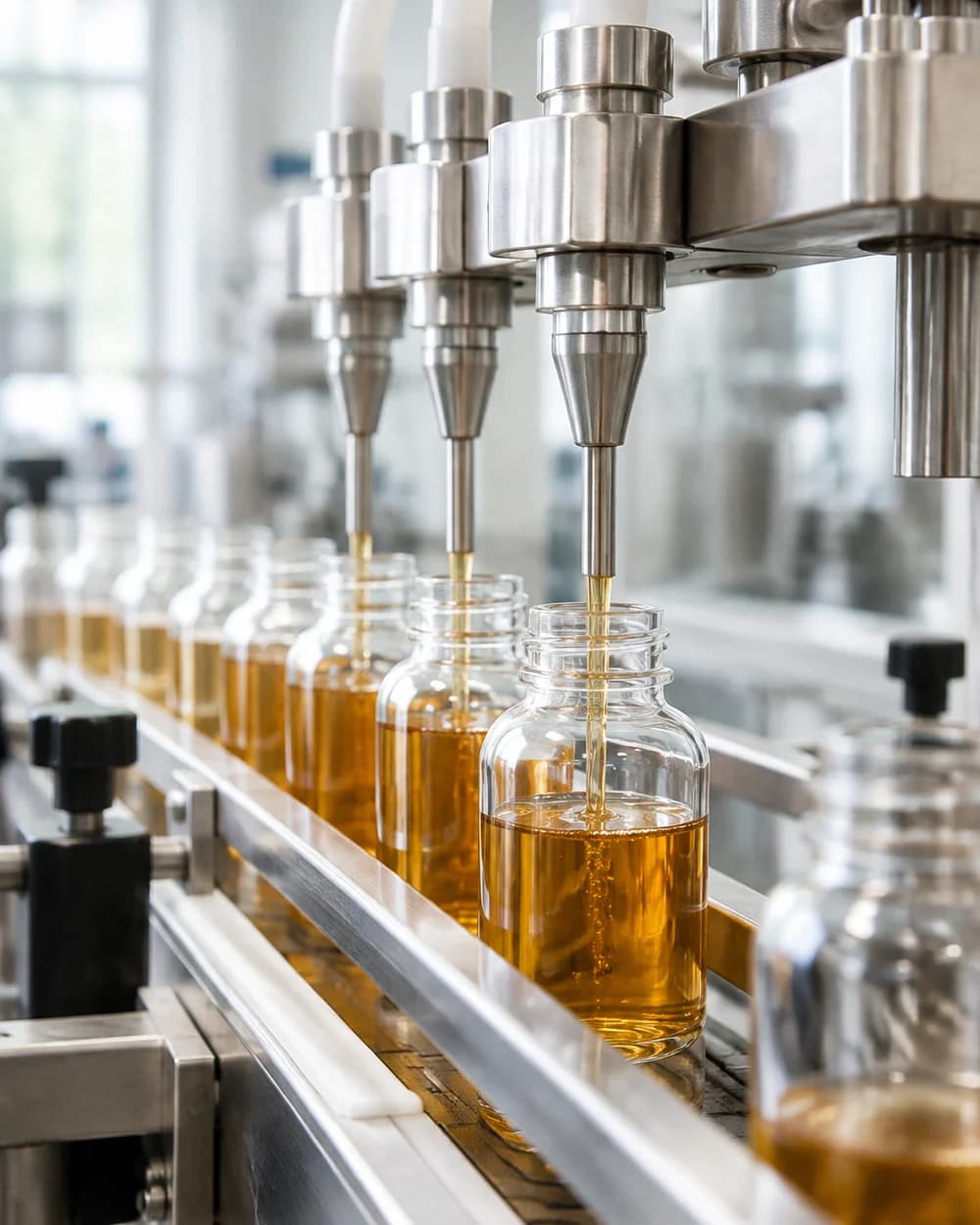
Ginseng liquid runs on two filling lines: a 10–50 ml glass and PET line with peristaltic dosing, and a bulk line for 1 L concentrate. Fill accuracy is ±1.5% on 30 ml and ±2% on 10 ml. Bottles pass through nitrogen purge before capping to limit headspace oxidation, which matters when the formula contains ascorbic acid or citrus terpenes.
Changeover between SKUs takes 4–6 hours including CIP. That is why MOQ sits at 1,000 units: below that, cleaning and line-time costs dominate the unit price. Pilot runs of 500–1,000 units are possible on the semi-automatic line, with the trade-off of slower throughput and a higher per-unit cost.
Ginseng Extract, Dosage and Taste
We work with Asian ginseng (Panax ginseng), American ginseng (Panax quinquefolius) and red ginseng, standardised to 4–20% ginsenosides by HPLC. A typical 30 ml shot carries 200–500 mg of extract, or 500–1,000 mg in a 50 ml format. Water-based extracts give a cleaner label; alcohol-based tinctures reach higher solids but need a 20–25% ABV declaration in most markets.
Taste is the second formulation job. Ginseng is bitter, and bitterness reads stronger in liquid than in capsules. We mask it with honey, monk fruit, stevia or fruit concentrates, then run a 30-person sensory panel before locking the batch. pH is adjusted to 3.5–4.2 for shelf stability, and every batch is tested for ginsenosides Rg1, Re, Rb1, Rc, Rb2 and Rd.
Quality, Compliance and Export Documents
The facility is GMP-certified, ISO 22000 and HACCP compliant, and FDA-registered for export to the US. Halal and vegan certifications are available where the formula and ingredient supply chain qualify. Each lot ships with a COA, microbiological panel, heavy metals (Pb, Cd, As, Hg), pesticide residue and, on request, PAH and solvent residue testing.
For the EU we provide the technical dossier and allergen statement; for the UK, a UKCA-compliant label check; for the Middle East, halal documentation and Arabic artwork support. Shelf life is 18–24 months unopened, 30 days after opening when refrigerated. Documentation lead time is 3–5 working days alongside production, so it does not extend your schedule.
Quality Control and Batch Documentation
Every ginseng liquid batch at EUPHM is tested against a written specification before release. Identity is confirmed by TLC or HPLC fingerprint against a reference extract, and potency is assayed for ginsenosides Rg1, Re, Rb1, Rc, Rb2 and Rd, with total ginsenosides reported as a percentage of the extract solids. Microbial testing covers total aerobic count, yeast and mould, E. coli, Salmonella and Staphylococcus aureus. Heavy metals (lead, arsenic, cadmium, mercury) are tested by ICP-MS, and pH, specific gravity, alcohol content where applicable, and appearance are checked on the finished fill.
Testing happens at three points: incoming raw material, bulk liquid after filtration and pasteurisation, and the finished filled bottle. Bulk release testing takes 5–7 working days for the full panel; microbial incubation alone accounts for 48–72 hours. We do not release a batch to packing until the finished-product COA is signed off by the QC lead. For private-label clients, the COA issued with each shipment lists batch number, manufacture and expiry dates, test method references, specification limits and measured results, so your importer can file it without requesting additional data.
Retention samples are drawn from every batch: two bottles per 1,000 units, held at 25°C/60% RH and 30°C/65% RH for the declared shelf life plus six months. Stability is monitored at 0, 3, 6, 12, 18 and 24 months for pH, ginsenoside content, microbial count and organoleptic change. Accelerated stability at 40°C/75% RH for six months is available for clients who need a shorter data package before launch. If a formulation changes, the stability clock restarts and we advise a fresh 12-month real-time study before committing to a 24-month expiry.
Documentation is issued in English as standard and can be translated for your market on request. The release pack includes the finished-product COA, raw material COAs for the ginseng extract and any excipients, a batch manufacturing record summary, a retention sample declaration and a stability summary. We retain batch records for five years from the date of manufacture, which covers the audit window most EU and UK importers apply. If your distributor asks for a specific test not in our standard panel, such as pesticide residues or a specific ginsenoside ratio, we quote it as a separate line before production starts.
Packaging, Labelling and Retail Readiness
Ginseng liquid fills run on amber glass dropper bottles (30 ml and 50 ml), PET bottles with tamper-evident caps (50 ml to 1 L), single-serve stick packs (10 ml and 15 ml) and aluminium sachets (20 ml). Stick and sachet formats require a different filler head and a form-fill-seal line, so we confirm format at quotation stage; switching from bottle to stick after artwork approval adds 5–7 working days to the schedule. Caps, droppers and orifice reducers are sourced to food-contact specification, and we can supply child-resistant closures where your market requires them.
For US-bound private label, we set up the FDA dietary-supplement label panel with you: statement of identity, net quantity, supplement facts box with ginsenoside content per serving, other ingredients in descending order of weight, directions, and the mandatory disclaimer. We do not write your claims, but we check that the label artwork you supply carries a lot code field, a best-by date field and the required allergen and storage statements. Lot and expiry coding is applied by inkjet or laser at fill; we can print in YYYY/MM/DD or your preferred format and apply a 2D DataMatrix if your retailer requests it.
Carton and pallet specifications are agreed before the PO is placed. Standard export cartons are 5-ply corrugated with a 20–24 kg gross weight limit, and we can print your SKU, barcode and handling marks directly on the carton. Pallets are 1,200 x 1,000 mm or 1,200 x 800 mm, stretch-wrapped and corner-boarded, with a maximum height of 1.8 m for sea freight. For Amazon FBA, we apply FNSKU labels, poly-bag or shrink-wrap per the current FBA packaging requirements, and print the box content label; we do not register your seller account, but we prepare the shipment so it can be booked in without rework at the warehouse.
Retail-ready checks are built into the pre-production artwork review. We verify barcode scannability at 100% magnification, check that the supplement facts panel matches the approved formula, and confirm that the net quantity declaration matches the fill weight after settling. If your retailer requires a specific carton mark, such as a GS1-128 label or a lot-specific SSCC, we quote the labelling step separately. We keep a signed artwork proof on file for each SKU and do not print a run until that proof is returned with your approval, which protects both sides if a label dispute arises later.
MOQ, Lead Times and Delivery
The MOQ for ginseng liquid private label is 1,000 units per SKU, with 500–1,000 units available for pilot runs so you can test the market before committing to a full batch. Samples from an approved formula take 7–10 working days, including filling, labelling and dispatch by courier. If the formula is not yet fixed, add 10–15 working days for bench development and a stability check before the sample is filled. We quote MOQ against the chosen bottle or sachet format, because the filler setup time differs between formats.
Mass production runs 20–35 working days after PO and artwork sign-off. The window covers raw material release, bulk preparation, filtration, pasteurisation, filling, coding, cartoning and QC release. Delays usually come from artwork revisions or late label approval rather than from production itself, so we ask for the signed proof at least five working days before the planned fill date. If you need a faster slot, we can quote air freight and a compressed QC schedule, but we do not shorten the microbial incubation step.
We ship EXW, FOB Shenzhen or Hong Kong, and DDP to most EU, UK, US and Australian destinations. Air freight is typically 5–8 days door to door and suits pilot runs or launch stock; sea freight is 25–40 days depending on port and runs at a lower per-unit cost for full pallets. We provide the commercial invoice, packing list, COA, MSDS, free-sale certificate and, where the destination requires it, a phytosanitary certificate for the botanical raw material. Incoterms and the document set are confirmed in the proforma invoice before production begins.
For repeat orders, we hold your approved artwork, formula and packaging specification on file, which shortens the next run to 18–25 working days. We recommend booking a production slot four to six weeks ahead of your planned retail launch, especially for stick-pack formats that share line time with other clients. Delivery terms are agreed per shipment, and we can split a PO across air and sea if part of the order is needed for a trade show or a marketplace launch date while the balance moves by sea.
What We Can Build
10–20 ml shot
Single-serve wellness shot. Glass or PET, screw cap or twist-off. Suited to retail multipacks and subscription boxes.
30–50 ml daily dose
Larger daily-format bottle for pharmacy and health-food shelves. Often combined with vitamins B or D.
1 L bulk concentrate
For brands that dilute and bottle locally, or for food-service use. Supplied in food-grade HDPE.
Sachet and stick pack
15–30 ml laminated stick for travel and sample programmes. Lower unit cost at higher volumes.
How We Work
- 01
Brief and formula
Share target dose, format, market and label claims. We confirm feasibility and send a costed proposal within 2 working days.
- 02
Sample production
We produce 7–10 day samples from your formula or ours. You receive 2–5 bottles per variant for sensory and stability review.
- 03
Specification lock
Finalise ginsenoside content, pH, preservative system and packaging. We issue a signed specification and COA template.
- 04
Artwork and compliance
Our regulatory team reviews your label for the destination market and returns comments within 3 working days.
- 05
Mass production
Production runs 20–35 working days after PO. You receive in-process checks and a pre-shipment sample.
- 06
QC and shipping
Full release testing, COA and export documents issued. We ship FOB Shenzhen or coordinate with your freight forwarder.
Why EUPHM
In-house extraction
We control ginsenoside content from raw root to finished bottle, so batch-to-batch variation stays inside a 5% window.
Low pilot MOQ
Start at 500–1,000 units to test a market, then scale to 1,000+ without changing supplier or formula.
Export-ready documents
COA, heavy metals, allergen and halal paperwork prepared for US, EU, UK and Middle East importers.
Questions buyers ask.
What is the MOQ for ginseng liquid private label?+
Standard retail bottling starts at 1,000 units per SKU. Pilot runs of 500–1,000 units are available on the semi-automatic line at a higher per-unit cost. MOQ is set by line changeover time, not by ingredient availability.
How long does production take?+
Samples take 7–10 working days. Mass production runs 20–35 working days after PO and artwork sign-off. Add 3–5 working days for export documentation, which we prepare in parallel with production.
Can you standardise ginsenoside content?+
Yes. We standardise to 4–20% total ginsenosides by HPLC and test Rg1, Re, Rb1, Rc, Rb2 and Rd per batch. The COA reports actual values, not just a pass/fail against specification.
Which certifications apply to ginseng liquids?+
The facility holds GMP, ISO 22000 and HACCP. Halal and vegan certification are available where the formula and ingredient supply chain qualify. We confirm eligibility at the brief stage before you commit.
Do you help with label compliance for the EU and UK?+
Yes. We review claims, allergen statements and nutrition declarations for the destination market. For the EU we supply the technical dossier; for the UK we check UKCA labelling; for the Middle East we support Arabic artwork and halal documentation.
Can you supply ginseng liquid in stick packs or sachets as well as bottles?+
Yes. We fill 10 ml and 15 ml stick packs and 20 ml aluminium sachets alongside amber glass and PET bottles. Stick and sachet formats run on a separate form-fill-seal line, so we confirm the format at quotation stage. Switching format after artwork approval adds 5–7 working days to the schedule. MOQ for stick packs is 5,000 units per SKU, and pilot runs of 1,000 units are available.
What is the shelf life of your ginseng liquid, and how is it supported?+
Standard shelf life is 18–24 months from the date of manufacture, depending on the format and the pasteurisation regime. We support it with real-time stability data at 25°C/60% RH and 30°C/65% RH, tested at 0, 3, 6, 12, 18 and 24 months for pH, ginsenoside content, microbial count and appearance. Accelerated data at 40°C/75% RH for six months is available if you need a shorter package before launch.
Do you provide a free-sale certificate and other export documents?+
Yes. Each shipment includes the commercial invoice, packing list, finished-product COA, MSDS and a free-sale certificate. Where the destination requires it, we arrange a phytosanitary certificate for the botanical raw material. Certificates of origin can be issued for preferential tariff treatment where applicable. We confirm the exact document set in the proforma invoice before production starts, so your importer knows what to expect at the border.
Have a product in mind?
Send us the brief and we will come back with a formulation direction, indicative price and a realistic lead time — usually within one working day.