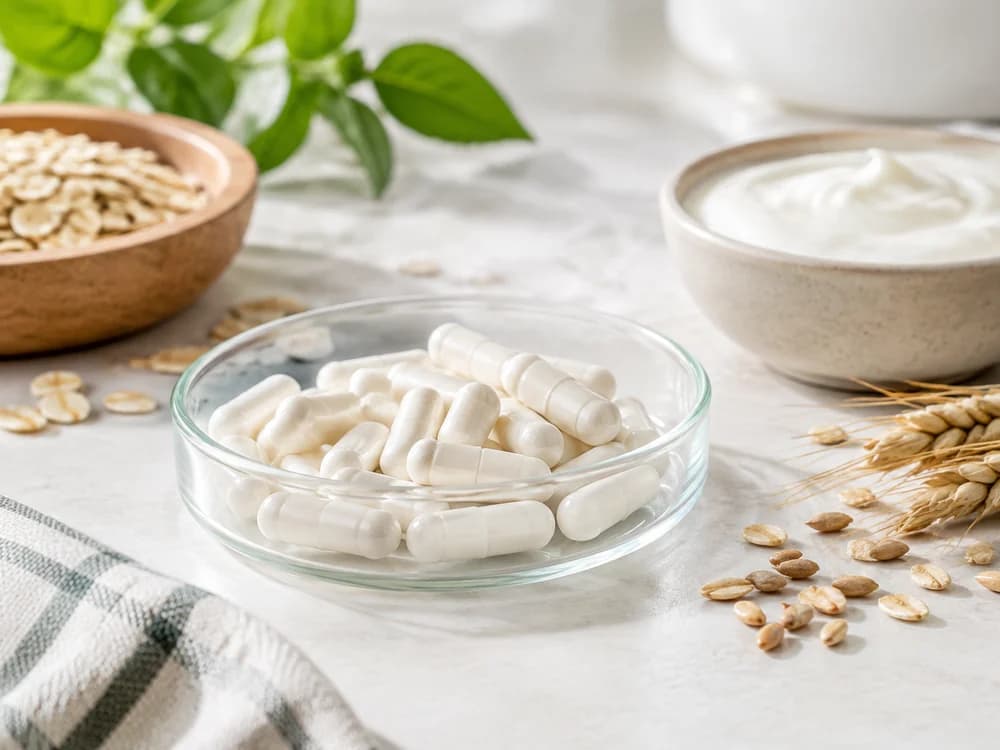
Prebiotics Powder Manufacturer for Retail and Clinical Brands
EUPHM produces prebiotic powders in stick packs, jars and bulk drums. MOQ from 1,000 units per SKU. Samples in 7-10 working days. GMP, ISO 22000, HACCP, halal certified.
Overview
Sourcing a prebiotics powder manufacturer means matching ingredient forms, doses and packaging to your market. This page covers what we run at our Guangdong plant: inulin, FOS, GOS, XOS and resistant dextrin, plus synbiotic blends with probiotic strains. Retail bottling starts at 1,000 units per SKU, with lower thresholds for pilot runs. Mass production takes 20-35 working days after approved samples.
Powder Production Capacity and Formats
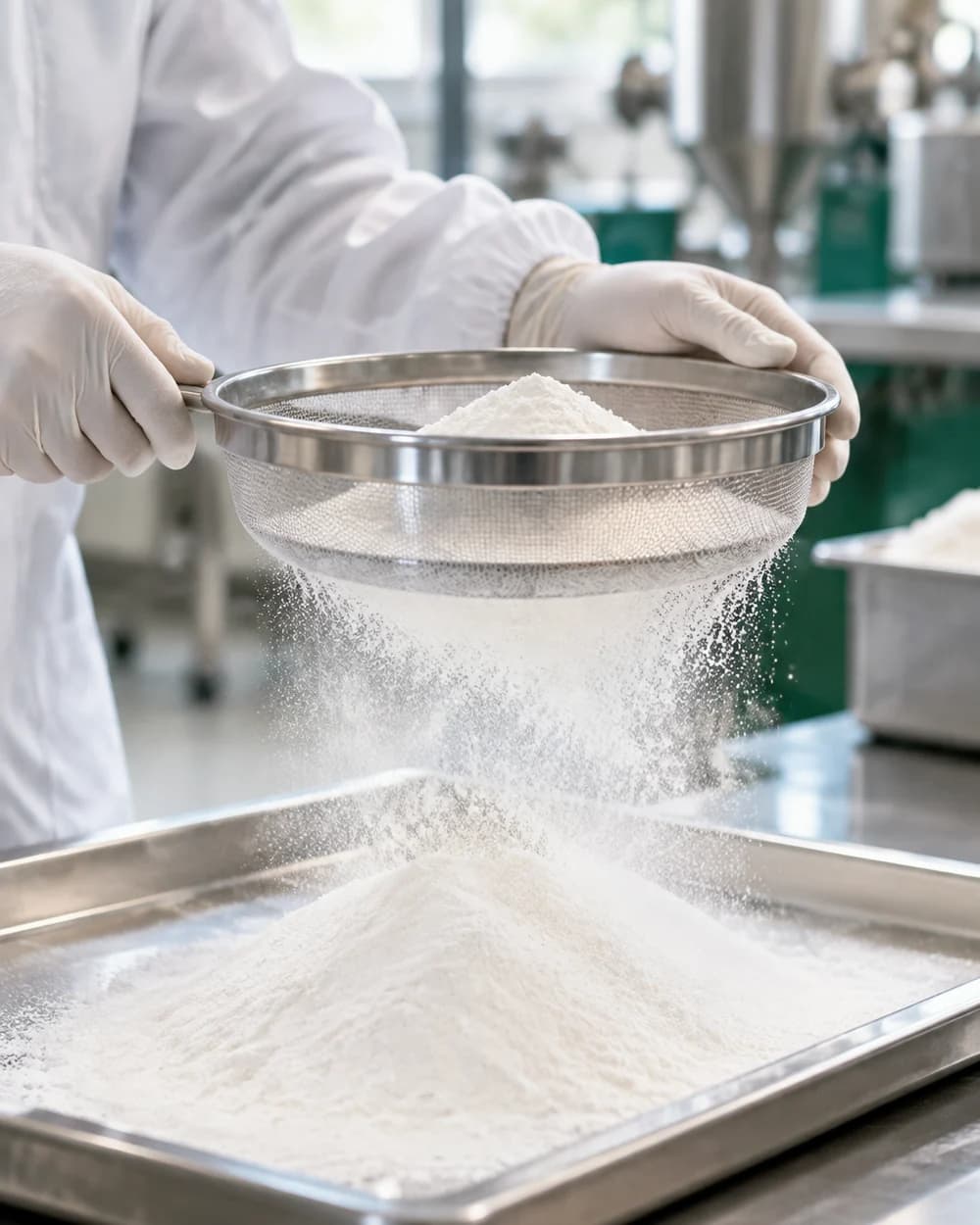
Our Guangdong plant runs two blending lines with 500 kg and 1,000 kg batch capacities. Stick pack lines fill 3 g to 8 g at 400-600 units per minute. Jar filling handles 100 g to 300 g at 60-80 units per minute. Bulk drums ship at 20 kg net weight. We blend prebiotic fibres with sweeteners, flavours, vitamins and minerals in the same batch, so you receive a finished powder rather than a base that needs further processing.
For brands scaling from pilot to retail, we hold 1,000-unit MOQs on standard stick pack formats. Pilot runs below that threshold are possible with manual filling, typically 500–1,000 units. Changeover between SKUs takes 4-6 hours, which keeps small runs viable. Lead time from PO to ex-factory is 20-35 working days, depending on ingredient availability and packaging components.
Prebiotic Ingredients and Formulation Support
We work with inulin from chicory root, fructo-oligosaccharides (FOS), galacto-oligosaccharides (GOS), xylo-oligosaccharides (XOS), resistant dextrin and partially hydrolysed guar gum. Standard doses range from 3 g to 8 g per serving. For synbiotic products, we blend prebiotic fibres with probiotic strains such as Lactobacillus and Bifidobacterium, targeting 1-10 billion CFU per stick pack. Flavour systems cover unflavoured, citrus, berry, vanilla and tropical profiles.
Formulation support includes pH and water activity testing, solubility checks and accelerated stability at 40°C/75% RH for 3-6 months. We can match an existing competitor profile or develop from a brief. Taste trials use 3-5 flavour variants per round. For organic claims, we source and EU organic certified inulin and acacia fibre, with full traceability documents from supplier to finished lot.
Quality, Compliance and Export Logistics
Every batch is tested for heavy metals, microbiology, moisture and label claim potency. We operate under GMP, ISO 22000 and HACCP. Halal certifications are maintained for relevant lines. Our facility is FDA-registered for US export. Documentation includes Certificate of Analysis, MSDS, allergen statements, and organic transaction certificates where applicable. Retain samples are held for 24 months.
We ship FOB Shenzhen and Yantian, with air freight for urgent orders. Typical sea transit is 18-28 days to US West Coast, 28-35 days to EU ports, and 12-20 days to Middle East hubs. Packaging components can be sourced locally or supplied by you. We handle labelling for US, EU and GCC markets, including nutrition panels and allergen declarations. MOQ for bulk drums is 500 kg per ingredient.
Quality Control and Batch Documentation
Every prebiotic powder batch is tested at three points: incoming raw material, in-process blend, and finished pack. Identity is confirmed by FTIR against a retained reference spectrum, and potency (for example inulin content or FOS purity) by HPLC. Microbial testing covers total aerobic count, yeast and mould, E. coli, Salmonella and Staphylococcus aureus. Heavy metals (lead, arsenic, cadmium, mercury) are screened by ICP-MS to EU and US limits. For stick packs we also check fill weight and seal integrity at the start, middle and end of each shift.
The certificate of analysis (COA) issued with each batch lists the product name, batch number, manufacturing date, expiry date, tests performed, specification limits, results and a pass/fail statement. It is signed by the QC manager and references the analytical methods used. A separate allergen and non-GMO statement is available on request. We retain samples from every batch for 24 months in a temperature-controlled archive, so a customer can request a re-test if a market authority raises a query after delivery.
Stability follows a standard protocol: accelerated storage at 40°C and 75% relative humidity for six months, with checks at 0, 1, 2, 3 and 6 months for appearance, moisture, potency and microbial count. Real-time studies at 25°C and 60% relative humidity run in parallel for products with a 24-month shelf life. Results are summarised in a stability report you can attach to your product development file. Moisture pick-up is the main risk for prebiotic fibres, so we specify foil-laminated stick packs and desiccant sachets where needed.
Packaging, Labelling and Retail Readiness
For retail bottling we run HDPE jars from 100 g to 300 g with induction seals and child-resistant caps where required, plus PET jars for clear presentation. Stick packs are three-side sealed in foil laminate at 3 g, 5 g and 8 g fill weights; sachets are available in paper-foil laminates for single-serve clinical packs. Bulk orders ship in 20 kg food-grade drums with double LDPE liners. We can apply lot numbers and expiry dates by inkjet or laser on the primary pack, and by thermal transfer on cartons.
For US dietary supplement labels we set up the Supplement Facts panel with the correct serving size, amount per serving, % daily value where applicable and the mandatory allergen statement. We do not write your structure/function claims, but we check that the label layout leaves space for the disclaimer you supply. EU labels follow Regulation 1169/2011 for nutrition declaration and allergen highlighting, with the responsible person address on pack. Middle East markets often require Arabic and English side by side, and we can lay out both panels in one artwork file.
Cartons are specified to your retail or Amazon requirement: standard 5-ply corrugated with a maximum gross weight of 15 kg for manual handling, or 20 kg for palletised freight. Pallet configuration is 1,200 x 1,000 mm or 1,200 x 800 mm, stretch-wrapped and corner-boarded. For Amazon FBA we print and apply FNSKU labels and poly-bag units where the listing requires it, and we can build cartons to the 23 kg FBA limit. Retail compliance checks cover barcode scannability (EAN-13 or UPC-A) and carton marking with lot, expiry and country of origin.
MOQ, Lead Times and Delivery
Sampling starts with a brief: ingredient forms, target dose per serving, pack format and market. We send stock samples of inulin, FOS, GOS, XOS or resistant dextrin within 3 working days, or develop a custom blend and send it in 7-10 working days. Sample costs are credited against the first production order. Once you approve the sample and artwork, we issue a proforma invoice and start production on receipt of the deposit, normally 30% of order value.
Mass production takes 20-35 working days after sample approval and purchase order, depending on whether the run is bulk powder or finished sticks. Bulk blending is at the shorter end; stick packing and retail bottling at the longer end. We confirm a production slot in writing and send weekly progress updates. If your launch date is tight, we can quote air freight for part of the order and sea freight for the balance, so retail packs arrive first and bulk stock follows.
We ship EXW, FOB Shenzhen or DDP to your warehouse, depending on your preference. Sea freight to US west coast ports takes 18-25 days; to Rotterdam or Felixstowe 28-35 days; to Jebel Ali 20-26 days. Air freight is 5-8 days door to door. Documents provided with each shipment include commercial invoice, packing list, bill of lading or air waybill, certificate of analysis, MSDS where applicable, free-sale certificate and, for plant-derived fibres, a phytosanitary certificate if the destination requires it.
What We Can Build
Stick packs and sachets
3 g, 5 g or 8 g single-serve sticks. Ideal for daily prebiotic supplements. MOQ 1,000 units. Nitrogen flushing available for oxygen-sensitive blends.
Retail jars and tubs
100 g, 200 g and 300 g PET or HDPE jars with induction seals. Suitable for scoop-serve prebiotic powders. MOQ 1,000 units per SKU.
Bulk drums for repackaging
20 kg food-grade drums with double polyethylene liners. For brands that fill locally or blend with other ingredients. MOQ 500 kg per ingredient.
Synbiotic blends
Prebiotic fibres combined with 1-10 billion CFU probiotic strains per serving. Requires cold-chain or desiccant packaging for stability.
How We Work
- 01
Share your brief
Send target ingredients, doses, fill weight, packaging format and market. We confirm feasibility and quote within 2 working days.
- 02
Sample development
We produce a lab-scale sample in 7-10 working days. Includes flavour and texture trials. You approve or request adjustments.
- 03
Quotation and PO
Final pricing based on confirmed formula, packaging and quantity. MOQ 1,000 units for retail. We issue a proforma invoice.
- 04
Raw material sourcing
We order prebiotic fibres, excipients and packaging components. Lead time 5-15 working days depending on ingredient origin.
- 05
Production and QC
Blending, filling and testing run over 20-35 working days. Batch records, CoA and retain samples are prepared for release.
- 06
Shipping and documents
We arrange FOB Shenzhen or air freight. Documents include CoA, MSDS, allergen statement and certificates of origin.
Why EUPHM
Low MOQ for testing
Start at 1,000 units per SKU. Pilot runs as low as 500 units with manual filling. Scale to 50,000+ units without changing supplier.
Certified for global retail
GMP, ISO 9001, ISO 22000, HACCP, NSF/ANSI 455-2 and halal certification; FDA facility registration for US-bound shipments.
Formulation depth
In-house blending of fibres, probiotics, flavours and sweeteners. Stability testing and label claim support included in development.
Questions buyers ask.
What is the MOQ for custom prebiotic powder sticks?+
MOQ is 1,000 units per SKU for retail stick packs and jars. For pilot runs, we can produce 500–1,000 units using manual filling at a higher per-unit cost. Bulk drums start at 500 kg per ingredient. MOQ depends on packaging format and whether we source custom components.
Can you blend prebiotics with probiotics in one stick pack?+
Yes. We produce synbiotic blends with 1-10 billion CFU per stick pack. Stability depends on water activity and packaging. We recommend desiccant sachets or nitrogen flushing. Accelerated testing at 40°C/75% RH for 3-6 months confirms shelf life before commercial production.
Which prebiotic fibres do you stock regularly?+
We hold chicory inulin, FOS, GOS, XOS, resistant dextrin and partially hydrolysed guar gum. Organic inulin and acacia fibre are available with USDA and EU organic certificates. Non-standard fibres can be sourced with 10-15 working days lead time.
How long does production take after I approve the sample?+
Mass production runs 20-35 working days from PO and sample approval. This covers raw material ordering, blending, filling, QC testing and packing. Air freight adds 3-7 days to US or EU. Sea freight adds 18-35 days depending on destination port.
Do you provide labelling for US, EU and Middle East markets?+
Yes. We prepare nutrition panels, allergen declarations and ingredient lists for US FDA, EU 1169/2011 and GCC standards. You remain responsible for final regulatory review in your market. We supply CoA, MSDS, halal and organic certificates with each shipment.
Can you supply prebiotic powder with a specific degree of polymerisation or fibre content?+
Yes. For inulin we can source standard or high-DP grades, typically 10-60 DP for chicory root fibre, and for FOS we work with 95% purity. GOS is supplied at 70% or 90% syrup or powder, and XOS at 95% powder. We ask for your target fibre content per serving and confirm the specification against a COA before you approve the sample. If your market requires a specific analytical method, tell us at the brief stage.
Do you offer organic or non-GMO prebiotic powder, and what documentation supports it?+
We can quote and EU organic grades for inulin and FOS where the supply chain is certified. Non-GMO status is supported by a supplier declaration and, where available, a PCR test report for the specific raw material. Organic certification documents are issued in the name of the certificate holder, so we confirm at quotation whether your brand can be named on the transaction certificate. Allow an extra 5-7 working days for organic documentation.
What is the shelf life of your prebiotic powder and how should it be stored?+
Sealed bulk drums and foil stick packs carry a 24-month shelf life from the manufacturing date when stored below 25°C and 60% relative humidity, away from direct sunlight. HDPE jars typically carry 18-24 months depending on the fibre. Once a jar is opened, we recommend use within 60 days and storage with the cap tightly closed. We include storage conditions on the label and in the COA, and we can run a stability study to support a longer date if your market allows it.
Have a product in mind?
Send us the brief and we will come back with a formulation direction, indicative price and a realistic lead time — usually within one working day.