
How to Audit a Supplement Factory Remotely
You do not need a plane ticket to disqualify a bad factory. You need a document pack, a 45-minute live walkthrough with a fixed shot list, one complete batch record, and the discipline to check certificate numbers against the issuing body's own registry.
Overview
Most first-time buyers audit a factory by asking for photos and a certificate PDF, then book a flight. Photos show what the factory wants you to see, and a PDF proves a certificate existed on the day it was scanned. A remote audit done properly is cheaper and, if you sample the right documents, harder to fake than a two-day site visit arranged by the sales team. This is the sequence we suggest to buyers who audit us, and the same sequence we would use on any plant in China, India or Eastern Europe.
Start with the document pack, not the video call
Ask for six things before anyone gets on a call: business licence, GMP certificate with its scope annex, the three most recent certificates for products similar to yours, an organisation chart that names who owns quality, the allergen and pest-control policy, and two COAs from commercial batches. A real factory sends these in a day because they already exist. A trading company posing as a factory takes a week, sends a licence for a different address, and cannot produce a COA that matches its own batch numbering.
Read the scope annex, not just the certificate cover. GMP and ISO certificates list the product categories and processes the site is actually certified for. A plant certified for capsules and tablets is not automatically certified for gummies or effervescents, even if the sales team says they can run them. Compare the certified address with the address on the business licence and on the COA. If three documents show three addresses, ask which one the batch was made in.
The video walkthrough: fix the shot list in advance
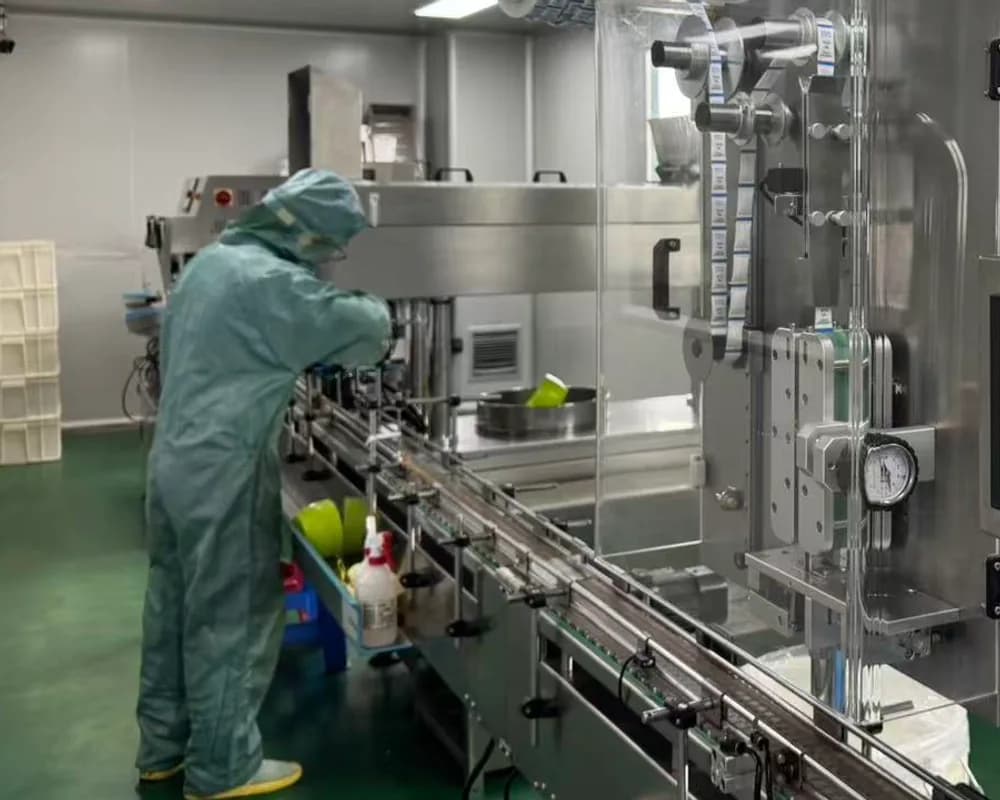
A recorded walkthrough is marketing. A live call where you choose the route is evidence. Tell them you want to start at goods-in and follow the material, not start at the showroom. Ask to see the receiving log and the quarantine area, then the weighing booth with the scale calibration sticker visible, then the production room in operation with people dressed for it, then the packaging line, then the finished-goods quarantine, then the retained-sample room, then the QC lab with instruments switched on.
Three details separate a working plant from a staged one. First, ask them to open a random bin in the warehouse and read the lot number and expiry out loud — then ask for the matching record later. Second, ask what the room pressure and humidity are right now, and whether anyone logs it. Third, ask to see the cleaning status board and a changeover in progress. Anyone can film clean equipment; only a running factory can show you the paperwork that goes with it.
Read one batch record end to end
The batch record is the only document that proves the product was made the way the certificate says. Ask for one complete record — not a summary page — and read it in this order: batch number and date, every ingredient with its supplier lot, the actual weights against the theoretical, each in-process check with the result and the initials, the yield against the expected range, the QC release signature, and any deviation with its investigation and disposition.
Two things are worth more than the rest. Deviations: a factory with zero deviations in a year is either perfect or not recording them, and the second is more likely. Ask to see one deviation report and how it was closed. Yield: if the actual yield sits outside the stated range and the batch was released anyway, the record tells you how seriously the site treats its own specification. If they will not send a full record before you place an order, that is your answer.
Verify certificates against the issuer, not the PDF
Every certificate has an identity beyond its logo: a certificate number, an issuing body, a scope, a facility address and an expiry date. Copy the number, then look it up in the issuing body's public registry, or email the address on their own website — never the address printed on the certificate. Registrar Corp, NSF, SGS, Bureau Veritas and Intertek all publish verification routes. A CQC certificate can be checked through CQC's own query service.
Watch the dates. A certificate that expired eight months ago is still a valid PDF. A scope that covers dry blending but not tablet compression is a real certificate describing a smaller capability than the sales deck claims. And a certificate issued to a different legal entity at the same address is normal in China — group structures are common — but you should ask for the relationship in writing, because your contract needs to be with the entity that actually holds the licence.
What a COA can and cannot prove
A COA is a claim about one lot. It proves the lot was tested against a specification; it does not prove the specification is right, that the method was suitable, or that the sample came from the material you will receive. Check that the COA names the lot, the test methods, the specification limits and the actual results, and that the report was issued by a laboratory with an accreditation number you can look up.
If a result is reported as less than a limit, ask for the limit of quantification. A heavy-metal result written as less than 10 ppm tells you almost nothing; less than 0.5 ppm with a named method tells you the lab can actually see the number. For a first order, pay for one independent test on the finished product from a lab you chose, and compare it to the factory's COA. If the two disagree, you have learned something important before the pallet ships, not after.
Red flags that end the call
Any one of these is a reason to stop: they will not send a full batch record before an order; the certificate address does not match the production address and nobody can explain it; the video call is a scripted tour with a fixed camera; the COA has no lot number or no method; they quote a lead time shorter than the drying or stability step physically allows; they offer to print a certificate or COA from another factory; they cannot name their QC manager.
None of this requires hostility. Ask plainly, write down the answers, and compare them with the documents two days later. Consistency across a licence, a certificate, a batch record and a live camera is hard to fake and easy to check — which is exactly why it is the cheapest audit you can run.
Four ways to verify a factory
Document pack first
Licence, GMP scope, three COAs and the allergen policy. Cheapest filter, kills half the shortlist in a day.
Live video walkthrough
45–60 minutes, your route, your shot list. Ask for a bin to be opened at random.
Third-party inspection
SGS, Bureau Veritas or Intertek on site before shipment. Costs a few hundred dollars, buys a written report.
Sample and independent test
Order a sample, send it to a lab you chose, compare the result with their COA.
The order we suggest
- 01
Request the pack
Six documents, one email. Note how long the reply takes and whether the addresses agree.
- 02
Book the walkthrough
Send your shot list in advance so nobody can claim the route was impossible.
- 03
Sample two batch records
One recent, one a year old, plus a deviation report. Read the yield and the initials.
- 04
Verify the certificates
Number, scope, address, expiry — checked at the issuer, not on the PDF.
- 05
Test the sample yourself
One independent lab report on the finished product before the first pallet.
Why EUPHM
No wasted flights
Most disqualifications happen on paper, before anyone books a ticket.
Comparable quotes
The same document pack from three factories shows who is actually certified for your format.
A paper trail for your buyer
If your retailer or distributor asks how you vetted the plant, you have the file.
Questions buyers ask.
Can a factory fake a batch record?+
It can, but faking a consistent set is expensive. Check that the batch number appears on the COA, the label record and the retained-sample log, and that the ingredient lot numbers trace to supplier certificates. Inconsistency between four documents is the usual tell.
Do I need to visit in person for a first order?+
Not necessarily. A document pack, a live walkthrough, two batch records and one independent lab test catch most problems. An in-person visit is worth it once you are placing repeat orders or committing to a custom mould.
Which certificates actually matter?+
For a US-bound dietary supplement, GMP compliance and an FDA facility registration matter most, followed by NSF/ANSI 455-2 if your buyer requires it. ISO 9001 and ISO 22000 show management systems. Halal and kosher matter only if you sell into those markets.
How do I check a GMP certificate number?+
Use the issuing body's own online query service or email the address published on their website. Do not use contact details printed on the certificate itself, because those can be altered in a PDF.
What if the factory refuses to share a batch record?+
Offer to sign an NDA and accept a redacted record with the customer name removed. A refusal with no alternative usually means the record does not exist in the form you asked for.
Is a trading company always a bad sign?+
No, but the contract, the certificate and the batch record must all point to the same plant. Many good exporters are trading companies that work with two or three certified factories. Ask which plant will make your batch, in writing.
How much does a third-party inspection cost?+
Typically a few hundred to about a thousand US dollars for a one-day inspection, depending on the agency and the scope. It is cheap relative to a rejected container.
What should the first sample test cover?+
Assay of the active, uniformity, microbial limits, heavy metals, and dissolution if you make a tablet or capsule claim about release. Ask the lab to report the method and the limit of quantification.
Xu Wei writes the manufacturing, quality and regulatory guides on EUPHM. He works directly with the plant's production and QA teams to document how each dosage form is made, tested and released, so every claim on the site can be traced back to a batch record or a certificate on file.
More guides in this category.
See all →
How to Choose a Supplement Manufacturer: A 2026 Buyer's Guide
A practical checklist for vetting supplement manufacturers in 2026: certificate scope, dosage-form fit, true landed cost, sample validation, batch records and the red flags to walk away from.
Read the guide →
From Sample to Mass Production: A Buyer's Guide
Moving from a sample to mass production involves clear steps: sample approval, deposit, raw material sourcing, production scheduling, quality checks, and shipping. Each stage has defined timelines and costs. This guide covers the process for dietary supplements.
Read the guide →
How to Get GMP Certified for Dietary Supplements
GMP certification is not a single certificate. It is an audit trail covering facility, documentation, testing and batch release. Here is the sequence brand owners follow when building that trail from scratch.
Read the guide →Have a product in mind?
Send us the brief and we will come back with a formulation direction, indicative price and a realistic lead time — usually within one working day.