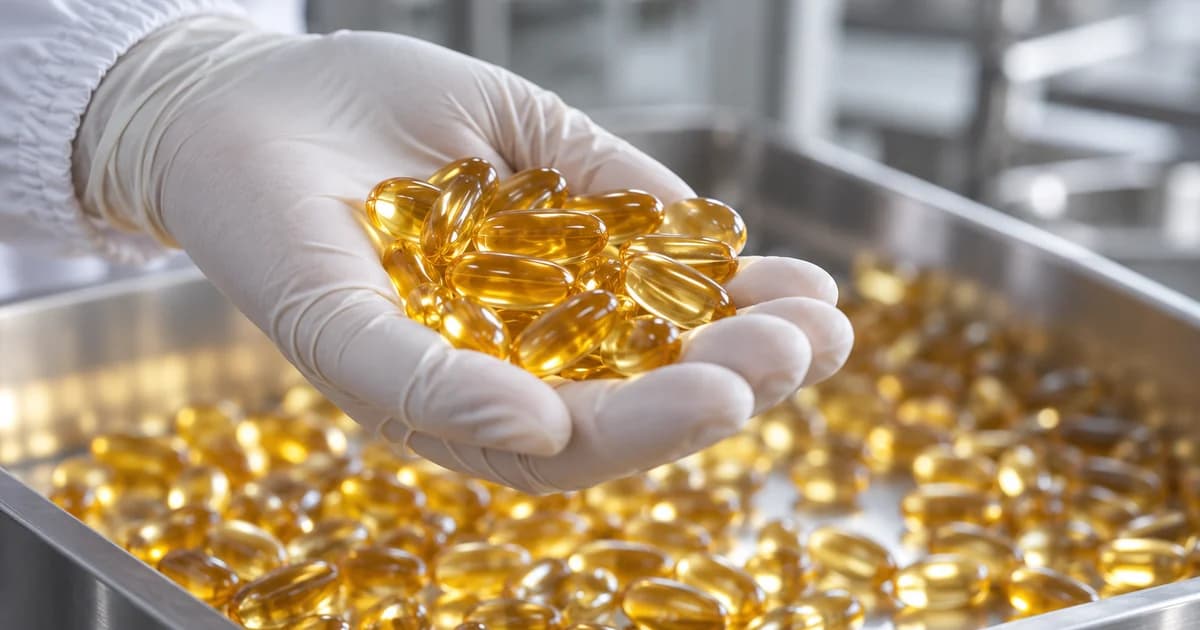
How Softgels Are Made: A Sourcing Guide for Brands
Softgels are one-piece capsules formed, filled and sealed in a single rotary die process. This guide covers the gelatin shell, fill formulation, encapsulation tolerances, quality checks and the MOQs and lead times buyers should plan for.
Overview
Softgels suit oils, emulsified actives and low-dose ingredients that need protection from oxygen and light. The process is continuous rather than batch-by-batch: two ribbons of molten shell mass meet on a cooled drum, fill is injected between them, and the die cuts and seals each capsule in one rotation. For brand owners, the practical questions are fill weight range, shell composition, compatibility of the fill with the shell, and how long the whole run takes from sample approval to packed cartons.
- MOQ (retail bottling)
- 1,000 units per SKU; lower for pilot runs
- Sample lead time
- 7–10 working days
- Mass production
- 20–35 working days after sample approval
- Typical fill weights
- 150 mg to 1,500 mg per softgel
- Shell options
- Bovine or fish gelatin; starch or carrageenan for vegan
- Certifications
- GMP, ISO 9001, ISO 22000, HACCP, NSF/ANSI 455-2, halal, FDA-registered
Rotary Die Encapsulation: Line Capability
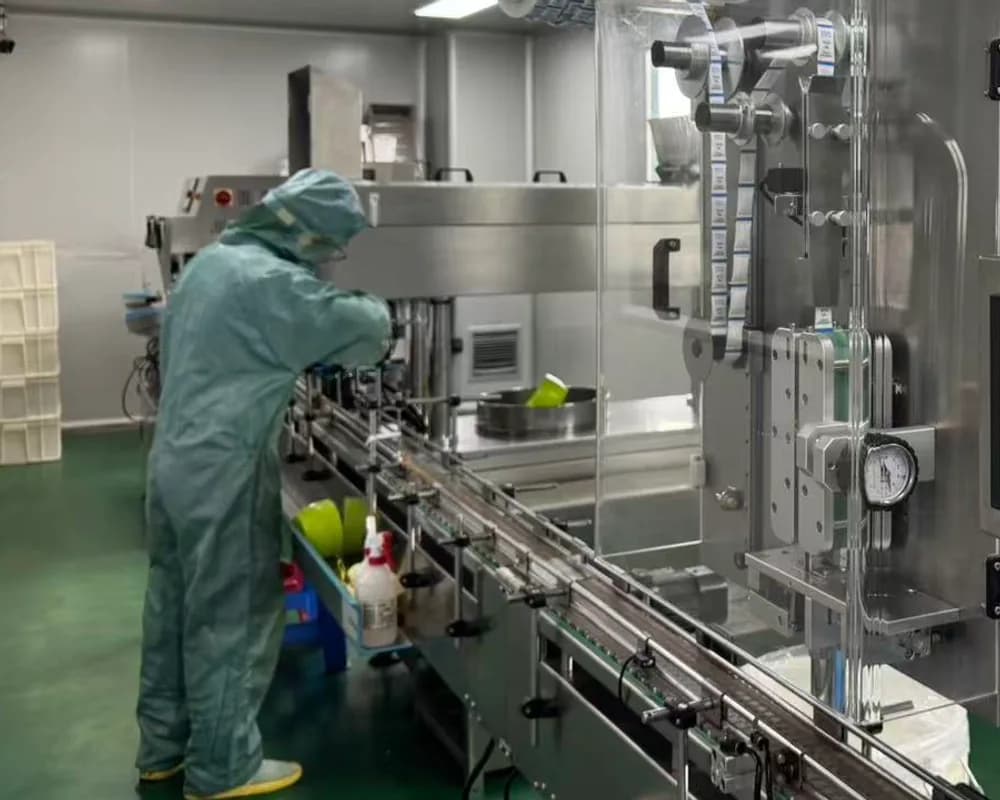
On a rotary die line, gelatin or a vegan gelling agent is melted, de-aerated and spread onto two chilled casting drums to form ribbons roughly 0.6–0.9 mm thick. The ribbons pass over a rotating die roll with capsule-shaped pockets. As the dies meet, a fill pump injects a metered dose between the two ribbons, and the die edges weld the shell closed. The whole cycle runs continuously, so output is measured in capsules per hour rather than per batch.
Capacity depends on capsule size and fill viscosity. Smaller softgels run faster; large 1,200–1,500 mg fish oil softgels run slower because the fill pump needs more time per dose. Standard lines handle oblong, round and oval shapes, with fill weights from about 150 mg to 1,500 mg. Tolerances on fill weight are typically held within ±3–5%, which matters for label claims on actives such as vitamin D or CoQ10. After drying, softgels pass through a tumbler to remove residual surface oil before inspection and packing.
Fill Formulation and Shell Compatibility
The fill decides most of the formulation work. Oil-based fills — fish oil, MCT, vitamin E, CBD — disperse easily and need little more than an antioxidant such as mixed tocopherols. Suspension fills, where a powder is dispersed in oil, require milling to a tight particle size so the powder does not settle or block the fill pump. Emulsified and self-emulsifying systems are used when an active needs better dispersion in the gut, but they add cost and require stability testing.
Shell composition must match the fill. High-water-activity fills can soften gelatin, so a plasticiser adjustment or a starch-based vegan shell is used instead. Enteric softgels use a shell that resists stomach acid and releases in the small intestine; these are harder to seal and usually carry a higher MOQ. For halal claims, the gelatin source and the entire line must be segregated. Vegan shells based on modified starch or carrageenan behave differently on the die, so trial runs are normal before scale-up.
Quality Control and Documentation
In-process checks run throughout the shift: fill weight, shell thickness, seam integrity and capsule dimensions are sampled at set intervals. After drying, softgels are inspected for leaks, deformation and fill migration. A leakage test and a disintegration test confirm the shell performs as intended. For actives with a label claim, assays are run on the finished fill to confirm potency within specification.
Documentation is what most buyers actually need. A GMP-certified, ISO 22000 and HACCP facility issues a certificate of analysis per batch, covering appearance, fill weight, assay, microbial limits and heavy metals. Certificates for halal or vegan status are held at ingredient and finished-product level, depending on the claim. Retain samples are kept for the shelf life of the product. Stability data — typically 24–36 months at 25°C/60% RH, with accelerated conditions — supports the expiry date printed on the label. FDA-registered facility status is relevant for US-bound shipments, but that is registration, not approval.
Batch Testing, COAs and Retention Samples
Every softgel batch is tested at three points: incoming raw materials, in-process fill and shell checks, and finished goods. For the fill, identity and potency are confirmed by HPLC or GC against a reference standard, with microbials (total aerobic count, yeast and mould, E. coli, Salmonella) tested to USP <2021> or equivalent. Heavy metals (lead, arsenic, cadmium, mercury) are screened by ICP-MS to USP <232> limits. Shell and finished capsules are checked for disintegration (USP <701>, typically under 30 minutes for gelatin) and for fill weight uniformity within ±5% of target.
A certificate of analysis (COA) is issued per batch and includes the product name, lot number, manufacture and expiry dates, tests performed with specifications and results, and a statement of conformity. Retention samples of every batch are held for at least two years beyond expiry under controlled conditions (typically 25°C/60% RH or 30°C/65% RH). Stability protocols follow ICH Q1A(R2): accelerated at 40°C/75% RH for six months and long-term at 25°C/60% RH for up to 36 months, with time points at 0, 3, 6, 9, 12, 18, 24 and 36 months as applicable.
Documentation packages are compiled per shipment and include the COA, master batch record extract, deviation reports if any, and a declaration of allergen status. For markets requiring it, a free-sale certificate and GMP certificate are provided. Batch records are retained for five years. If a specification is out of trend, the batch is placed on hold and an investigation is opened before release; the customer is notified in writing with the disposition.
Packaging, Labelling and Retail Readiness
Softgels are typically packed in HDPE bottles (60, 90, 120, 180 or 240 count) with induction seals and child-resistant or standard caps, or in blister packs (PVC/PVDC or alu-alu) for unit-dose or pharmacy channels. Stick packs and sachets are available for single-serve formats, though softgels are less common in sachets than powders. Bottle dimensions and label panel sizes are confirmed at artwork stage. Cartons are specified with lot number and expiry date inkjet-coded on the base and side panel, in a format agreed with the brand (for example LOT 12345, EXP 2027-08).
For US retail, the label must carry the statement of identity, net quantity of contents, supplement facts panel with serving size and percent daily value where applicable, ingredient list, and the address of the manufacturer or distributor. The FDA does not pre-approve labels, but structure/function claims must include the disclaimer. For Amazon, FNSKU labels are applied over the barcode or printed on the carton, and poly-bagging with a suffocation warning is required for loose bottles. We can print and apply FNSKU labels in-house.
Carton specifications are agreed per SKU: typically 12, 24 or 48 bottles per shipper, with gross weight and dimensions stated on the packing list. Pallets are built to 1,200 x 1,000 mm or 1,200 x 800 mm, stretch-wrapped and corner-boarded, with a maximum height of 1.8 m for sea freight or 1.6 m for air. Pallet labels include SSCC, batch and quantity. Retail compliance checks cover barcode scannability (GS1), nutrition rounding rules, and country-specific requirements such as the UK's novel food status or the EU's health claims register.
Softgel MOQ, Lead Times and Delivery Terms
Sampling starts with a brief and formulation review. Prototype samples are typically ready in 7–10 working days; if a new shell colour or custom shape die is required, add 10–15 working days for tooling. Sample approval is confirmed in writing against a signed specification. Mass production then runs 20–35 working days after approval and receipt of deposit, depending on fill complexity, shell type and packaging format. Pilot runs below standard MOQ are possible at a higher unit cost, with MOQ set at 1,000 units per SKU for retail bottling.
Shipping is by air or sea. Air freight from Guangdong to the US or EU typically takes 5–8 days door-to-door; sea freight to the US West Coast is 18–25 days port-to-port, and to Europe 28–35 days. Incoterms offered are EXW, FOB (Shenzhen or Hong Kong), and DDP for selected destinations. DDP includes duties and customs clearance but requires an accurate HS code and product description; we confirm these at order stage. For DDP, the buyer remains the importer of record for regulatory purposes.
Documents provided per shipment include commercial invoice, packing list, bill of lading or air waybill, COA per batch, MSDS where applicable, free-sale certificate, and GMP certificate. Phytosanitary certificates are not normally required for softgels but can be arranged for gelatin of animal origin if the destination requires it. Certificate of origin (Form A, Form E or general CO) is available on request. We recommend booking sea freight at least three weeks before the requested ship date to secure space.
Packaging and Format Choices
Oblong softgels
The default for fish oil, vitamin D and CoQ10. Fill weights 300–1,200 mg, easy to swallow and widely accepted by retailers.
Round softgels
Compact shape for smaller doses such as vitamin E or CBD. Fill weights 150–600 mg, often used where a smaller capsule matters.
Enteric softgels
Shell resists stomach acid and releases in the intestine. Higher MOQ and longer development because sealing is more demanding.
Vegan softgels
Starch or carrageenan shell instead of gelatin. Suitable for vegan and some halal claims, with trial runs before scale-up.
How a Project Runs
- 01
Brief and feasibility
Share the fill, target dose and shell preference. The team confirms whether the formulation runs on the line and flags any compatibility risks.
- 02
Sample production
Samples are made in 7–10 working days. You receive softgels for appearance, fill weight and disintegration checks before committing.
- 03
Sample approval
You sign off on the sample, shell, colour and fill weight. Any changes after this point restart the sample clock.
- 04
Scale-up and production
Mass production runs 20–35 working days after approval, depending on capsule size, fill and line scheduling.
- 05
QC and release
In-process and finished-goods testing confirm fill weight, assay, microbial limits and heavy metals. A certificate of analysis is issued.
- 06
Packing and shipping
Softgels are packed into bottles or blister packs, labelled and prepared for export with the documentation your market requires.
Why EUPHM
Pilot runs before scale
Lower MOQs on pilot runs let you test a formula without committing to a full 1,000 unit retail batch.
Certification coverage
GMP, ISO 9001, ISO 22000, HACCP, NSF/ANSI 455-2 and halal certification; FDA facility registration for US-bound shipments.
One process, one partner
Fill formulation, encapsulation, QC and packing sit in one facility, which shortens the path from sample to shelf.
Questions buyers ask.
What is the minimum order quantity for softgels?+
For retail bottling, MOQ is 1,000 units per SKU. Pilot runs can go lower so you can test a formulation before committing to a full batch. The exact figure depends on capsule size, fill complexity and whether the shell is standard gelatin or a vegan alternative.
How long does it take to make softgels?+
Samples take 7–10 working days. Mass production runs 20–35 working days after sample approval. That window covers encapsulation, drying, QC and packing. Add time for label printing or custom packaging if you need it.
Can softgels be made without gelatin?+
Yes. Vegan softgels use modified starch or carrageenan as the gelling agent instead of gelatin. They behave differently on the die, so a trial run is standard before scale-up. Vegan shells can also support some halal claims, depending on the full ingredient list.
What fill weights are possible?+
Typical fill weights range from about 150 mg to 1,500 mg per softgel. Smaller rounds suit low-dose actives; oblongs handle fish oil and larger oil fills. Fill weight tolerance is usually held within ±3–5%, which matters for label claims on vitamins and other actives.
Are your softgels FDA approved?+
No dietary supplement facility is FDA approved. EUPHM operates an FDA-registered facility and holds GMP, ISO 22000 and HACCP certification. FDA registration means the facility is listed with the agency; it is not an approval of products or processes.
Do you provide stability data for softgels, and how long is the shelf life?+
Yes. We run ICH Q1A(R2) stability studies: accelerated at 40°C/75% RH for six months and long-term at 25°C/60% RH. Shelf life is assigned based on the long-term data available at the time of release, typically 24 months for standard oil fills, with a commitment to extend to 36 months once data supports it. The COA states the assigned expiry date, and stability summaries are available under NDA.
Can you handle Amazon FNSKU labelling and retail-ready packaging?+
Yes. We apply FNSKU labels in-house, either over the existing barcode or printed directly on the carton, and can poly-bag bottles with a suffocation warning. We also confirm GS1 barcode scannability and check the supplement facts panel against US labelling rules. Retail-ready cartons, display-ready pallets and SSCC pallet labels are available. Artwork proofing is done before production, and a signed proof is required before we print.
What Incoterms do you offer, and which documents are included?+
We offer EXW, FOB Shenzhen or Hong Kong, and DDP for selected destinations. Each shipment includes commercial invoice, packing list, bill of lading or air waybill, COA per batch, MSDS where applicable, free-sale certificate and GMP certificate. Certificate of origin and phytosanitary certificates can be arranged on request. For DDP, we confirm HS codes and import requirements at order stage; the buyer remains the importer of record for regulatory purposes.
Xu Wei writes the manufacturing, quality and regulatory guides on EUPHM. He works directly with the plant's production and QA teams to document how each dosage form is made, tested and released, so every claim on the site can be traced back to a batch record or a certificate on file.
More guides in this category.
See all →
Omega-3 Softgels Buyer's Guide: Sourcing, Specs, and Compliance
This guide covers the commercial and technical details of sourcing omega-3 softgels: fill weights, EPA/DHA ratios, oxidation control, and lead times from a GMP-certified plant in Guangdong.
Read the guide →
Enteric-Coated Softgels Explained for Brand Owners
Enteric-coated softgels delay release until the intestine, protecting acid-sensitive actives and reducing gastric irritation. This guide covers polymer options, fill weights, and manufacturing parameters for brands sourcing a contract partner.
Read the guide →Have a product in mind?
Send us the brief and we will come back with a formulation direction, indicative price and a realistic lead time — usually within one working day.