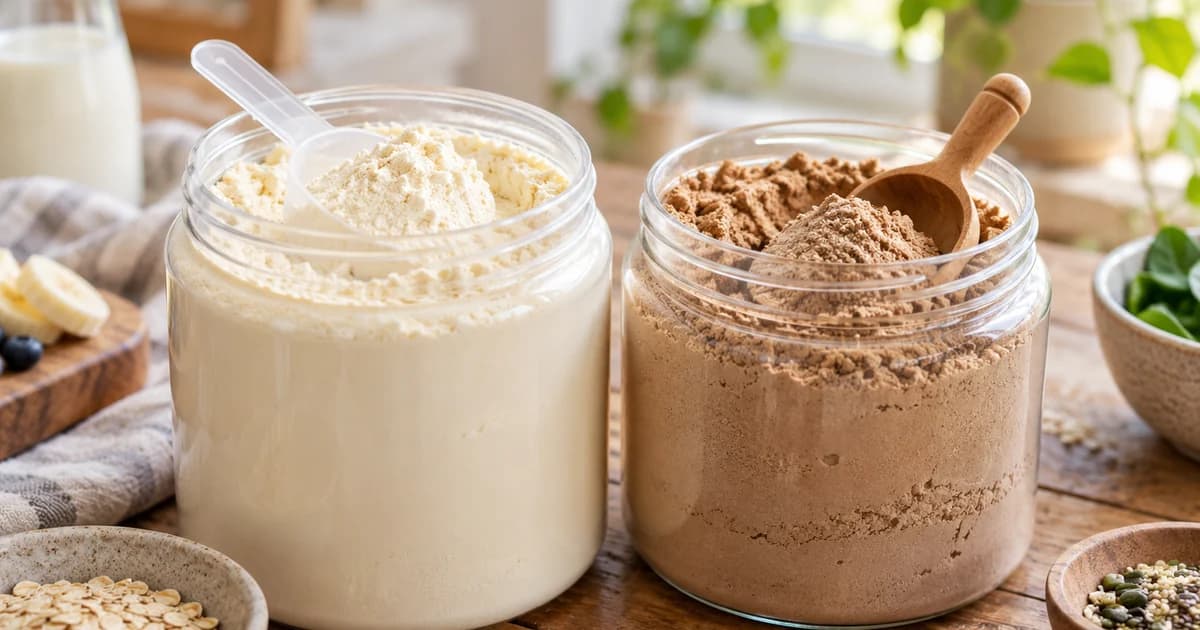
Whey vs Plant Protein: A Sourcing Guide for Brands
Choosing between whey and plant protein affects formulation, cost, and compliance. This guide compares both for brands sourcing a contract manufacturing partner in the US, EU, UK and Middle East.

Overview
Whey and plant proteins differ in amino acid profile, taste, texture, and regulatory handling. Your choice shapes MOQ, lead time, and certification needs. This overview covers key parameters for retail-ready protein powders, from pilot runs of 1,000 units to mass production of 20,000+ units, so you can brief your manufacturer with confidence.
| MOQ (retail bottling) | 1,000 units per SKU |
|---|---|
| Sample lead time | 7–10 working days |
| Mass production | 20–35 working days after sample approval |
| Fill weights | 1 lb to 5 lb (454 g–2.27 kg) tubs; 20 g–50 g sachets |
| Certifications | GMP, ISO 9001, ISO 22000, HACCP, NSF/ANSI 455-2, halal, FDA-registered |
| Line capacity | Up to 2,000 units per hour on automated filling lines |
Capability: Producing Whey and Plant Proteins
A GMP-certified plant handles both protein types on separate, dedicated lines to avoid cross-contact. Whey requires temperature-controlled blending to protect heat-sensitive fractions; plant proteins need humidity control below 45% RH to prevent clumping. Filling speeds reach 2,000 units per hour for 2 lb tubs. Changeover between SKUs takes 4–6 hours, including full cleaning and allergen swab testing.
For pilot runs, expect 1,000 units per SKU. Scale to 20,000+ units for mass production. Lead times: 7–10 working days for samples, 20–35 working days for full runs after approval. Capacity is 500,000 units per month across two shifts. Warehousing holds up to 10,000 pallets for staged releases.
Formulation: Whey vs Plant Protein Differences
Whey isolate delivers 90% protein by weight, with a complete amino acid profile and high leucine content (10–12%). It dissolves clear and mixes thin. Plant blends—pea, rice, soy—typically reach 70–80% protein and need flavour masking for earthy notes. Pea protein alone is low in methionine; combine with rice to balance. Vegan certifications require no animal-derived carriers or lubricants.
Cost per kilogram: whey isolate runs $18–$28; pea isolate $12–$20; organic pea $22–$35. Flavouring systems add $0.50–$1.50 per unit. For a 2 lb tub at 25 g protein per serving, expect 30–36 servings. Moisture content must stay below 6% for shelf life of 24 months. EUPHM can run both protein types on the same site, simplifying dual-SKU launches.
Quality and Compliance for Global Markets
Both protein types require heavy metal testing (lead, cadmium, arsenic, mercury) and microbial panels. Whey needs allergen labelling for milk; plant proteins may need soy or gluten declarations. For the EU, follow Regulation 1169/2011; for the US, FDA-registered facility labelling with Supplement Facts. Halal certifications apply to both, but plant proteins often need vegan verification.
Batch records are retained for 5 years. Certificates of analysis (CoA) ship with every lot. Third-party testing costs $300–$600 per SKU. Lead times for certified organic or halal runs add 5–7 working days for documentation. Shipping from Guangdong to Rotterdam takes 28–32 days; to Los Angeles 18–22 days. DDP terms available.
Quality Control and Batch Documentation
Every batch of whey or plant protein is tested at three stages: incoming raw material, in-process blend, and finished goods. Identity testing confirms protein source (for example, whey protein isolate versus concentrate) via FTIR or ELISA. Potency is verified by Kjeldahl or Dumas nitrogen analysis, with protein content typically specified at 80% or 90% on a dry basis. Microbial testing covers total plate count, yeast and mould, E. coli, Salmonella, and Staphylococcus aureus, using methods aligned with ISO 6579 and ISO 4833. Heavy metals (lead, cadmium, arsenic, mercury) are screened by ICP-MS against EU or USP limits. For plant proteins, we also test for pesticide residues and, where relevant, gluten contamination.
Disintegration testing applies to tablets or capsules, not powders, so for protein powders the equivalent is solubility and dispersion checks. Each batch is assessed for particle size distribution, bulk density, and mix uniformity. Retention samples of every batch are kept for at least two years beyond shelf life, stored under controlled conditions (20–25°C, 60% RH or as specified). A Certificate of Analysis (COA) is issued per batch and includes the product name, lot number, manufacturing date, expiry date, tests performed, specifications, results, and the signature of the QC manager. COAs are available in English and can be customised to your brand’s specification sheet.
Stability protocols follow ICH Q1A guidelines: accelerated testing at 40°C/75% RH for six months, plus real-time testing at 25°C/60% RH for the declared shelf life. For protein powders, we monitor moisture, protein content, microbial counts, and sensory attributes at 0, 1, 3, 6, 12, 18, and 24 months. If you require a specific shelf life claim, such as 24 months, we can provide supporting stability data. Water activity is kept below 0.6 to inhibit microbial growth, and packaging barrier properties are validated to maintain this throughout the shelf life.
Packaging, Labelling and Retail Readiness
Protein powders are typically filled into HDPE or PET jars with induction seals, or into stand-up pouches with zippers. We offer tubs from 1 lb to 5 lb (454 g–2.27 kg), single-serve sachets from 20 g to 50 g, and stick packs. For sample or travel sizes, we can produce 10 g sachets. Bottles and jars can be supplied in clear, white, or custom colours, with optional shrink sleeves or label printing. All primary packaging materials are food-grade and meet EU 10/2011 and FDA 21 CFR 177 requirements. We can also source and fill your own packaging if you prefer.
Labelling must comply with the destination market. For the US, FDA dietary supplement labels require a Supplement Facts panel with serving size, amount per serving, and % Daily Value for vitamins and minerals. If you make structure/function claims, the disclaimer “This statement has not been evaluated by the Food and Drug Administration” is mandatory. For the EU, Regulation (EU) No 1169/2011 applies, with nutrition declaration per 100 g and per serving. Allergen information must be highlighted (whey contains milk; some plant proteins may contain soy). Lot codes and expiry dates are inkjet-printed on the bottom or back of the container, and we can apply tamper-evident seals.
Cartons are specified to withstand transit: typically 12–24 units per carton, with dimensions and gross weight printed on the side. Pallets are standard 1200×1000 mm or 1200×800 mm, stretch-wrapped and corner-protected. For Amazon FBA, we can print and apply FNSKU labels, poly-bag units if required, and provide carton labelling with box content information. Retail compliance for major chains may require a GS1 barcode and specific carton markings; we can accommodate these. We do not provide retail-ready display units unless specified at quotation stage.
MOQ, Lead Times and Delivery
Sampling for whey or plant protein typically takes 7–10 working days after receipt of your specification and any custom flavour or packaging requirements. Samples are provided free of charge for standard formulations, but you cover courier costs. For custom formulations, a development fee may apply, which is credited against your first production order. Once you approve the sample, we issue a proforma invoice and begin production scheduling. Mass production takes 20–35 working days after sample approval and receipt of deposit, depending on packaging complexity and whether you supply your own components.
Shipping options include air freight (5–10 days door-to-door) and sea freight (25–40 days port-to-port). For urgent orders, express courier is available at higher cost. We quote EXW, FOB Shenzhen or Hong Kong, and DDP for most major markets. DDP includes customs clearance and duties, simplifying logistics for brands without an import entity. We provide a full document set: commercial invoice, packing list, bill of lading or air waybill, Certificate of Analysis, Material Safety Data Sheet (MSDS), and a free-sale certificate. For plant proteins, a phytosanitary certificate can be arranged if your market requires it. Other documents such as certificate of origin or halal certificates are available on request.
Payment terms are typically 30% deposit with the balance against copy of shipping documents, or a letter of credit for larger orders. We recommend booking shipping space at least two weeks before production completion to avoid delays. For repeat orders, lead times can be reduced to 15–25 working days if packaging materials are held in stock. We keep you updated with production photos and a pre-shipment sample if requested. All shipments are insured against loss or damage unless you specify otherwise.
Configurations to Compare
Whey isolate
90% protein, low lactose, fast absorption. Best for clear drinks and lean muscle products. Cost $18–$28/kg. Requires milk allergen labelling.
Whey concentrate
70–80% protein, creamier mouthfeel, lower cost at $12–$20/kg. Contains more lactose and fat. Popular for mass-market gainers.
Pea protein isolate
80–85% protein, hypoallergenic, vegan. Earthy taste needs masking. Cost $12–$20/kg. Combine with rice for complete amino profile.
Brown rice protein
70–80% protein, hypoallergenic, mild flavour. Low in lysine; blend with pea. Cost $10–$18/kg. Ideal for vegan lines.
How a Project Runs
- 01
Submit your brief
Share protein type, fill weight, target servings, certifications and market. We confirm feasibility within 2 working days.
- 02
Receive samples
We produce 2–3 sample variations in 7–10 working days. You test taste, texture and mixability. Shipping via courier.
- 03
Approve formulation
Lock flavour, sweetener, and protein source. We provide a final specification sheet and cost per unit at your MOQ.
- 04
Place purchase order
50% deposit triggers raw material procurement. Lead time for ingredients: 10–15 working days for standard proteins.
- 05
Production and QC
Mass production runs 20–35 working days. In-process checks every 30 minutes. Full batch record and CoA issued.
- 06
Shipping and release
We palletise, label and ship DDP or FOB. Documents include CoA, packing list, and certificate of origin. Delivery in 18–32 days.
Why EUPHM
Dual protein capability
Run whey and plant proteins on separate lines at one GMP-certified site. No cross-contact. One supplier for both SKUs.
Certifications for global retail
GMP, ISO 9001, ISO 22000, HACCP, NSF/ANSI 455-2 and halal certification; FDA facility registration for US-bound shipments.
Low MOQ for pilot runs
Start at 1,000 units per SKU. Scale to 20,000+ with 20–35 day mass production. Test the market before committing to volume.
Questions buyers ask.
What is the MOQ for whey vs plant protein?+
Both start at 1,000 units per SKU for retail bottling. Pilot runs from 1,000 units are available for either protein type at a higher per-unit cost. MOQ depends on fill weight and packaging format.
How long does sampling take for protein powders?+
Sample lead time is 7–10 working days for both whey and plant proteins. This includes formulation, blending, and courier dispatch. You receive 2–3 variations for taste and texture testing.
Can I get both whey and plant protein from one manufacturer?+
Yes. EUPHM runs dedicated lines for each protein type to avoid cross-contact. This simplifies dual-SKU launches and reduces supplier management. Changeover between protein types takes 4–6 hours with full allergen cleaning.
What certifications are available for plant protein?+
Plant proteins can be certified vegan, halal, and. The facility holds GMP, ISO 22000 and HACCP. Certification adds 5–7 working days for documentation and audit trail.
What is the shelf life for whey and plant protein powders?+
Both typically achieve 24 months when moisture stays below 6% and packaging uses food-grade barriers. Whey is more hygroscopic; plant proteins need humidity control during filling. We provide stability data for your specific formulation.
What is the difference between whey protein isolate and concentrate in terms of sourcing?+
Whey protein isolate (WPI) typically contains 90% protein and has lower lactose and fat, while concentrate (WPC) ranges from 34% to 80% protein. WPI requires more processing, so it costs more and may have longer lead times. For EU markets, WPC with 80% protein is common; for lactose-sensitive consumers, WPI is preferred. We source both from EU-approved dairy suppliers and can blend them to meet your target protein content and cost.
Can you handle organic certification for plant protein?+
Yes, we can produce and EU organic plant protein powders if the raw materials are certified. You must provide the organic certificate for the finished product or authorise us to use our certified supplier. We maintain organic handling records and can arrange inspection by your certifier. Note that organic whey protein is less common and may have higher MOQs. Certification costs and audit fees are borne by the brand owner.
What is the shelf life of protein powders and how should they be stored?+
Unopened protein powders typically have a shelf life of 18–24 months from the date of manufacture when stored in a cool, dry place below 25°C and away from direct sunlight. Once opened, we recommend consumption within 1–2 months. Our stability testing supports these claims. Packaging with high moisture barrier (such as foil-lined pouches) extends shelf life. We print the expiry date and lot code on each unit and can include storage instructions on the label.
Xu Wei writes the manufacturing, quality and regulatory guides on EUPHM. He works directly with the plant's production and QA teams to document how each dosage form is made, tested and released, so every claim on the site can be traced back to a batch record or a certificate on file.
More guides in this category.
See all →
Creatine Gummies Guide for Brand Owners and Procurement Teams
Creatine gummies are a fast-growing format in sports nutrition. This guide covers formulation, stability, dosing, MOQs, lead times and certifications so you can brief a contract manufacturer with confidence.
Read the guide →
Pre-Workout Formulation Guide for Brand Owners
A practical guide to developing pre-workout powders that meet label claims, taste right and scale from pilot batches to retail. Covers actives, flavours, MOQ and lead times.
Read the guide →Have a product in mind?
Send us the brief and we will come back with a formulation direction, indicative price and a realistic lead time — usually within one working day.