
Zinc Tablet Manufacturer for Custom Supplement Brands
EUPHM produces zinc tablets in a GMP-certified facility in Guangdong, China. We handle formulation, blending, compression, coating and packing for brands in the US, EU, UK and Middle East. MOQ starts at 1,000 units per SKU.
Overview
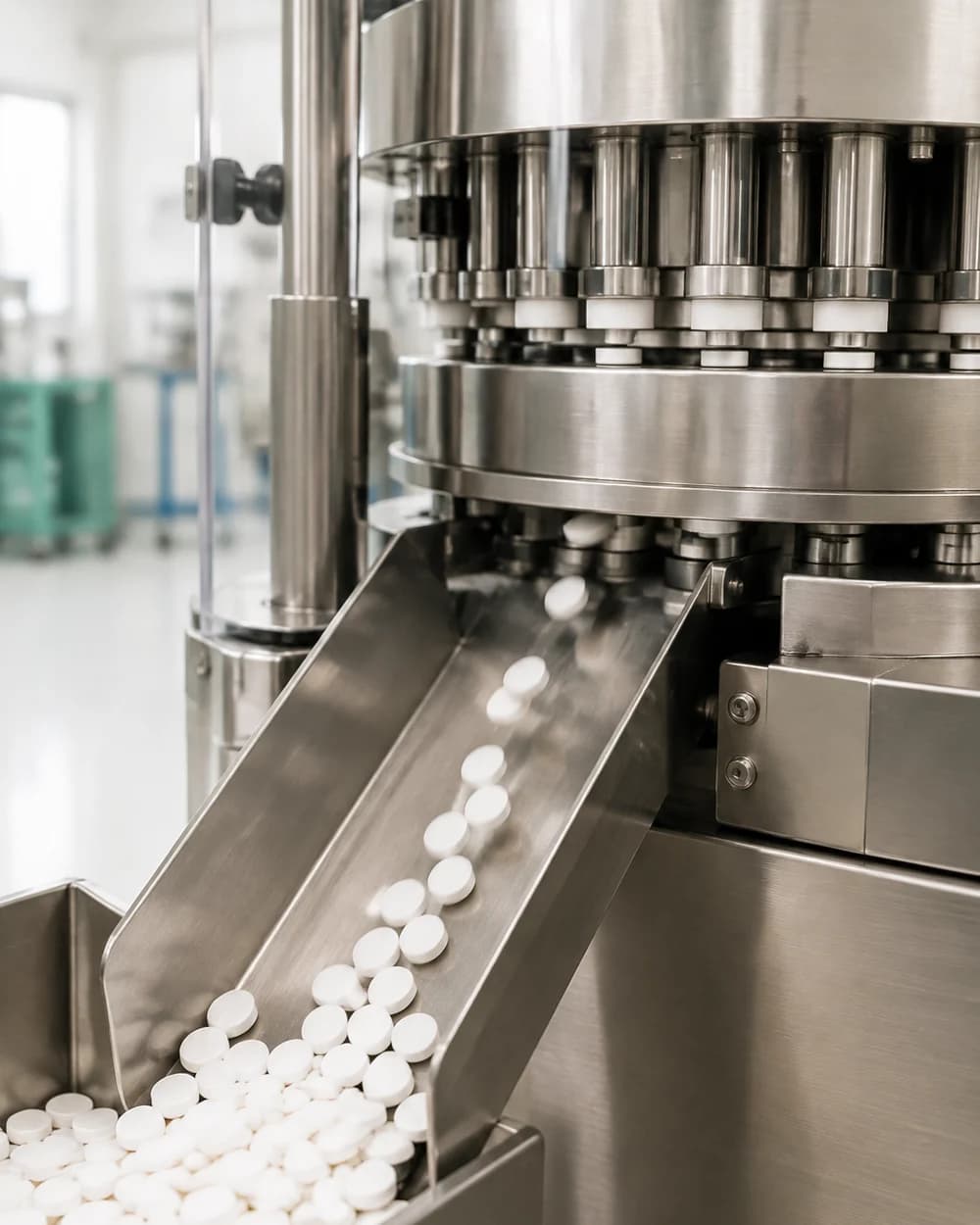
Zinc is one of the most requested minerals in immune, skin and men's health ranges, but it is also one of the harder tablets to compress well. Dose accuracy, disintegration and taste all matter. As a dedicated zinc tablet manufacturer, EUPHM runs zinc gluconate, citrate, picolinate, oxide and bisglycinate formats on high-speed rotary presses. We support retail bottling, blister packs and bulk supply, with documentation for FDA-registered and EU-compliant markets.
- MOQ
- 1,000 units per SKU for retail bottling; lower for pilot runs
- Tablet formats
- Round, oval, caplet, film-coated or uncoated
- Typical fill weight
- 300–1,200 mg per tablet
- Sample lead time
- 7–10 working days
- Mass production
- 20–35 working days after sample approval
- Certifications
- GMP, ISO 9001, ISO 22000, HACCP, NSF/ANSI 455-2, halal, FDA-registered
Zinc tablet production capacity and formats
Our compression lines run at 60,000 to 120,000 tablets per hour depending on size and coating. That covers pilot batches of 1,000 units and repeat orders into the millions. We hold separate blending suites for mineral premixes to reduce cross-contamination risk. Zinc tablets can be produced as uncoated white cores, film-coated colours, or dual-layer formats if you want to combine zinc with vitamin C or elderberry. Tooling is available for round 8–13 mm, oval and caplet shapes.
Every batch starts with a signed formula and a retained reference sample. We check weight variation, hardness, thickness and disintegration through the run, not only at the end. If you need a specific disintegration target for EU or US markets, we can adjust binder levels and compression force to hit it. Packaging options include HDPE bottles with induction seals, blister packs, and bulk drums for repackaging.
Zinc forms, dosages and formulation notes
The zinc salt you choose affects elemental zinc content, tablet size and cost. Zinc gluconate is common in immune products and delivers around 14% elemental zinc. Zinc citrate gives about 30% and is often used in oral health and lozenge formats. Zinc picolinate and bisglycinate are positioned for absorption-focused brands. Zinc oxide is the most concentrated at roughly 80% elemental zinc, but it is harder to compress at high doses without a binder system.
Typical label doses range from 5 mg to 50 mg elemental zinc per tablet. We calculate the salt weight needed and adjust excipients so the tablet stays within your target weight and size. For vegan or allergen-free claims, we use plant-based magnesium stearate and cellulose. If you want a chewable or effervescent zinc, we can quote those separately, but this page focuses on swallowable tablets.
Quality control and export documentation
Zinc tablets leave our plant with a certificate of analysis covering assay, weight variation, hardness, disintegration, microbial limits and heavy metals. We test incoming zinc salts against identity and purity before they enter production. The facility is GMP-certified and holds ISO 22000 and HACCP. For halal or organic claims, we source certified raw materials and keep the paper trail. EU customers receive documentation aligned with EC regulation 1924/2006 for claim review.
We ship FOB Shenzhen or Yantian, with air freight for sample and small orders. Lead times are 20–35 working days for mass production after sample sign-off. We can hold stock of your approved formula for repeat orders, which shortens reorder lead times. If you are sourcing from the US, EU, UK or Middle East, we provide commercial invoices, packing lists, certificates of origin and, where required, health certificates.
Batch Testing, COAs and Retention Samples
Every zinc tablet batch is tested against a written specification before release. Identity is confirmed by FTIR or HPLC against a reference standard, and potency is assayed by ICP-OES or titration depending on the zinc form. Microbial limits follow USP <2021> and <2022> with total aerobic count under 1,000 CFU/g and absence of E. coli and Salmonella. Heavy metals are screened by ICP-MS for lead, arsenic, cadmium and mercury against EU and US pharmacopoeial limits. Disintegration is run in purified water at 37°C, with uncoated tablets required to disintegrate within 15 minutes and film-coated within 30 minutes.
In-process checks run throughout compression. Tablet weight is verified every 15 minutes against a target fill weight with a ±5% tolerance, and hardness is checked hourly on a durometer with a typical range of 5–12 kp for zinc tablets. Friability is tested at the start and end of each run using a 100-revolution drum, with a target weight loss below 1.0%. These records are retained in the batch manufacturing record and reviewed by QA before the batch is released.
A certificate of analysis accompanies every shipment. The COA lists the product name, batch number, manufacturing and expiry dates, specification parameters, test methods, results and the QA sign-off. Retention samples of each batch are held for the full shelf life plus 12 months under controlled conditions at 25°C/60% RH and 30°C/65% RH. Accelerated stability is run for 6 months at 40°C/75% RH, with assays at 0, 1, 2, 3 and 6 months to confirm potency and disintegration remain within specification.
Packaging, Labelling and Retail Readiness
Zinc tablets can be packed in HDPE bottles from 60 cc to 500 cc with induction seals, in blister packs using PVC/PVDC or alu-alu for moisture-sensitive formulas, or in stick packs and sachets for single-dose formats. Bottles are labelled with a wrap-around or pressure-sensitive label, and cartons are printed to your artwork with a minimum 300 dpi resolution. Lot and expiry coding is applied by inkjet or laser on the bottle base, label and carton, with a recommended format of YYYYMMDD and a shelf life of 24 to 36 months depending on the stability data.
For US retail, labels include the statement of identity, net quantity, supplement facts panel with zinc quantity per serving and %DV, other ingredients, directions, warnings and the manufacturer or distributor address. EU labels follow Regulation (EU) No 1169/2011 and the Food Supplements Directive, with the appropriate nutrition declaration and allergen information. We can add Amazon FNSKU barcodes, retail GS1 barcodes and FBA carton labels on request. Cartons are specified to your case pack, typically 12, 24 or 48 units, and pallets are configured to standard 1,200 x 1,000 mm or 1,200 x 800 mm footprints with stretch wrap and corner boards.
Zinc tablet MOQ, lead times and delivery terms
Sampling for zinc tablets typically takes 7–10 working days from receipt of your formula and artwork. Samples are sent by courier with a preliminary COA and a packaging mock-up where relevant. Once the sample is approved and the deposit is received, mass production runs 20–35 working days depending on the zinc form, coating requirement and packaging format. Pilot runs below the standard MOQ of 1,000 units per SKU are available for new brands, with a minimum of 1,000 units for simple uncoated tablets.
Shipping is arranged by air or sea. Air freight takes 5–10 days door to door and suits urgent launches or sample quantities. Sea freight takes 25–40 days port to port and is more economical for full pallets. We quote EXW, FOB Shenzhen or Hong Kong, and DDP for selected destinations. DDP pricing includes freight, insurance, customs clearance and import duties, and is available for the US, EU, UK, Australia and Canada.
Each order is shipped with a commercial invoice, packing list, bill of lading or airway bill, certificate of analysis, material safety data sheet where applicable, and a free-sale certificate. Phytosanitary certificates are not normally required for zinc tablets, but can be arranged if your destination customs requests them. Halal certificates are available on request and are issued by recognised certifying bodies for the specific production run.
Formats and Packaging Options
Zinc salt form
Choose gluconate, citrate, picolinate, bisglycinate or oxide. Each has a different elemental zinc percentage and tablet size impact.
Elemental dose
Set your target from 5 mg to 50 mg per tablet. We back-calculate the salt weight and adjust excipients to fit.
Tablet shape and coating
Round, oval or caplet; uncoated, film-coated or enteric-coated. Coating helps with taste and brand colour.
Packaging format
HDPE bottles, blister packs, sachets or bulk drums. Bottle sizes from 30 to 180 counts are available.
How a Project Runs
- 01
Send your brief
Share target dose, zinc form, tablet count and packaging. We confirm feasibility and quote within 2 working days.
- 02
Formulation review
Our team checks excipient compatibility, tablet weight and compression behaviour. You approve the formula before sampling.
- 03
Sample production
We produce a pilot batch, typically 7–10 working days. You receive samples with a preliminary COA for review.
- 04
Sample approval
You test the samples and confirm taste, size and packaging. We lock the master formula and artwork.
- 05
Mass production
Full batch runs on rotary presses. In-process checks cover weight, hardness, thickness and disintegration throughout.
- 06
QC and shipping
Final testing, COA issue and packing. Shipment is arranged FOB Shenzhen or Yantian, with air freight for urgent orders.
Why EUPHM
Mineral compression expertise
Zinc blends can be abrasive and sticky. We adjust binder and lubricant levels to keep tablets within weight and hardness limits.
Low MOQ for market testing
Start at 1,000 units per SKU. Pilot runs are available below that for brands validating a new zinc product.
Export-ready documentation
COA, health certificate and origin documents are prepared for US, EU, UK and Middle East import requirements.
Questions buyers ask.
What is the MOQ for zinc tablets?+
MOQ is 1,000 units per SKU for retail bottling. Lower quantities are possible for pilot runs. MOQ depends on tablet size, coating and packaging format. Share your target dose and bottle count for an exact figure.
How long does sampling take?+
Sample lead time is 7–10 working days after formula approval. You receive physical samples with a preliminary certificate of analysis. Courier time is additional and depends on your location.
Which zinc form is best for tablets?+
Zinc gluconate and citrate are the most common for swallowable tablets. Picolinate and bisglycinate are used for absorption-focused positioning. Oxide is cheapest per elemental milligram but harder to compress at high doses. We can advise based on your label claim.
Do you provide halal certificates?+
Yes. We can source halal- -certified zinc salts and excipients. The final certificate depends on the raw material supplier and is issued per batch. Vegan and organic options are also available.
What documentation comes with each order?+
Each batch includes a certificate of analysis covering assay, weight, hardness, disintegration, microbials and heavy metals. We also provide commercial invoice, packing list and certificate of origin. Health certificates can be arranged on request.
Can you produce zinc tablets with a specific dissolution profile?+
Yes. We can adjust the binder, disintegrant and coating to meet a target dissolution profile. For zinc tablets, a typical specification is not less than 75% dissolved in 45 minutes in 0.1N HCl or purified water. We run dissolution testing during development and on stability to confirm the profile holds over shelf life.
Do you offer low-MOQ private label zinc tablets with my label?+
Yes. Our standard MOQ is 1,000 units per SKU for retail bottling, but we accept pilot runs from 1,000 units for simple uncoated tablets. Private label orders include your artwork, label and carton printing, with lot and expiry coding applied. A sample is produced for your approval before mass production begins.
What is the shelf life of your zinc tablets and how is it supported?+
Shelf life is typically 24 to 36 months from the date of manufacture, depending on the zinc form and packaging. It is supported by accelerated stability data at 40°C/75% RH for 6 months and real-time data at 25°C/60% RH and 30°C/65% RH. We provide a stability summary with the COA on request.
Have a product in mind?
Send us the brief and we will come back with a formulation direction, indicative price and a realistic lead time — usually within one working day.