Bi-Layer Tablet Manufacturer for Dietary Supplements
EUPHM produces bi-layer tablets that separate incompatible actives or combine immediate and sustained release in one dose. Our GMP facility in Guangdong handles pilot runs and retail bottling for brands in the US, EU, UK and Middle East.
Overview
Bi-layer tablets let you combine ingredients that would otherwise react, degrade or require separate dosage forms. One layer can release quickly; the second can be formulated for extended release or enteric protection. EUPHM runs rotary bi-layer presses with independent layer weight control, so each stratum meets its own specification. This page covers tooling, formulation limits, batch sizes and the compliance documents you will need for cross-border retail.
| MOQ (retail bottling) | 1,000 units per SKU; lower for pilot runs |
|---|---|
| Sample lead time | 7-10 working days |
| Mass production | 20-35 working days after approval |
| Tablet size range | 6-22 mm diameter; layer weight ratio 30:70 to 70:30 |
| Line capacity | Up to 180,000 tablets per shift on bi-layer presses |
| Certifications | GMP, ISO 9001, ISO 22000, HACCP, NSF/ANSI 455-2, halal, FDA-registered |
Bi-Layer Compression Capability
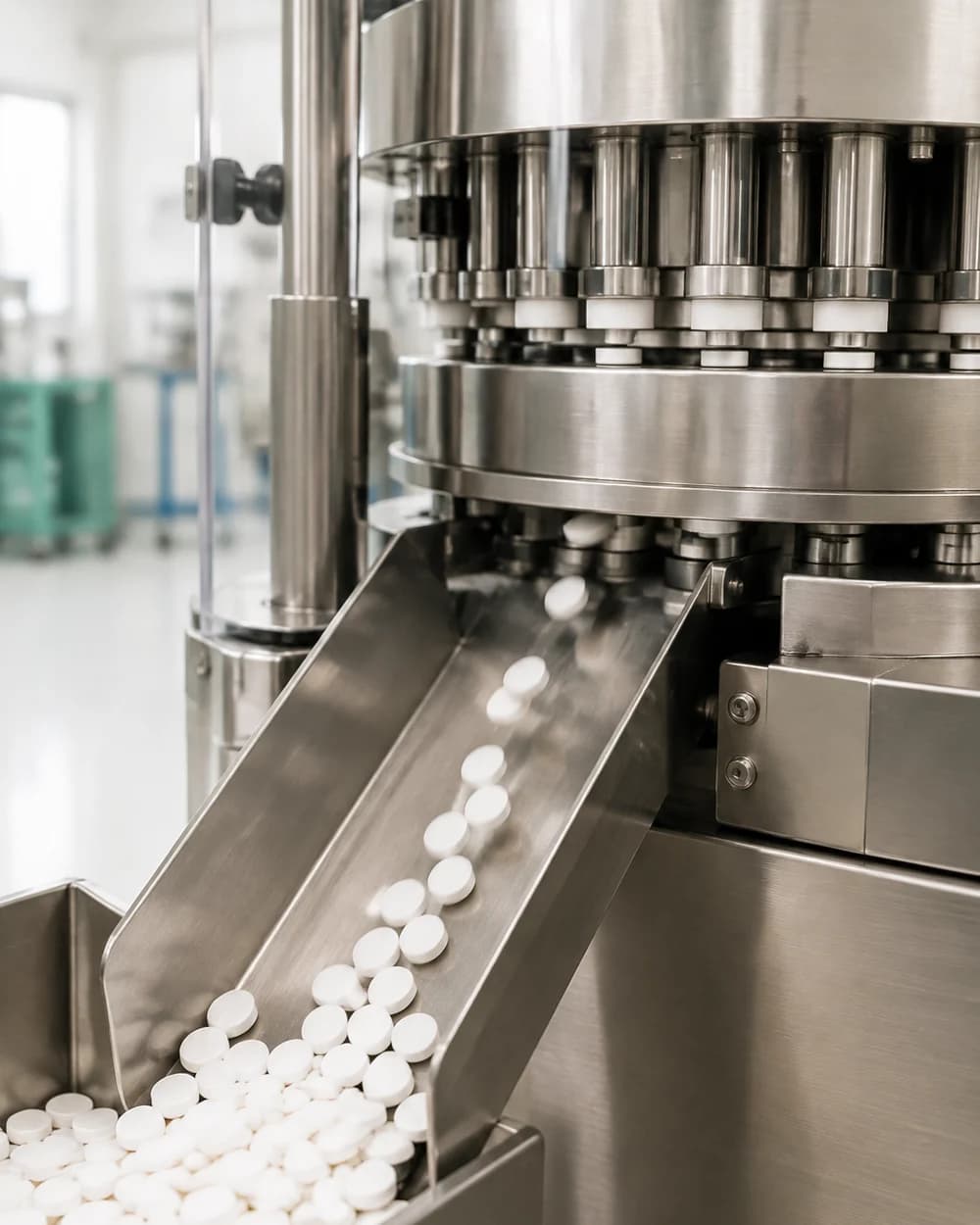
Bi-layer tablets are pressed in two stages. The first layer is lightly tamped; the second is filled on top and compressed to final hardness. This requires precise control of layer weight, interface bonding and capping risk. EUPHM operates rotary bi-layer presses with independent fill cams for each layer. We can hold layer ratios from 30:70 to 70:30 and tablet diameters from 6 mm to 22 mm. Typical hardness ranges from 80 N to 180 N depending on the formulation.
Tooling is custom-made for each product. We produce round, oval, capsule and caplet shapes, with or without score lines. For pilot runs, we can use existing tooling where dimensions match, which shortens sample lead time to 7-10 working days. For commercial batches, new tooling adds 10-15 working days before mass production begins. Batch sizes start at 1,000 units for retail bottling; larger runs are scheduled across 20-35 working days.
Formulation and Release Profiles
The main reason to choose a bi-layer tablet is separation. You can put an acid-sensitive probiotic in one layer and a mineral in the other. Or combine an immediate-release botanical with a sustained-release amino acid. EUPHM formulates each layer independently: binder, disintegrant, lubricant and coating can all differ. We test layer adhesion with friability and hardness checks at 10-minute intervals during compression. If interface bonding is weak, we adjust binder level or compression force before scaling up.
Release profiles are verified in-house. Immediate-release layers typically disintegrate within 15 minutes; sustained-release layers are tested at 1, 2, 4 and 6-hour intervals. For enteric protection, we can apply a pH-dependent coating to the finished tablet or use a gastro-resistant granulation in one layer. Common actives include vitamins, minerals, herbal extracts, amino acids and probiotics. We do not work with controlled substances or pharmaceuticals.
Quality, Compliance and Export Logistics
EUPHM is a GMP-certified facility with ISO 22000 and HACCP. We are FDA-registered for dietary supplements, which allows US-bound shipments. For EU and UK clients, we provide certificates of analysis, allergen statements, non-GMO declarations and heavy-metal test results. halal and vegan certifications are available depending on ingredient sourcing. Every batch is retained for 24 months. Stability testing follows ICH climatic zone II or IVb, with 6-month accelerated and 12-month real-time data.
Export documentation includes commercial invoice, packing list, certificate of origin, health certificate and, where required, halal certificates. We ship FOB Shenzhen or Yantian, with air freight for samples and pilot batches. Typical production lead time is 20-35 working days after artwork and deposit. We can label and bottle under your brand, or supply bulk tablets in double polyethylene bags inside fibre drums. MOQ for bulk is 50 kg per SKU.
Quality Control and Batch Documentation
Every bi-layer tablet batch is sampled at three points: incoming raw materials, in-process compression, and finished goods. Identity testing by FTIR or HPLC confirms each active, while potency assays quantify the label claim per layer. Microbial limits follow USP <61> and <62> or the equivalent Ph. Eur. method, with total aerobic count under 1,000 CFU/g and absence of specified pathogens. Heavy metals are screened by ICP-MS against California Proposition 65 and EU 2023/915 thresholds. Disintegration testing is run separately on each layer when release profiles differ, using USP <701> conditions at 37°C in purified water or simulated gastric fluid.
In-process checks on the bi-layer press occur every 30 minutes: individual layer weight, total tablet weight, thickness, hardness and friability. Layer weight ratio is verified against the approved formula, typically within ±5% of target for each stratum. At batch completion, a composite sample is pulled for full release testing. The certificate of analysis (COA) issued with each batch lists identity, potency, microbials, heavy metals, disintegration, uniformity of dosage units and appearance, plus the specification range and the actual result. A batch record with press parameters, operator signatures and equipment logs accompanies the COA on request.
Retention samples are held for the shelf life declared on the label plus 12 months, stored under label conditions. Stability follows ICH Q1A(R2): long-term at 25°C/60% RH and accelerated at 40°C/75% RH for six months. For bi-layer products, additional testing monitors layer adhesion and any migration of moisture or actives between strata. If a customer requires a specific shelf life beyond the initial data, an ongoing stability programme can be set up with three batches per year. Data tables are shared under confidentiality, and the protocol is agreed before the first commercial batch.
Documentation for export includes the COA, the batch manufacturing record summary, a specification sheet and, where applicable, a statement of allergen status and a non-GMO declaration. For markets requiring a free-sale certificate or a certificate of manufacture for regulatory submission, these are prepared by the regulatory affairs team. Records are retained for five years, which covers the typical audit window for GMP and retailer supplier-approval schemes. If a deviation occurs, an investigation report with root cause and corrective action is issued within ten working days of batch closure.
Packaging, Labelling and Retail Readiness
Bi-layer tablets are denser and often larger than single-layer tablets, so packaging choice affects both protection and cost. High-density polyethylene (HDPE) bottles with induction seals are standard for 60 to 180 counts, with optional desiccant canisters for moisture-sensitive layers. Blister packs in PVC/PVDC or alu-alu are available for clinical or travel formats, and stick packs or sachets suit single-dose positioning. For bi-layer tablets with an enteric or extended-release layer, alu-alu blisters provide the best moisture barrier. Bottle fill weights and tablet counts are verified by automated checkweighers at line speed.
Labels for the US market must carry the FDA dietary-supplement panel: supplement facts with serving size, amount per serving and percent daily value where established, plus the statement of identity, net quantity, ingredient list, allergen declarations and the manufacturer or distributor address. Structure/function claims require the standard disclaimer. For the EU, the nutrition declaration and the novel food or health-claim status of each ingredient are checked before artwork approval. Artwork is proofed against the approved formula and a barcode verification is run before mass printing.
Lot and expiry coding are applied by inkjet or laser on the bottle base and the carton, in a format agreed with the brand owner. Expiry is calculated from the stability data supporting the label shelf life, typically 24 to 36 months for bi-layer tablets. Cartons are specified with tablet count, dimensions and gross weight, and pallet layouts are provided with TI-HI configuration, typically 40 to 60 cartons per pallet depending on bottle size. Shrink-wrap and corner boards are used for sea freight. Amazon FNSKU labels, poly-bagging and retail-ready carton marking can be applied on request.
MOQ, Lead Times and Delivery
The sample timeline starts with a formulation and tooling review, which takes three to five working days. A pilot batch of 500 to 1,000 tablets is then compressed, packaged in sample bottles and dispatched within seven to ten working days of approval. The sample pack includes the COA, a specification sheet and a tablet sample for organoleptic and hardness assessment. If a new tooling set is required for an unusual shape or layer ratio, add five to seven working days for tooling fabrication and first-article inspection.
Mass production runs 20 to 35 working days after sample approval and purchase-order confirmation, depending on batch size and packaging complexity. A standard commercial batch is 100,000 to 500,000 tablets; bottling and labelling add three to five working days to the compression window. Line capacity on bi-layer presses reaches up to 180,000 tablets per shift, so larger orders are scheduled across multiple shifts. The production schedule is confirmed in writing, and a pre-shipment sample is retained for customer approval before final packing.
Shipping terms are offered as EXW, FOB Shenzhen or Hong Kong, and DDP for selected destinations. Air freight suits pilot and launch quantities of 50 to 200 kg and takes five to eight days door to door. Sea freight is cost-effective above 300 kg, with transit of 25 to 35 days to US west coast ports and 30 to 40 days to European ports. Export documents provided include the COA, MSDS where required, free-sale certificate, and phytosanitary certificate for botanical ingredients where the destination requires it. Commercial invoice, packing list and bill of lading are issued with each shipment.
Packaging and Format Choices
Immediate + sustained
One layer releases within 15 minutes; the second extends release over 4-8 hours. Used for energy, joint and sleep formulas.
Incompatible actives
Separates ingredients that react, such as vitamin C and copper, or probiotics and minerals. Prevents potency loss during shelf life.
Enteric + immediate
One layer is coated for intestinal release; the other dissolves in the stomach. Suitable for sensitive botanicals and enzymes.
Flavour + active
A flavoured outer layer masks odour or taste from the active layer. Common for chewable or dispersible bi-layer tablets.
From Brief to Batch
- 01
Formulation review
Send your target actives, dosage and release profile. We check compatibility, layer ratio and tooling availability within 3 working days.
- 02
Sample production
We produce 100-500 sample tablets on a pilot bi-layer press. Lead time is 7-10 working days. You receive samples with a preliminary COA.
- 03
Stability and analytical
Samples undergo hardness, friability, disintegration and assay testing. Accelerated stability starts at the same time. Results in 10-15 working days.
- 04
Tooling and artwork
New tooling is machined in 10-15 working days. Artwork for bottles, labels and cartons is proofed against your market regulations.
- 05
Mass production
Commercial batches run on rotary bi-layer presses. Production takes 20-35 working days after deposit and approved samples.
- 06
QC release and shipping
Final batch testing covers weight, hardness, disintegration, assay and microbials. We release COA, health certificate and export documents.
Why EUPHM
Dual-release in one dose
Combine fast onset with extended action without a second tablet. Reduces pill burden and improves compliance.
Incompatibility solved
Separate reactive actives to protect potency. No need for two separate SKUs or blister packs.
Export-ready compliance
GMP, ISO 9001, ISO 22000, HACCP, NSF/ANSI 455-2 and halal certification; FDA facility registration for US-bound shipments.
Questions buyers ask.
What is the minimum order quantity for bi-layer tablets?+
For retail bottling, MOQ is 1,000 units per SKU. Pilot runs can be lower, typically 500–1,000 units, but tooling costs may apply. For bulk supply, MOQ is 50 kg per SKU. Larger orders are scheduled across 20-35 working days after approval.
Can you make bi-layer tablets with probiotics in one layer?+
Yes, provided the probiotic strain is stable in tablet form. We use low-compression force for the probiotic layer and can apply a protective coating. Viability testing is done at 0, 3 and 6 months. Not all strains survive compression, so we request a sample for trial.
How do you prevent layer separation or capping?+
We control layer weight, compression force and binder level. During compression, we check hardness and friability every 10 minutes. If interface bonding is weak, we adjust the formulation or increase the first layer tamp force. This is validated during sample production before scale-up.
What certifications do you hold for bi-layer tablet manufacturing?+
EUPHM holds GMP, ISO 22000 and HACCP. We are FDA-registered for dietary supplements. halal and vegan certifications are available depending on ingredient sourcing. Certificates are provided with each shipment where applicable.
What is the lead time for a new bi-layer tablet project?+
Sample lead time is 7-10 working days. If new tooling is required, add 10-15 working days. Stability testing takes 10-15 working days. Mass production is 20-35 working days after deposit and approved samples. Total project time from brief to shipment is typically 8-12 weeks.
Can you compress bi-layer tablets with an enteric layer and a sustained-release layer in the same tablet?+
Yes. One layer can be formulated with an enteric polymer such as HPMCP or acrylic-based coatings, while the second layer uses a hydrophilic matrix for sustained release. The two layers are compressed sequentially on a rotary bi-layer press with independent weight control. Release testing is performed on each layer separately, and the final product is tested for layer adhesion and moisture migration. The formulation team will confirm compatibility and propose a dissolution method during the sample stage.
What is the shelf life of a bi-layer tablet and how is it supported?+
Shelf life is typically 24 to 36 months, supported by ICH Q1A(R2) stability data at long-term and accelerated conditions. Bi-layer tablets are also monitored for layer adhesion and inter-layer migration. If the initial data support a shorter period, the label reflects that. An ongoing stability programme with three batches per year can extend the claim as data accumulate. The exact shelf life is stated on the COA and agreed before artwork approval.
Do you provide DDP shipping and what documents come with each order?+
DDP is available for selected destinations, with duties and taxes handled by the freight partner. Each shipment includes a commercial invoice, packing list, bill of lading or air waybill, certificate of analysis, and a free-sale certificate. An MSDS is provided where the destination requires it, and a phytosanitary certificate is arranged for botanical ingredients when required. EXW and FOB Shenzhen or Hong Kong are also offered. Document sets are confirmed at order stage.
Other versions built in this dosage form.
- Tablet Manufacturer
- Film-Coated Tablet Manufacturer
- Chewable Tablet Manufacturer
- Effervescent Tablet Manufacturer
- Multi-Layer Tablet Manufacturer
- Sustained-Release Tablet Manufacturer
- Sugar-Coated Tablet Manufacturer
- Mini Tablet Manufacturer
- Vitamin C Tablet Manufacturer
- Vitamin D3 Tablet Manufacturer
- Vitamin B12 Tablet Manufacturer
- Vitamin B Complex Tablet Manufacturer
- Multivitamin Tablet Manufacturer
- Folic Acid Tablet Manufacturer
- Probiotics Tablet Manufacturer
- Collagen Tablet Manufacturer
- Biotin Tablet Manufacturer
- Melatonin Tablet Manufacturer
- Magnesium Tablet Manufacturer
- Zinc Tablet Manufacturer
- Iron Tablet Manufacturer
- Calcium Tablet Manufacturer
- Selenium Tablet Manufacturer
- Chromium Tablet Manufacturer
- NMN Tablet Manufacturer
- Glucosamine Tablet Manufacturer
- Hair Skin & Nails Tablet Manufacturer
- Sleep Support Tablet Manufacturer
- Immune Support Tablet Manufacturer
- Menopause Tablet Manufacturer
- Joint Health Tablet Manufacturer
Have a product in mind?
Send us the brief and we will come back with a formulation direction, indicative price and a realistic lead time — usually within one working day.