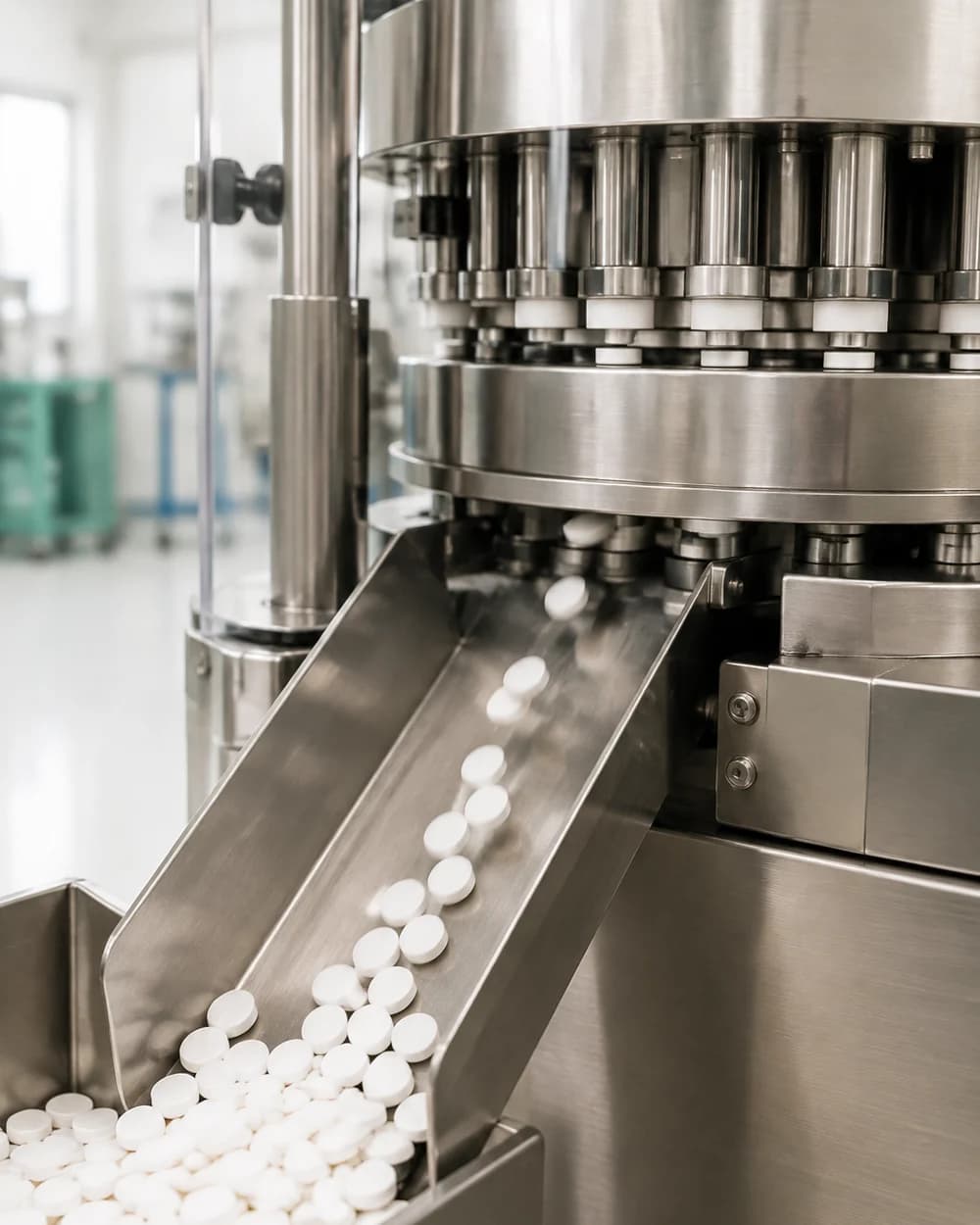
Mini Tablet Manufacturer for Low-Dose Supplements
EUPHM produces mini tablets from 2 mm to 6 mm diameter for nutraceutical, paediatric and specialised adult ranges. MOQ starts at 1,000 units per SKU for retail bottling, with lower thresholds for pilot runs.
Overview
Mini tablets suit low-dose actives, paediatric formats and products where swallowing a standard 10 mm tablet is difficult. They also allow flexible dosing without changing the outer packaging. As a GMP-certified contract manufacturer, we handle formulation, granulation, compression, coating and packing under one roof. This page covers tooling, fill weights, lead times and compliance for small-format tablets. For standard sizes, see our parent page on /tablet-manufacturer.
Tooling and Compression Capability
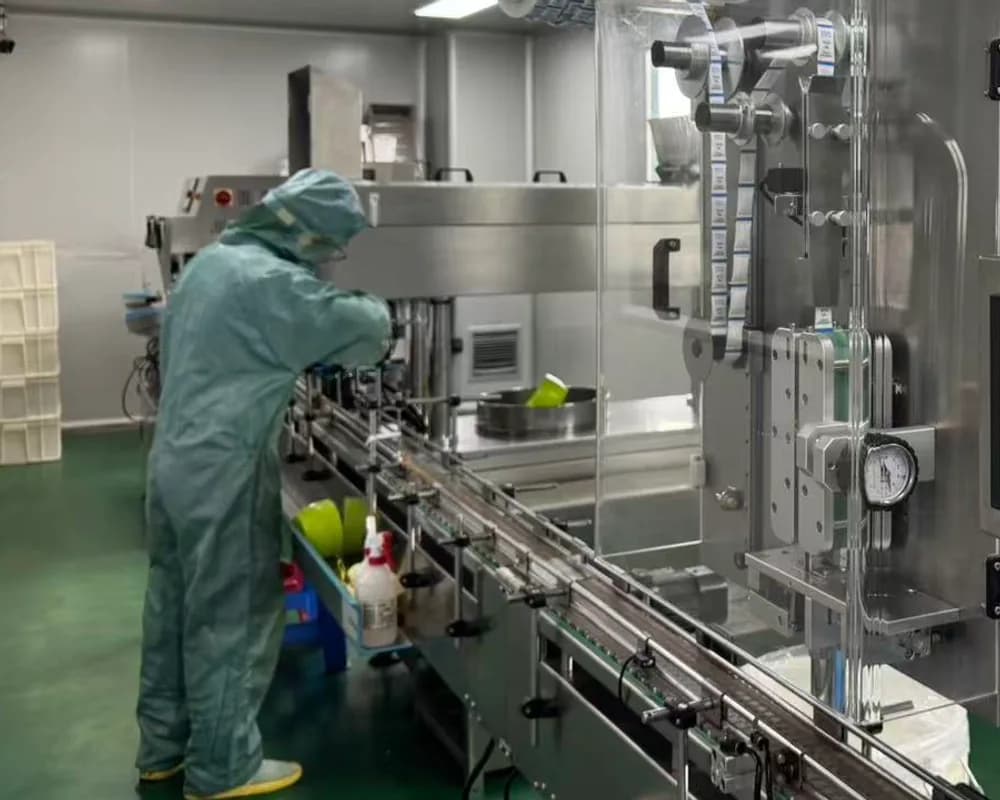
Mini tablets demand tighter tooling tolerances than standard formats. We run rotary presses with multi-tip punches to achieve 2–6 mm diameters at commercial volumes. Depending on the formulation, output ranges from 150,000 to 400,000 tablets per hour on a single line. Lower speeds are used for fragile actives or high-dose APIs. Tooling is custom-made per product, with a lead time of 15–20 working days for new punches and dies. We keep a library of standard round and oval profiles to reduce setup time for repeat orders.
Because mini tablets have a small surface area, weight variation is controlled to ±3% or tighter. Our presses are equipped with automatic weight control and rejection systems. For bi-layer or tri-layer mini tablets, we use specialised tooling to keep layer boundaries clean at 3 mm and above. Film coating is available in a 5–8% weight gain range, using aqueous or solvent-based systems. Coating adds 1–2 working days to the production schedule.
Formulation for Small-Format Tablets
Not every ingredient compresses well at 2–4 mm. We adjust particle size, binder level and moisture content to prevent capping and lamination. Common actives include melatonin at 1–3 mg, vitamin D3 at 1,000–5,000 IU, methylcobalamin at 500–5,000 mcg, and iron bisglycinate at 10–25 mg. For paediatric ranges, we use natural sweeteners such as monk fruit or stevia, and flavours like strawberry, orange and vanilla. Disintegrants are selected to break down within 15 minutes in purified water at 37°C.
Mini tablets can be produced as immediate-release, chewable, or enteric-coated. Enteric coating at 2–4 mm requires a two-stage process to protect the core during gastric transit. We also offer sublingual formats where the tablet dissolves under the tongue in 30–60 seconds. For probiotics, we use a protective matrix and controlled low-temperature compression to maintain CFU counts above 1 billion per tablet. Each formulation is tested for hardness, friability and disintegration before scale-up.
Quality Control and Global Shipping
Every batch is tested for identity, potency, microbial limits and heavy metals in our in-house lab. We follow GMP, ISO 22000 and HACCP protocols. Certificates of analysis are issued per lot, and retain samples are kept for 24 months. For halal and claims, we source certified raw materials and maintain segregation throughout production. Our facility is FDA-registered for dietary supplements. We do not claim FDA approval, as that applies to drugs, not supplements.
Packing options include 30 cc to 120 cc HDPE bottles, blister packs with 7–14 tablets per card, and sachets. We ship from Guangdong to the US, EU, UK and Middle East. Air freight takes 5–8 days, sea freight 18–28 days. Documentation covers commercial invoice, packing list, certificate of origin, health certificate and MSDS where required. For repeat orders, we hold packaging components for up to 12 months to shorten lead times.
Quality Control and Batch Documentation
Every mini tablet batch is tested against a written specification before release. Incoming raw materials are sampled at 100% of containers for identity by FTIR or HPLC, and composite samples are tested for potency, microbial limits (TPC, yeast and mould, E. coli, Salmonella), heavy metals (lead, cadmium, arsenic, mercury by ICP-MS) and, where relevant, pesticide residues. During compression, in-process checks run every 30 minutes on weight variation, thickness, hardness and friability; disintegration is tested at start, middle and end of each compression run.
Finished mini tablets are tested for identity, potency (usually 95.0–105.0% of label claim), uniformity of dosage units, microbial limits, heavy metals and disintegration. Disintegration for uncoated mini tablets is typically specified at not more than 15 minutes in purified water at 37°C; coated or enteric formats follow the relevant USP or Ph. Eur. method. Each batch has a certificate of analysis (COA) listing tests, specifications, methods and results, signed by the QC manager and retained with the batch record.
Retention samples are kept for the shelf life plus 12 months, stored under labelled conditions (typically 25°C/60% RH and, for accelerated studies, 40°C/75% RH). Stability protocols follow ICH Q1A(R2): 0, 3, 6, 9, 12, 18, 24 and 36 months for long-term, and 0, 3 and 6 months for accelerated. We provide stability data to support the shelf life printed on your label, and can run a customer-specific stability study if your market requires it.
Batch records, COAs, deviation reports and retention sample logs are available for audit. For mini tablet manufacturing, the smaller fill weights (10–250 mg) mean weight variation is tighter: we typically control individual tablet weight within ±5% of target, with ±3% achievable on well-flowing granulations. This is documented in the batch record and summarised on the COA.
Packaging, Labelling and Retail Readiness
Mini tablets can be packed in HDPE bottles (typically 30, 60, 90 or 120 cc with induction seal and child-resistant closure), blister packs (PVC/PVDC or alu-alu), stick packs or sachets. Bottle filling runs at 30–60 bottles per minute depending on count; blister lines handle 2–4 cycles per minute. We can add desiccant, cotton or oxygen absorbers where the formulation requires it. Cartons are specified with dimensions, board grade and print colours, and pallets are typically 1,200 × 1,000 mm or 1,200 × 800 mm with a stated carton count and gross weight.
For US-bound dietary supplements, labels must carry the statement of identity, net quantity of contents, supplement facts panel, ingredient list, allergen declaration where applicable, and the name and place of business of the manufacturer, packer or distributor. We also print lot number and expiry date in a legible format, typically inkjet or laser coding on the bottle, carton and, where used, the blister foil. For EU markets, the label follows Directive 2002/46/EC and local language requirements; for Amazon, we can apply FNSKU labels and poly-bag or shrink-wrap to FBA prep standards.
Retail readiness checks cover barcode verification (GS1-128 or UPC-A), label artwork proofing against the approved master, and a first-article inspection before the full run. We keep a packaging record for each batch, including label version, lot coding and quantity packed. If you sell through retail chains, we can supply carton markings to your buyer's specification, including ITF-14 barcodes and SSCC labels for pallet tracking.
MOQ, Lead Times and Delivery
Sample lead time for a custom mini tablet is typically 7–10 working days after formulation and artwork approval, including a small pilot batch for your evaluation. Mass production runs 20–35 working days after sample approval, depending on coating, packaging format and QC release. MOQ is 1,000 units per SKU for standard bottles; pilot runs below this are possible with a pilot-run surcharge. We confirm the exact MOQ in the quotation once the tablet size, fill weight and packaging are fixed.
Shipping is by air or sea. Air freight from Guangdong to Europe or North America typically takes 5–8 days door to door; sea freight takes 25–40 days depending on port and routing. We quote EXW, FOB Shenzhen/Hong Kong or DDP to your warehouse. For DDP, we handle export clearance, freight, import duty and delivery; you receive the goods with the commercial invoice, packing list and COA.
Documents provided with each shipment include the certificate of analysis, material safety data sheet (MSDS) where applicable, free-sale certificate, and, for plant-derived ingredients, phytosanitary certificate where the destination country requires it. We also provide a certificate of origin on request. For mini tablet manufacturing, the COA is batch-specific and matches the lot number on the carton and bottle, so your QC team can trace each delivery back to the batch record.
Manufacturing Options to Compare
Immediate-release mini tablets
Standard compression for fast disintegration. Suitable for melatonin, vitamin D3 and B12. Diameter 2–6 mm, fill weight 10–250 mg.
Chewable mini tablets
Soft texture with natural sweeteners and flavours. Ideal for paediatric and senior ranges. Diameter 4–6 mm, fill weight 50–200 mg.
Enteric-coated mini tablets
Acid-resistant coating for probiotics and sensitive actives. Two-stage process. Diameter 3–6 mm, fill weight 30–150 mg.
Sublingual mini tablets
Dissolves under the tongue in 30–60 seconds. For B12, melatonin and CoQ10. Diameter 2–4 mm, fill weight 10–50 mg.
How a Project Runs
- 01
Share your specification
Send target actives, dosage, diameter, coating and packaging. We review feasibility within 24 hours.
- 02
Formulation and sample
We develop a prototype and ship samples in 7–10 working days. You approve taste, hardness and appearance.
- 03
Quotation and PO
We issue a costed quote with MOQ, lead time and payment terms. Production starts on receipt of PO and deposit.
- 04
Tooling and pilot batch
New punches and dies are made in 15–20 working days. A pilot batch confirms weight control and coating uniformity.
- 05
Mass production
Full run takes 20–35 working days. In-process checks occur every 30 minutes for weight, thickness and hardness.
- 06
QC and shipping
Final testing, CoA issuance and packing. We arrange air or sea freight to your warehouse.
Why EUPHM
Low MOQ for niche products
Start at 1,000 units per SKU. Lower thresholds for pilot runs let you test the market before scaling.
In-house tooling and coating
No third-party delays. We make punches, compress, coat and pack under one roof, saving 5–10 days.
Full documentation support
CoA, health certificate, halal and organic certificates provided. We assist with customs clearance in the EU and Middle East.
Questions buyers ask.
What is the smallest tablet size you can produce?+
We produce mini tablets down to 2 mm diameter. Below 2 mm, weight variation becomes difficult to control. For 2–3 mm tablets, we use multi-tip tooling and automatic weight rejection to maintain ±3% uniformity.
Can you make mini tablets with probiotics?+
Yes. We use low-temperature compression and a protective matrix to keep CFU counts above 1 billion per tablet. Enteric coating is available for 3–6 mm formats. Stability testing is recommended for 12–24 months.
What is the MOQ for a custom mini tablet?+
MOQ is 1,000 units per SKU for retail bottling. For pilot runs, we can go lower. Tooling costs apply for new sizes and shapes. Repeat orders do not incur tooling fees.
How long does production take?+
Samples ship in 7–10 working days. Mass production takes 20–35 working days after sample approval and receipt of deposit. Tooling adds 15–20 working days for new custom shapes.
Are your mini tablets suitable for children?+
Yes, for ages 4 and above with adult supervision. We use natural sweeteners and flavours. Chewable and sublingual formats are available. Always check local regulations for paediatric dosage and labelling.
Can you produce mini tablets with a enteric coating?+
Yes. Enteric coating is available for mini tablets down to 3 mm diameter, using standard polymers such as Eudragit L30 D-55 or Aqoat. Coating adds 3–5 working days to the production window and requires a disintegration test in 0.1N HCl for 2 hours followed by buffer at pH 6.8. We confirm feasibility during formulation based on the active's acid sensitivity and the target release profile.
What is the shelf life of your mini tablets and can you customise it?+
Shelf life is assigned from stability data generated on your formulation and packaging. Typical assignments are 24 months for uncoated mini tablets in HDPE bottles and 18–24 months for coated or moisture-sensitive formats. We can run a customer-specific stability study (long-term and accelerated) to support a longer shelf life, with data provided in the stability report. The expiry date is printed at packing based on the approved shelf life.
Do you provide a free-sale certificate and can you support registration in my market?+
Yes, we issue a free-sale certificate for each product on request, confirming the product is manufactured under GMP and is freely sold in China. For registration dossiers, we can supply the batch record summary, COA, stability data, MSDS and manufacturing flow chart. We do not act as your regulatory agent, but we provide the technical documents your consultant needs to file in your market.
Other versions built in this dosage form.
- Tablet Manufacturer
- Film-Coated Tablet Manufacturer
- Chewable Tablet Manufacturer
- Effervescent Tablet Manufacturer
- Multi-Layer Tablet Manufacturer
- Sustained-Release Tablet Manufacturer
- Bi-Layer Tablet Manufacturer
- Sugar-Coated Tablet Manufacturer
- Vitamin C Tablet Manufacturer
- Vitamin D3 Tablet Manufacturer
- Vitamin B12 Tablet Manufacturer
- Vitamin B Complex Tablet Manufacturer
- Multivitamin Tablet Manufacturer
- Folic Acid Tablet Manufacturer
- Probiotics Tablet Manufacturer
- Collagen Tablet Manufacturer
- Biotin Tablet Manufacturer
- Melatonin Tablet Manufacturer
- Magnesium Tablet Manufacturer
- Zinc Tablet Manufacturer
- Iron Tablet Manufacturer
- Calcium Tablet Manufacturer
- Selenium Tablet Manufacturer
- Chromium Tablet Manufacturer
- NMN Tablet Manufacturer
- Glucosamine Tablet Manufacturer
- Hair Skin & Nails Tablet Manufacturer
- Sleep Support Tablet Manufacturer
- Immune Support Tablet Manufacturer
- Menopause Tablet Manufacturer
- Joint Health Tablet Manufacturer
Have a product in mind?
Send us the brief and we will come back with a formulation direction, indicative price and a realistic lead time — usually within one working day.