Royal Jelly Liquid Manufacturer for Private Label Brands
EUPHM produces royal jelly liquids — fresh, freeze-dried, and blends — in 10 ml to 500 ml bottles. MOQ 1,000 units per SKU. GMP, ISO 22000, and HACCP certified. Pilot runs from 1,000 units.
Overview
Royal jelly is a temperature-sensitive, protein-rich ingredient. Turning it into a shelf-stable liquid requires the right preservative system, pH control, and cold-chain discipline. EUPHM has run royal jelly lines in Guangdong since 2011, filling amber glass, PET, and sachets. We handle pasteurisation, homogenisation, and nitrogen flushing where needed. Every batch ships with a certificate of analysis covering 10-HDA content, microbials, and heavy metals.
- MOQ
- 1,000 units per SKU; 1,000 for pilot runs
- Fill volume
- 10 ml to 500 ml (bottles); 5 g to 30 g (sachets)
- Royal jelly solids
- Fresh 1:1 to 3:1; freeze-dried 2%–5% w/v
- 10-HDA content
- 1.4%–2.2% (fresh); 3.5%–5.0% (freeze-dried)
- Sample lead time
- 7–10 working days
- Mass production
- 20–35 working days after deposit and artwork approval
Liquid Filling Capacity and Formats
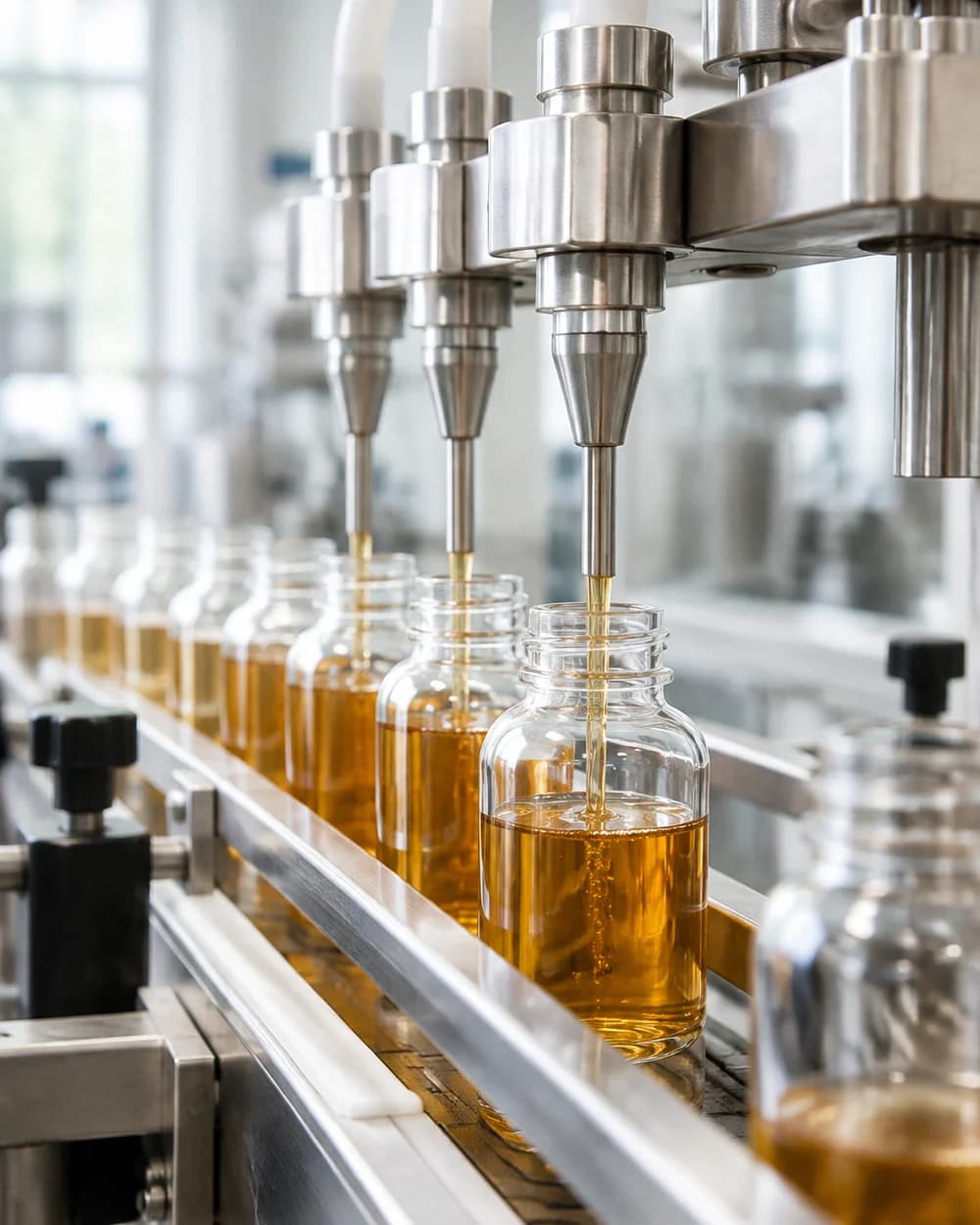
The plant runs four liquid filling lines. Two handle 10–50 ml dropper and spray bottles at 8,000–12,000 units per shift. One line fills 50–250 ml amber glass and PET at 6,000–9,000 units per shift. The fourth line produces 5–30 g stick packs at 30,000–45,000 units per shift. Changeover takes 2–4 hours, including a full CIP cycle.
For royal jelly, we recommend amber glass with a nitrogen flush for fresh suspensions, or PET with an induction seal for freeze-dried solutions. Both formats protect 10-HDA from light and oxygen. Sachets suit single-serve travel and subscription packs. We can also fill aluminium tubes for topical-adjacent formats, though the primary use remains oral.
Formulation and Ingredient Sourcing
Royal jelly arrives as fresh frozen paste or freeze-dried powder. Fresh paste is held at -18°C and thawed in batches under 4°C. Freeze-dried powder is stored at ambient in sealed foil. We blend with carriers such as glycerin, propylene glycol, or honey. Preservative options include potassium sorbate and sodium benzoate at 0.1%–0.2%, or a natural system based on citrus extract and nisin for clean-label briefs.
Typical formulations use 2%–5% freeze-dried royal jelly in water or glycerin, adjusted to pH 3.8–4.5 for stability. Flavour masking matters: royal jelly has a sharp, slightly bitter note. We stock natural flavours — honey, berry, citrus, vanilla — and can match a reference sample. For vegan claims, note that royal jelly is an animal product; we produce separate vegan lines for bee-free alternatives.
Quality Control and Compliance
Every incoming royal jelly lot is tested for 10-HDA by HPLC, moisture, and microbial load. In-process checks cover pH, viscosity, fill weight, and seal integrity every 30 minutes. Finished goods are held for 5–7 days for stability and micro release. Shelf life is typically 18–24 months for preserved liquids, 12 months for fresh-style refrigerated formats.
The facility is GMP, ISO 22000, and HACCP certified. Halal certificates are available for the relevant lines. Organic certification ( and EU organic) applies when you supply certified organic royal jelly and we run the batch on a dedicated organic line. We are an FDA-registered facility for US-bound shipments. Documentation includes COA, MSDS, and full traceability from apiary to batch.
Packaging, Labelling and Retail Readiness
Royal jelly liquid is filled into amber glass bottles (10–500 ml), PET bottles (30–250 ml), and stick sachets (5–30 g). Amber glass is standard for light-sensitive formulations, while PET is used for larger formats where cost and shatter resistance matter. Stick sachets are filled on a vertical form-fill-seal line with nitrogen flushing to reduce dissolved oxygen below 2 mg/L. All primary packaging materials are food-grade and supplied with migration test certificates.
Labels must include the product name, net quantity, ingredient list, allergen statement, supplement facts panel (for US) or nutrition declaration (for EU), lot code, best-before date, storage conditions, and manufacturer or distributor details. We print lot and expiry codes by inkjet on the bottle base or sachet seal. For Amazon FNSKU labelling, we apply the FNSKU barcode over the existing barcode or print it directly on the label. Cartons are standard 5-ply corrugated with a maximum weight of 15 kg. Pallets are 1200 x 800 mm or 1200 x 1000 mm, stretch-wrapped and corner-boarded for export.
For retail readiness, we can apply tamper-evident seals, shrink bands, and child-resistant closures where required. We do not provide retail packaging design, but we can advise on label dimensions and placement to meet FDA 21 CFR 101 and EU 1169/2011 requirements. All artwork must be approved by the brand owner before printing. We keep a digital archive of approved artwork for 3 years.
MOQ, Lead Times and Delivery
Sample lead time is 7–10 working days from receipt of your specification and packaging requirements. Samples are provided free of charge for standard formulations, but you pay courier costs. Mass production takes 20–35 working days after deposit and artwork approval. This includes raw material procurement (7–10 days), production (5–7 days), QC testing (5 days), and packing (3–5 days). Peak season (September to November) may add 5–7 days.
We ship by air or sea. Air freight is typically 5–7 days door-to-door for 100–500 kg, while sea freight is 25–35 days for full container loads. We offer EXW, FOB Shenzhen or Hong Kong, and DDP for most destinations. DDP includes customs clearance and duties, but we require a complete list of restricted ingredients for your country. For US shipments, we provide FDA prior notice and a US agent if needed. For EU shipments, we provide an EU importer address if you do not have one.
Documents provided with each shipment include the certificate of analysis, material safety data sheet (MSDS), free sale certificate, and phytosanitary certificate where applicable. We also provide a packing list, commercial invoice, and bill of lading. For halal or organic claims, we can supply certificates from our raw material suppliers, but we do not hold halal certification for the finished product. All documents are issued in English and can be legalised by a notary or chamber of commerce on request.
Configurations to Compare
Fresh royal jelly suspension
1:1 to 3:1 fresh paste in honey or glycerin. Requires cold chain. Best for premium, short-shelf-life ranges.
Freeze-dried royal jelly solution
2%–5% powder in water or glycerin. Ambient stable. Most common for private label and export.
Royal jelly blend with other actives
Combine with propolis, ginseng, or bee pollen. We check compatibility and adjust pH and preservatives.
Single-serve stick packs
5–30 g fills. Ideal for travel, subscription, and sample packs. Nitrogen flush optional.
From Enquiry to Delivery
- 01
Brief and feasibility
Share your target fill, 10-HDA level, and claims. We confirm feasibility and send a quote within 2 working days.
- 02
Sample development
We produce 2–5 sample variants in 7–10 working days. You receive labelled bottles for sensory and stability checks.
- 03
Sample approval
You sign off on formula, fill, packaging, and artwork. We lock the specification sheet and issue a proforma invoice.
- 04
Deposit and raw materials
30% deposit triggers raw material ordering. Royal jelly lead time is 10–15 days from approved suppliers.
- 05
Mass production
Production runs 20–35 working days after deposit and artwork approval. In-process QC every 30 minutes.
- 06
Release and shipping
Final QC, COA, and packing list. We ship FOB Shenzhen or Yantian. Air and sea freight options.
Why EUPHM
Low MOQ for pilots
Start at 1,000 units for pilot runs, then scale to 1,000+ for retail. No need to commit to a full container.
Cold-chain and ambient lines
We run separate lines for fresh and freeze-dried royal jelly. No cross-contamination between temperature regimes.
Full documentation
COA, MSDS, halal, organic, and GMP certificates supplied with every shipment. FDA-registered facility.
Questions buyers ask.
What is the minimum order quantity for royal jelly liquid?+
MOQ is 1,000 units per SKU for retail bottling. For pilot runs, we can go down to 1,000 units with a higher per-unit cost. Sachets start at 5,000 units. MOQ applies per fill size and per formula.
How do you keep royal jelly stable in liquid form?+
We control pH to 3.8–4.5, use a preservative system, and fill under nitrogen where needed. For fresh suspensions, we recommend amber glass and refrigerated storage. Freeze-dried solutions are ambient stable for 18–24 months.
What is the lead time for samples and mass production?+
Samples ship in 7–10 working days. Mass production takes 20–35 working days after deposit and artwork approval. Raw material lead time for royal jelly is 10–15 days, which we factor into the schedule.
Can you provide organic or halal certified royal jelly liquid?+
Yes. We hold halal certificates for the facility. Organic certification (USDA and EU) is available when you supply certified organic royal jelly and we run the batch on a dedicated organic line. Lead time may extend by 5–7 days.
Do you ship to the US, EU, and Middle East?+
Yes. We ship FOB Shenzhen or Yantian. For US-bound orders, we are an FDA-registered facility. For EU, we provide EU importer documentation. For the Middle East, halal certificates accompany each batch. Air freight takes 3–7 days; sea freight 18–35 days.
What is the shelf life of your royal jelly liquid, and how should it be stored?+
Unopened royal jelly liquid has a shelf life of 18 months from the date of manufacture when stored at 4–8°C. Once opened, it should be refrigerated and used within 30 days. For ambient distribution, we can formulate with a preservative system and pasteurisation to achieve 12 months at 25°C, but this must be validated by stability testing for your specific formulation. We provide storage instructions on the label and in the COA.
Can you fill royal jelly liquid into custom packaging that I supply?+
Yes, we can fill customer-supplied bottles, sachets, or closures, provided they meet our specifications for food contact and line compatibility. You must provide a migration test certificate and dimensions. We charge a line setup fee of USD 500–1,000 depending on format. Customer-supplied packaging is subject to a 5% rejection rate allowance. We recommend sending a sample for trial filling before mass production.
Do you offer low-temperature filling for royal jelly liquid?+
Yes, we fill royal jelly liquid at 4–8°C on a dedicated cold-fill line. This preserves 10-HDA and heat-sensitive proteins. The line is cleaned and sanitised between batches, and we validate the fill temperature every 30 minutes. Cold-fill requires amber glass or opaque PET to protect from light. We recommend cold-fill for fresh royal jelly formulations and ambient fill for freeze-dried or preserved formulations.
Have a product in mind?
Send us the brief and we will come back with a formulation direction, indicative price and a realistic lead time — usually within one working day.