Low-Sugar Gummy Manufacturer for Private Label
EUPHM produces low-sugar gummy supplements with 1–3 g sugar per serving. MOQ 1,000 units per SKU. Samples in 7–10 working days. Certifications include GMP, ISO 22000, HACCP, halal and vegan.
Overview
Sugar reduction changes a gummy’s texture, shelf life and taste. Pectin, gelatin and modified starch each behave differently when sugar is below 20% of the formula. A low-sugar gummy manufacturer must adjust cooking temperature, drying time and moisture content to keep the chew soft. EUPHM has run low-sugar lines since 2019. We produce 1–3 g sugar per 3 g gummy, using allulose, erythritol, maltitol or stevia. Pilot runs start at 1,000 units. Retail MOQ is 1,000 units per SKU. Mass production takes 20–35 working days.
| MOQ | 1,000 units per SKU (pilot from 1,000) |
|---|---|
| Sugar per serving | 1–3 g per 3 g gummy |
| Sample lead time | 7–10 working days |
| Mass production | 20–35 working days |
| Gummy base | Pectin, gelatin, modified starch or vegan blend |
| Certifications | GMP, ISO 9001, ISO 22000, HACCP, NSF/ANSI 455-2, halal, FDA-registered |
Low-Sugar Line Capacity and Formats
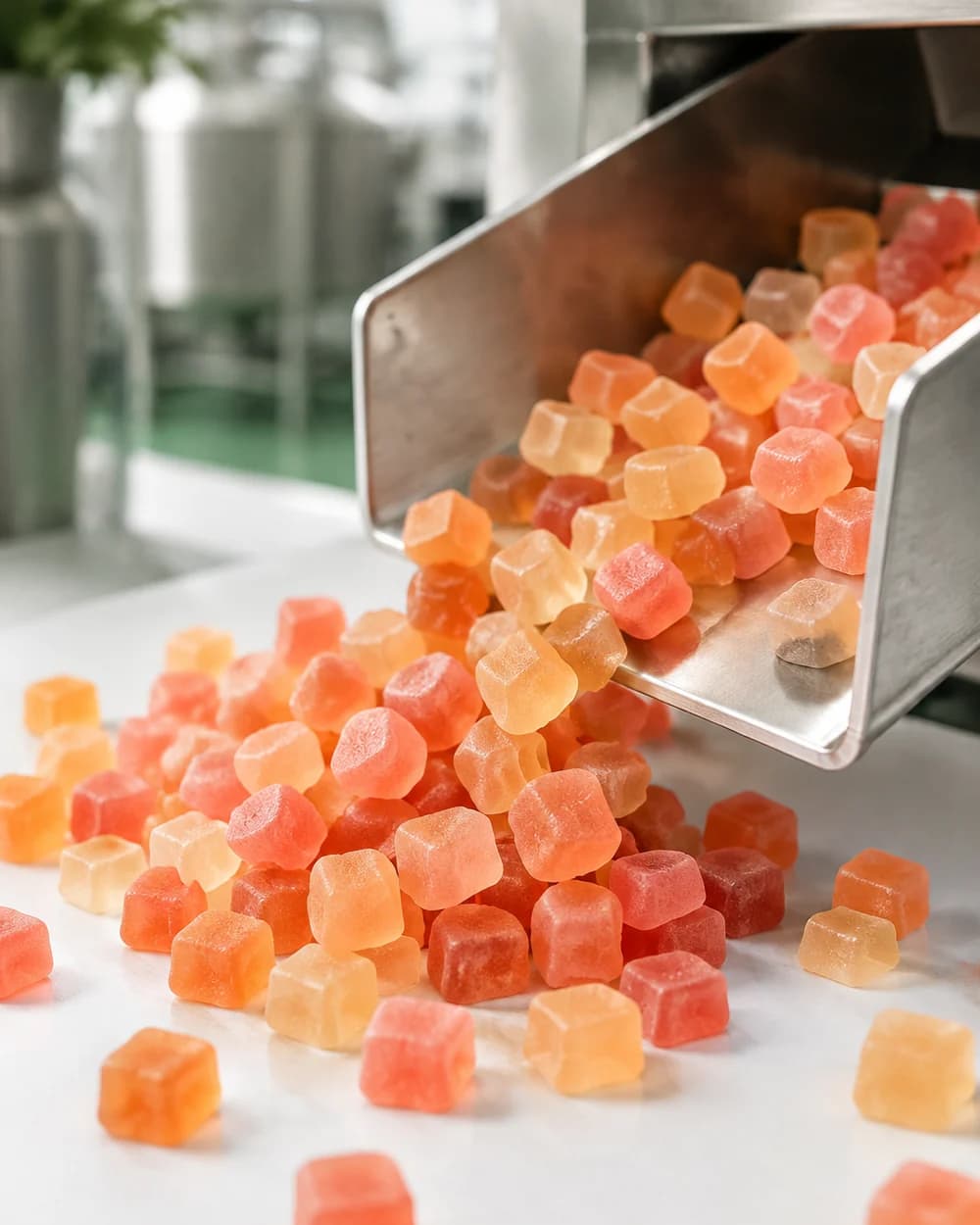
The low-sugar line runs pectin and gelatin depositors with 12 mould sizes. Standard shapes include bears, rings, stars, squares and custom 3D moulds. Fill weight ranges from 2.5 g to 5 g per piece. Line output is 180,000 to 220,000 gummies per shift, depending on mould and drying time. Low-sugar formulas need longer drying than full-sugar gummies: 24–48 hours in a 25–30°C room with 30–35% relative humidity. This keeps water activity below 0.65 and prevents stickiness.
Packaging options cover 30, 60, 90 and 120-count bottles, plus single-serve sachets and stick packs. Bottles use HDPE or PET with induction seals and child-resistant caps. Sachets run at 40–60 units per minute. We can add desiccant or oxygen absorbers for formulas with sensitive actives. Bulk packaging in 5 kg or 10 kg food-grade bags is available for repackers. All primary packaging meets EU and US food-contact requirements.
Formulating Below 3 g Sugar per Gummy
Sugar does more than sweeten. It controls water activity, adds bulk and masks bitter actives. Removing it means replacing that function. Allulose gives 70% of sucrose sweetness with 0.4 kcal/g and browns less than fructose. Erythritol adds body but can cause a cooling effect above 5% of the formula. Maltitol is cost-effective but has a glycaemic index of 35 and may cause laxative effects above 20 g per day. Stevia and monk fruit work as intense sweeteners at 0.02–0.05% and need bulking agents to match texture.
We test each low-sugar base for hardness, springiness and chewiness on a texture analyser. Target values: hardness 1,200–1,800 g, springiness 0.85–0.95, cohesiveness 0.70–0.85. Actives such as vitamin C, zinc, elderberry, melatonin and collagen are added at 80–120% of label claim to cover overage. Flavour systems use natural or nature-identical flavours at 0.3–0.8%. Colour comes from fruit and vegetable concentrates or approved synthetic lakes. Every formula is stability-tested at 25°C/60% RH and 40°C/75% RH for 3 and 6 months.
Quality Control and Low-Sugar Compliance
Low-sugar claims are regulated. In the EU, 'low sugar' requires 2.5 g or less per 100 g for solids. In the US, 'low sugar' is not a defined nutrient content claim, but 'reduced sugar' needs at least 25% less than the regular product. We review each formula against the target market’s rules before production. Batch records include sugar analysis by HPLC, water activity, pH, texture and microbiological tests for total plate count, yeast and mould, E. coli, Salmonella and Staphylococcus aureus.
The facility is GMP-certified and holds ISO 22000 and HACCP. Halal and vegan certifications are available on request. certification applies when all ingredients meet the standard. We keep full traceability from raw material lot to finished bottle. Retention samples are stored for 2 years. Certificates of analysis are issued per batch. Third-party testing through Eurofins or SGS can be arranged at cost. Documentation for customs and regulatory filing is prepared within 5 working days of shipment.
Quality Control and Batch Documentation
Every low-sugar gummy batch is tested at three points: incoming raw materials, in-process syrup and finished product. Identity and potency are confirmed by HPLC for actives such as vitamins, minerals and botanical extracts. Microbial testing covers total plate count, yeast and mould, E. coli, Salmonella and Staphylococcus aureus, with results available within five working days. Heavy metals (lead, arsenic, cadmium, mercury) are screened by ICP-MS against EU and US pharmacopoeia limits. Disintegration testing follows USP <2040> for gummies, ensuring the chew breaks down within 60 minutes.
A certificate of analysis (COA) is issued for each batch and includes batch number, production date, expiry date, test parameters, specification limits, results and the analyst's signature. Retention samples of every batch are kept for two years at 25°C/60% RH and 30°C/65% RH, allowing re-testing if a customer query arises. Stability protocols run at 40°C/75% RH for six months (accelerated) and 25°C/60% RH for 24 months (real-time), monitoring sugar content, moisture, texture and microbial load.
In-process controls check cooking temperature (±2°C), Brix (°Bx) and moisture content at deposition. Each batch is assigned a unique lot code that links to raw material lots, machine logs and operator records. Deviation reports are raised if any parameter falls outside the specification, and corrective actions are documented before release. This traceability supports recall readiness and is audited under GMP, ISO 22000 and HACCP.
For low-sugar formulations, additional checks include water activity (target below 0.65) and sugar profile by HPLC to verify that the declared 1–3 g per gummy is accurate. Allergen cross-contact is controlled through dedicated lines or validated cleaning between runs. Documentation packs are provided in English and can be translated for EU or Middle East import requirements.
Packaging, Labelling and Retail Readiness
Low-sugar gummies can be packed in HDPE bottles (60, 90, 120 or 150 count), blister packs, stick packs or single-serve sachets. Bottles are induction-sealed and fitted with child-resistant or standard caps. Stick packs are typically 3 g to 5 g per stick, suited for on-the-go formats. Cartons are printed with lot number and expiry date using inkjet or laser coding, and each carton carries a GS1-128 barcode for traceability.
For the US market, labels must include a supplement facts panel, serving size, amount per serving, percent daily value where applicable, other ingredients, allergen statement, and the manufacturer's name and address. The FDA does not require pre-market approval, but structure/function claims must carry the standard disclaimer. For the EU, nutrition declaration, allergen highlighting and health claim compliance under Regulation (EC) No 1924/2006 apply.
Carton specifications: 24 bottles per carton for 90-count, with dimensions and gross weight provided per SKU. Pallets are 1,200 x 1,000 mm or 1,200 x 800 mm, stretch-wrapped and corner-boarded, holding 48 to 60 cartons per layer. We can apply Amazon FNSKU labels, poly-bagging and retail-ready shelf-ready packaging on request. Artwork proofs are provided for approval before printing, and we check barcodes against GS1 standards.
Shelf-life labelling is based on real-time stability data. We recommend 18 to 24 months for low-sugar pectin gummies and 12 to 18 months for gelatin-based formats, depending on moisture barrier and packaging. Packaging materials are tested for migration and seal integrity to protect the low-sugar matrix from moisture pick-up.
MOQ, Lead Times and Delivery
Sample requests are processed within 7–10 working days after formula and packaging confirmation. Samples are free for standard formulations, with freight collect. Pilot runs start at 1,000 units per SKU and are invoiced at a pilot rate. Retail MOQ is 1,000 units per SKU, depending on packaging format and gummy base. Mass production takes 20–35 working days after sample approval and receipt of deposit.
Shipping options include air freight (5–10 days door-to-door) and sea freight (25–40 days depending on destination port). Incoterms offered are EXW, FOB Shenzhen or Hong Kong, and DDP for selected markets. We provide a commercial invoice, packing list, certificate of origin, COA, MSDS, free-sale certificate and, where relevant, phytosanitary certificate. For EU imports, we can supply a food contact declaration for packaging.
Production scheduling is confirmed upon deposit and artwork approval. We recommend booking capacity 6–8 weeks ahead for Q4 retail launches. For repeat orders, lead time can reduce to 15–20 working days if raw materials are in stock. We do not guarantee delivery dates affected by customs or carrier delays, but we provide tracking and documentation support throughout.
Packaging and Format Choices
Sweetener system
Allulose, erythritol, maltitol, stevia, monk fruit or blends. Each affects taste, texture and cost per unit. We recommend based on target sugar claim and retail price point.
Gummy base
Pectin for vegan and fast melt, gelatin for springy chew, modified starch for heat stability. Vegan blends use pectin and tapioca starch. All bases work below 3 g sugar.
Active ingredients
Vitamins, minerals, botanicals, melatonin, collagen, probiotics and omega-3. Dosage from 10 mg to 1,000 mg per gummy. Overages applied to meet label claim through shelf life.
Packaging format
Bottles 30–120 count, sachets, stick packs and bulk bags. Child-resistant and senior-friendly caps. Label printing and cartoning available. MOQ applies per SKU.
From Brief to Batch
- 01
Send your brief
Share target sugar level, actives, serving size, packaging and market. We confirm feasibility and send a quote within 2 working days.
- 02
Formulation and sample
Our lab develops a low-sugar base and flavour system. You receive 2–3 sample variants in 7–10 working days. One revision round is included.
- 03
Sample approval
You test texture, taste and stability. We adjust if needed. Once approved, we lock the formula and issue a specification sheet.
- 04
Order and deposit
You place a purchase order for 1,000 units per SKU. A 30–50% deposit starts production. Balance is due before shipment.
- 05
Production and QC
Mass production runs 20–35 working days. In-process checks cover weight, texture, water activity and microbiological safety. Batch records are kept.
- 06
Shipping and documents
We pack, palletise and ship by sea or air. Certificates of analysis, halal certificates and customs documents are sent within 5 working days.
Why EUPHM
Sugar claims you can defend
Every batch is tested by HPLC for sugar content. We provide the analysis you need for EU or US label claims. No guesswork.
Texture without sugar
Low-sugar gummies often turn hard or sticky. Our drying and base selection keep water activity below 0.65 and texture within spec for 24 months.
Scale from pilot to retail
Start at 1,000 units for a pilot. Move to 1,000 units for retail. The same line runs both, so your formula does not change between scales.
Questions buyers ask.
What is the minimum order for low-sugar gummies?+
Retail bottling starts at 1,000 units per SKU. Pilot runs start at 1,000 units with the same formula. MOQ depends on mould, packaging and active ingredients. We confirm exact MOQ in the quote within 2 working days.
How long do samples take?+
Sample lead time is 7–10 working days after we receive your brief and deposit. You get 2–3 variants. One revision round is included. Shipping by courier takes 3–5 working days to the US or EU.
Can you make vegan low-sugar gummies?+
Yes. We use pectin or modified starch instead of gelatin. Vegan certification is available. The texture is slightly softer than gelatin, but we adjust the base to match your target hardness. Vegan low-sugar formulas are produced on a dedicated line.
What certifications does the facility hold?+
The plant is GMP-certified and holds ISO 22000 and HACCP. Halal, vegan and certifications are available where ingredients qualify. We are FDA-registered for US exports. Certificates are shared before production.
How do you keep sugar below 3 g per gummy?+
We replace sugar with allulose, erythritol, maltitol or stevia and add bulking agents like soluble corn fibre or tapioca starch. The base is adjusted for water activity and texture. Each batch is tested by HPLC to confirm the sugar level meets your target market’s claim rules.
What is the shelf life of low-sugar gummies and how is it validated?+
Shelf life is typically 18–24 months for pectin-based low-sugar gummies and 12–18 months for gelatin formats. We validate through accelerated stability at 40°C/75% RH for six months and real-time testing at 25°C/60% RH for up to 24 months. Tests monitor sugar content, moisture, water activity, texture and microbial load. Final shelf life is confirmed by real-time data before commercial release.
Can you provide a certificate of analysis (COA) before shipment?+
Yes. A batch-specific COA is issued after finished product testing and before shipment. It includes batch number, production and expiry dates, test parameters (identity, potency, microbials, heavy metals, disintegration), specification limits, results and analyst signature. We can also provide a specification sheet and MSDS. COAs are available in English and can be translated for your market.
What packaging formats are available for low-sugar gummies?+
We offer HDPE bottles (60–150 count), blister packs, stick packs (3–5 g per stick) and single-serve sachets. Bottles can be induction-sealed with child-resistant caps. Cartons are lot-coded and barcoded. We support Amazon FNSKU labelling, poly-bagging and retail-ready packaging. Artwork proofs are provided for approval, and packaging materials are tested for seal integrity and migration.
Other versions built in this dosage form.
- Gummy Manufacturer
- Chewable Manufacturer
- Vegan Gummy Manufacturer
- Sugar-Free Gummy Manufacturer
- Pectin Gummy Manufacturer
- Gelatin-Free Gummy Manufacturer
- Kids Gummy Manufacturer
- Adult Gummy Manufacturer
- Custom-Shaped Gummy Manufacturer
- 3D Gummy Manufacturer
- Multi-Layer Gummy Manufacturer
- Halal Gummy Manufacturer
- Organic Gummy Manufacturer
- Soft Chew Manufacturer
- Kids Chewable Manufacturer
- Sugar-Free Chewable Manufacturer
- Sugar-Coated Chewable Manufacturer
- Vitamin C Gummy Manufacturer
- Vitamin D3 Gummy Manufacturer
- Vitamin B12 Gummy Manufacturer
- Vitamin B Complex Gummy Manufacturer
- Multivitamin Gummy Manufacturer
- Folic Acid Gummy Manufacturer
- CoQ10 Gummy Manufacturer
- Probiotics Gummy Manufacturer
- Collagen Gummy Manufacturer
- Biotin Gummy Manufacturer
- Hyaluronic Acid Gummy Manufacturer
- Lutein Gummy Manufacturer
- Astaxanthin Gummy Manufacturer
- Melatonin Gummy Manufacturer
- Magnesium Gummy Manufacturer
- Zinc Gummy Manufacturer
- Iron Gummy Manufacturer
- Calcium Gummy Manufacturer
- Ashwagandha Gummy Manufacturer
- Turmeric Gummy Manufacturer
- Elderberry Gummy Manufacturer
- Apple Cider Vinegar Gummy Manufacturer
- Creatine Gummy Manufacturer
- Berberine Gummy Manufacturer
- Milk Thistle Gummy Manufacturer
- Ginger Gummy Manufacturer
- Sea Moss Gummy Manufacturer
- Mushroom Extract Gummy Manufacturer
- Maca Gummy Manufacturer
- Ginseng Gummy Manufacturer
- Psyllium Fiber Gummy Manufacturer
- L-Theanine Gummy Manufacturer
- GABA Gummy Manufacturer
- 5-HTP Gummy Manufacturer
- Hair Skin & Nails Gummy Manufacturer
- Sleep Support Gummy Manufacturer
- Immune Support Gummy Manufacturer
- Energy Gummy Manufacturer
- Weight Management Gummy Manufacturer
- Menopause Gummy Manufacturer
Have a product in mind?
Send us the brief and we will come back with a formulation direction, indicative price and a realistic lead time — usually within one working day.