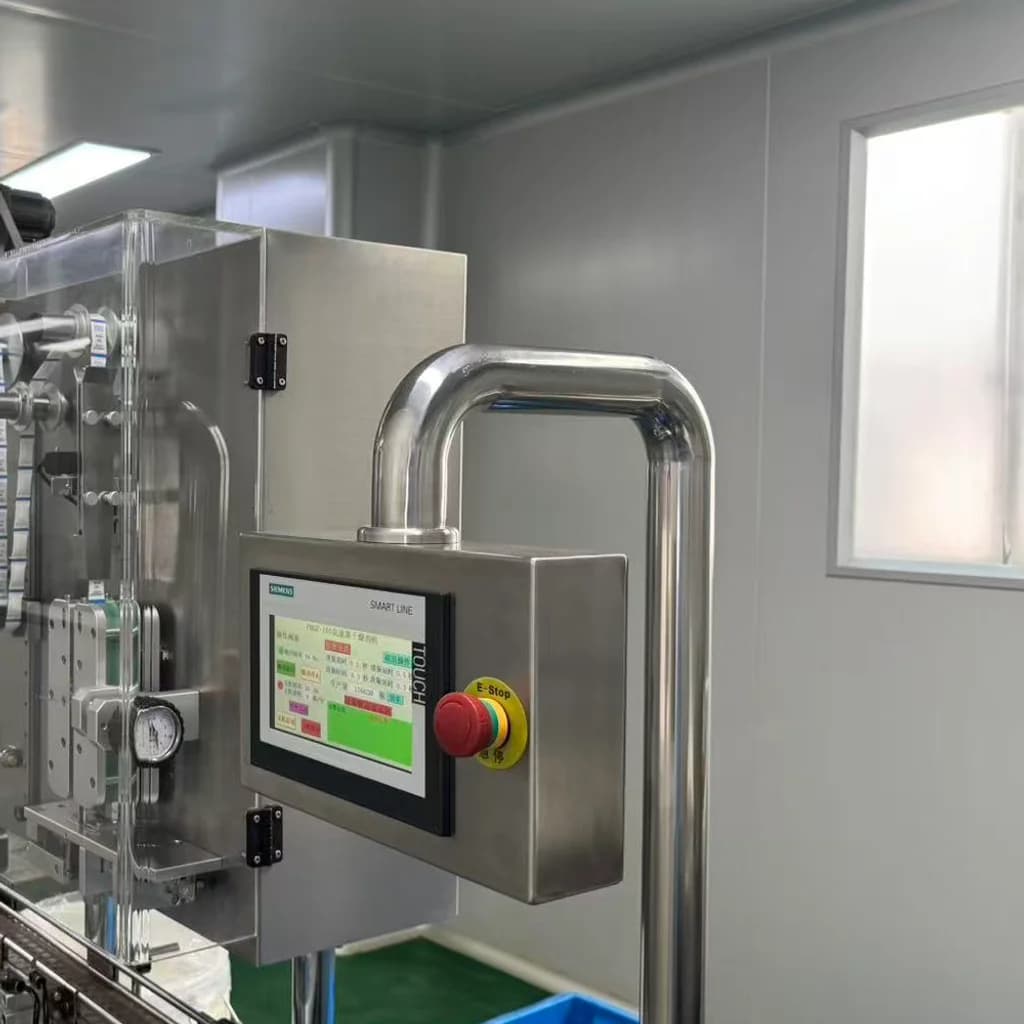
Multi-Layer Gummy Manufacturer for Complex Dosage Formats
Multi-layer gummies let you combine actives that cannot sit in one matrix. We run 2-layer and 3-layer depositing lines in Guangdong, with MOQ from 1,000 units per SKU.
Overview
Multi-layer gummies are produced by depositing two or more gummy masses into the same mould in sequence. Each layer can carry a different active, colour, flavour or texture. This separates incompatible ingredients, masks bitter actives and creates a visible stripe or core. As a multi-layer gummy manufacturer, EUPHM runs both starch-mould and metal-mould lines for retail and bulk formats.
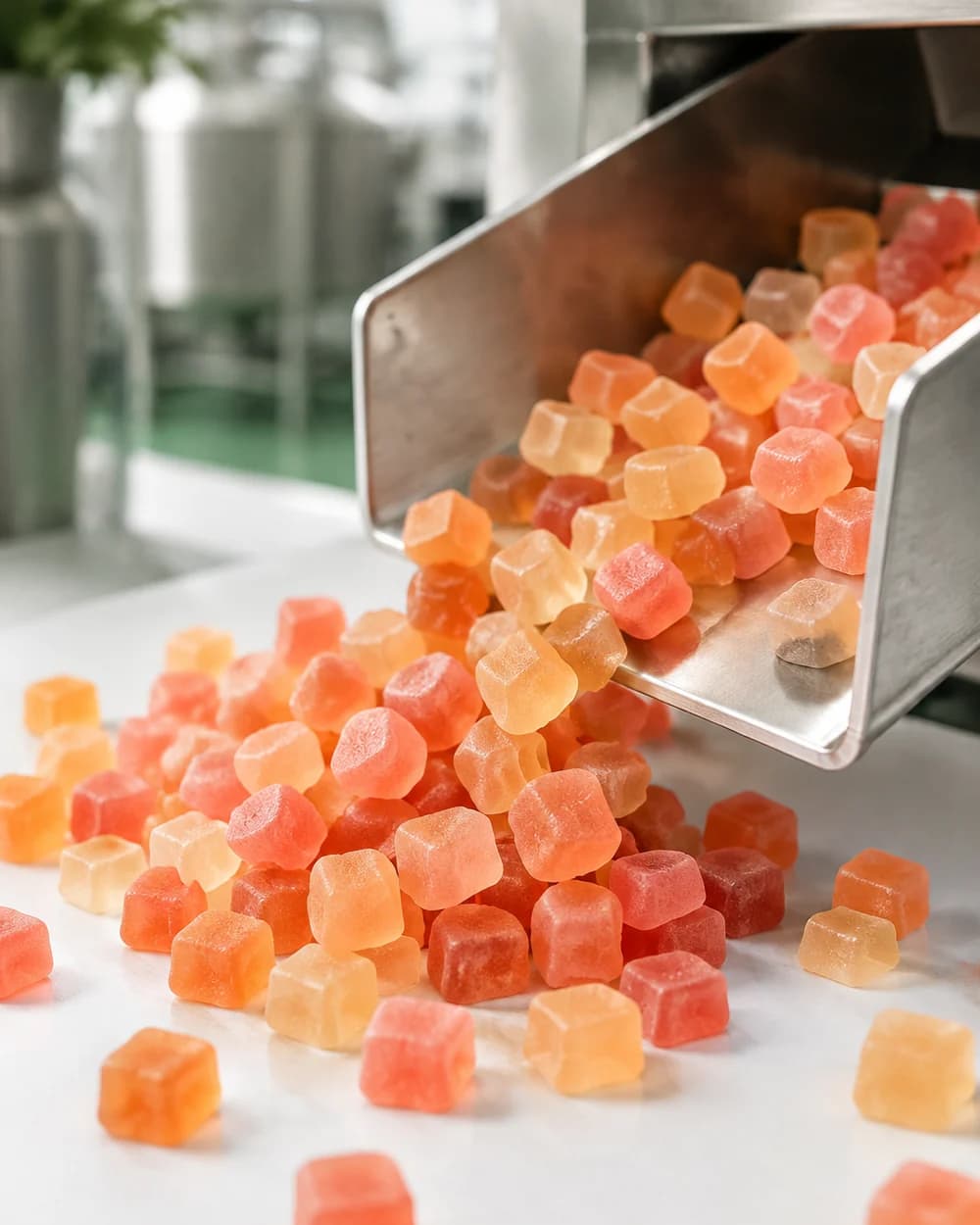
- MOQ
- 1,000 units per SKU for retail bottling; lower for pilot runs
- Layer count
- 2 or 3 layers; centre-fill and stripe options
- Fill weight
- 2.0 g to 5.5 g per piece
- Sample lead time
- 7-10 working days
- Mass production
- 20-35 working days after sample approval
- Certifications
- GMP, ISO 9001, ISO 22000, HACCP, NSF/ANSI 455-2, halal, FDA-registered
Depositing Lines and Layer Control
Multi-layer gummies need precise timing. If the first layer sets too far, the second layer will not bond; if it is too soft, the layers merge. Our depositing lines run 2-layer and 3-layer cycles with controlled nozzle sequencing and mould temperature. Typical output is 12,000 to 18,000 pieces per hour per line, depending on piece weight and layer count. We keep layer ratio within +/- 5% of the approved sample.
For 3-layer formats, the middle layer often carries the active while the outer layers handle flavour and texture. We can also run a centre-fill where the inner core is a liquid or soft gel. That requires a separate depositing head and a sealing layer. Line changeover between layer formats takes 4 to 6 hours, which affects scheduling on smaller runs.
Formulating Actives Across Layers
The main reason to use multiple layers is ingredient separation. Vitamin C and certain probiotics degrade faster when in direct contact with minerals. A 2-layer gummy can keep them apart until consumption. Oils such as omega-3 or CBD need an emulsified layer; we use a starch-based matrix that holds up to 15% oil load by weight. Bitter actives like green tea extract or zinc go into a thin inner layer with a sweet outer shell.
Pectin and gelatin bases are both available. Pectin layers set faster and suit vegan claims; gelatin layers give a springier bite. We adjust water activity to 0.55-0.65 to protect moisture-sensitive actives. For sugar-free formats, we use maltitol or allulose syrups, though allulose layers set slower and need longer curing. Colour matching across layers is done against a Pantone reference.
Quality Checks and Export Logistics
Every multi-layer batch is checked for layer adhesion, weight uniformity and active content. We test the finished gummy, not just the pre-blend, because heat during depositing can degrade heat-sensitive actives. Standard testing includes micro, heavy metals, and potency by HPLC. Certificates of analysis are issued per batch. The facility is GMP-certified, ISO 22000 and HACCP compliant, and holds halal certification for relevant lines.
For export, we pack in HDPE bottles, blister packs or pouches. Bottles are induction-sealed and labelled to your artwork. We ship FOB Shenzhen or Yantian, with air freight for samples. Typical mass production runs 20-35 working days after sample sign-off. Documentation includes commercial invoice, packing list, COA, and health certificate where required. We do not claim FDA approval; the facility is FDA-registered where that applies.
Quality Control and Batch Documentation
Every batch of multi-layer gummies is tested against a written specification before release. Incoming raw materials are checked for identity and certificate of analysis (COA) conformity. During production, in-process checks cover layer weight, colour uniformity, texture and pH. Finished gummies are sampled from each lot for identity and potency of actives, microbial limits (total plate count, yeast and mould, E. coli, Salmonella), heavy metals (lead, cadmium, arsenic, mercury) and disintegration time. Testing follows methods such as USP <2021> for microbials and USP <2040> for disintegration, unless the client specifies otherwise.
A batch record is compiled for each production run. It includes the formulation, lot numbers of raw materials, depositing parameters, in-process results and the final COA. The COA lists the tests performed, specifications, results and pass/fail status. We retain samples from every batch for at least two years, stored under controlled temperature and humidity. Stability studies follow a standard protocol: 0, 3, 6, 12 and 24 months at 25°C/60% RH and 30°C/65% RH, with accelerated conditions at 40°C/75% RH for three months. Clients receive the stability summary with the first commercial shipment.
For multi-layer formats, additional checks focus on layer adhesion and separation. A visual inspection confirms distinct layers without bleeding. A texture analyser measures the force required to separate layers, ensuring the product holds together through shipping. If an active is sensitive to moisture or heat, we test its potency in the finished gummy at release and at the end of shelf-life. Any out-of-specification result triggers a root-cause investigation and a documented corrective action before the batch is released.
Packaging, Labelling and Retail Readiness
Multi-layer gummies are packed in bottles, blisters, stick packs or sachets, depending on the target market. Bottles are typically HDPE or PET with induction seals and child-resistant caps where required. Blister packs use PVC/PVDC or alu-alu for moisture protection. Stick packs and sachets are filled on vertical form-fill-seal machines, with fill weights from 2.0 g to 5.5 g per piece. We can apply lot numbers and expiry dates by inkjet or laser coding on the primary package, carton and pallet.
For the US market, labels must include the statement of identity, net quantity, supplement facts panel, ingredient list, allergen declaration and the manufacturer's name and address. We provide a label review service against FDA 21 CFR 101 requirements, but the brand owner remains responsible for final label content. For the EU, we check compliance with Regulation (EU) No 1169/2011 and health claim rules. Amazon sellers can have FNSKU labels applied and poly-bagged units prepared for FBA. Retail-ready cartons and display-ready pallets are available on request.
Cartons are specified with dimensions, board grade and print to suit the distribution channel. Standard export cartons hold 24 to 48 bottles, with a maximum gross weight of 15 kg. Pallets are 1,200 mm x 800 mm or 1,200 mm x 1,000 mm, stretch-wrapped and labelled with SSCC codes. We can ship full-pallet or mixed-SKU pallets, subject to minimum order quantities per SKU. Packaging materials are food-grade and meet EU and US food-contact regulations.
MOQ, Lead Times and Delivery
The minimum order quantity for multi-layer gummies is 1,000 units per SKU for retail bottling. pilot volumes are discussed case by case for market testing, with a surcharge. Samples are produced in 7 to 10 working days after receipt of a signed sample request and formulation confirmation. Sample costs are credited against the first bulk order. Mass production takes 20 to 35 working days after sample approval, depending on layer complexity and packaging.
We ship under EXW, FOB or DDP terms. FOB ports are Shenzhen or Hong Kong. Air freight is available for urgent orders, with transit times of 3 to 7 days to major hubs. Sea freight takes 18 to 35 days depending on destination. For DDP, we handle customs clearance and delivery to your door, with duties and taxes billed separately. All shipments include a commercial invoice, packing list, bill of lading or airway bill, COA, MSDS and a free-sale certificate. A phytosanitary certificate is provided when required for plant-derived ingredients.
Production scheduling is confirmed once the deposit is received and artwork is approved. We provide a weekly production status report. Changes to artwork or formulation after production starts may incur additional costs and delay shipment. For repeat orders, we keep master batch records and packaging films on file to reduce lead times to 15 to 25 working days.
Packaging and Format Choices
2-layer stripe
Two distinct colours or flavours deposited side by side or top and bottom. Common for vitamin C plus zinc or dual-flavour launches.
3-layer sandwich
Active in the middle layer, flavour and texture outside. Suits bitter actives and omega-3 emulsions.
Centre-fill core
Liquid or soft centre with a sealed outer shell. Higher cost, but useful for oil-based actives and fast release.
Sugar-free layers
Maltitol or allulose base in each layer. Vegan pectin option available. Curing time adds 2-3 days.
From Spec to Shipment
- 01
Brief and formula
Send target actives, layer count, piece weight and claims. We review compatibility and propose a base.
- 02
Sample production
We produce 2-5 kg of samples in 7-10 working days. You receive physical samples and a draft spec.
- 03
Sample approval
You test taste, texture, layer adhesion and colour. We adjust until the sample matches your brief.
- 04
Scale-up
We confirm layer ratios, cure time and packaging. Deposit trial runs on the production line.
- 05
Mass production
Full run in 20-35 working days. In-process checks at depositing, curing and packing.
- 06
QC and shipping
Batch COA, micro and potency tests. Pack and ship FOB Shenzhen or Yantian with export documents.
Why EUPHM
Separate incompatible actives
Keep vitamins, minerals, probiotics and oils apart until consumption. Extends shelf life and protects potency.
Mask bitter ingredients
Put strong-tasting actives in an inner layer. The outer layer carries sweetness and flavour.
Visual differentiation
Layered stripes and cores stand out on shelf. Supports premium positioning and clear flavour cues.
Questions buyers ask.
What is the MOQ for multi-layer gummies?+
MOQ is 1,000 units per SKU for retail bottling. Pilot runs can go lower, typically 1,000-2,000 units, but expect higher per-unit tooling and setup costs. For 3-layer or centre-fill formats, MOQ may be 5,000 units because of additional line changeover time.
How long do samples take?+
Sample lead time is 7-10 working days after we receive your brief and confirm the formula. This includes 2-5 kg of physical samples and a draft specification. If you need custom colours or a new mould shape, add 5-7 working days for tooling.
Can you make vegan multi-layer gummies?+
Yes. We use pectin or modified starch bases for vegan layers. Pectin sets faster than gelatin, so layer timing is adjusted. Vegan certification is available on request. Note that centre-fill formats with a liquid core may require a gelatin shell for stability, so we review that case by case.
What certifications does the facility hold?+
The facility is GMP-certified and holds ISO 22000 and HACCP. Halal certification are available for relevant production lines. Organic and certification can be arranged for organic projects. We do not claim FDA approval; the facility is FDA-registered where that applies to export documentation.
How do you test multi-layer gummies?+
We test layer adhesion by pull test, weight uniformity per piece, and active potency by HPLC on the finished gummy. Micro and heavy metals are tested per batch. Because depositing heat can degrade actives, we test the finished product, not just the pre-blend. A certificate of analysis is issued for each batch.
Can you provide stability data for multi-layer gummies?+
Yes. We run stability studies on every new formulation. The standard protocol covers 0, 3, 6, 12 and 24 months at 25°C/60% RH and 30°C/65% RH, plus three months accelerated at 40°C/75% RH. We test potency, microbials, colour and texture. The stability summary is provided with the first commercial shipment, and ongoing stability is monitored for each production batch.
What label artwork files do you require?+
We accept Adobe Illustrator (.ai), PDF or high-resolution PNG files. Artwork must include dieline, bleed and safe area. For US labels, include the supplement facts panel and allergen statement. For EU labels, include the nutrition declaration and address of the food business operator. We provide a pre-flight check and a digital proof for approval before printing. Changes after proof approval may incur plate costs.
Do you offer DDP shipping?+
Yes. We offer DDP terms for most destinations. We handle export clearance, freight, import clearance and delivery to your address. Duties and taxes are billed separately or included in the quote, depending on the agreement. DDP is available for air and sea freight. We recommend DDP for first orders to simplify logistics, and FOB for experienced importers with their own freight forwarders.
Other versions built in this dosage form.
- Gummy Manufacturer
- Chewable Manufacturer
- Vegan Gummy Manufacturer
- Sugar-Free Gummy Manufacturer
- Pectin Gummy Manufacturer
- Gelatin-Free Gummy Manufacturer
- Kids Gummy Manufacturer
- Adult Gummy Manufacturer
- Custom-Shaped Gummy Manufacturer
- 3D Gummy Manufacturer
- Halal Gummy Manufacturer
- Organic Gummy Manufacturer
- Low-Sugar Gummy Manufacturer
- Soft Chew Manufacturer
- Kids Chewable Manufacturer
- Sugar-Free Chewable Manufacturer
- Sugar-Coated Chewable Manufacturer
- Vitamin C Gummy Manufacturer
- Vitamin D3 Gummy Manufacturer
- Vitamin B12 Gummy Manufacturer
- Vitamin B Complex Gummy Manufacturer
- Multivitamin Gummy Manufacturer
- Folic Acid Gummy Manufacturer
- CoQ10 Gummy Manufacturer
- Probiotics Gummy Manufacturer
- Collagen Gummy Manufacturer
- Biotin Gummy Manufacturer
- Hyaluronic Acid Gummy Manufacturer
- Lutein Gummy Manufacturer
- Astaxanthin Gummy Manufacturer
- Melatonin Gummy Manufacturer
- Magnesium Gummy Manufacturer
- Zinc Gummy Manufacturer
- Iron Gummy Manufacturer
- Calcium Gummy Manufacturer
- Ashwagandha Gummy Manufacturer
- Turmeric Gummy Manufacturer
- Elderberry Gummy Manufacturer
- Apple Cider Vinegar Gummy Manufacturer
- Creatine Gummy Manufacturer
- Berberine Gummy Manufacturer
- Milk Thistle Gummy Manufacturer
- Ginger Gummy Manufacturer
- Sea Moss Gummy Manufacturer
- Mushroom Extract Gummy Manufacturer
- Maca Gummy Manufacturer
- Ginseng Gummy Manufacturer
- Psyllium Fiber Gummy Manufacturer
- L-Theanine Gummy Manufacturer
- GABA Gummy Manufacturer
- 5-HTP Gummy Manufacturer
- Hair Skin & Nails Gummy Manufacturer
- Sleep Support Gummy Manufacturer
- Immune Support Gummy Manufacturer
- Energy Gummy Manufacturer
- Weight Management Gummy Manufacturer
- Menopause Gummy Manufacturer
Have a product in mind?
Send us the brief and we will come back with a formulation direction, indicative price and a realistic lead time — usually within one working day.